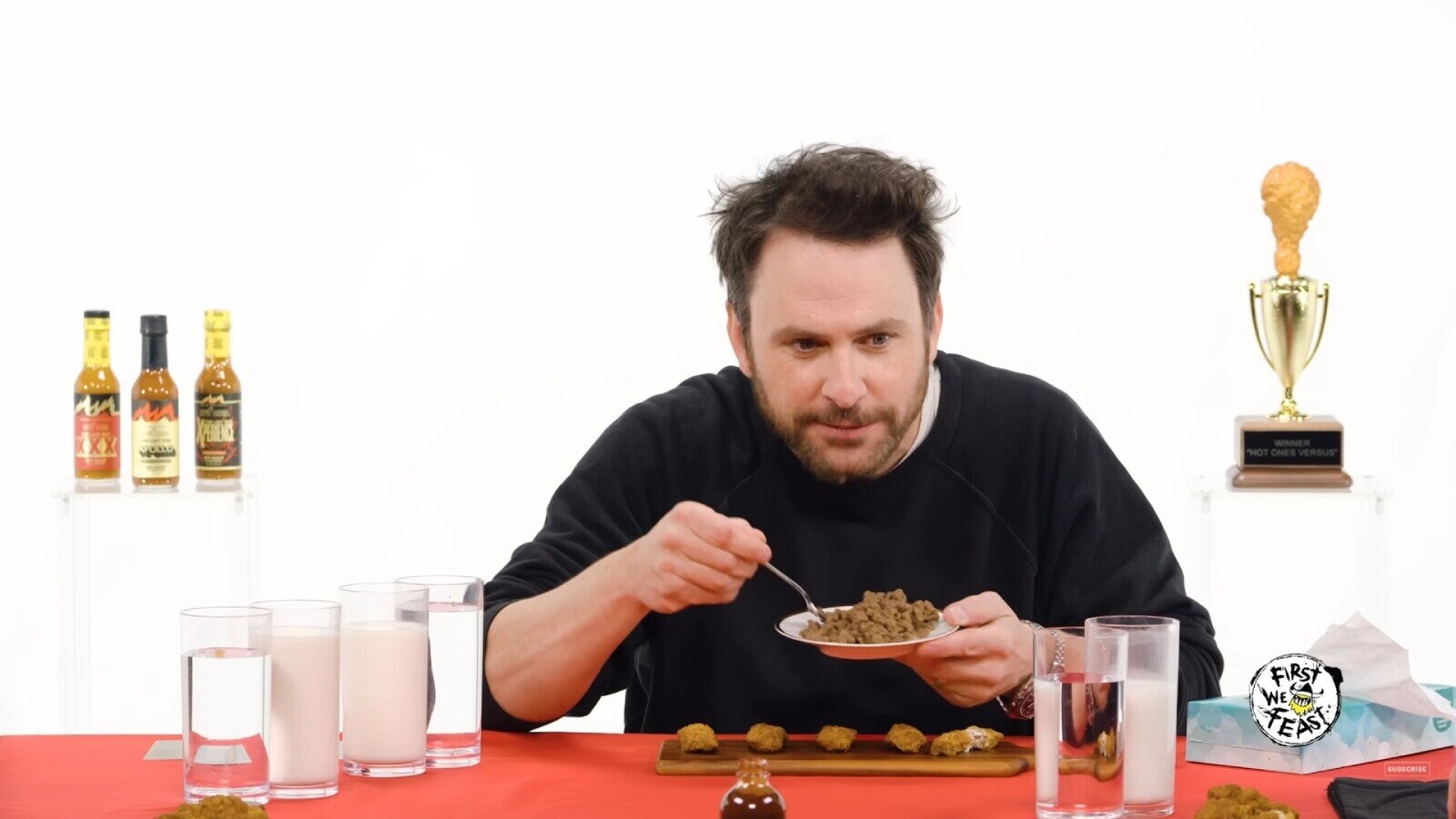
There are celebrity interviews, there are spicy-wing interviews, and then there is the very special category of television-adjacent chaos where a grown man voluntarily eats cat food because the alternative is a punishment wing designed to make the human soul file a complaint. That is where Charlie Day found himself on Hot Ones Versus, sitting across from his longtime It’s Always Sunny in Philadelphia collaborators Rob McElhenney and Glenn Howerton, facing a challenge that felt less like a promotional stop and more like a dare written by the inside of Charlie Kelly’s brain.
The headline sounds like a joke. It is not. Charlie Day actually, really, truly ate cat food on camera. Not “cat food” as in a cute nickname for a weird snack. Not a clever prop. Not an off-screen implication followed by a cutaway. The moment happened during the First We Feast series Hot Ones Versus, where guests must either answer uncomfortable questions or suffer through fiery consequences. In this case, the choice put Day’s real-life dignity directly against one of the most absurd running gags from It’s Always Sunny in Philadelphia: Charlie Kelly’s bizarre relationship with cat food.
For fans of the long-running sitcom, the bit hit with surgical precision. It was the sort of moment that made viewers sit up and say, “Wait, are they really doing this?” And then, because this is Charlie Day, the answer was yes. Of course they were.
What Happened on ‘Hot Ones Versus’?
The episode brought together Rob McElhenney, Charlie Day, and Glenn Howerton, three of the creative engines behind It’s Always Sunny in Philadelphia. The format of Hot Ones Versus is simple enough to understand and mean enough to enjoy: the guests ask one another difficult, embarrassing, or professionally dangerous questions. If someone refuses to answer, they have to eat a punishing hot wing. Whoever takes the most punishment loses, and the chaos escalates from there.
Unlike the traditional Hot Ones interview, where host Sean Evans guides a celebrity through progressively hotter wings, Hot Ones Versus turns the pressure sideways. Friends interrogate friends. Co-stars weaponize shared history. Longtime collaborators suddenly remember every awkward thing that happened in a writers’ room, on a set, or during a questionable business decision. It is less like a talk show and more like a dinner party where everyone knows your secrets and the appetizers are legally spicy.
For the Always Sunny trio, that setup was perfect. McElhenney, Day, and Howerton have spent nearly two decades building comedy out of discomfort, vanity, stubbornness, bad decisions, and characters who treat shame like a rumor started by cowards. So when the game asked them to choose between honesty and heat, the episode naturally became a contest of pride, pain tolerance, and absurd loyalty to the bit.
Why Charlie Day Eating Cat Food Is So Funny
Charlie Day eating cat food is not funny simply because cat food is gross. Plenty of internet stunts are gross, and most of them disappear from memory faster than a half-finished office cupcake. This moment worked because it was connected to a deep fan reference. In It’s Always Sunny in Philadelphia, Charlie Kelly’s strange routines include some legendary food habits, from milk steak to glue-adjacent lifestyle choices to the infamous cat food routine.
On the show, cat food is part of Charlie’s grimy, surreal, and somehow emotionally committed world. It is one of those details that tells you everything about the character. Charlie Kelly is not simply “quirky.” He lives according to a logic system assembled from poverty, panic, rats, illiteracy, loyalty, and possibly fumes. When the sitcom leans into his domestic rituals, the comedy comes from how confidently he treats the unacceptable as normal.
That is why the Hot Ones Versus moment feels like fiction crashing into reality. The actor who helped create and perform one of television’s most beloved human disasters suddenly had to confront the kind of thing his character might do on a Tuesday. It was not just a dare. It was a weird little ceremony. Charlie Day, the person, had to shake hands with Charlie Kelly, the myth.
The Cat Food Choice Was a Perfect ‘Always Sunny’ Test
Every good Always Sunny gag has a moral trapdoor. The Gang usually believes it is winning while making everything worse. The beauty of the cat food challenge is that it created a very similar trap for Day. Refuse the cat food, and he risks betraying the absurd legacy of Charlie Kelly. Eat it, and he confirms that the line between actor and character is, at least for one bite, dangerously thin.
That tension is what made the clip shareable. It was not just “celebrity eats weird thing.” It was “Charlie Day finally pays off a joke that fans have been laughing about for years.” The audience did not need a long explanation. The setup carried its own history. Fans knew exactly why everyone at the table was laughing before the bite even happened.
And Day’s performance in the moment mattered. He did not turn it into a grand heroic sacrifice. He approached it with the half-defeated, half-game energy that has always made his comedy so effective. He can make discomfort feel musical. His face, posture, and timing all suggested a man who knew the internet had already won.
How Rob McElhenney and Glenn Howerton Made It Better
The cat food moment also worked because McElhenney and Howerton were there to frame it. The three performers have a chemistry that cannot be faked by a press tour. They have written together, acted together, argued through comedy together, and built a sitcom that has somehow survived changing television eras, streaming battles, and the cultural half-life of edgy jokes.
McElhenney often brings a self-aware showman energy. Howerton brings a sharp, controlled intensity that can turn even a simple question into a power struggle. Day brings the unpredictable spark, the guy who looks like he might accidentally solve the problem by making it worse. Put them around a table with hot wings and personal questions, and the result feels closer to a bonus Always Sunny scene than a standard promotional appearance.
Throughout the episode, the trio revisited the history and pressure of their show. Topics included the long life of It’s Always Sunny, difficult creative choices, jokes that never made it to air, the possibility of ending the series, and the strange business empire that has grown around the cast. The cat food was the loudest visual gag, but it landed inside a broader conversation about why these performers still fascinate people after so many seasons.
Why ‘It’s Always Sunny’ Fans Loved the Moment
It’s Always Sunny in Philadelphia has one of the most durable fan bases in modern comedy because the show rewards obsessive viewing. A throwaway phrase can become a meme. A disgusting meal can become a personality test. A side character can become a sacred text. Fans do not simply remember the big episodes; they remember the food, the scams, the bar arguments, the legal threats, the musical numbers, and the deranged confidence of people who should never be left alone with a plan.
Charlie eating cat food on Hot Ones Versus played directly into that fan culture. It gave viewers a real-world continuation of a fictional joke without requiring the sitcom itself to repeat the bit. That is difficult to pull off. Fan service can feel lazy when it simply points at something familiar and waits for applause. This worked because the moment had stakes, however ridiculous. Day did not just mention the reference. He physically committed to it.
There is also something refreshing about a performer who understands the assignment. Day did not act above the gag. He did not treat the reference like an embarrassing relic from an earlier phase of his career. He leaned into it, which is exactly what fans want from a cast that has spent years proving that comedy can be both smart and profoundly stupid at the same time.
The Genius of Turning a Sitcom Joke Into Reality
Comedy often becomes more powerful when it crosses formats. A joke born in a scripted sitcom can take on new life in interviews, podcasts, live shows, and social media clips. The Hot Ones Versus cat food moment is a perfect example of transmedia comedy without the corporate buzzword smell. It does not require a cinematic universe. It requires one actor, one gross plate, and a fan base that knows exactly why it matters.
In the sitcom, Charlie Kelly’s cat food habit is part of a fictional universe. On Hot Ones Versus, that universe leaked. The actor did not become the character, exactly, but he borrowed the character’s appetite for bad decisions. That tiny overlap created a comic shock: the audience recognized the reference, saw the real person hesitate, and then watched him do the thing anyway.
That is why the moment felt more memorable than many polished celebrity interviews. It was specific. It was weird. It belonged to this cast and no one else. You could not swap in another sitcom actor and get the same effect. The joke required Charlie Day’s history, the Always Sunny fan base, and the merciless format of Hot Ones Versus.
Charlie Day’s Comedy Has Always Been About Commitment
Charlie Day’s comedic style is built on total commitment. Whether he is screaming through a conspiracy board, singing with wild sincerity, misunderstanding basic social cues, or charging into a scene with chaotic physical energy, Day rarely plays halfway. His best work often feels like a man sprinting toward the wrong conclusion with the confidence of an Olympic athlete.
That commitment is what makes the cat food moment feel inevitable in hindsight. Day has always been good at making humiliating comedy feel oddly triumphant. He can look ridiculous without seeming careless. He knows how to make the audience laugh at the situation while still rooting for the person trapped inside it.
On Hot Ones Versus, that skill translated perfectly. The bite was gross, yes, but the humor was not only in the grossness. It was in the pause before the decision, the awareness of the reference, the reactions from his co-stars, and the strange dignity of following through. Somehow, eating cat food became a professional act of brand consistency. That sentence should not make sense, and yet here we are.
What the Moment Says About Modern Celebrity Interviews
The reason shows like Hot Ones and Hot Ones Versus continue to stand out is that they understand a simple truth: audiences are tired of interviews that feel laminated. Traditional press junkets can be predictable. A celebrity compliments the cast, praises the director, tells one safe anecdote, and escapes unharmed. Everyone smiles. Nobody eats pet food. Civilization continues, but barely.
Hot Ones changed that rhythm by adding discomfort. The wings make guests more present. The questions are often deeply researched. The heat breaks down the usual celebrity polish. Hot Ones Versus pushes that idea further by letting friends and co-stars pressure one another. The result can be messy, revealing, and extremely funny.
Charlie Day’s cat food moment is a textbook example of why the format works. It gave viewers something that felt unscripted but still narratively perfect. It connected to the guest’s career, rewarded longtime fans, and created an instantly understandable clip. In an entertainment economy where attention is harder to win than ever, that combination is gold.
Why This Was More Than a Gross-Out Gag
Gross-out humor gets dismissed easily, sometimes for good reason. A shocking image can grab attention without offering much else. But this particular moment had layers. It was a callback. It was a dare. It was a loyalty test. It was a celebration of a show that has always found comedy in people making the worst possible choice with breathtaking confidence.
It also reminded viewers why It’s Always Sunny in Philadelphia remains culturally sticky. The show’s characters are awful, but the performers behind them are precise. They know exactly how far to push a bit. They understand that discomfort is funniest when it has structure. Cat food alone is not a joke. Charlie Day eating cat food because Charlie Kelly made cat food part of sitcom history is a joke with architecture.
That architecture is why fans still talk about the scene. It was not random. It was earned. The series spent years teaching viewers the language of Charlie Kelly’s world, and Hot Ones Versus gave them a surprise sentence in that language.
Experience Section: Watching the Cat Food Moment as a Fan
Watching Charlie Day eat cat food on Hot Ones Versus feels like one of those internet moments you think you are prepared for until it actually happens. At first, the setup seems too perfect to be real. You hear the challenge, recognize the Always Sunny reference, and assume there will be an escape hatch. Maybe he will joke his way out of it. Maybe the plate will be revealed as tuna. Maybe someone will cut to a reaction shot and spare everyone the final bite. But then the room keeps moving toward the inevitable, and you realize the joke has locked the doors.
That is the fun of it. The audience becomes part of the dare. You are not just watching Charlie Day decide whether to eat cat food. You are remembering every strange Charlie Kelly food reference, every filthy apartment scene, every time the show turned terrible judgment into comedy gold. The moment works because the viewer brings baggage to it. Delicious, terrible, emotionally questionable baggage.
There is also a strange nostalgia in seeing the cast together outside the scripted world of Paddy’s Pub. Rob, Glenn, and Charlie have the rhythm of people who have spent years building something difficult and ridiculous together. Their reactions feel quick because their shared history is real. They do not need to overexplain the joke. They know the audience knows. That confidence makes the scene even funnier.
As a viewing experience, the cat food moment is uncomfortable in the best possible way. It produces the kind of laugh that starts with disbelief. You laugh, then you wince, then you laugh again because Day’s commitment is genuinely impressive. Most people would choose embarrassment over spice or spice over embarrassment. Charlie somehow finds a third option: become the meme and survive.
It also makes you think about why certain comedy moments last. Fans do not hold onto Charlie Kelly’s cat food routine because it is appetizing. They hold onto it because it is specific, strange, and completely tied to character. The best sitcom details feel like they could only belong to one person. Jerry had cereal. Ron Swanson had breakfast foods. Charlie Kelly has cat food, milk steak, and the nutritional instincts of a raccoon with a head injury.
That specificity is what modern viral culture often lacks. Many clips are designed to be shared, but fewer are designed to matter to a specific audience. This one mattered because it rewarded people who had watched the show, quoted it, rewatched it, and used its weirdest lines as friendship passwords. For longtime fans, the moment felt like a private joke happening in public.
And honestly, there is something oddly admirable about Day’s willingness to do it. Nobody needed a cat food moment for the press cycle to function. The cast could have answered a few questions, eaten a few wings, promoted the show, and gone home with their digestive systems mostly untroubled. Instead, Day gave fans a small, disgusting gift. It was silly. It was unnecessary. It was very funny. In the world of It’s Always Sunny, that is practically a mission statement.
Conclusion
Charlie Day eating cat food on Hot Ones Versus is exactly the kind of absurd entertainment moment that could only happen at the intersection of internet interview culture and long-running sitcom mythology. On paper, it sounds like a cheap gross-out stunt. In practice, it became a perfect fan-service payoff because it connected directly to Charlie Kelly, one of the most memorably chaotic characters in modern comedy.
The episode worked because McElhenney, Day, and Howerton know their audience and trust the weirdness that made It’s Always Sunny in Philadelphia endure. The cat food bite was not polished, dignified, or remotely recommended by any nutritionist with a pulse. But it was committed, specific, and deeply funny. In other words, it was pure Sunny energy.
For fans, the moment was more than a viral clip. It was a tiny collision between character and actor, fiction and reality, bad ideas and excellent timing. Charlie Day did not just eat cat food. He honored a joke, horrified a table, delighted the internet, and proved once again that great comedy sometimes requires courage, chemistry, and a willingness to put something deeply inadvisable on a fork.
Note: This article is written for entertainment commentary and SEO publication, based on publicly available information about Charlie Day, Hot Ones Versus, First We Feast, and It’s Always Sunny in Philadelphia. The article avoids copied wording, source-link clutter, and unnecessary citation markup for clean web publishing.