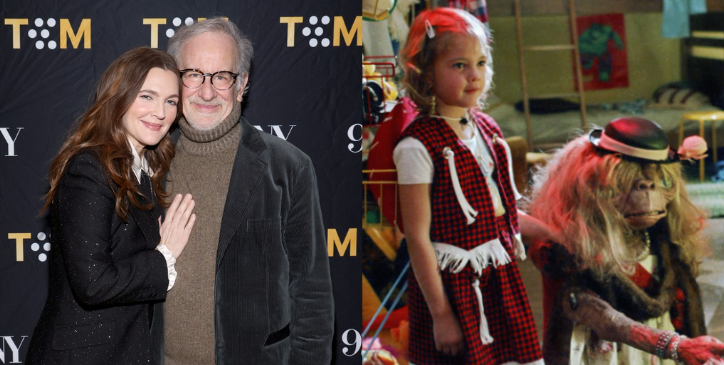
Some Hollywood stories age like milk. Others age like Reese’s Pieces: sweet, nostalgic, and somehow still impossible to resist. The latest reminder comes from Steven Spielberg and Drew Barrymore, whose lifelong connection began on the set of E.T. the Extra-Terrestrial, the 1982 classic that gave the world a glowing finger, a bicycle silhouette across the moon, and one of the most believable child performances in movie history.
At a recent public conversation celebrating E.T., Spielberg affectionately called out Barrymore for her unpredictable brilliance as a six-year-old actor. His point was not that she was difficult, dramatic, or a tiny Hollywood tornado in pigtails. Quite the opposite. Spielberg remembered that Barrymore was so naturally funny, emotionally open, and wonderfully unscripted that many of her best moments as Gertie were not carefully engineered in a studio office. They happened because Drew Barrymore was, well, Drew Barrymore.
One story has made fans melt all over again: while filming, Barrymore reportedly looked at the alien puppet and blurted out that she did not like his feet. Spielberg used the moment. Why? Because it was perfectly Gertie. It was exactly the kind of line a real child would say after meeting a wrinkly extraterrestrial houseguest who looked like a wise potato with abandonment issues.
That small memory explains why E.T. still works more than four decades later. The movie is not just about aliens. It is about childhood honesty, loneliness, imagination, and the strange emotional truth that sometimes the “fake” thing in the room feels more real than anything else.
The Sweet “Call Out” That Made Fans Love Them Even More
Steven Spielberg’s comments about Drew Barrymore were delivered with warmth, humor, and a little bit of proud-director energy. He described young Barrymore as “irrepressible,” a word that fits her E.T. performance better than any polished press release could. She was not simply reciting lines. She was reacting, inventing, interrupting, questioning, and bringing the kind of childlike spontaneity directors spend entire careers trying to fake.
In Spielberg’s telling, Barrymore often made up dialogue during filming. The “I don’t like his feet” moment became a perfect example of why he trusted her instincts. It was funny, specific, slightly rude in the way only children can get away with, and completely believable. A grown screenwriter might have worked for hours to create that line. Barrymore apparently just looked at E.T. and gave him a podiatry review.
The moment is also a reminder of Spielberg’s directing style with children. He did not flatten Barrymore’s personality into a neat performance. He made room for it. Instead of correcting every unexpected line, he recognized when the accident was better than the plan. That flexibility helped make Gertie feel like a real little girl rather than a tiny adult reading dialogue.
Why Drew Barrymore’s Gertie Still Feels So Real
Drew Barrymore was only a child when she played Gertie, Elliott’s little sister in E.T. the Extra-Terrestrial. Yet her performance remains one of the film’s secret weapons. Gertie is not the main hero, but she gives the movie some of its brightest sparks. She screams, stares, asks questions, dresses E.T. up, and reacts to the alien with a hilarious mix of fear, fascination, and “who invited this leathery little gentleman into our house?”
Barrymore’s performance works because it never feels overly rehearsed. Children in movies can sometimes sound like miniature screenwriters with juice boxes. Gertie does not. She sounds like a kid whose brain is moving faster than her manners. That authenticity gives E.T. its emotional grounding. The alien may be extraordinary, but the children around him behave in ways that feel ordinary, messy, and human.
The Magic of Letting a Child Be a Child
Spielberg understood something important: if you want a story about wonder, you cannot direct all the wonder out of the room. Barrymore’s natural reactions made the alien feel alive. When she was curious, the audience became curious. When she cared for E.T., the audience cared too. When she treated him like a strange but lovable friend, viewers accepted him not as a movie prop but as a character with feelings.
That is a major reason the film continues to connect with new generations. The special effects may belong to the early 1980s, but the emotional logic is timeless. Children still talk to toys, worry about imaginary friends, and assign personalities to objects adults would describe as “just stuff.” Barrymore’s Gertie captured that instinct beautifully.
Drew Barrymore Thought E.T. Was Realand Spielberg Protected the Magic
One of the most charming behind-the-scenes details about E.T. is that young Drew Barrymore reportedly treated the alien puppet as if he were real. She talked to him, cared about him, and even brought him lunch. Her co-stars have remembered her concern for the character, including a story about her wanting E.T. to have a scarf because the stage was cold.
Instead of ruining the illusion, Spielberg leaned into it. When Barrymore interacted with E.T. between takes, crew members helped keep the puppet “alive” so the magic would not collapse. In practical terms, that was a clever directing choice. Emotionally, it was something much sweeter: adults protecting a child’s imagination while making a film about protecting an alien friend.
This behind-the-scenes care reflects the movie’s entire spirit. E.T. is about empathy. Elliott protects E.T. from government agents, Gertie protects him in her own little-sister way, and Spielberg protected the atmosphere that allowed his young actors to believe in the story they were telling.
The Spielberg-Barrymore Bond Went Far Beyond One Movie
The connection between Steven Spielberg and Drew Barrymore did not end when E.T. wrapped. Barrymore has often described Spielberg as a father figure in her life, and Spielberg has spoken about the powerful effect that working with the child cast had on him. He has said that making E.T. helped awaken his desire to become a parent.
That context makes his recent “call out” even more touching. He was not simply teasing a former child star about improvising lines. He was looking back at a relationship that shaped both of them. Barrymore became a breakout star through E.T., while Spielberg discovered something about himself as a storyteller and future father.
Hollywood loves reunion stories, but this one has more emotional weight than most. It is not just “famous director sees famous actress again.” It is two people revisiting the set where one was a little girl finding safety and creative freedom, and the other was a filmmaker learning how deeply a child’s imagination could change his work.
Why E.T. the Extra-Terrestrial Became a Cultural Phenomenon
Released in 1982, E.T. the Extra-Terrestrial became one of the defining films of the decade. Directed by Steven Spielberg and written by Melissa Mathison, the movie follows Elliott, a lonely boy who discovers a gentle alien stranded on Earth. With help from his siblings, including Barrymore’s Gertie, Elliott tries to help E.T. return home.
The plot is simple, but the emotional execution is enormous. Spielberg mixed science fiction with suburban family drama, turning a backyard encounter into a universal story about friendship, grief, divorce, and belonging. The alien is not a monster. He is a lost child in a strange world. Elliott is not just helping E.T.; he is also trying to heal something lonely inside himself.
The film became a box office giant and earned major Academy Awards recognition, including nine Oscar nominations and four wins. John Williams’ soaring score became inseparable from the movie’s identity. Even people who have never watched the film from start to finish can recognize the moonlit bicycle image. That is not just marketing. That is mythology.
A Personal Story Disguised as a Blockbuster
Part of the reason E.T. feels so intimate is that Spielberg drew from personal emotions, including his memories of childhood loneliness and his parents’ divorce. The film may include a spaceship, government agents, and a glowing finger, but underneath the science fiction is a child’s wish for connection.
That is why Barrymore’s performance matters so much. Gertie brings comic relief, but she also reinforces the family dynamic. Her innocence makes the home feel real. Her reactions help the audience understand that E.T. is not just Elliott’s secret; he becomes part of the family’s emotional world.
The Improvised Line That Says Everything
Let’s return to the feet. On the surface, “I don’t like his feet” is just a funny child’s comment. But as a film moment, it does a lot of work. It tells us Gertie is not automatically enchanted. She notices details. She has opinions. She is not afraid to say the weird little alien has weird little alien feet.
That matters because wonder is more powerful when it includes honesty. If every child in the movie had reacted to E.T. with instant poetic awe, the film might have floated away into sugar. Gertie keeps it grounded. She sees the magic, but she also sees the feet. That is childhood in one sentence.
Spielberg’s choice to keep the line shows his trust in reality over perfection. Sometimes the best movie moments are not the cleanest. They are the ones that feel caught rather than constructed.
What the Story Reveals About Spielberg as a Director
Steven Spielberg is often praised for spectacle: sharks, dinosaurs, war sequences, spaceships, and adventure set pieces. But the Barrymore story highlights another skill: his ability to listen. Great directing is not only about telling actors what to do. It is also about noticing when an actor, especially a child, gives you something better than what you imagined.
With Barrymore, Spielberg seemed to understand that her unpredictability was not a problem to solve. It was the performance. Her personality helped define Gertie, and Gertie helped define the emotional flavor of the film. That is a rare kind of collaboration, especially between an experienced filmmaker and a very young actor.
It also shows why E.T. does not feel cold or mechanical. The movie has carefully designed visuals and technical craft, but it also has room for chaos, giggles, fear, tenderness, and odd little comments about alien toes.
Why Fans Still Care About Spielberg and Barrymore’s E.T. Memories
In an entertainment world overflowing with reboots, sequels, cinematic universes, and nostalgia campaigns, some stories still cut through because they feel sincere. Spielberg and Barrymore’s E.T. memories are not just promotional trivia. They remind audiences why they loved the movie in the first place.
Fans care because the stories match the film’s message. Barrymore caring for E.T. between takes sounds like something Gertie would do. Spielberg keeping the puppet animated for her sounds like something the movie itself would approve of. The behind-the-scenes reality and the on-screen fantasy seem to hold hands.
That is rare. Often, learning how a film was made can make the magic smaller. In this case, it makes the magic bigger.
The Lasting Legacy of Drew Barrymore’s Childhood Role
Drew Barrymore went on to build a long and varied career as an actor, producer, author, entrepreneur, and talk show host. Yet E.T. remains one of her most beloved roles because it captures her at the beginning: funny, bright, open-hearted, and completely unforgettable.
Her later reflections on the film show how deeply the experience stayed with her. She has described E.T. as something like a first imaginary friend, a figure connected to belief, comfort, and emotional survival. That idea adds another layer to the movie. For audiences, E.T. was a character. For Barrymore, he was part of a formative childhood experience.
When Spielberg affectionately calls out her improvisation, he is also acknowledging her contribution. Gertie was not memorable by accident. Barrymore helped make her memorable, one unscripted reaction at a time.
Experience Section: What This Story Teaches About Creativity, Childhood, and Nostalgia
There is something deeply relatable about the Spielberg-Barrymore E.T. story, even for people who have never stepped onto a movie set. Almost everyone has had a childhood moment when imagination felt completely real. Maybe it was a stuffed animal you protected during a thunderstorm, a blanket that seemed emotionally necessary, or a backyard game that turned two lawn chairs and a cardboard box into a spaceship. Adults may call those things pretend, but children experience them with full emotional commitment.
That is why Barrymore’s bond with E.T. feels so moving. She did not look at the puppet as a technical object. She responded to him as a presence. In doing so, she gave the film a kind of emotional electricity that no special effect could create by itself. Her belief helped the audience believe. Her tenderness taught viewers how to treat this strange creature. If Gertie could care about him, so could we.
For writers, filmmakers, actors, parents, teachers, and anyone who works with children, Spielberg’s approach offers a useful lesson: do not rush to correct every unexpected moment. Sometimes the “mistake” is the most honest part. A child’s odd comment, a spontaneous laugh, or an unplanned question can reveal more truth than a perfectly rehearsed answer. Creativity often arrives wearing mismatched socks and saying something inconvenient.
The story also speaks to the power of nostalgia when it is rooted in real emotion. People do not keep returning to E.T. only because they remember the bicycle or the candy or the famous “phone home” line. They return because the film remembers what childhood felt like: confusing, magical, lonely, funny, and huge. A backyard could become a universe. A secret friend could become the center of your heart. A goodbye could feel like the end of the world.
Spielberg and Barrymore’s reunion memories work because they preserve that feeling. They invite viewers to revisit the movie not as a dusty classic but as a living emotional experience. The affectionate teasing about Barrymore’s improvised dialogue is more than a cute celebrity anecdote. It is proof that the most lasting art often comes from trust: a director trusting a child actor, a child trusting an alien puppet, and an audience trusting a movie enough to cry over a creature made of rubber, mechanics, and movie magic.
In that sense, the sweet call-out is not really a call-out at all. It is a thank-you. Spielberg is thanking Barrymore for being unpredictable. Barrymore is thanking Spielberg for letting her be herself. And fans are thanking both of them for giving the world a film that still feels like a warm porch light left on for anyone who has ever felt a little far from home.
Conclusion
Steven Spielberg sweetly calling out Drew Barrymore over E.T. is the kind of Hollywood story that lands because it is funny, specific, and full of heart. His memory of her improvising as Gertie reminds us that E.T. the Extra-Terrestrial became a classic not only because of its visual effects, music, or box office success, but because it captured something emotionally true.
Drew Barrymore’s childhood performance gave the film spontaneity. Spielberg’s direction protected that spontaneity. Together, they created moments that still feel alive decades later. Whether Barrymore was caring for E.T., reacting to his unusual appearance, or accidentally improving the script with one honest observation, she helped make the alien more humanand the movie more unforgettable.
Note: This article is written as entertainment commentary and analysis based on publicly reported interviews, reunion appearances, film history, and verified information about E.T. the Extra-Terrestrial.