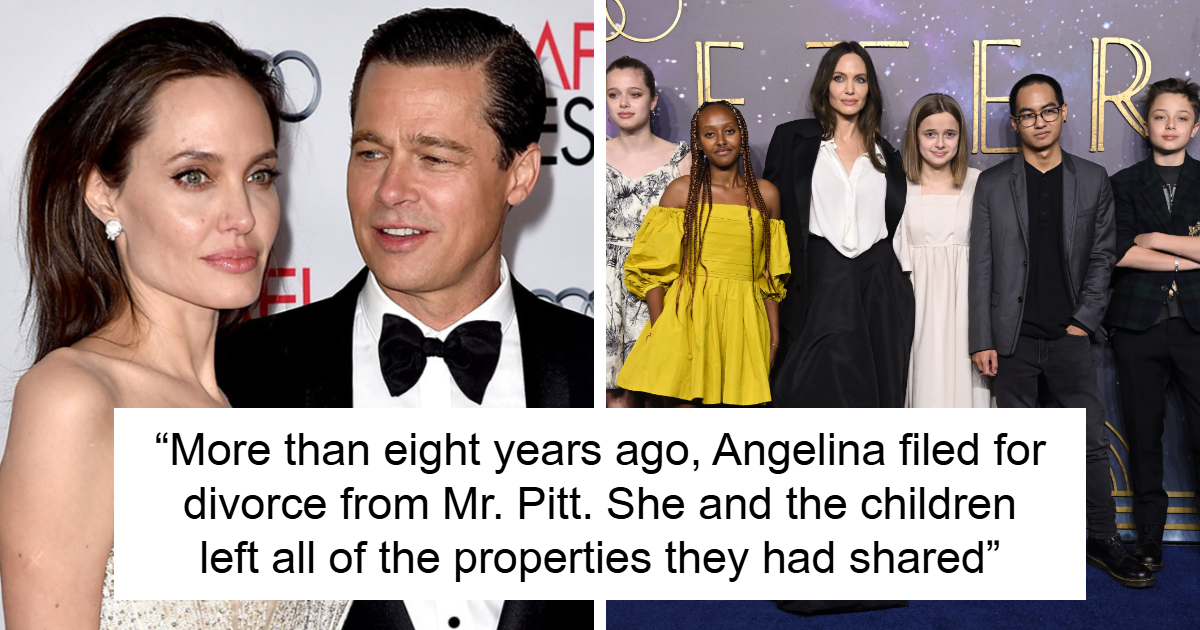
After more than eight years of legal filings, custody disagreements, financial negotiations, and enough tabloid oxygen to inflate a Hollywood blimp, Brad Pitt and Angelina Jolie finally reached a divorce settlement. The former couple, once treated by pop culture as the closest thing Hollywood had to a royal household, signed off on a confidential agreement at the end of 2024, bringing a major chapter of their split to a close.
The headline sounds simple: Brad Pitt and Angelina Jolie reach divorce settlement after 8 years. But the story behind it is anything but simple. Their divorce was not merely a celebrity breakup with better lighting. It involved six children, major assets, a separate international winery dispute, allegations both serious and contested, years of court procedure, and a public that somehow remained intensely invested despite everyone involved clearly needing less noise, not more.
For readers who have lost track somewhere between “Brangelina” nostalgia and the Château Miraval legal saga, this settlement marks the end of the divorce case itself, not necessarily every legal issue connected to the former couple. Think of it as closing one giant door while another very expensive French vineyard-shaped window remains open.
A Quick Recap: From Hollywood Power Couple to Long Legal Battle
Brad Pitt and Angelina Jolie began their relationship in the mid-2000s and became one of the most recognizable celebrity couples in the world. They married in 2014 at Château Miraval, their estate in the south of France, after years together and after building a large family that included six children: Maddox, Pax, Zahara, Shiloh, Knox, and Vivienne.
In September 2016, Jolie filed for divorce, citing irreconcilable differences. The filing came after an alleged incident on a private flight involving Pitt, Jolie, and their children. Pitt denied wrongdoing, and investigations did not result in criminal charges. Still, the allegations became part of the public backdrop surrounding the divorce and helped explain why the proceedings became so emotionally and legally complicated.
By 2019, a judge declared Pitt and Jolie legally single through a process often called bifurcation. In plain English, that meant the marriage was legally over, but the full divorce packagecustody details, assets, finances, and other arrangementsstill needed to be worked out. Anyone who has ever tried to split a streaming account with an ex can imagine the difficulty. Now add global fame, multiple homes, children, attorneys, court filings, and a French winery worth serious money.
What the Divorce Settlement Actually Means
The settlement means Pitt and Jolie reached an agreement in their divorce case after years of negotiation. The terms were confidential, which is common in high-profile family law cases, especially when children and sensitive personal matters are involved. Public filings indicated that both sides gave up the right to future spousal support, but most details remained private.
That confidentiality matters. It prevents the divorce from becoming an endless public spreadsheet of personal finances, custody provisions, and family arrangements. For two people whose relationship has already been examined under a microscope, privacy may be less of a luxury and more of a survival tool.
The settlement also does not mean every disagreement between Pitt and Jolie disappeared overnight. The divorce case reached resolution, but their legal battle over Château Miraval continued separately. That distinction is important for readers searching for updates on the Brad Pitt Angelina Jolie divorce settlement and wondering why new court headlines still appear. The divorce is one lane. The winery fight is another lane. Unfortunately for headline writers, both lanes still use the same famous names.
Why Did Brad Pitt and Angelina Jolie’s Divorce Take So Long?
Eight years is a long time for any divorce. In celebrity years, it is practically a geological era. Several factors likely contributed to the drawn-out process.
1. Child Custody Was Central
When Jolie filed for divorce, the couple’s children were minors. Custody became one of the most important and sensitive parts of the case. Over the years, however, four of the six children reached adulthood, changing the legal landscape. By the time the settlement was finalized, the youngest children, twins Knox and Vivienne, were the remaining minors.
Custody disputes can slow any divorce, even without public attention. In this case, the emotional stakes were higher because the family’s private life was constantly discussed by media outlets and online audiences. The case showed how difficult it can be for public figures to protect children from the spotlight once legal conflict becomes news.
2. The Case Included Serious Allegations
The divorce was shaped by allegations connected to the 2016 private flight. Jolie’s side made claims about Pitt’s behavior, while Pitt denied wrongdoing. Authorities reviewed the matter, and no criminal charges were filed. Because the claims were serious, media coverage often became intense, and legal discussions around custody and privacy became even more complex.
A responsible reading of the case requires balance. It is fair to report that allegations existed. It is also fair to report that Pitt denied them and that the investigations did not lead to charges. In a case involving family, children, and public figures, accuracy should always beat drama. The internet may prefer fireworks, but facts prefer seat belts.
3. Private Judging and Court Procedure Added Delays
At one point, a private judge handled parts of the case and issued custody-related decisions. Jolie later challenged that judge’s role, arguing there were concerns over disclosure of professional connections. An appeals court agreed that the judge should be disqualified, which meant parts of the case had to be revisited. That kind of procedural reset can add months or even years.
Legal cases do not move like movie trailers. They move like airport security lines during holiday travel: slowly, carefully, and with paperwork nobody wants to read but everyone must respect.
4. Property and Business Interests Were Complicated
The former couple shared major assets, including Château Miraval. The French estate was not just a romantic symbol; it was also tied to a successful wine business. Jolie later sold her stake, and Pitt filed a lawsuit claiming she violated an agreement that neither would sell without the other’s consent. Jolie denied that such an enforceable agreement controlled the sale and pushed back against Pitt’s claims.
That dispute became its own legal drama, separate from the divorce settlement. It continues to matter because many readers assume the divorce settlement ended every conflict. It did not. The Miraval dispute remains a major post-divorce legal issue.
The Château Miraval Dispute: The Divorce Is Settled, But the Wine Fight Continues
Château Miraval has become one of the most famous pieces of real estate in celebrity divorce history. Located in France, the estate was where Pitt and Jolie married in 2014. It also produced rosé through a business that became both financially valuable and emotionally symbolic.
Pitt’s lawsuit centered on Jolie’s sale of her stake in the winery. He argued that the sale violated an agreement between them and damaged the business. Jolie’s side has rejected key parts of that argument and has framed the sale as a necessary step in separating her life and finances from Pitt.
As of 2026, the Miraval litigation was still producing court developments. Recent reporting showed that Jolie won a ruling blocking Pitt from forcing disclosure of certain private communications related to the winery dispute. That does not end the entire case, but it shows that the former couple’s legal conflict remains active outside the divorce settlement.
In SEO terms, this is why searches for “Brad Pitt and Angelina Jolie divorce settlement” often overlap with “Château Miraval lawsuit.” The divorce settlement closed the marriage case, while the winery lawsuit continued as a business and property dispute. The two stories are connected by history, but they are not identical.
How the Settlement Changes the Public Story
The settlement shifts the public narrative from “When will this divorce end?” to “What comes next?” For Jolie, her attorney described the outcome as a step toward peace and healing after years of strain. For Pitt, later comments suggested he viewed the legal finalization as more procedural than dramatic. Both interpretations can be true at once. Divorce can be legally technical for one person, emotionally exhausting for another, and a headline machine for everyone else.
For the entertainment industry, the settlement also ends one of the longest-running celebrity divorce cases in recent memory. Pitt and Jolie are both Oscar-winning stars with careers far larger than their relationship. Yet for years, their personal legal battles often competed with their professional work for public attention.
Jolie has continued acting, directing, and humanitarian work, while Pitt has remained active as an actor and producer. The settlement may allow both to move further away from the divorce narrative, though the public’s appetite for updates will not vanish instantly. Celebrity culture has a long memory, especially when the names involved are this famous.
What This Means for Their Children
The most important people in the story are not the movie stars or the lawyers. They are the children. Over the eight years of legal proceedings, the Jolie-Pitt children grew up under unusual public scrutiny. Some reached adulthood while the case was still unresolved, which changed the legal meaning of custody but not necessarily the emotional impact of the conflict.
Because several details remain private, it is wise not to speculate about the family’s internal relationships. Public signs, legal documents, and media reports provide fragments, not the whole picture. What is clear is that long divorces can create stress for children, particularly when the parents are famous and every development becomes a headline.
The settlement may help reduce the legal noise around the family. That does not guarantee instant harmony, but it can create space. Sometimes the end of a court case is not a magical happy ending. It is simply the moment when people can stop fighting in one forum and begin figuring out life beyond it.
Why the Public Stayed So Interested
Part of the fascination comes from timing. Pitt and Jolie became a couple during an era when celebrity magazines, entertainment television, and early online gossip were all feeding the same cultural machine. “Brangelina” was not just a nickname; it was a brand created by public obsession.
Their relationship had every element that makes celebrity culture buzz: two major movie stars, a dramatic origin story, global humanitarian work, a growing family, glamorous red carpets, and a French estate that sounded like it was named by a lifestyle editor after three espressos. When the relationship ended, the public did not simply move on. It followed the breakup like a long-running series with too many spin-offs.
But the long divorce also reflected a broader shift in how audiences talk about famous people. In earlier decades, celebrity divorce coverage often focused on romance and scandal. Today, readers also pay attention to legal process, power dynamics, parenting, privacy, and reputation management. The Pitt-Jolie case sat at the intersection of all those topics.
SEO Analysis: Why This Story Keeps Ranking
From a search perspective, “Brad Pitt and Angelina Jolie reach divorce settlement after 8 years” is a strong topic because it combines evergreen celebrity interest with a clear news event. Readers search for the basic update, but they also want context: why it took so long, what the settlement includes, whether the divorce is final, what happened with the children, and whether the winery lawsuit is over.
Related keywords naturally include “Brad Pitt Angelina Jolie divorce,” “Angelina Jolie divorce settlement,” “Brad Pitt divorce finalized,” “Château Miraval lawsuit,” “Jolie Pitt custody battle,” and “Hollywood divorce settlement.” These terms should appear naturally in an article, not be crammed into every paragraph like a suitcase before a budget flight.
The best-performing content on this topic should explain the timeline clearly, avoid sensational exaggeration, and separate confirmed facts from claims. Readers do not need another recycled celebrity gossip paragraph. They need a useful, accurate, readable breakdown of what happened and what remains unresolved.
Experience-Based Lessons From the Brad Pitt and Angelina Jolie Divorce Settlement
The experience of watching the Brad Pitt and Angelina Jolie divorce unfold offers several lessons about relationships, privacy, and conflict resolution. Even though most people are not dividing French estates or appearing in Oscar campaigns, the emotional patterns behind long separations can feel familiar. When a breakup becomes a legal marathon, the original relationship can become buried under process, pride, paperwork, and pain.
One major lesson is that legal closure and emotional closure are not always the same thing. A judge can approve a settlement. Lawyers can file documents. Financial arrangements can be finalized. But the people involved may still need time to process what happened. For families, especially those with children, closure is often gradual. It may arrive through quieter routines, better boundaries, and fewer public arguments rather than one dramatic “case closed” moment.
Another lesson is that privacy becomes more valuable during conflict, not less. Pitt and Jolie’s divorce shows how public attention can make an already difficult family matter even harder. Every filing becomes a headline. Every statement becomes a debate. Every silence gets interpreted. For ordinary people, the equivalent might be social media posts, group chats, or friends choosing sides. The healthier approach is usually to share less, document what matters, and avoid turning private pain into public performance.
The case also reminds readers that children should not become supporting characters in adult conflict. In long divorces, kids can feel the tension even when parents think they are shielding them. Public figures face an extreme version of that challenge, but the principle applies everywhere. Children benefit when adults reduce hostility, communicate carefully, and resist the urge to use family issues as reputation tools.
A fourth lesson is that complicated assets can keep people tied together long after a relationship ends. Homes, businesses, investments, shared debts, and sentimental property can all delay closure. Château Miraval is a glamorous example, but the same issue happens with houses, family businesses, cars, bank accounts, and even beloved pets. The more intertwined a couple’s finances are, the more important it becomes to document agreements clearly before emotions turn icy.
Finally, the settlement shows that time does not automatically solve conflict. Eight years passed, but the divorce still required negotiation, legal structure, and final approval. Waiting can sometimes cool emotions, but it can also deepen resentment if the underlying issues remain unresolved. Whether someone is a celebrity or a regular person trying to rebuild after a breakup, the goal should be movement: toward clarity, stability, and a life not defined by the argument.
Conclusion
The Brad Pitt and Angelina Jolie divorce settlement closes one of Hollywood’s most closely watched legal chapters. After eight years, the former couple reached a confidential agreement that ended the divorce case, even though their separate Château Miraval dispute continued. The settlement does not erase the difficult history, the allegations, the custody fights, or the years of public scrutiny. But it does mark a turning point.
For readers, the biggest takeaway is simple: celebrity divorces may look glamorous from a distance, but they are still built from very human problemsfamily, trust, money, privacy, and the difficult work of moving forward. Pitt and Jolie’s story became global entertainment news, yet at its center was a family trying to exit a painful chapter. The legal settlement may not answer every question, but it gives the story something it had been missing for years: an ending, at least to one part of the case.