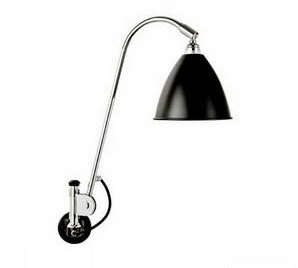
The Bestlite BL6 Wall Lamp with Short Pillar proves that a light fixture does not need to shout, sparkle, or resemble a small spaceship to get attention. Its appeal comes from disciplined proportions: a compact wall mount, a slender adjustable arm, and a bell-shaped shade that puts light exactly where it is useful.
Designed by Robert Dudley Best in 1930, the BL6 belongs to the long-running Bestlite collection now produced by GUBI. Its Bauhaus-influenced design combines industrial practicality with an unexpectedly graceful silhouette. The result is a wall lamp that can look equally comfortable beside a modern bed, above a traditional writing desk, or illuminating a kitchen counter where onions are being chopped with unreasonable confidence.
This guide examines the Bestlite BL6 Wall Lamp in detail, including its short-pillar configuration, construction, adjustability, lighting performance, installation options, finish choices, room placement, and everyday ownership experience.
What Is the Bestlite BL6 Wall Lamp?
The Bestlite BL6 is an adjustable wall-mounted task lamp. Unlike a fixed decorative sconce that throws light in one general direction and then considers its work finished, the BL6 uses a movable arm and articulated shade to direct illumination toward a book, desktop, work surface, or architectural feature.
The fixture has remained in production since its introduction in 1930. That longevity is important because the BL6 does not merely imitate vintage industrial lighting. It is part of an original design family created during the rise of European modernism, when designers were stripping away unnecessary decoration and focusing on practical forms, efficient manufacturing, and honest materials.
Understanding the “Short Pillar” Description
The phrase short pillar generally refers to the compact vertical tube attached to the wall bracket. On the standard BL6 configuration, this section measures approximately 5.9 inches, or 150 millimeters. From that short support rises the longer curved arm carrying the shade.
This little pillar has a larger visual job than its dimensions suggest. It separates the adjustable arm from the wall, provides room for the pivoting mechanism, and gives the lamp its distinctive mechanical character. Without it, the BL6 would look flatter and more ordinary. With it, the lamp resembles a carefully engineered instrument rather than a shade that has simply been screwed to the drywall.
Technical documents for different regional versions consistently show a 150-millimeter tube, a shade approximately 140 millimeters high, and a shade diameter of about 160 millimeters. The precise backplate, socket, cord, switch, and wiring arrangement can vary between U.S., U.K., European, hardwired, and plug-in models.
A Brief History of a British Bauhaus Classic
Robert Dudley Best was born into the family behind Best & Lloyd, a major British lighting manufacturer established in Birmingham in the nineteenth century. Rather than repeating the ornate styles historically associated with decorative lamps, Best became interested in the cleaner and more functional principles emerging from continental Europe.
His design education and exposure to modernist ideas led to the development of the Bestlite range. The lamps were influenced by Bauhaus principles, particularly the belief that useful objects could be beautifully proportioned without being buried beneath decoration. The earliest Bestlite products found practical applications in industrial and professional settings before gaining wider recognition among architects and design-conscious homeowners.
The broader Bestlite family later became associated with Winston Churchill, who used a Bestlite desk lamp in Whitehall. That famous connection helped turn a practical British light into a recognizable design icon. The BL6 wall lamp shares the same functional vocabulary: curved metal tubing, mechanical joints, a focused shade, and an overall refusal to waste material on visual nonsense.
Design and Construction
A Silhouette That Balances Industry and Elegance
The BL6 has an industrial structure, but it does not feel harsh. The long arm bends gently toward the shade, softening the geometry and creating a swan-neck profile. The circular wall plate and short pillar remain visibly mechanical, while the rounded shade adds a calmer, more domestic character.
This balance allows the Bestlite BL6 Wall Lamp with Short Pillar to work in more interiors than its 1930 origin might suggest. It complements Bauhaus, industrial, Scandinavian, mid-century modern, transitional, and minimalist rooms. It can also bring welcome discipline to an eclectic space filled with art, antiques, books, and at least one chair nobody is allowed to sit on.
Materials and Finishes
Depending on the selected version, the lamp may combine powder-coated aluminum, chromed steel, brass, painted metal, porcelain, or bone china. Traditional chrome models often use a powder-coated shade and base with a chromed tube and arm. Brass versions may pair the metal structure with charcoal, gray, matte white, brass, or porcelain shades.
The metal construction gives the lamp a reassuring sense of substance. It does not have the featherweight feeling common to inexpensive swing-arm lights. The joints, arm, and shade read as separate functional components, which adds visual depth even when the fixture is switched off.
Brass models deserve special attention. Manufacturer documentation advises against polishing certain lacquered brass surfaces. Aggressive metal polish may damage the protective finish or create uneven patches. A soft, damp cloth is the safer choice unless the care instructions supplied with the exact model say otherwise.
Key Dimensions and Technical Details
| Feature | Typical Specification |
|---|---|
| Short pillar or tube length | Approximately 5.9 inches |
| Arm reach | Up to approximately 16.5 inches |
| Shade diameter | Approximately 6.3 inches |
| Shade height | Approximately 5.5 inches |
| Typical fixture height | Approximately 21 to 22 inches, depending on adjustment |
| U.S. socket | Commonly E12 candelabra base |
| European socket | Commonly E14 |
| Location rating | Indoor or dry-location use |
| Bulb included | Usually no |
Note: Specifications differ among regional and production versions. Verify the socket, voltage, switch type, wiring method, backplate dimensions, finish, and maximum bulb wattage on the exact product listing before ordering. A European E14 model should not be assumed to match a U.S. E12 electrical configuration simply because both lamps look identical in photographs.
Current U.S. retail specifications commonly describe the fixture as roughly 6.2 inches wide and 21.3 inches high, with an adjustable extension ranging from about 6 to 16.5 inches. Some listings also identify the fixture as UL listed and suitable for 120-volt installations.
Adjustability and Lighting Performance
The BL6 earns its wall space through adjustability. The arm can move away from the wall and reposition the shade over the area being used. The shade is attached through an articulated joint, allowing the beam to be aimed downward, sideways, or at an angle.
This is genuine functional flexibility rather than a decorative hinge included for dramatic product photography. When mounted next to a bed, the lamp can be pulled toward the reader and moved back afterward. Above a desk, it can illuminate paperwork without filling the entire room with bright light. In a kitchen, it can focus on a preparation surface while leaving the surrounding room pleasantly subdued.
Focused Rather Than Flooded Light
The shade produces a concentrated pool of light. That makes the BL6 especially effective as a task light, but it should not be treated as the only light source in a large room. It works best as one layer in a broader lighting plan that includes ambient ceiling fixtures, floor lamps, table lamps, or indirect illumination.
The enclosed metal shade also reduces glare from many viewing angles. You see the illuminated surface beneath the lamp rather than staring directly into a bare bulb. However, the exact comfort level depends on mounting height, shade angle, bulb shape, and brightness.
Choosing the Right Bulb
For most home applications, a warm-white LED bulb in the 2700K to 3000K range is a sensible choice. A high color-rendering index is useful beside artwork, fabrics, food-preparation surfaces, or reading areas because it helps colors appear more natural.
A bulb producing approximately 350 to 450 lumens is generally suitable for intimate reading and task lighting. More output is not automatically better. A very bright bulb placed near eye level can turn a relaxing reading corner into something resembling a dental examination.
Check the physical size of the bulb as carefully as its wattage. The BL6 shade is compact, so an oversized smart bulb may protrude beneath it. A small E12 LED in the United States, often in a B11 or similarly compact shape, tends to fit more neatly. Some current retail specifications recommend a 5-watt LED producing around 400 lumens.
Best Places to Use the BL6 Wall Lamp
Beside the Bed
Bedside placement is one of the strongest applications for the Bestlite BL6. Wall mounting frees the nightstand for books, glasses, a phone, and the glass of water that somehow remains untouched until morning.
Install the lamp where the shade can be brought over the reader’s shoulder without shining directly into the other side of the bed. For a pair of lamps, measure from the mattress and headboard rather than blindly centering each fixture on the wall. Beds move; wall holes are more committed.
Above a Desk
The BL6 is an excellent alternative to a desk lamp when surface area is limited. Its wall-mounted design leaves room for a laptop, notebooks, speakers, and the growing archaeological layers of coffee cups that accompany serious work.
Right-handed users may prefer the lamp mounted to the left so the hand casts less shadow while writing. Left-handed users can reverse that arrangement. The flexible arm allows further adjustment as tasks change.
In the Kitchen
Mounted above an open counter, shelf, or breakfast nook, the BL6 provides useful directional light and adds architectural character. Black and chrome versions reinforce an industrial kitchen, while brass and white combinations soften natural wood cabinetry or marble surfaces.
Because the fixture is generally intended for dry indoor locations, it should not be installed where it will receive direct splashes, heavy steam, or grease without confirming suitability. A beautiful lamp positioned directly above a frying pan will quickly become a beautiful lamp wearing a sticky sweater.
In a Hallway or Reading Corner
The adjustable shade can highlight framed artwork, a console table, or a small seating area. In narrow corridors, however, the arm’s projection must be considered carefully. Place it where people will not collide with it while carrying luggage, laundry baskets, or ambitious houseplants.
Choosing the Best Finish
Black and Chrome
Black and chrome is the most visibly industrial option. The dark shade creates graphic contrast, while the reflective arm highlights the lamp’s engineering. It looks especially sharp against white, pale gray, concrete, brick, and natural wood.
White or Off-White and Chrome
White and off-white versions appear lighter and less assertive. They suit Scandinavian interiors, compact bedrooms, and rooms where the wall lamp should remain visually quiet. The curved arm still provides character, but the pale shade blends more easily with neutral walls.
Brass Combinations
Brass introduces warmth and a more luxurious expression. Charcoal and brass create dramatic contrast, while matte white and brass feel softer. All-brass models are the most decorative, and porcelain or bone-china shades add a refined material contrast.
Do not choose a finish only because it matches every knob and faucet in the room. Repeating one or two related metal tones is usually enough. A lamp can coordinate with an interior without behaving like it was issued a uniform.
Installation Considerations
The BL6 is sold in multiple configurations, including hardwired and corded models. A hardwired installation provides the cleanest appearance because the electrical connection is concealed behind the wall plate. It may require an electrical box, suitable wiring, and professional installation.
A corded version is more flexible for renters or rooms without existing wall wiring. It can often be mounted near an outlet and operated through an inline switch. The visible fabric cord becomes part of the design, so plan its route rather than letting it wander down the wall like a lost piece of spaghetti.
Some hardwired U.S. models include a switch on the wall bracket, while other configurations rely on a wall switch, cord switch, or external dimmer. Confirm the control method before purchasing. If dimming is important, verify compatibility among the fixture, LED bulb, and dimmer. Manufacturer documents recommend consulting an electrician regarding dimmer installations.
Plan the Swing Radius
Before drilling, move an imaginary arm through its entire range. Check nearby shelves, cabinet doors, artwork, headboards, curtains, and walkways. The lamp must have enough space to adjust without striking the wall or neighboring objects.
Mounting height depends on the intended use. For bedside reading, sit naturally against the pillows and estimate where the lower edge of the shade should rest relative to shoulder and eye level. For a desk, consider the height of the work surface and whether the lamp will illuminate the center without producing glare on a monitor.
Advantages and Possible Drawbacks
Why the BL6 Stands Out
- It has an authentic design history dating to 1930.
- The arm and shade provide practical directional lighting.
- Wall mounting preserves desk and nightstand space.
- Multiple finishes suit modern, industrial, and transitional interiors.
- Replaceable bulbs allow control over brightness and color temperature.
- The recognizable silhouette works as decoration even when switched off.
What Buyers Should Consider
- The BL6 is a premium designer fixture with a price to match.
- Regional socket and electrical specifications vary.
- The focused beam does not replace general room lighting.
- The projecting arm requires adequate clearance.
- Hardwired installation may require an electrician.
- Polished metal surfaces can reveal fingerprints and dust.
The price is the most obvious objection. Less expensive swing-arm sconces can perform the same basic task. The argument for the BL6 rests on its proportions, material quality, mechanical details, historical importance, and ability to remain visually relevant for decades.
How to Buy the Right Bestlite BL6
Start by confirming whether the listing is for a genuine GUBI-produced Bestlite lamp. Check the manufacturer name, model designation, finish code, voltage, socket type, dimensions, certification, warranty, and included mounting hardware.
Look closely at whether the product is hardwired or plug-in. Product photos are not always enough because retailers may use images from another regional configuration. Read the technical details rather than trusting a beautifully styled bedroom photograph where the cord has mysteriously vanished.
Authentic models are sold through established design retailers and lighting specialists. Documentation may identify the designer, year of design, material composition, and model-specific electrical information. Retail pages from GUBI dealers consistently describe the lamp as an adjustable, Bauhaus-influenced design intended for bedside, desk, hallway, and kitchen task lighting.
Extended Real-World Experience With the Bestlite BL6 Wall Lamp
Living with the Bestlite BL6 Wall Lamp with Short Pillar is different from admiring it in a product photograph. Online, the fixture looks like a slim black or brass line against a perfectly plastered wall. In daily use, its best quality is not its famous design history. It is the simple pleasure of moving the shade toward the exact spot where light is needed.
As a bedside lamp, the BL6 quickly changes the habits of the space. A traditional table lamp often illuminates the entire nightstand and part of the room, whether that light is useful or not. The BL6 creates a more private pool of illumination. Pulling the arm toward the bed makes printed pages easy to read, while angling the shade downward prevents much of the light from reaching the other sleeper. When reading is over, the fixture can be moved back toward the wall, restoring visual order without taking up an inch of the tabletop.
The movement feels deliberate rather than loose, provided the joints are correctly adjusted. This matters because an adjustable lamp that slowly droops is less a lighting solution and more a metal houseplant. The BL6’s hardware may need occasional tightening, but the mechanical design makes minor adjustments understandable. The small Bestlite tool supplied with certain versions is intended to help secure the arm hardware without attacking it with random pliers from the garage.
At a desk, the short pillar creates useful separation between the wall and the main arm. That space helps the fixture pivot without looking crowded. The lamp can sit close to the wall during video calls or general computer work, then extend over notebooks, sketches, or paperwork. Because the beam is concentrated, the desk feels calmer at night than it would under a bright ceiling light.
The shade position has a noticeable effect on comfort. Pointing it too far outward can expose the bulb and cause glare. Tilting it toward the work surface creates a more controlled circle of light. After several days, adjustment becomes instinctive: pull, angle, work, return. The lamp becomes less like a static sconce and more like a small piece of equipment.
Finish choice also changes the ownership experience. Black shades are visually crisp and hide minor marks well, although dust eventually becomes visible. Chrome reflects its surroundings and can look especially bright in daylight, but fingerprints are easier to spot. Brass feels warmer and more decorative, yet it benefits from careful cleaning. A soft cloth is usually all that is required; enthusiastic polishing is not a personality trait the lamp needs.
The BL6 does not solve every lighting problem. It will not flood a large bedroom, illuminate an entire kitchen, or compensate for a badly planned electrical layout. Its strength is precision. It provides useful light, preserves surface space, and adds a recognizable architectural gesture to the wall.
That combination explains why the design still feels relevant. The Bestlite BL6 is not interesting merely because it is old, and it is not useful merely because it moves. Its history, materials, compact short pillar, curved arm, and focused shade work together as one coherent object. Many lamps can brighten a page. Far fewer can do it while making the wall look significantly more intelligent.