By a writer who respects classic cars, stand-up comedy, and the basic human instinct to avoid becoming a cautionary tale.
Introduction: Jay Leno, America’s Most Durable Car Guy
Jay Leno has spent decades making America laugh, collecting rare cars, wrenching on vintage machines, and somehow turning near-disaster into another punchline. Most celebrities have a signature brand. Some have perfume. Some have skincare. Jay Leno has a chin, a garage, and a remarkable ability to survive incidents that would make the average person immediately take up a safer hobby, such as stamp collecting or competitive naps.
The phrase “A Brief History of Jay Leno Almost Killing Himself” sounds dramatic, but it is not about self-harm. It is about a very specific pattern: Leno loves mechanical things, mechanical things occasionally fight back, and Leno responds by cracking jokes, going back to work, and behaving as if bones and skin are replaceable car parts.
From a gasoline fire in his Burbank garage to a motorcycle crash involving a vintage bike, and then a spectacular tumble down a Pennsylvania hillside, Leno’s recent injury history reads like a slapstick routine written by a mechanic with a dark sense of humor. Yet beneath the comedy is a surprisingly useful story about passion, risk, resilience, and why even experienced people should never underestimate machines, fuel, gravity, or “shortcuts” that involve a steep hill.
Who Is Jay Leno, Beyond the Bandages?
Jay Leno is best known as the longtime host of The Tonight Show, a stand-up comedian, and one of America’s most famous car collectors. His public image has always combined old-school work ethic with blue-collar curiosity. He is not simply a celebrity who owns expensive vehicles as decorative trophies. He actually works on them, studies them, drives them, and talks about engines with the excitement of a kid explaining why his new toy is definitely cooler than yours.
That is part of why his accidents gained so much attention. Leno is not a distant collector pointing at a polished hood from behind a velvet rope. He is the guy under the hood, under the car, next to the bike, or apparently rolling down the hill. His reputation comes from being hands-on. Unfortunately, being hands-on also means your hands are occasionally near gasoline, hot parts, wires, tools, and the universe’s endless supply of poor timing.
His show Jay Leno’s Garage helped turn his private passion into public entertainment. Viewers watched him celebrate steam cars, supercars, motorcycles, oddball prototypes, and antique engineering. But vintage vehicles are not modern appliances. They come with quirks, hazards, and mechanical personalities. Some leak. Some smoke. Some require rituals. Some appear to have been designed by people who considered seat belts a sign of weakness.
The 2022 Garage Fire: When a Vintage Car Fought Back
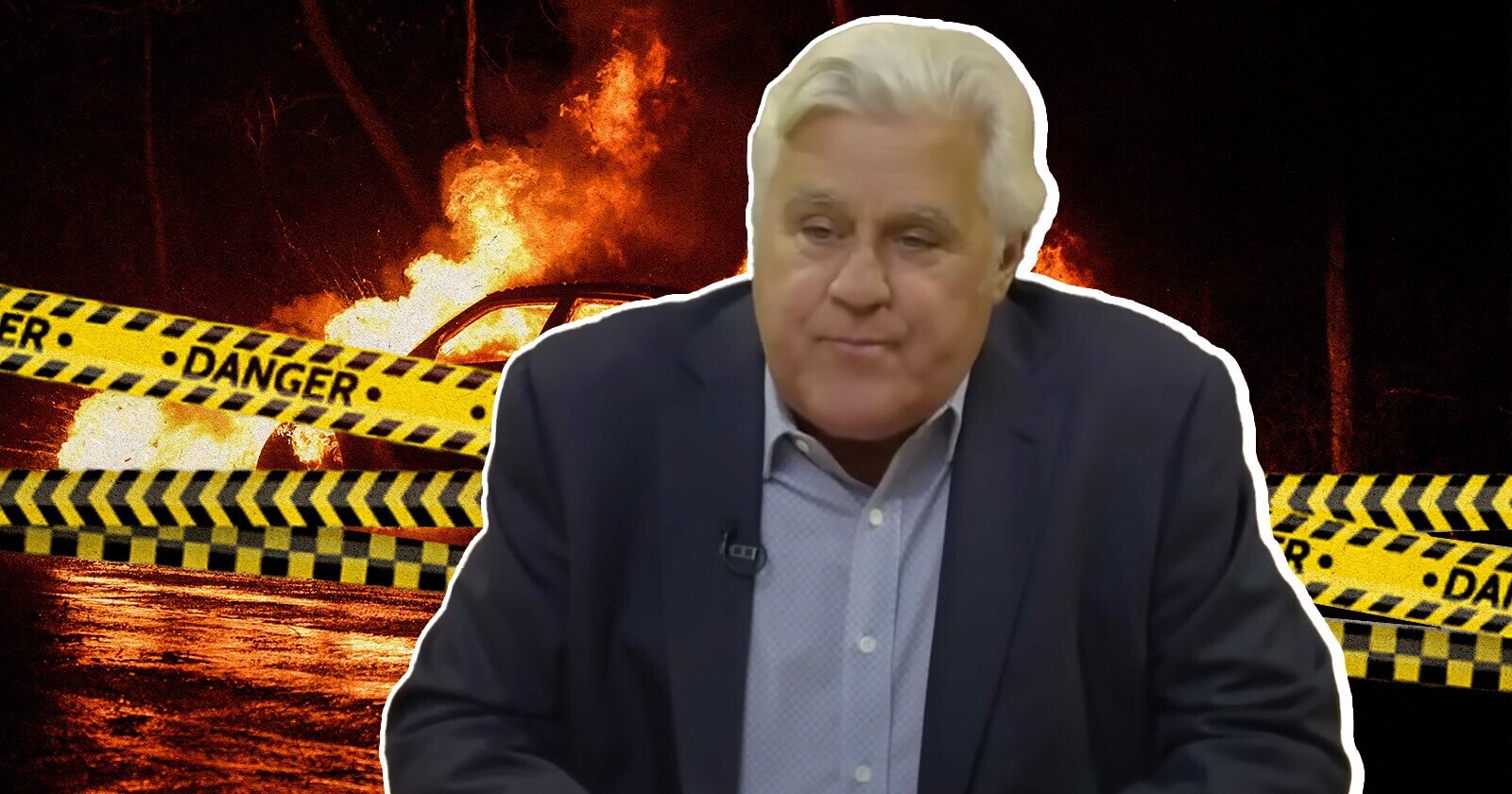
The most serious modern chapter in the Jay Leno injury saga came in November 2022. Leno was working on a 1907 White Steam Car in his Burbank garage when a clogged fuel line led to a gasoline fire. According to later interviews and reports, gasoline sprayed and ignited, burning his face, chest, and hands.
For most people, “my face caught fire” would be the beginning of a lifelong commitment to avoiding garages. For Leno, it became part of his recovery story and, eventually, comedy material. His friend Dave Killackey was there and helped smother the flames, a fast reaction that likely kept the situation from becoming even worse.
Leno was treated at the Grossman Burn Center in California. Reports described significant burns, with some injuries categorized as second-degree or possibly progressing toward third-degree. He underwent surgical treatment, skin graft-related procedures, and hyperbaric oxygen therapy. In normal human terms, that is a terrifying medical ordeal. In Jay Leno terms, it was apparently a brief interruption before returning to stand-up.
Why the Fire Was So Dangerous
Gasoline is not just “liquid that makes cars go.” It is a highly flammable substance whose vapors can ignite quickly around heat, sparks, pilot lights, or other ignition sources. Vintage vehicles can be especially tricky because older systems may not include the safety designs found in modern cars. When old fuel lines, pressure, vapors, and flame meet, the result can go from “minor repair” to “call the burn center” in a heartbeat.
This is one of the major lessons from Leno’s fire: experience reduces risk, but it does not erase it. Leno is not a clueless hobbyist poking random wires with a fork. He knows cars deeply. Still, a clogged line and a flash of fuel created a severe accident. The garage does not care how many Emmys you have.
The 2023 Motorcycle Crash: Because Apparently Fire Was Not Enough
Just when the public thought Leno might take it easy, he was injured again in January 2023. This time, the problem involved a vintage motorcycle. He was test-riding a 1940 Indian motorcycle when he noticed the smell of leaking gas. He turned into a parking lot, where a wire stretched across the area reportedly knocked him off the bike.
The injuries were not small. Leno said he broke his collarbone, broke two ribs, and cracked both kneecaps. That is not a “walk it off” situation unless your definition of walking includes limping like a pirate whose ship has no health insurance.
Yet the most Jay Leno part of the story is that he downplayed it. He said he was okay and continued working. This is either admirable resilience, stubbornness, or the operating system of a man who has been doing stand-up for so long that pain is just another heckler.
The Vintage Vehicle Pattern
The motorcycle crash echoed the garage fire in one important way: both incidents were connected to vintage machines and fuel issues. Leno’s passion is not casual. He spends real time around old vehicles, and old vehicles often require direct mechanical attention. That passion creates joy, knowledge, and great stories. It also creates exposure to hazards that most people encounter only when ignoring a warning label.
In SEO terms, anyone searching “Jay Leno motorcycle accident,” “Jay Leno burns,” or “Jay Leno car fire” is really looking at the same larger story: a comedian whose love of machines is sincere enough that he keeps returning to them even after they try to edit his skeleton.
The 2024 Hill Fall: Gravity Enters the Chat
In November 2024, Leno added a non-automotive entry to the list. While staying near Pittsburgh for a stand-up performance, he reportedly tried to walk from his hotel to a nearby restaurant. The restaurant was close, but the direct route involved a steep grassy hillside. Leno decided to take the shortcut.
Gravity, as usual, had notes.
He fell down the hill, reportedly tumbling around 50 to 60 feet. The fall left him with facial bruising, a swollen eye, a broken wrist, and other injuries. He wore an eye patch afterward, which made him look less like a late-night legend and more like a man who had just lost a duel with a lawn.
Most people would cancel the show, go to the hospital, and spend the evening reconsidering their relationship with hills. Leno performed anyway. Reports said he completed his set before seeking further medical care. That detail became a key part of the public fascination: he was badly bruised, visibly injured, and still chose the stage.
Why the Hill Story Went Viral
The hill accident went viral because it was oddly relatable. Few people own a 1907 White Steam Car. Even fewer test-ride antique motorcycles. But nearly everyone has looked at a “shortcut” and thought, “That seems fine,” moments before discovering that nature has a legal department.
The story also fit the existing Leno mythology. By 2024, the public already knew him as the celebrity who survived a garage fire and a motorcycle crash. A fall down a hill made the pattern feel almost cartoonish. It was not funny because he was hurt. It was funny because he seemed determined to treat the whole thing as an inconvenience, like a delayed flight or a bad sandwich.
Why Jay Leno Keeps Laughing at Disaster
One reason people remain fascinated by Leno’s accidents is his reaction. He does not frame himself as a victim of fate. He usually responds with humor, understatement, and a kind of old-school “the show must go on” attitude. That can be inspiring, but it is also slightly alarming. There is a fine line between toughness and treating your body like a rental car.
Leno’s humor works because it comes from perspective. He has acknowledged that many people are injured while working with their hands every day. Mechanics, welders, factory workers, firefighters, construction crews, and hobbyists face real risks without celebrity headlines or magazine interviews. By making jokes about himself, Leno avoids the trap of sounding like a pampered star complaining because life got inconvenient.
That humility is part of the appeal. He knows his garage is full of rare machines. He knows he has resources most people do not. But when gasoline ignites or a motorcycle throws you, pain is democratic. Burns do not care about your IMDb page. Broken ribs do not ask whether you once hosted prime time television.
Safety Lessons from Jay Leno’s Near-Misses
It would be easy to turn these stories into simple celebrity gossip, but there are practical lessons hiding under the jokes. Leno’s accidents are reminders that expertise is not immunity, passion needs boundaries, and “I’ve done this a thousand times” can be the most dangerous sentence in any garage.
1. Fuel Vapors Are Sneakier Than Fuel Spills
Gasoline vapors can ignite even when the visible liquid seems under control. In any workshop, ventilation matters. So does eliminating ignition sources. A tiny spark, hot surface, open flame, or pilot light can become a major problem when flammable vapors are present.
2. Vintage Machines Deserve Extra Respect
Older cars and motorcycles may be beautiful, historic, and charming, but they were built under different safety expectations. Their fuel systems, brakes, tires, lighting, wiring, and handling can behave very differently from modern machines. Nostalgia is wonderful, but it should not replace protective gear and careful inspection.
3. Do Not Turn Shortcuts Into Stunt Work
The Pennsylvania hill fall is a perfect everyday lesson. A destination can be only 200 yards away and still be a terrible walk if the route involves a steep, slippery slope. The safe path that takes longer is often better than the shortcut that ends with an eye patch.
4. Seek Medical Care Quickly
Leno’s ability to perform after serious injuries is impressive, but ordinary readers should not treat it as a medical recommendation. Burns, head injuries, broken bones, and severe falls need proper evaluation. Toughness is not a substitute for a doctor, and “I feel okay” is not always reliable when adrenaline is doing its little tap dance.
What Leno’s Accidents Say About Passion
The strange thing about Jay Leno’s injury history is that it has not made him seem reckless in the usual celebrity sense. He is not crashing sports cars outside nightclubs or creating chaos for attention. His accidents come from a recognizable place: devotion to a craft, love of machines, and an almost comic refusal to slow down.
Passion is powerful because it makes hard work feel meaningful. Leno’s garage is not just storage. It is a classroom, museum, workshop, and playground. He preserves automotive history by keeping old machines alive. That requires risk, patience, and mechanical intimacy. You cannot fully understand some vehicles from a distance. You have to hear them, smell them, fix them, and sometimes discover that they are trying to roast your eyebrows.
Still, passion becomes healthier when paired with humility. The smartest enthusiasts are not the ones who never get hurt. They are the ones who learn from every close call. Leno jokes that he may not learn from mistakes, but the rest of us are allowed to take notes.
Experiences and Reflections Related to “A Brief History of Jay Leno Almost Killing Himself”
There is something oddly useful about looking at Jay Leno’s recent accidents as more than celebrity news. They create a relatable framework for anyone who has a hobby, a craft, a demanding job, or a personality that occasionally says, “I can handle this,” five seconds before reality replies, “Interesting theory.”
The first experience many readers can connect with is the danger of comfort. The more familiar we become with a task, the easier it is to underestimate it. A mechanic who has worked around engines for decades may become comfortable with fuel lines. A rider who knows motorcycles may trust instinct. A traveler who sees a restaurant at the bottom of a hill may assume the direct route is harmless. Familiarity can save time, but it can also lower the volume on our internal warning system.
That lesson applies far beyond cars. A home cook can get careless with hot oil. A gardener can skip gloves while using sharp tools. A DIY homeowner can climb a ladder “just for a second.” An office worker can ignore wrist pain until it becomes a real injury. Most accidents do not begin with a villainous thunderclap. They begin with a small decision that feels ordinary.
The second experience is the importance of having another person nearby during risky work. In Leno’s garage fire, his friend’s quick response mattered. That point is worth repeating for hobbyists: if you are working with fuel, heavy equipment, power tools, electricity, chemicals, or unstable machinery, do not treat solitude as a badge of honor. Having someone nearby can turn a disaster into a survivable incident. Even a simple check-in system is better than disappearing into a garage for six hours with only a socket wrench and optimism.
The third experience is learning when to stop. People who are passionate about their work often push through discomfort. Performers do it. Tradespeople do it. Parents do it. Entrepreneurs do it. Leno performing after a bad fall is impressive, but ordinary people should be careful about romanticizing that level of grit. Sometimes stopping is not weakness; it is maintenance. Cars need maintenance. Bodies do too. Ignore a warning light long enough, and the repair bill gets dramatic.
The fourth experience is using humor without using humor as denial. Leno’s comedy helps him process pain publicly. Humor can be healthy. It can reduce fear, make recovery less isolating, and help people talk about frightening events. But humor should not replace honest assessment. You can joke about falling down a hill and still admit the hill won. You can laugh about a garage mishap and still improve safety habits afterward.
The fifth experience is accepting that passion always carries some risk, but risk can be managed. The answer is not necessarily to quit the hobby, sell the tools, and live in a padded room eating soup with a rubber spoon. The answer is to respect the activity enough to prepare properly. Wear protective equipment. Ventilate the workspace. Read the manual. Use the long route. Ask for help. Slow down when the situation changes. These choices do not make a person less adventurous. They make the adventure last longer.
Jay Leno’s story remains compelling because it is ridiculous, human, and strangely motivational. He gets hurt, jokes about it, and keeps moving. But the better takeaway is not “be indestructible like Jay Leno.” The better takeaway is “love what you love, but do not let enthusiasm talk you out of common sense.” Whether your passion is classic cars, woodworking, cycling, cooking, hiking, or fixing a mysterious noise in your basement, remember that confidence should ride in the passenger seat, not drive the whole car.
Conclusion: The Man, the Myth, the Medical Chart
A brief history of Jay Leno almost killing himself is really a brief history of a man refusing to live cautiously just because life occasionally punches him in the face. Literally, in the case of the hill.
His recent injuries are serious: burns from a gasoline fire, broken bones from a motorcycle crash, and bruises and fractures from a hillside fall. But the public response has been shaped by the way Leno handles these incidents. He jokes. He works. He downplays. He returns to the garage, the stage, and the routine. That resilience is part of his brand, but it also gives readers a useful reminder: passion is wonderful, but safety is not optional.
Jay Leno’s story is funny because he survived. It is memorable because he kept laughing. And it is useful because it reminds the rest of us to respect fuel, machines, gravity, and any shortcut that looks like it was designed by a cartoon coyote.
Note: This article is written for entertainment and informational purposes. It discusses public accident reports and general safety lessons, not medical advice. Anyone experiencing burns, head trauma, broken bones, or severe injuries should seek professional medical care immediately.