Research note: The gallery details and community background were verified through the original Bored Panda feature and r/mildlyterrifying community page.
Not every frightening image needs a masked villain, a haunted mansion, or a monster with an impressive dental plan. Sometimes all it takes is a shadow shaped like a spider, a mannequin staring in the wrong direction, or an innocent family photograph with one deeply questionable detail in the background.
That quieter category of visual horror is the specialty of r/mildlyterrifying, an online community devoted to pictures and stories that are disturbing without necessarily being full-scale nightmare fuel. The group’s unofficial threshold is wonderfully specific: content should be scary enough to raise your heart rate or produce approximately half a goosebump.
When a collection of 50 unsettling photos from the community was highlighted in January 2023, the subreddit had reportedly attracted more than 75,000 members. Its posts ranged from strange animals and distorted faces to unexpected footprints, decaying objects, optical illusions, and ordinary household items apparently auditioning for a horror movie.
Content note: The descriptions below include insects, eerie humanlike figures, unusual animals, distorted faces, and scenes designed to create mild discomfort. Readers with specific visual phobias may wish to proceed cautiously.
What Makes These 50 Unsettling Photos So Effective?
The most memorable images in the collection are not always the most dangerous. In fact, many show situations that are completely harmless. What they share is ambiguity. Something looks almost normal, but not normal enough for the brain to relax.
A forest sculpture resembles a transparent person standing among the trees. A hornet nest grows around the face of a wooden statue. A peeling billboard exposes a second face beneath the first. A book cover glows beside someone’s bed after the lights go out. None of these scenes contains a confirmed supernatural threat, but each one gives the imagination plenty of unpaid overtime.
Psychological research into creepiness suggests that uncertainty is central to the feeling. Clear danger produces fear and an obvious response: escape, hide, or deal with the problem. Creepiness is more complicated. It whispers that something might be wrong while refusing to provide enough evidence for a verdict.
That unresolved question keeps the viewer staring. Is it a person or a sculpture? Is that shape an animal, a shadow, or a home appliance plotting revenge? Is someone standing in the old photograph, or is the grainy background creating a false figure? The longer certainty remains unavailable, the more efficiently the picture rents space in your head.
Fear-response research was synthesized from Harvard Health, NIH-hosted studies, the American Psychological Association, Smithsonian Magazine, Scientific American, and National Geographic.
Why a Photograph Can Make Your Heart Beat Faster
The Brain Reacts Before the Logical Explanation Arrives
Visual information is processed quickly because noticing potential threats has always been useful for survival. When the brain interprets an image as dangerous or suspicious, the amygdala and related networks can help activate the body’s stress response.
Adrenaline may increase heart rate, breathing speed, muscle tension, and alertness. Your pupils can widen, your attention narrows, and suddenly the mysterious object behind the curtain becomes the most important thing in the universe. A moment later, the rational part of the brain may announce that it is only a coat. Unfortunately, the nervous system has already started the orchestra.
This is why a harmless photo can cause a genuine physical reaction. The body does not always wait for a complete investigation before preparing for trouble. From an evolutionary perspective, assuming that the suspicious shape might be a predator was safer than calmly requesting additional evidence from it.
Uncertainty Keeps the Alarm Switched On
A clearly fake monster can be less unsettling than a blurry object that might be real. Certainty gives the brain somewhere to stand. Ambiguity removes the floorboards.
Many mildly terrifying photos use poor lighting, hidden details, unusual camera angles, or incomplete visual information. The viewer becomes an investigator, repeatedly scanning the scene for clues. That process increases attention and can prolong the uncomfortable response.
It also explains the power of “when you see it” pictures. The first glance appears ordinary. Then a face, figure, reflection, or pair of eyes becomes visible. The image changes without changing at all, and the viewer is left wondering how something so obvious remained hidden for several seconds.
The Main Categories of Mildly Terrifying Images
1. Almost-Human Faces
Humans are exceptionally sensitive to faces. We identify expressions, direction of attention, health, mood, and possible intent from tiny visual cues. When a face is slightly distorted, frozen, incomplete, or attached to the wrong kind of object, the result can become deeply uncomfortable.
Dental training mannequins are a good example. Their oversized mouths and simplified features serve a practical purpose, but practicality does not stop them from looking as though they meet after office hours to discuss humanity’s weaknesses.
Old dolls, statues, masks, and badly constructed portraits create a similar effect. They resemble people closely enough to activate social perception, yet their eyes and expressions do not behave like those of living humans.
2. The Uncanny Valley
The “uncanny valley” describes the discomfort that can occur when something looks nearly human but contains noticeable mismatches. A realistic figure with motionless eyes, an artificial smile, or unusual proportions may feel more disturbing than an obviously stylized cartoon.
Several photos in the collection enter this territory through sculpture, taxidermy, artwork, costumes, or accidental distortion. One handmade celebrity portrait becomes frightening not because it is technically poor, but because it is recognizable and unrecognizable at the same time. The brain understands the assignment. It simply disagrees with the final submission.
3. Familiar Objects Behaving Strangely
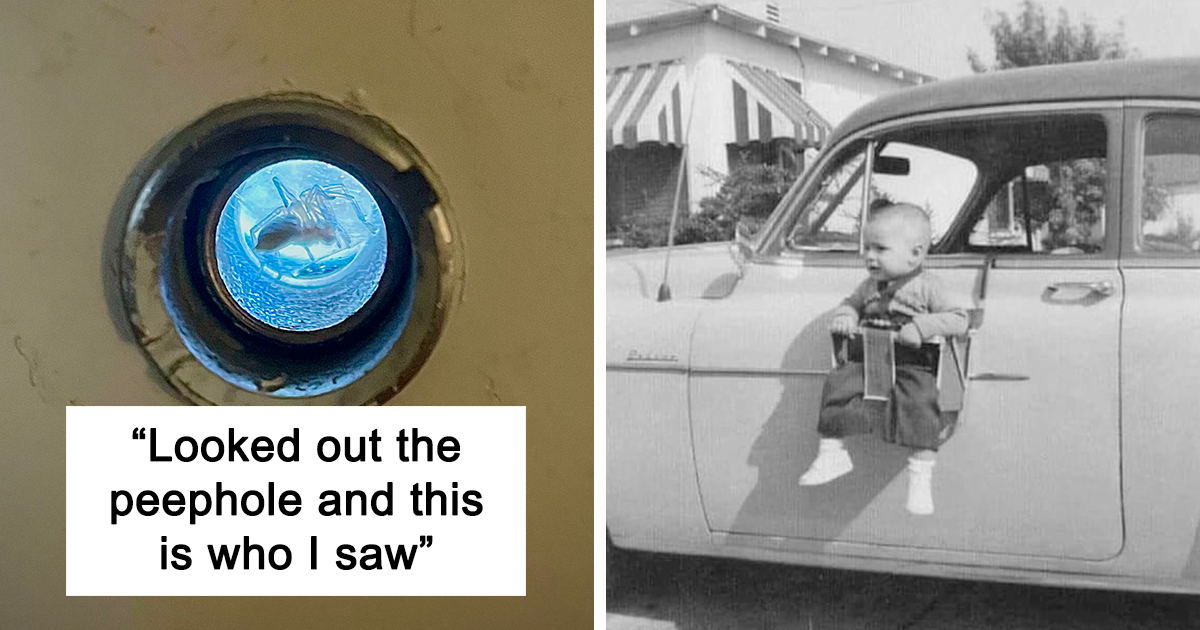
A lamp is not scary. A lamp casting the shadow of a giant spider is a different administrative category.
Ordinary objects become unsettling when light, damage, reflections, or perspective give them an unexpected identity. A peeling advertisement can appear to have skin. A chair covered with clothing may resemble a seated stranger. A frost pattern can look like a hand pressed against a window.
These images work because the familiar becomes temporarily unfamiliar. The viewer recognizes the object but cannot immediately dismiss the threatening interpretation.
4. Nature With Excellent Horror Timing
Nature does not need special effects. It already has parasitic fungi, clusters of insects, deep-sea creatures, unusual animal poses, molted skins, and plants that look suspiciously interested in human affairs.
One notable image shows a hornet nest formed around the face of a wooden statue. The insects were not attempting to create horror art, yet the result looks disturbingly intentional. Elsewhere, a sun bear standing upright becomes eerie because its posture appears unexpectedly human.
Unusual animals may trigger both curiosity and instinctive caution. Long limbs, unfamiliar textures, clusters of holes, exposed teeth, or sudden movement can activate fear or disgust before the viewer fully understands the species involved.
5. Evidence That Someoneor SomethingWas There
Few things are more effective than signs of an unseen visitor. Bare footprints outside the house, an unexplained handprint, a disturbed patch of snow, or an open door can create a complete horror narrative from one still image.
The danger is not visible, which allows the imagination to supply it. Was the visitor human? When did they arrive? Where did they go? Why are there no return footprints? Congratulations: your brain has now written three acts and selected ominous background music.
Visual-perception, phobia, and verification information was checked against Psychology Today, peer-reviewed uncanny-valley research, Cleveland Clinic, Mayo Clinic, Snopes, and the Associated Press.
Pareidolia: When the Brain Finds a Face That Is Not There
Pareidolia is the tendency to perceive meaningful forms, especially faces, in random or ambiguous visual patterns. It is why electrical outlets look surprised, cars appear to smile, and certain houses seem disappointed by the neighborhood.
Face recognition is so important to social life that the brain often accepts weak evidence. Two dark spots and a line may be enough. In a brightly lit kitchen, this can be amusing. In a dark hallway at 2 a.m., the same process becomes less charming.
Many unsettling photos depend on hostile pareidolia. Shadows become intruders. Tree bark develops eyes. A collection of objects creates the outline of a skull. Once the viewer sees the face, it can be difficult to return to the original interpretation.
Context also matters. A face-like pattern on toast is funny. The same pattern on a basement wall behind a locked door feels like a reason to move.
Why Some Viewers Laugh While Others Look Away
Fear responses vary considerably. Personal experience, cultural associations, temperament, disgust sensitivity, and specific phobias all influence what a person finds unsettling.
A spider-shaped shadow may be a clever optical illusion to one reader and an immediate browser-closing event to another. Someone who loves insects may admire the structure of a wasp nest, while another viewer mentally adds the entire building to a controlled demolition schedule.
Trypophobia, commonly described as discomfort around clusters of small holes or repeating patterns, can make certain natural textures difficult to view. Specific phobias involving snakes, spiders, confined spaces, blood, or animals may also be triggered by photographs alone.
Humor can soften the reaction. Comment sections often fill with jokes, movie references, improvised backstories, and urgent recommendations to burn an object that is probably not flammable. Shared laughter reminds viewers that they are safe and turns individual discomfort into a social experience.
Why People Voluntarily Browse Unsettling Photos
Morbid Curiosity
People are naturally interested in danger, abnormality, death, and uncertainty. Morbid curiosity does not necessarily mean someone enjoys suffering. It can reflect a desire to understand threats from a safe distance.
An unsettling photo offers a small informational puzzle. What happened? Is the image real? Why does the object look human? Could this happen in my house? The viewer receives the emotional stimulation of danger without needing to investigate strange footprints in person.
Recreational Fear
Researchers use the term “recreational fear” for activities that create controlled fright, including horror movies, haunted attractions, scary games, and creepy stories. The viewer knows the experience is contained and can leave at any time.
That sense of control is important. A frightening image can produce adrenaline and intense focus, followed by relief when the threat is recognized as fictional, distant, or harmless. The cycle can be exciting, much like a roller coaster that does not require the passenger to understand mechanical engineering.
The Pleasure of Solving the Image
Many disturbing photos become less frightening once their context is known. A ghostly person in the woods turns out to be a reflective sculpture. The giant spider is a lamp shadow. The distorted animal is the result of a panoramic camera error.
Discovering the explanation creates a satisfying mental reversal. The viewer moves from confusion to recognition, from danger to safety, and occasionally from screaming to feeling a little silly.
Are the Unsettling Photos Real?
Not every viral image is authentic. Online photographs may be cropped, mislabeled, digitally altered, generated by artificial intelligence, or separated from their original context. Even a genuine photo can become misleading when paired with an invented story.
A strange image should therefore be treated as an invitation to investigate, not automatic proof of paranormal activity. Start by examining shadows, reflections, repeated textures, inconsistent edges, and distorted backgrounds. Panoramic modes and low-resolution enlargement can produce bizarre faces and stretched bodies without assistance from the spirit world.
Reverse image search can reveal where a picture appeared earlier and whether its original caption was different. Checking the uploader, date, location, and independent reporting may also clarify what the photo actually shows.
Modern generative tools make visual verification more difficult, so context is increasingly important. An image may feel authentic because it produces a strong emotional reaction, but heart rate is not a fact-checking instrument.
How to Browse Creepy Content Without Ruining Your Evening
Most mildly frightening images are harmless entertainment, but people with anxiety, trauma histories, or strong phobias may experience more intense reactions. A few basic habits can make the experience more comfortable.
- Browse during the day rather than immediately before sleep.
- Read captions first when visual triggers are a concern.
- Stop scrolling when the experience stops being enjoyable.
- Avoid forcing yourself through content that causes panic or lingering distress.
- Use slow breathing and focus on nearby physical objects if an image triggers a strong stress response.
- Remember that avoidance severe enough to disrupt daily life may be worth discussing with a mental health professional.
Controlled exposure is used professionally to treat some phobias, but clinical exposure therapy is gradual, structured, and guided by an appropriate plan. Randomly scrolling through fifty spiders before bed is not the same thing, despite what your most chaotic friend may claim.
Experiencing the Gallery: From Curiosity to the Final Double Take
The Confident Beginning
A typical journey through a collection of unsettling photos begins with confidence. The viewer opens the page believing that a few strange pictures cannot possibly be a problem. There is coffee nearby, daylight outside, and perhaps a pet in the room. Conditions appear favorable.
The first image may be artistic rather than frightening: reflective human sculptures positioned among trees. For a second, they resemble silent people watching from different points in the forest. Then the explanation becomes clear, and the viewer relaxes. “Interesting,” they think. “I am clearly too rational for this gallery.” This belief will not age well.
The Moment Ordinary Things Turn Against You
A few images later, familiar objects begin behaving badly. A billboard peels in a way that makes the printed face appear to be shedding another face. A glowing book cover surprises someone in bed. A lamp produces a shadow with too many legs.
These images create an oddly personal discomfort because they involve objects found in normal homes and streets. A fantasy monster belongs to fiction. A suspicious lamp may be sitting six feet away.
The viewer may glance around the room after seeing the spider-like shadow. This is unnecessary but understandable. Every coat becomes taller. Every pile of laundry gains shoulders. The decorative plant in the corner receives a brief but thorough security assessment.
The “When You See It” Trap
The most effective experience often comes from a photograph that initially appears harmless. Perhaps it shows a family gathering, a snowy backyard, or a dim room. The caption promises that something is hidden, so the viewer begins scanning.
At first, nothing appears wrong. The people are smiling. The furniture is ordinary. Then a pale face, distant figure, unusual reflection, or pair of eyes suddenly becomes visible. The recognition is immediate, but it feels delayedas though the hidden detail waited for permission to enter the scene.
After finding it, the viewer cannot stop seeing it. The entire composition reorganizes around that one detail. What was previously a family photograph is now “the photograph with the person in the background.” The brain has promoted a minor cluster of pixels to executive management.
Relief Through Context and Comments
Captions and comments often provide relief. A threatening silhouette becomes an art installation. A frightening animal pose is explained by anatomy or camera perspective. A supposed creature turns out to be a plastic bag, although admittedly a plastic bag with terrible energy.
Humorous reactions are part of the experience. Viewers propose burning furniture, abandoning buildings, calling specialists, or transferring legal ownership of the property to whatever is hiding inside it. These exaggerated responses transform fear into a group joke.
The social element matters because emotion spreads. Seeing other people laugh at the same image helps reframe it as entertainment. The viewer is no longer alone with an unexplained face in the darkness; thousands of strangers are also requesting that it pay rent.
The Images That Follow You Off the Page
After the gallery is closed, most pictures disappear from immediate memory. A few remain. Usually, they are not the goriest or most obviously frightening. They are the ambiguous onesthe footprints, the frozen smile, the old photo, the shape behind the door.
Later that evening, a shadow may briefly resemble one of them. The viewer recognizes the mistake almost instantly, but the association proves that unsettling images are effective because they recruit imagination rather than replacing it.
That is the peculiar appeal of mildly terrifying photography. It offers a compact scare, an intriguing mystery, and a safe return to reality. The experience raises the pulse without requiring a chainsaw, a haunted hotel, or even a competent monster. Sometimes a badly placed mannequin is more than enough.
Conclusion: The Best Unsettling Photos Leave a Question Behind
The 50 photos shared by this popular online group demonstrate that horror is often strongest at the border between ordinary and abnormal. A strange face, an unexplained reflection, or a familiar object viewed from the wrong angle can create more tension than an elaborate special effect.
These images exploit fast threat detection, pareidolia, the uncanny valley, personal phobias, and the brain’s dislike of uncertainty. They also offer the pleasures of curiosity, discovery, humor, and controlled fear. We know we are probably safe, but “probably” is doing a remarkable amount of work.
So scroll carefully, inspect the background, and remember one useful rule: when a caption says, “Look closely,” you may wish to appreciate your remaining innocence before doing so.
Note: This article discusses the themes and viewing experience surrounding the 50-photo collection. It does not reproduce the original images, and descriptions have been independently written for informational and entertainment purposes.