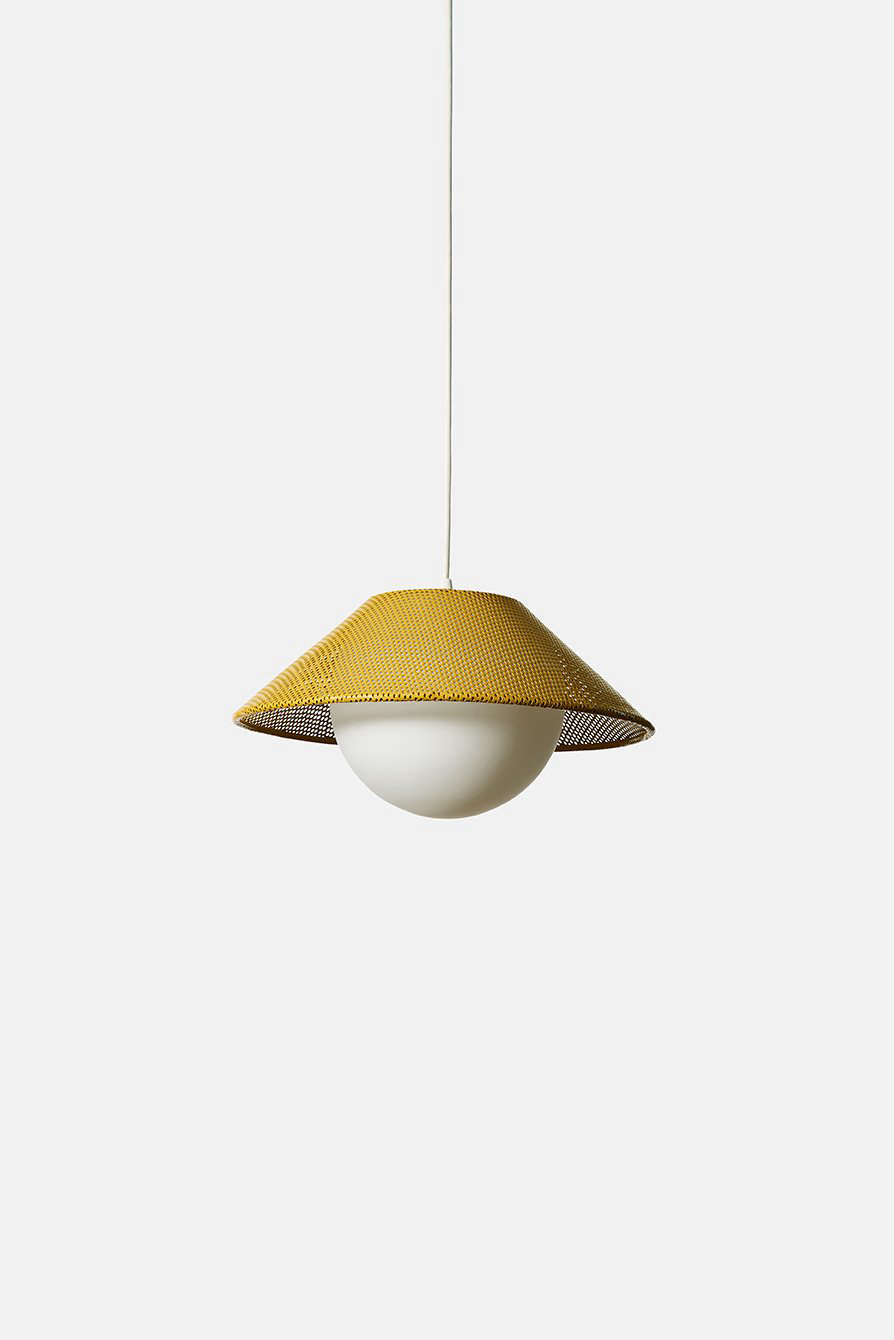
The Akoya 14 Pendant Light – Ochre Yellow is the kind of fixture that does not simply hang from the ceiling; it arrives with a personality. It has the soft glow of a pearl, the sunny confidence of ochre yellow, and just enough sculptural charm to make a dining table, kitchen island, reading corner, or boutique-style entryway feel thoughtfully finished. In a world full of ceiling lights that look like they were chosen during a two-minute panic scroll, the Akoya pendant feels intentional.
Designed by RBW, formerly known as Rich Brilliant Willing, the Akoya line is known for combining hand-blown opal glass with a perforated metal shade. The result is a pendant light that feels modern without turning cold, playful without looking childish, and refined without whispering, “please do not touch the furniture.” The Ochre Yellow finish gives the fixture a warm, earthy presence that sits beautifully between golden yellow, muted mustard, and modern desert clay.
This article takes a closer look at the Akoya 14 Pendant Light in Ochre Yellow: its design language, materials, lighting performance, best placements, styling ideas, installation considerations, and real-life experience. Whether you are planning a full remodel or simply trying to rescue a room from the dreaded “builder-grade ceiling dome,” this pendant deserves a serious look.
What Is the Akoya 14 Pendant Light?
The Akoya pendant is a decorative LED pendant light inspired by the visual softness of a pearl. Its name evokes the Akoya pearl, prized for its round shape and luminous surface. That idea translates clearly into the fixture: a glowing opal glass globe sits inside a shallow, perforated shade, creating the impression of a small radiant pearl protected by a delicate shell.
The requested Akoya 14 Pendant Light – Ochre Yellow refers to an earlier 14-inch version that became popular through design-focused product listings and interior inspiration features. Current Akoya product information from RBW emphasizes updated sizes, including 16-inch and 22-inch options, but the design DNA remains the same: opal glass, a sheer perforated shade, integrated LED performance, and a cheerful yet sophisticated finish palette.
That distinction matters for buyers. If you are sourcing this exact Akoya 14 model, you may be looking at a past listing, remaining inventory, a showroom piece, or a resale opportunity. If you are buying new from current dealers, you may see the newer Akoya sizes instead. Either way, the Ochre Yellow version remains one of the most memorable colorways because it adds warmth without overwhelming the room.
Design: A Pearl Inside a Perforated Shell
The most distinctive feature of the Akoya pendant is the relationship between the globe and the shade. Many pendant lights hide the bulb. Akoya does the opposite. It proudly reveals the glowing opal glass diffuser, allowing it to become the visual center of the fixture.
The shade works like a soft architectural frame. Its perforations allow light to breathe through the surface, producing subtle texture rather than a harsh beam. This is not a spotlight trying to interrogate your salad. It is ambient, flattering, and calm. The perforated metal shade creates a visual lightness that helps the fixture feel airy, even though the design has a strong silhouette.
Why Ochre Yellow Works So Well
Ochre yellow is one of those colors that designers love because it does several jobs at once. It is warm, earthy, optimistic, and slightly retro. Unlike bright lemon yellow, ochre does not shout. Unlike beige, it does not disappear. It lives in that comfortable middle zone where color adds character but still behaves like an adult at dinner.
In the Akoya pendant, Ochre Yellow gives the shade a sunny sculptural quality. During the day, it reads as a cheerful accent. At night, when the opal glass glows, the color feels richer and more atmospheric. It pairs especially well with walnut, oak, black metal, white walls, terrazzo, soft gray cabinetry, and natural stone. It also looks excellent in spaces that mix modern and vintage elements.
Materials and Build Quality
The Akoya pendant is built around two key materials: hand-blown opal glass and perforated metal. The opal glass diffuser softens the LED light source, reducing glare and creating an even glow. This makes the fixture appropriate for rooms where people gather, eat, talk, or linger.
The perforated shade adds structure and texture. In the Akoya family, the shade has been described as sheer and lightweight in appearance, but the fixture still has a substantial, well-made feel. Depending on the production year and listing, specifications may vary slightly, so it is smart to confirm the exact dimensions, mounting type, cord or stem length, voltage, color temperature, and dimming compatibility before purchase.
The original Akoya 14 listing was associated with a compact pendant size suitable for residential dining areas, kitchen counters, and clustered arrangements. The newer Akoya versions continue that same idea with updated performance and additional configuration options.
Lighting Performance: Warm, Efficient, and Comfortable
A pendant light must do more than look pretty in daylight. It has to earn its keep after sunset. The Akoya line uses integrated LED technology, which is known for energy efficiency, long life, and consistent output. Earlier Akoya 14 specifications referenced warm LED output and dimming capability, while newer Akoya listings highlight improved LED performance, warm color temperature options, strong color rendering, and long-rated life.
For everyday living, the most relevant details are warmth, brightness, and dimming. A warm white color temperature, such as 2700K, gives rooms a cozy, evening-friendly feel. A slightly cleaner 3000K option can work well in kitchens or commercial interiors where you want a little more crispness. The opal diffuser helps prevent the light from feeling sharp, which is especially important when the pendant hangs close to eye level above a table or counter.
Why CRI Matters
Color Rendering Index, or CRI, measures how accurately a light source reveals colors. A higher CRI helps wood tones, food, textiles, artwork, and skin tones look more natural. For a pendant that may hang over dinner, coffee, homework, or conversation, good color rendering is more than a technical bonus. It is the difference between “this room feels inviting” and “why does my pasta look emotionally unavailable?”
Dimming Makes the Fixture More Useful
Dimming is a major advantage for a pendant like the Akoya. Full brightness may be useful while cooking, cleaning, or setting a table. Lower brightness is better for dinner, late-night tea, or a quiet evening when the room needs glow rather than glare. If you are installing the fixture, use a compatible dimmer recommended for the specific LED driver and voltage configuration.
Best Places to Use the Akoya 14 Pendant Light – Ochre Yellow
The Akoya 14 Pendant Light is compact enough to work in many residential settings, but distinctive enough to become a focal point. The key is to let it breathe. Because the Ochre Yellow shade has personality, it works best where it can be seen clearly rather than squeezed between visual clutter.
Over a Dining Table
A single Akoya pendant can look beautiful over a small round or square dining table. The pearl-like opal globe creates intimacy, while the yellow shade adds color without requiring a dramatic wall treatment. For larger rectangular tables, multiple pendants in a row can create rhythm and balance.
As a general design guideline, pendants over dining tables are often placed about 30 to 36 inches above the tabletop, adjusted for ceiling height, fixture scale, and sightlines. The goal is simple: illuminate the table without blocking faces. Nobody wants to spend dinner talking to a lampshade, even a very attractive one.
Above a Kitchen Island
The Akoya pendant also works well over a kitchen island, especially in a kitchen with clean cabinetry and warm materials. Ochre Yellow can soften stark white kitchens, add contrast to dark cabinets, and bring sunny character to natural wood finishes.
For island placement, designers commonly start with the bottom of the pendant around 30 to 36 inches above the countertop. Multiple pendants should be spaced evenly, with enough clearance from the ends of the island. A row of Akoya pendants can feel polished, but avoid overcrowding. The fixture has charm; give it room to perform.
In an Entryway or Hall
In a compact entryway, the Akoya 14 in Ochre Yellow can act like a friendly hello. The color feels welcoming, and the round glowing center provides a soft visual cue as people enter the home. In a hallway, two or three pendants may create a boutique hotel effect without making the space feel overly formal.
In a Reading Nook or Bedroom Corner
A pendant light in a reading nook frees up table space and adds architectural interest. The Akoya’s warm glow makes it suitable for a cozy corner with a lounge chair, side table, and textured throw. In a bedroom, it can work as a hanging bedside light, especially when paired with simple linens and warm wood furniture.
Style Pairings and Interior Design Ideas
The Ochre Yellow Akoya pendant has a flexible personality. It can lean mid-century, contemporary, Scandinavian, desert modern, or playful minimalist depending on the surrounding materials.
Modern Warm Minimalism
Pair the pendant with white walls, pale oak floors, matte black accents, and soft linen upholstery. The Ochre Yellow shade becomes the main color moment, giving the room warmth without adding busy patterns.
Mid-Century Inspired Rooms
Ochre yellow naturally belongs in mid-century-inspired interiors. Combine the Akoya pendant with walnut furniture, tapered legs, curved chairs, and abstract artwork. The fixture will feel right at home without looking like a museum prop from 1962.
Desert Modern Spaces
In rooms with clay tile, plaster walls, jute rugs, terracotta planters, or sandy neutral palettes, the Ochre Yellow finish adds a sun-baked glow. It works especially well with cactus greens, rust, cream, and warm stone.
Playful Contemporary Kitchens
If your kitchen has flat-panel cabinets, quartz counters, and streamlined hardware, the Akoya pendant can prevent the space from feeling too clinical. The rounded globe softens sharp lines, while the yellow shade adds a cheerful focal point.
How Many Akoya Pendants Should You Use?
The right number depends on the surface below and the size of the fixture you are sourcing. A single Akoya 14 pendant can suit a breakfast nook, small dining table, bedside area, or entry. Two pendants may work over a shorter island or rectangular table. Three can look elegant over a longer island, provided the spacing is generous and the ceiling height supports the arrangement.
When in doubt, use painter’s tape, cardboard cutouts, or temporary hanging markers to test scale. It sounds low-tech because it is. It also works. Lighting often looks smaller in a showroom and larger once it is floating above your soup.
Installation and Practical Considerations
Before purchasing or installing the Akoya 14 Pendant Light – Ochre Yellow, confirm the technical details of the exact fixture. Older Akoya 14 listings and current Akoya models may differ in diameter, height, wattage, lumen output, CRI, cord length, stem configuration, canopy finish, and voltage options.
Professional installation is recommended for hardwired pendant lights, especially when installing multiple fixtures, adding dimmers, or working with high ceilings. Make sure the electrical box is properly rated, the pendant height is planned before final wiring, and the dimmer is compatible with the integrated LED system.
Cleaning and Maintenance
Maintenance is simple but should be gentle. Dust the perforated shade with a soft microfiber cloth or a low-suction vacuum brush. Clean the opal glass diffuser with a soft cloth and mild cleaner if needed, avoiding abrasive pads. Always turn off power and allow the fixture to cool before cleaning. The shade’s perforations are part of its charm, but yes, they can collect dust. Beauty has tiny holes sometimes.
Pros and Cons of the Akoya 14 Pendant Light – Ochre Yellow
Pros
- Distinctive pearl-inspired design with a sculptural profile
- Warm Ochre Yellow finish adds personality without overwhelming the room
- Opal glass diffuser creates a soft, comfortable glow
- Perforated shade adds texture and visual lightness
- Works well in dining rooms, kitchens, entries, bedrooms, and hospitality spaces
- LED performance offers energy-efficient illumination
- Can be used alone, in pairs, or in grouped arrangements
Cons
- The exact 14-inch version may be harder to find than current Akoya models
- Ochre Yellow is expressive, so it may not suit every neutral-only interior
- Integrated LED fixtures require attention to driver and dimmer compatibility
- Perforated shades may need more careful dusting than smooth shades
- Premium designer lighting usually costs more than mass-market pendants
Who Should Choose This Pendant?
The Akoya 14 Pendant Light – Ochre Yellow is ideal for homeowners, designers, architects, and style-conscious renters who want lighting with warmth, craft, and personality. It is especially appealing if you like modern design but do not want your home to feel like a silent art gallery where everyone is afraid to sit down.
Choose this pendant if you want a fixture that can act as both lighting and decor. It is not the right choice if you want invisible lighting, ultra-industrial styling, or a colorless minimalist look. But if your space needs a focal point that feels cheerful, refined, and softly luminous, Akoya in Ochre Yellow is a strong candidate.
Buying Tips for the Akoya Pendant
Because the Akoya family has evolved, buyers should pay close attention to product naming and specifications. The title “Akoya 14 Pendant Light – Ochre Yellow” may appear in older design listings, while current retailers may carry updated Akoya LED pendants in different sizes. Before ordering, confirm the following details:
- Fixture diameter and height
- Shade finish and diffuser material
- Color temperature, such as 2700K or 3000K
- Delivered lumen output
- CRI rating
- Mounting type, cord length, or stem length
- Voltage and dimming compatibility
- UL or damp-location rating if relevant
- Return policy, lead time, and warranty
For design-sensitive projects, order finish samples when available. Ochre can look different depending on wall color, daylight, flooring, and surrounding metals. A finish that appears golden in one room may look more mustard or clay-like in another. Lighting is dramatic like that; it changes outfits throughout the day.
Experience: Living With the Akoya 14 Pendant Light – Ochre Yellow
Living with a pendant like the Akoya 14 in Ochre Yellow is different from living with a generic ceiling light. The first thing you notice is how much visual warmth it brings to a room before it is even switched on. In daylight, the shade acts like a small piece of functional sculpture. It catches attention but does not demand applause. The color feels cheerful in the morning, relaxed in the afternoon, and quietly elegant in the evening.
In a dining area, the Akoya pendant changes the mood immediately. A table that previously looked like a place to drop mail and half-finished coffee suddenly feels like a place where dinner might happen on purpose. The opal glass diffuser keeps the light soft, so the glow feels flattering rather than clinical. That matters more than people think. Good lighting can make a weeknight pasta dinner feel cozy; bad lighting can make a birthday cake look like evidence in a crime scene.
Above a kitchen island, the pendant works best when it is allowed enough space. One fixture over a small prep zone feels charming and focused. Two or three over a longer island can look beautifully rhythmic, especially if the rest of the kitchen is simple. The Ochre Yellow finish adds warmth to white cabinets and prevents gray kitchens from feeling too cool. It also plays nicely with brass, black, and stainless steel, though it usually looks most natural when paired with wood or stone.
The experience of dimming the Akoya is one of its biggest pleasures. At full brightness, it can support everyday tasks, depending on the room and number of fixtures. Dimmed down, it becomes atmospheric and almost lantern-like. This flexibility makes it useful in open-plan homes, where one fixture may need to support breakfast, homework, entertaining, and late-night snack negotiations with the refrigerator.
Another practical experience is how the shade affects the room’s personality. Ochre Yellow is not invisible. That is the point. Guests may notice it. Some may ask where it came from. Others may simply say the room feels “happy” or “warm” without knowing why. The fixture adds a designer touch without feeling precious. It looks curated, but not fussy.
There are a few realities to keep in mind. The perforated shade needs occasional dusting, and because the fixture has a distinctive color, it should be coordinated with nearby finishes. If your room already has several competing accent colors, the Akoya may need a calmer backdrop. But in a balanced space, it becomes the visual punctuation mark the room was missing.
Overall, the Akoya 14 Pendant Light – Ochre Yellow feels like a smart choice for people who want lighting that is warm, modern, and memorable. It offers more personality than a plain globe pendant and more softness than a bare metal fixture. It is cheerful but grown-up, sculptural but practical, and bright without being bossy. That is a rare combination, and frankly, ceilings could use more of it.
Conclusion
The Akoya 14 Pendant Light – Ochre Yellow is more than a decorative ceiling fixture. It is a thoughtful blend of color, craft, and comfortable illumination. Its pearl-inspired opal glass diffuser softens the light, while the perforated shade adds texture and architectural interest. The Ochre Yellow finish gives the pendant its signature warmth, making it a natural fit for dining rooms, kitchen islands, entries, bedrooms, and design-forward commercial spaces.
For anyone considering this fixture, the most important step is to verify current specifications before buying, especially because older Akoya 14 references and newer Akoya product versions may differ. Once the right size, finish, color temperature, and dimming setup are confirmed, this pendant can become one of those rare design pieces that feels both beautiful and useful every day.
Note: Product dimensions, availability, finish names, pricing, and technical specifications may vary by retailer, production year, and configuration. Always confirm details with the seller or manufacturer before purchase or installation.