Some clocks whisper. Some clocks tick. And then there is the wonderfully unhinged kind of clock that waits for a radioactive atom to decay before deciding whether the next second has arrived. The 2025 One Hertz Challenge: Timekeeping At One Becquerel is exactly that kind of beautiful science mischief: a maker project that turns the idea of a steady one-hertz rhythm into a philosophical argument with physics.
At first glance, “one hertz” and “one becquerel” sound like cousins who should sit together at the same measurement-family reunion. One hertz means one cycle per second. One becquerel means one radioactive decay per second. Same “per second” flavor, right? Not quite. A hertz describes a repeating, predictable oscillation. A becquerel describes an average rate of random nuclear events. One is a metronome; the other is popcorn in a microwave, if the popcorn were governed by quantum mechanics and had a dramatic lab-coat personality.
That difference is what makes this project so fascinating. It is not merely a clock. It is a tiny argument about what timekeeping really means: do we need every tick to arrive exactly on schedule, or can a clock be “right” over the long run while behaving like a caffeinated squirrel in the short run?
What Was the 2025 One Hertz Challenge?
The Hackaday One Hertz Challenge invited makers to design devices where something happens once per second. The idea was deliberately simple, which is usually how the best rabbit holes begin. Blink an LED once per second? Sure. Drive a strange mechanical display? Absolutely. Make a clock that advances based on radioactive decay? Now we are wearing safety glasses and asking the universe awkward questions.
The challenge ran during the summer of 2025 and attracted more than a hundred submissions. It rewarded creativity as much as accuracy, with categories that celebrated precise timing, ridiculous mechanisms, clockwork inventions, and even projects that could have used the classic 555 timer but chose a more dramatic path. In that context, a radioactive timebase was a perfect fit. It was technical, strange, educational, and just theatrical enough to make Lord Vetinari nod approvingly from the Discworld sidelines.
Why “One Becquerel” Is Not the Same as “One Hertz”
The heart of this project is the difference between periodic timing and statistical timing. A conventional one-hertz signal repeats once every second. A quartz clock, for example, divides a high-frequency crystal oscillation down into a neat pulse. An atomic clock goes even deeper, defining the second through the stable frequency associated with cesium atoms. In both cases, the system is built around a repeatable rhythm.
A radioactive decay event is different. A becquerel is a unit of activity: one nuclear transformation per second on average. The key phrase is on average. Radioactive decay is random at the level of individual atoms. You cannot point to one unstable nucleus and schedule its decay for 3:14 p.m., because atoms are terrible at calendar invites.
So, if a source has an activity of one becquerel, you should not expect one clean event every second. You may get two events close together, then nothing for a while, then another event, then another quiet stretch. Over a long period, the average can approach one event per second, but the individual intervals remain irregular. That is the deliciously weird trick behind timekeeping at one becquerel: it can be statistically accurate while emotionally rude.
The Project: A Radioactive Vetinari Clock
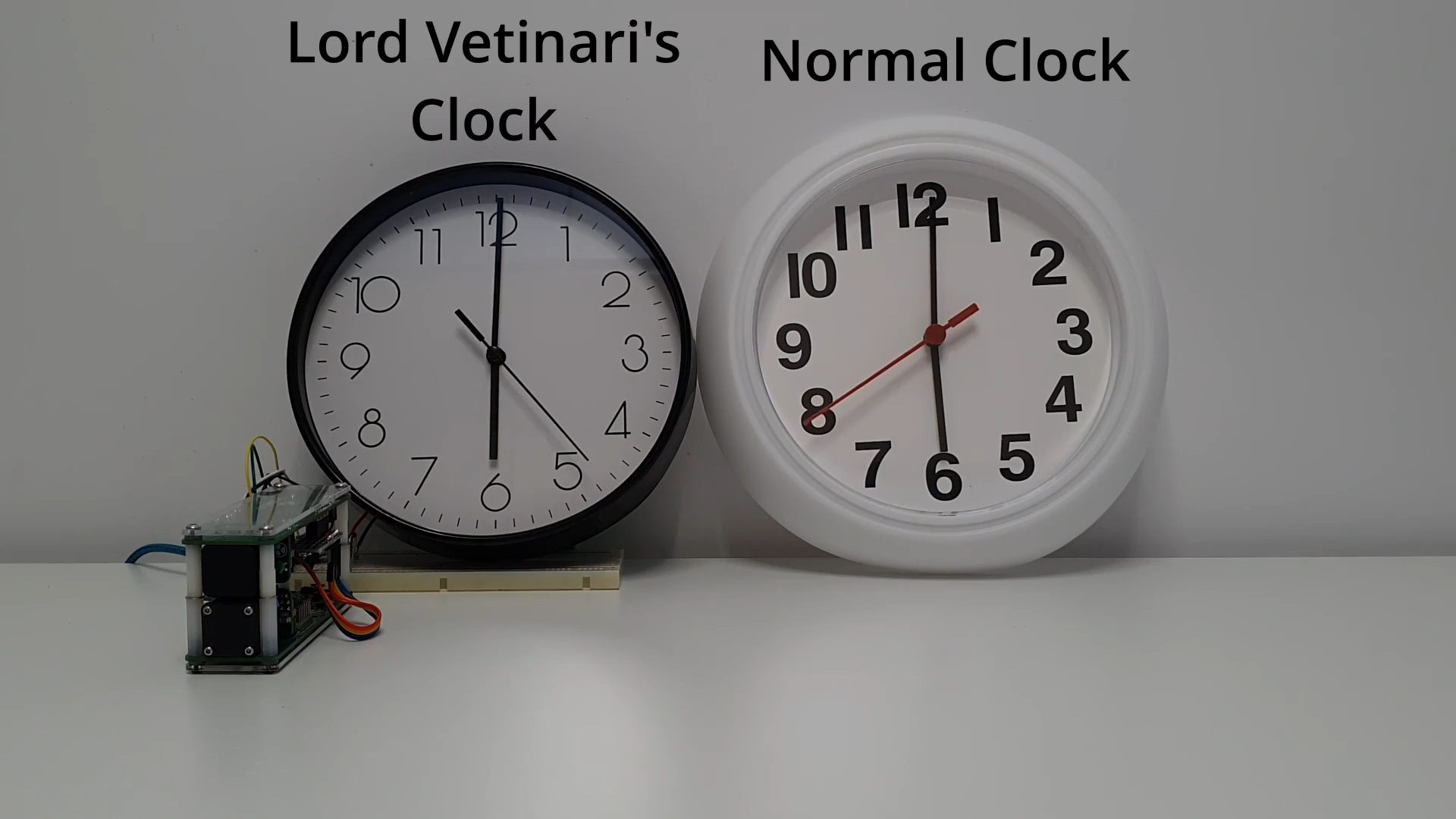
The project that inspired the title was created by maker Mihai Cuciuc and presented as a version of Lord Vetinari’s Clock. In Terry Pratchett’s Discworld books, Lord Vetinari’s clock is famous for its irregular tick, the kind of sound that gently sands down your sanity one uneven second at a time. This real-world interpretation uses radioactive decay as the source of that irregularity.
The clock’s timebase comes from americium-241, often abbreviated as Am-241. Americium-241 is a man-made radioactive isotope with a long half-life of a little over 432 years. It primarily emits alpha particles and also releases weak gamma radiation. The project does not treat decay as a smooth rhythm; instead, it embraces the randomness and uses detection events to advance the clock.
That is the central charm. The clock can keep reasonable time over long periods, but the individual seconds arrive with the dramatic timing of a cat deciding whether to knock a glass off the table. Sometimes the tick comes quickly. Sometimes it waits. The average behaves; the moment-to-moment experience does not.
How the Clock Thinks About Radiation
To understand the concept, imagine trying to count one specific kind of raindrop during a storm while standing near a sprinkler. Background radiation is the sprinkler. It is always there, coming from cosmic rays, natural materials in the ground, potassium-40, and other ordinary sources. If your desired signal is only around one event per second, background noise can easily overwhelm it.
That is why the project used a more selective approach than a simple “click whenever radiation is detected” system. A basic Geiger counter can tell that ionizing radiation occurred, but it usually cannot explain the energy signature with much detail. A spectroscopic detector can be more selective because it can distinguish radiation by energy. In this project, the maker used solid-state scintillation detectors related to the Pomelo gamma-ray spectroscope, a compact detector design capable of identifying gamma-ray energies.
The clever idea was coincidence detection. Instead of accepting every radiation event, the system looked for two related signals that occur together as part of the same Am-241 decay process: an alpha particle and a characteristic low-energy gamma ray. When both signals appeared at the same time, the clock treated that as a valid event. In plain English: the clock did not believe every click it heard. It wanted a witness.
Why Background Radiation Matters
At one count per second, background radiation is not a footnote; it is the nosy neighbor leaning over the fence. Natural radiation can produce counts in the same general energy region as the desired signal, making it hard to know whether a detected event came from the source or the environment.
This is why the project’s coincidence approach is so interesting. Rather than simply shielding everything into a miniature bunker, the system uses correlation. Random background events are less likely to produce the expected pair of signals at the same moment. A real Am-241 decay event, by contrast, can produce a recognizable combination. The method does not make randomness disappear, but it helps make the signal more trustworthy.
For readers who love the math flavor, this is where counting statistics enter the room carrying a clipboard. Radioactive decay events follow statistical behavior: the uncertainty in a count grows roughly with the square root of the number of counted events. If you count about 3,600 events in an hour, the natural statistical spread is on the order of 60 events. That means an hour measured by the radioactive clock may wander by about a minute, even though the long-term average can still be close to correct. The clock is not broken. It is just aggressively honest about probability.
Americium-241: The Isotope Behind the Idea
Americium-241 is widely known because small sealed sources of it are used in some ionization smoke detectors. In that setting, alpha particles ionize air inside a chamber, creating a tiny current. Smoke interrupts that current, which triggers the alarm. Regulatory agencies in the United States emphasize that smoke detectors are safe when used as intended and not tampered with.
That safety point matters. This article is not a build guide, and it should not be read as encouragement to handle radioactive material, open smoke detectors, remove sources, or improvise with ionizing radiation. The scientifically interesting part of the project is the measurement concept: activity, randomness, energy discrimination, and long-term averaging. The practical handling of radioactive sources belongs under appropriate rules, training, equipment, and adult professional supervision. Science is fun. Accidental contamination is not a hobby; it is paperwork with consequences.
The Beauty of an Imperfect Clock
Modern timekeeping is obsessed with precision. Atomic clocks define the second using billions of cycles of radiation associated with cesium-133. GPS, telecommunications, financial networks, power grids, and scientific instruments all depend on clocks that are almost offensively accurate. Compared with that, a one-becquerel clock is not trying to win a precision contest. It is trying to make a point.
The point is that “time” is not only a number on a display. It is a process. Most clocks hide their process behind a clean face: quartz vibrates, electronics divide, hands move. The radioactive Vetinari clock exposes its process. Every tick says, “An atom changed state, and now you get a second.” That makes the clock feel alive in a peculiar way. Not alive like a pet. More like a haunted kitchen timer with a physics degree.
It also highlights the difference between accuracy and regularity. A clock can have a correct average rate while producing uneven intervals. That sounds contradictory until you think about traffic. Your average commute might be 30 minutes, but that does not mean every red light, merge lane, and confused delivery van distributes itself politely across the route. The average tells one story; the individual events tell another.
Why Makers Loved the Idea
The maker community tends to appreciate projects that combine elegance and absurdity. A one-becquerel clock checks both boxes. It is elegant because it uses a real physical process and meaningful detection logic. It is absurd because the whole thing exists to produce a one-second tick in the least chill way possible.
That is exactly the spirit of the One Hertz Challenge. A normal engineering brief might ask for the simplest, safest, cheapest way to generate a one-hertz signal. The answer would probably be a microcontroller, quartz crystal, 555 timer, GPS-disciplined oscillator, or line-frequency reference. The challenge, however, asked makers to explore the creative space around one second. Suddenly a candle flame, mechanical contraption, radio time signal, or radioactive decay chain becomes fair game.
The result is more than a contest entry. It is a public science demonstration. It teaches that measurements are not magic. Detectors have thresholds. Backgrounds matter. Noise matters. Averages matter. The definition of a unit may sound simple until you try to embody it in hardware. Then the unit looks back at you and says, “Cute idea. Have you met uncertainty?”
Timekeeping, Statistics, and the Long Game
A radioactive clock also reminds us that long-term behavior can be predictable even when short-term behavior is not. No one can forecast the exact next decay event, but with enough atoms and enough time, the average rate becomes meaningful. This is why radioactive half-life is useful in fields such as archaeology, medicine, environmental monitoring, and nuclear science.
For Am-241, the half-life is so long that the source changes slowly by human standards. Still, the project notes that the clock’s rate would gradually decline over time because the activity decreases as nuclei decay. The reported drift is about 0.4 seconds per day. That is not much for a whimsical maker clock, but it is enough to prove the deeper point: a radioactive timebase carries its own aging process inside it.
In a quartz clock, aging often means electronics drift, batteries weaken, or mechanical parts wear. In a radioactive timebase, aging is literally nuclear inventory changing over centuries. That is a wonderfully strange thing to say about a clock. Most clocks need service. This one needs patience and a calendar with geological confidence.
What This Project Teaches About One Hertz
The 2025 One Hertz Challenge: Timekeeping At One Becquerel shows that one hertz is not just a number. It is a design constraint that forces makers to define what “once per second” really means. Does it mean a precise pulse every second? A long-term average? A visible event? A sound? A display update? A mechanism that makes the user feel time instead of merely reading it?
That last question may be the most interesting. A perfectly regular clock fades into the room. An irregular clock forces you to notice time. Each uneven tick creates anticipation. The silence between ticks becomes part of the experience. You are not just watching time pass; you are waiting for the universe to roll the dice again.
In that sense, the project sits somewhere between engineering, physics, and art. It is technically informed, but its emotional effect matters too. A clock like this is not designed to be the master reference for a data center. It is designed to make people ask, “Wait, can you really keep time that way?” The answer is yes, sort of, and that “sort of” is where all the fun lives.
Practical Lessons for Curious Readers
1. Units can share wording but not behavior
Hertz and becquerel both use “per second,” but they describe very different phenomena. Hertz is a rhythm. Becquerel is activity. Confusing them is easy; understanding the difference is the lesson.
2. Random does not mean useless
Radioactive decay is random event by event, but its average behavior is reliable enough to support serious scientific measurement. The clock turns that concept into a noisy, memorable demonstration.
3. Detection is not just counting clicks
Radiation measurement depends on energy, background, geometry, detector sensitivity, and statistical confidence. A simple count can mislead if the source and background are not separated intelligently.
4. Accuracy and precision are not twins
The clock may average close to one tick per second over time, yet individual ticks can be wildly uneven. That makes it accurate in one sense and delightfully imprecise in another.
5. Safety belongs in the design conversation
Any discussion of radioactive materials must include responsible boundaries. The correct takeaway is not “go build this from household parts.” The correct takeaway is “physics is fascinating, and radiation requires respect.”
Experience Notes: Living With a One-Becquerel Idea
Thinking about a one-becquerel clock changes the way you experience ordinary clocks. After reading about this project, the smooth tick of a wall clock starts to feel almost smug. It behaves so well. It divides time into equal pieces and never asks you to consider the statistical nature of anything. A radioactive clock, by contrast, makes every second feel negotiated. You wait for the tick, and the tick arrives when probability feels like it. That experience is oddly educational because it turns an abstract concept into a mood.
The first experience this topic offers is intellectual humility. Many people learn that a becquerel is “one decay per second” and immediately assume it produces a perfect one-second beat. The project gently corrects that assumption with a grin. It shows that definitions can be precise while real events remain messy. That is a useful lesson far beyond radiation. Weather forecasts, polling, network latency, medical tests, and manufacturing tolerances all live in the same neighborhood where averages are useful but individual outcomes still surprise you.
The second experience is appreciation for measurement. A casual observer might think the hard part is finding a radioactive source. In reality, the deeper challenge is knowing what you are measuring. Background radiation, detector thresholds, energy windows, and random coincidences all complicate the story. The clock succeeds as a concept because it does not merely count noise. It tries to recognize a signature. That is a very maker-friendly lesson: sensors do not create truth by existing. They need interpretation.
The third experience is patience. A conventional clock gives instant confidence. A radioactive timebase asks for long-term trust. Watch it for ten seconds and it may look wrong. Watch it for long enough and the average begins to make sense. That delayed confidence is almost poetic. It reminds us that some systems cannot be judged in a snapshot. You need duration, data, and enough humility to let statistics breathe.
The fourth experience is aesthetic. The irregular tick is not a flaw; it is the personality. It turns timekeeping from background furniture into performance art. You hear the gaps. You notice anticipation. You become aware that “now” is not a smooth conveyor belt but a series of observed events. That may be impractical for waking up on time, but it is excellent for waking up curiosity.
Finally, the project creates a strong safety experience: fascination must travel with responsibility. The best way to enjoy this idea is as a science story, a measurement lesson, and a maker-culture case study. It is not a casual weekend recipe. Radioactive materials, even small sealed sources, deserve caution, regulation, and proper expertise. The clock’s real value is not that it invites everyone to copy it. Its value is that it makes everyone think more carefully about time, randomness, and the invisible physics already ticking around us.
Conclusion
The 2025 One Hertz Challenge: Timekeeping At One Becquerel is a brilliant example of how a simple contest prompt can open a surprisingly deep scientific door. By using radioactive decay as a timebase, the project turns one second into a conversation about probability, detector design, background radiation, and the difference between rhythm and average rate.
It is funny, strange, technically thoughtful, and a little bit cursed in the best possible way. Most clocks try to make time feel orderly. This one reminds us that beneath our neat displays and polished units, nature often plays by statistical rules. A one-becquerel clock may never replace an atomic clock, a GPS reference, or the humble quartz oscillator in your kitchen timer. But as a demonstration of radioactive timekeeping, it is unforgettable.
Note: This article is an educational analysis based on publicly available information from maker-culture coverage and U.S. science and safety references. It is not a construction guide. Radioactive materials should not be handled, modified, removed from consumer products, or used without proper training, legal compliance, and professional safety controls.