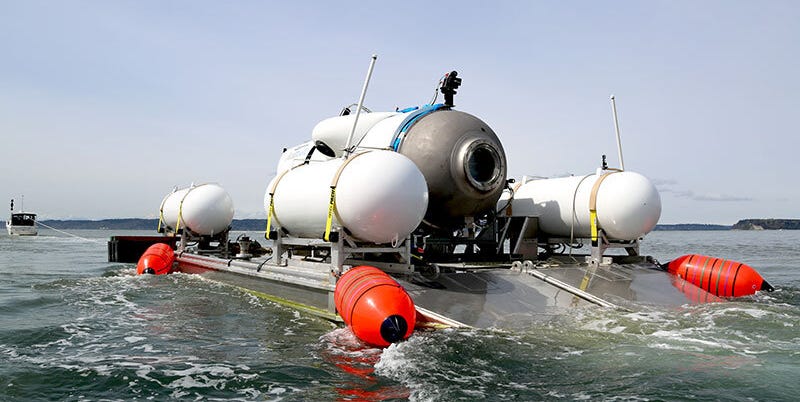
The disappearance of the Titan submersible in June 2023 triggered one of the most intense deep-sea search operations in modern memory. Aircraft, ships, sonar buoys, remotely operated vehicles, international agencies, private companies, military experts, and anxious viewers around the world all focused on one brutal question: Could anyone rescue the people inside?
The honest answer was painful from the beginning. Military options to rescue the submarine Titan were limited not because the U.S. Navy, Coast Guard, or Canadian forces lacked courage, skill, or urgency. They were limited because the deep ocean is not a swimming pool with dramatic music. It is dark, freezing, remote, high-pressure, and wildly unforgiving. At Titanic depth, even the most advanced rescue tools become slow, specialized, and conditional.
There is also an important language point. Titan was often called a “submarine” in headlines, but technically it was a submersible. A submarine can usually leave port, navigate, and return independently. A submersible depends on a support vessel for launch, recovery, navigation updates, communications, and logistics. That difference matters because rescue plans depend on how a craft is built, where it can be accessed, and whether it has a rescue interface at all.
The Titan Incident: A Quick Overview
On June 18, 2023, Titan was descending toward the wreck of the RMS Titanic in the North Atlantic. The Titanic lies roughly 12,500 feet below the surface, about two and a half miles down. The submersible lost contact with its support ship during the dive. At the time, rescuers had to consider several possibilities: Titan could be floating on the surface, stuck mid-water, tangled near the wreck site, resting intact on the seafloor, or already destroyed.
That uncertainty shaped the search. If Titan had surfaced but could not communicate, aircraft and ships might have found it visually or by radar. If it was trapped underwater but intact, rescuers would first need to locate it, then inspect it, then attach lines or use another method to bring it up. If it had suffered a catastrophic pressure failure, there would be no rescue to performonly recovery and investigation.
When a remotely operated vehicle later found debris near the Titanic wreck, officials concluded that Titan had experienced a catastrophic implosion. The tragedy killed all five people on board. But before that confirmation, rescue teams had to operate under the possibility that the crew might still be alive. That meant racing the clock while dealing with physics that does not care about hope, headlines, or human schedules.
Why the Depth Changed Everything
The biggest reason military rescue options were limited was depth. The Titanic wreck site sits far deeper than the operating range of most traditional submarine rescue systems. Military submarine rescue vehicles are generally designed to reach disabled submarines at shallower depths, usually where a rescue craft can mate with a hatch and transfer sailors under pressure-controlled conditions.
Titan was believed to be operating near 12,500 feet. That is far beyond the depth where divers can work, far beyond the reach of most manned rescue systems, and deep enough to crush unprotected equipment like a soda can under a truck tire. Actually, make that a long line of trucks. The pressure at that depth is thousands of pounds per square inch.
Military rescue systems are impressive, but they are not magic portals. The U.S. Navy’s submarine rescue chamber can operate to hundreds of feet, and its pressurized rescue module is designed for disabled submarines at depths up to about 2,000 feet. That is extraordinary in normal naval rescue termsbut still nowhere near Titanic depth. Titan was roughly six times deeper than that deeper rescue range.
Military Rescue Gear Is Built for Submarines, Not Tourist Submersibles
Another major limitation was design compatibility. Military submarine rescue systems work best when a disabled submarine has a standardized hatch or rescue seat that another vehicle can seal against. The process is like docking two spacecraft, except it happens underwater, in darkness, under crushing pressure, with waves moving the surface ship above. Casual Tuesday, right?
Titan did not have a standard military submarine escape trunk. It was a small experimental deep-sea submersible with a hatch bolted from the outside before launch. People inside could not simply open it and swim out. Even if Titan had been found intact on the seafloor, rescuers would not have been able to “dock” with it the way they might with a naval submarine.
This is one reason the phrase “send a submarine to rescue it” sounds simple but collapses under real-world engineering. A rescue vehicle must not only reach the target; it must connect safely, transfer people, maintain pressure, avoid damaging the vessel, and return to the surface. Titan’s structure did not give military rescuers a ready-made way to do that.
ROVs Could Search, But Searching Is Not the Same as Rescuing
Remotely operated vehicles, or ROVs, were among the most useful tools in the Titan search. An ROV can descend to extreme depths, send video back to operators, use sonar, inspect debris, and manipulate objects with robotic arms. Some ROVs can work at depths greater than the Titanic site.
But an ROV is not a rescue elevator. It cannot open Titan and carry people out. It cannot safely remove passengers from a sealed pressure vessel. Its role would have been to find Titan, inspect it, possibly clear obstructions, and help attach a lifting line if the submersible were intact. That is valuable, but it is only one step in a long chain.
Imagine losing a car-sized object in a pitch-black mountain range, except the mountain range is two and a half miles underwater, the weather above is changing, the target may not be making noise, and the cable connecting your robot to the surface is longer than several skyscrapers stacked end to end. That is the operational world rescuers faced.
Salvage Equipment Is Not Instant Rescue Equipment
The U.S. Navy sent deep-ocean salvage expertise and equipment, including systems designed to lift heavy objects from great depths. The Navy’s CURV-21 ROV is rated for deep-ocean salvage work down to 20,000 feet, and the Flyaway Deep Ocean Salvage System can lift large, bulky objects such as aircraft or small vessels. On paper, that sounds promising.
In practice, salvage is slow. First, the target must be located. Then experts must determine whether it is intact enough to lift. Then an ROV must attach rigging at the correct point. Then the lift system must raise the object through miles of water without tearing it apart, losing control, or endangering surface crews.
For a rescue, timing is everything. Titan reportedly carried a limited supply of breathable air for five people. Even if the vessel had been found intact, there was no guarantee that salvage equipment could be positioned, installed, rigged, attached, and operated before oxygen, carbon dioxide buildup, cold, and stress became fatal. Salvage gear can recover objects. It is much harder to recover living people from an incompatible vessel at extreme depth.
Location Was Another Huge Challenge
The search area was remote, hundreds of miles from shore in the North Atlantic. That created delays before specialized ships and equipment could arrive. Military aircraft can move people and cargo quickly, but deep-sea rescue still needs ships, launch systems, cranes, winches, ROV control stations, technicians, weather windows, and coordination between agencies.
A helicopter can rescue a person from a rooftop. A Coast Guard cutter can intercept a boat. But a vehicle at Titanic depth requires a floating industrial operation. Even when equipment is “flyaway” or rapidly deployable, it still needs to be installed on a suitable vessel. That vessel must then travel to the search site, hold position, and support deep underwater operations.
In other words, the first responders were not driving across town. They were assembling a pop-up deep-ocean engineering project in one of the harshest marine environments on Earth.
The Ocean Is Terrible at Giving Clear Clues
During the search, sonar buoys and aircraft were used to listen for signs of Titan. Reports of underwater noises created brief hope, but the deep ocean is full of confusing sounds. Ships, wreckage, marine life, currents, equipment, and the Titanic debris field itself can all complicate interpretation.
Military sonar is powerful, but Titan was small compared with naval submarines. It did not have the acoustic profile of a large military vessel. It was not broadcasting a strong beacon that rescuers could easily follow. Searching for it was less like tracking a known submarine and more like trying to find a dark suitcase in a stadium during a power outagewhile standing outside the stadium.
The Titanic site also contains a wide debris field. Metal objects, wreckage fragments, and uneven seafloor terrain can make underwater search and identification more difficult. A contact on sonar is not automatically the missing submersible. Rescuers must verify what they are seeing, usually with ROVs or other specialized tools.
Why Military Submarines Could Not Simply Dive Down
Many people wondered why a military submarine could not go down and help. The reason is simple: most naval submarines are not designed to operate at Titanic depth. Their exact crush depths are classified, but they are nowhere near the depth of the Titanic wreck. Sending another crewed submarine into that environment would not be a rescue plan; it would be a second emergency waiting for a bad idea to finish stretching.
Deep-diving research submersibles do exist, but there are very few of them, and they are not always available, nearby, or configured for rescue. Even if one could reach the depth, it still would not necessarily be able to connect to Titan, open it, transfer passengers, or lift it.
This is the harsh difference between exploration and rescue. A craft may be able to visit the deep ocean for observation, mapping, or research. That does not mean it can perform emergency extraction from another vessel under severe time pressure.
Time Was the Enemy
Every rescue has a clock. In Titan’s case, the estimated breathable air supply became a central part of public attention. But oxygen was not the only concern. Carbon dioxide buildup, temperature, condensation, darkness, fear, and physical exhaustion could all become dangerous. A sealed vessel underwater is not a comfortable waiting room. It is a pressure-rated survival capsule with a deadline.
That deadline made each step more urgent: identify the last known position, search the surface, deploy aircraft, coordinate with Canadian partners, bring in deep-sea ships, launch ROVs, analyze acoustic data, and prepare salvage options. The problem is that deep-ocean operations do not move at social media speed. Cables lower slowly. Ships transit slowly. ROVs search slowly. Data must be checked carefully.
The public saw a rescue drama. The teams involved faced a layered technical problem in which every solution depended on the previous step working first.
The Difference Between “Possible” and “Practical”
It is tempting to say, “The military has advanced technology; surely something could be done.” That sentence is emotionally understandable. It is also technically incomplete. At extreme depth, many things are theoretically possible but not practically achievable in time.
Could a heavy lift system raise an intact object from Titanic depth? Under the right conditions, yes. Could an ROV reach the seafloor and inspect a target? Yes. Could aircraft and ships search a huge area? Yes. Could those tools find, inspect, rig, lift, and recover a sealed submersible quickly enough to save people inside? That was the difficult part.
Rescue is not one miracle tool. It is a chain. If any link failslocation, access, rigging, lifting, stability, timingthe rescue fails. Titan’s depth, design, remoteness, and limited life support made that chain extremely fragile.
What the Titan Tragedy Revealed About Deep-Sea Risk
The Titan disaster forced a wider conversation about private deep-sea exploration, certification, oversight, and emergency planning. Investigators later highlighted problems involving design, testing, maintenance, certification, and safety culture. Those findings matter because rescue capability should never be treated as a substitute for prevention.
In aviation, spaceflight, commercial shipping, and military operations, emergency plans are built into the mission before launch. The deeper and more remote the mission, the more important that planning becomes. At Titanic depth, rescue may be technically possible only under narrow circumstances. That means engineering discipline, independent review, conservative testing, and honest risk assessment are not boring paperwork. They are the lifeboats you build before you ever need them.
The ocean does not negotiate. It does not care whether a vessel is privately operated, publicly funded, experimental, expensive, famous, or featured in glossy marketing. It applies pressure evenly and relentlessly. Any deep-sea operation has to respect that reality long before the first passenger climbs inside.
Lessons for Future Deep-Sea Exploration
The lesson is not that humans should stop exploring the ocean. Exploration matters. The deep sea holds scientific, historical, ecological, and cultural value. The Titanic wreck itself is a maritime memorial as well as a site of enormous public fascination. But exploration must be paired with humility.
Future operators need clear emergency response plans, realistic rescue assumptions, third-party inspection, properly rated materials, transparent maintenance records, and coordination with maritime authorities. Passengers also need to understand the difference between adventure and risk transfer. Signing a waiver does not change the laws of physics.
Military support can be extraordinary, and in the Titan case, the response brought together public agencies, private experts, international partners, and specialized equipment. Still, the tragedy showed that even the best responders cannot overcome every design limitation after an emergency begins. Rescue capability starts at the drawing board.
Experience-Based Reflections: What This Case Teaches About Rescue Planning
One of the most practical experiences connected to the Titan tragedy is the reminder that rescue planning has to be boring before it becomes heroic. In high-risk operations, the glamorous part is the dive, the launch, the mission patch, the dramatic destination, and the story people tell afterward. The lifesaving part is usually less cinematic: checklists, engineering reviews, load calculations, hatch compatibility, communications redundancy, emergency drills, and uncomfortable meetings where someone is allowed to say, “This is not ready.”
In maritime and aviation safety culture, experienced operators often talk about “layers of defense.” No single layer is perfect. A radio can fail. Weather can change. A sensor can misread. A crew can misunderstand. A part can fatigue. The goal is to build enough layers so one failure does not become a fatal chain. Titan’s case is a painful example of what happens when the emergency phase begins after too many protective layers have already been weakened.
Another experience from rescue operations is that the public often imagines rescue as an action scene, while professionals understand it as logistics under pressure. Before anyone can save people underwater, they must answer basic questions: Where exactly is the craft? Is it intact? Is it accessible? Can another system reach it? Can it be lifted without breaking apart? Can passengers be transferred? How long do they have? Which ship can support the equipment? Is the sea state safe enough to launch and recover vehicles?
Each answer takes time, and time is the one resource trapped people do not have in abundance. That is why “limited military options” does not mean “limited effort.” It means the available tools were constrained by distance, depth, design, and physics. Military teams can bring world-class coordination, aircraft, sonar, ROVs, salvage systems, and experts. But they cannot instantly transform a non-standard deep-sea submersible into a rescue-compatible naval submarine.
The Titan case also teaches future explorers to be honest about rescue assumptions. A brochure may say a craft can dive to 4,000 meters, but a responsible emergency plan must ask what happens if it cannot come back. Can it be located independently? Does it carry a reliable beacon? Can the hatch be opened from inside or outside under emergency conditions? Is there a certified lifting point? Has a full rescue scenario been rehearsed? Which agencies know the mission schedule in advance? Which assets are close enough to matter?
In extreme environments, optimism is useful for morale but dangerous as a safety system. The best operators plan as if things will go wrong, then work hard to make sure they do not. That mindset is not pessimistic; it is professional. The Titan tragedy should push deep-sea tourism and research operators toward stronger standards, clearer regulation, and better public understanding of what rescue can and cannot do.
Finally, this experience reminds us that courage and technology are not substitutes for compatibility. A rescue system designed for a disabled military submarine cannot automatically rescue a privately built submersible with a different hatch, different structure, different depth profile, and different operational model. The ocean rewards preparation, not improvisation. When the destination is two and a half miles beneath the North Atlantic, the rescue plan must be built into the mission from the beginningnot imagined after the emergency call goes out.
Conclusion
Military options to rescue the submarine Titan were limited because the problem was not simply “find a missing vessel.” It was to locate a small, non-standard submersible in a remote deep-ocean environment, at a depth beyond normal submarine rescue systems, within a narrow life-support window, and with no easy way to transfer passengers even if it were found intact.
The response showed the seriousness and skill of the agencies involved. It also showed the brutal limits of rescue technology when prevention, design compatibility, and emergency planning are not enough. The deep ocean is one of the last truly hostile frontiers on Earth. Visiting it safely requires more than ambition. It requires engineering humility, independent oversight, and emergency plans that are as real as the pressure outside the hull.
Note: This article is written for web publication in standard American English and uses verified public information about the Titan submersible incident, deep-sea rescue systems, and military salvage limitations.