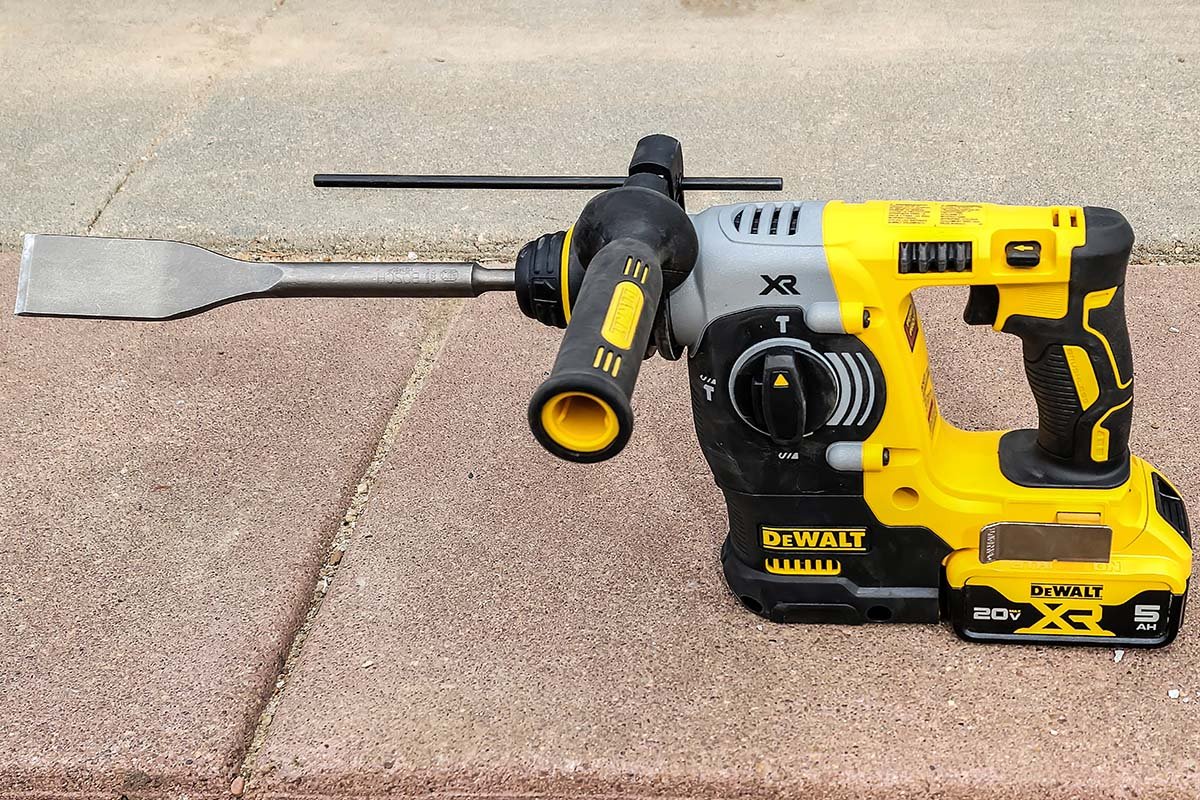
A standard cordless drill is perfectly happy making holes in lumber, installing cabinet hardware, and assembling furniture. Ask it to chew through concrete all afternoon, however, and it may begin reconsidering its career choices. That is where the DeWalt DCH273B 20V MAX XR cordless rotary hammer enters the picture.
Although it is often described as a cordless hammer drill, the DCH273B is technically a rotary hammer. That distinction matters: It uses an SDS-Plus bit system and a piston-driven impact mechanism designed for serious masonry work. Bob Vila product tester Glenda Taylor put the tool through hands-on tests involving concrete, cinder block, ceramic tile, and old mortar. The results were impressive enough to earn it a 9.4 out of 10 rating.
This DeWalt cordless hammer drill review examines those findings alongside manufacturer specifications, retailer data, safety guidance, and practical ownership considerations. The short verdict is that the DCH273B is powerful, comfortable, and genuinely usefulbut it is not the right purchase for someone whose idea of heavy construction is hanging one picture frame every six months.
DeWalt DCH273B at a Glance
| Tool type | Cordless SDS-Plus rotary hammer |
|---|---|
| Power platform | DeWalt 20V MAX lithium-ion battery system |
| Maximum drilling capacity | 1 inch in concrete |
| Impact energy | 2.1 joules |
| No-load speed | Up to approximately 1,100 rpm |
| Impact rate | Up to approximately 4,600 beats per minute |
| Operating modes | Rotation only, rotary hammer, and hammer only |
| Chuck system | SDS-Plus |
| Approximate bare-tool weight | 6.4 pounds |
| Included accessories | Adjustable side handle, depth rod, and utility hook |
| Battery and charger | Usually sold separately with the DCH273B bare tool |
Hammer Drill or Rotary Hammer: What Are You Actually Buying?
The terminology surrounding this tool can become muddier than a jobsite after three days of rain. A conventional hammer drill uses two ridged discs to create a rapid vibrating action while the bit rotates. It works well for small holes in brick, block, and light concrete.
A rotary hammer such as the DeWalt DCH273B uses a more forceful pneumatic-style mechanism. Instead of relying mainly on the operator to push the bit into the material, it transfers substantial impact energy through an SDS-Plus masonry bit. The result is faster drilling with less downward pressure.
The DCH273B can also stop bit rotation and provide hammer-only action. Install a compatible chisel, select the chipping mode, and the tool can remove old mortar, break up small sections of masonry, or knock away stubborn tile adhesive. A regular hammer drill cannot perform that trick effectively, no matter how motivational your workshop playlist may be.
How the DeWalt Cordless Rotary Hammer Performed in Testing
Drilling Through Concrete and Cinder Block
During Bob Vila’s testing, the DCH273B was fitted with a large masonry bit and used to drill into concrete and cinder block. Its impact action remained smooth under pressure, and it produced clean holes without forcing the tester to wrestle the tool through the material.
That performance reflects more than an impressive number on a box. The 2.1-joule mechanism provides meaningful impact force, while the brushless motor avoids the friction and maintenance associated with carbon brushes. In practical terms, the drill keeps working efficiently when the job involves repeated anchor holes, mounting hardware, concrete fasteners, or masonry penetrations.
Working on Ceramic Tile
The tester also used a smaller bit to drill through glazed ceramic tile. The tool made an even hole without chipping the surface during that test. Its controllable trigger helped the bit start gradually rather than attacking the glaze like a caffeinated woodpecker.
Nevertheless, the DCH273B is a large and powerful tool for delicate tile. A smaller drill with the proper tile bit will usually offer better finesse. Hammer action should generally remain off while penetrating the glazed surface, and the work should begin slowly. This DeWalt can do the job, but using it for fine tile work is rather like taking a pickup truck through a fast-food drive-through: possible, though not especially graceful.
Removing Old Mortar
Hammer-only mode proved especially useful when the tester installed a chisel bit and removed aging mortar from brick. The DCH273B completed the work far more quickly than a manual hammer and chisel would have.
This third mode adds considerable value for remodelers, masons, and restoration contractors. It can help with light chipping and surface removal without requiring a separate demolition hammer. It is not intended to tear out an entire reinforced foundation, but it is well suited to controlled repair work where a full-size breaker would be excessive.
Power and Speed: Why Bigger Numbers Are Not Everything
The DCH273B reaches roughly 1,100 no-load rpm and approximately 4,600 impacts per minute. Some competitors advertise higher speeds or impact rates, but drilling performance depends on the complete mechanism, not one headline number. Impact energy, bit quality, motor efficiency, ergonomics, and the tool’s ability to maintain momentum all affect the actual result.
Its 2.1 joules of impact energy place the drill in a useful middle ground. It has enough muscle for frequent holes in concrete, brick, and block while remaining more manageable than a larger SDS-Max machine. For common tasks such as hanging threaded rod, installing cable trays, mounting rails, attaching structural hardware, and setting concrete anchors, the power-to-size balance makes sense.
A sharp, application-appropriate SDS-Plus bit remains essential. Even an excellent rotary hammer cannot turn a worn bit into a champion. Dull accessories slow progress, generate unnecessary heat, drain the battery, and encourage users to push harder than they should.
Comfort, Weight, and Vibration Control
The DCH273B weighs about 6.4 pounds without a battery and approaches 8 pounds when paired with a typical 5Ah pack. That is not featherweight territory, but it is relatively manageable for a heavy-duty cordless rotary hammer. Its L-shaped layout places the motor and battery in a balanced arrangement that helps during horizontal and overhead drilling.
DeWalt’s SHOCKS Active Vibration Control system is one of the tool’s best features. Rotary hammers create repetitive impact forces that can quickly fatigue the hands, wrists, and arms. The isolation system reduces the vibration transferred to the grip, making repeated drilling noticeably more comfortable than it would be with an older, less refined machine.
Bob Vila’s tester specifically praised the lower vibration and nonslip pistol grip. The adjustable side handle also gives the operator a second control point and can rotate into a convenient position. The test unit’s accessory handle reportedly had a slight wobble after tightening, which is worth checking during setup, especially before starting a large-diameter hole.
The side handle is not decorative. A masonry bit can bind when it encounters aggregate or reinforcing material, and the body of the tool may rotate suddenly. Keeping both hands on the drill and maintaining a stable stance provides much better control.
The SDS-Plus Chuck Is Fast, Secure, and Specialized
Instead of a conventional three-jaw keyless chuck, the DCH273B accepts SDS-Plus accessories. Grooves in the bit shank engage with the chuck, allowing the bit to move back and forth during hammering without slipping out. Changing bits is quick: Pull back the chuck sleeve, insert the accessory until it locks, and confirm that it is secure.
The disadvantage is that ordinary round-shank drill bits do not fit directly. Owners who want to drill wood or metal with standard bits will need a suitable adapter, and even then, a regular drill/driver is typically more compact and convenient. The rotation-only mode is useful, but it does not turn the DCH273B into the ideal tool for every drilling chore.
This specialization is part of its appeal. The SDS-Plus system transfers impact energy efficiently, offers dependable bit retention, and supports masonry bits, chisels, scaling tools, and other purpose-built accessories.
Battery Life and the Cost of Going Cordless
The DCH273B bare tool does not normally include a battery or charger. Bob Vila’s test used a 5Ah DeWalt 20V MAX battery, a sensible minimum for demanding masonry work. Smaller packs may run the tool, but their shorter runtime and reduced ability to support repeated high-load drilling can interrupt productivity.
For existing DeWalt 20V MAX users, battery compatibility is a major advantage. A charged pack from another compatible DeWalt tool can be attached to the rotary hammer, lowering the real cost of ownership. Buyers entering the platform for the first time must budget for at least one substantial battery and a charger. Two batteries are preferable for sustained work because one can charge while the other earns its keep.
The Bob Vila test noted that charging the batteries used in the evaluation took more than three hours each. Charging time depends on battery capacity, temperature, state of charge, and charger model, so a compatible fast charger may reduce downtime. Prices also fluctuate considerably among bare tools, kits, and promotional bundles. Compare the complete package rather than assuming the least expensive listing is the best deal.
Dust Control and Jobsite Safety
Drilling concrete can release respirable crystalline silica, a serious occupational health hazard. The DCH273B is compatible with DeWalt dust-extraction accessories, including onboard systems offered for this rotary-hammer family. When paired with the appropriate extractor and operated according to its instructions, the tool can be incorporated into an OSHA Table 1-compliant drilling setup.
Compatibility alone does not guarantee compliance. Users must select the correct extractor, filter, shroud, bit, and work practice for the application. Eye protection and hearing protection are also important, and a properly selected respirator may be required when engineering controls cannot keep exposure below applicable limits.
Before drilling into a wall, slab, or foundation, check for electrical wiring, plumbing, post-tension cables, and other concealed hazards. A beautifully drilled hole is considerably less impressive when it also discovers the water line.
What the DeWalt DCH273B Does Well
- Serious masonry performance: The 2.1-joule mechanism drills concrete and block efficiently.
- Three useful modes: Rotation, rotary hammering, and hammer-only operation expand its range.
- Reduced vibration: The SHOCKS system improves comfort during repetitive work.
- Cordless mobility: It works in unfinished buildings, outdoor areas, and remote locations without an extension cord.
- Brushless efficiency: The motor supports good runtime and avoids replaceable motor brushes.
- Accurate hole depth: The included depth rod helps produce consistent holes for anchors and fasteners.
- Dust-extraction readiness: Compatible accessories make cleaner, safer drilling easier to arrange.
Where It Falls Short
- Premium total cost: A battery, charger, extractor, and SDS-Plus bits can substantially increase the final bill.
- Too much tool for minor jobs: Occasional small anchor holes do not necessarily justify a professional rotary hammer.
- Noticeable working weight: A large battery makes extended overhead use tiring despite the balanced design.
- Specialized accessories: Standard round-shank bits require an adapter.
- Limited demolition capacity: Hammer-only mode is useful for light chipping, not major concrete removal.
- Possible handle movement: The accessory handle on the tested unit exhibited a little wobble when tightened.
Who Should Buy This DeWalt Cordless Hammer Drill?
The DCH273B is a strong match for electricians, plumbers, HVAC technicians, concrete contractors, remodelers, stone installers, and facilities teams that regularly drill masonry. It is particularly attractive when work takes place on ladders, outdoors, in unfinished spaces, or far from a reliable power outlet.
Serious DIYers renovating a masonry home may also find the investment worthwhile. Projects involving numerous concrete anchors, basement framing, deck ledgers, railing hardware, mortar removal, or repeated block-wall penetrations can quickly expose the limitations of a conventional hammer drill.
Casual users should think carefully. If the entire project requires four small holes for a television mount, a less expensive hammer drillor a rentalmay provide better value. Likewise, anyone planning substantial demolition or repeated large-diameter boring should consider a more powerful rotary hammer rather than expecting the DCH273B to impersonate a jackhammer.
Extended Practical Experience: What It Is Like to Use the DCH273B
Preparing for the First Hole
The experience begins with choosing the correct SDS-Plus bit and inspecting it for damage. After the battery is removed, the bit slides into the chuck and locks with a positive mechanical feel. A quick tug confirms engagement. The side handle should then be positioned so both wrists remain comfortable, while the depth rod is adjusted to match the required embedment depth.
These setup steps take only a minute, but they make the work more predictable. Marking the hole clearly and holding the drill perpendicular to the surface prevents an anchor from entering at an awkward angle. When accuracy matters, it helps to start gently and allow the bit to establish a shallow pocket before increasing trigger pressure.
Finding the Right Amount of Pressure
New rotary-hammer users often assume that more pushing produces faster drilling. The DCH273B rewards a lighter touch. Its internal mechanism needs room to strike, so the operator should apply enough pressure to keep the bit engaged without leaning on the tool with full body weight.
Once the rhythm feels natural, the difference from a conventional hammer drill becomes obvious. The machine advances into concrete rather than merely buzzing against it. Dust travels out through the bit flutes, and the motor maintains a purposeful tone. If progress suddenly slows, withdrawing the bit briefly can help clear debris from a deep hole.
Switching from Drilling to Chipping
Changing to hammer-only mode gives the tool a second personality. With a narrow chisel installed, it can loosen deteriorated mortar or remove small patches of stubborn material. Starting at a shallow angle provides more control and reduces the risk of gouging sound brick beneath the joint.
The DCH273B feels especially valuable during this type of repair because it replaces repeated manual blows with consistent mechanical impacts. It still requires judgment; the chisel can wander or remove more material than intended. Short, controlled passes are usually better than holding the trigger and hoping the wall negotiates a peaceful surrender.
Managing Weight During a Longer Work Session
At nearly 8 pounds with a 5Ah battery, the tool becomes noticeable after repeated shoulder-height or overhead holes. The vibration-control system reduces the buzzing transmitted to the hands, but it cannot repeal gravity. Alternating tasks, lowering the tool between holes, and using a stable platform can reduce fatigue.
The L-shaped design helps keep the mass reasonably balanced. A compact battery may feel better overhead, although it generally sacrifices runtime. For a handful of holes, that trade-off may be worthwhile. For a long row of concrete anchors, the 5Ah pack offers a more practical balance between endurance and bulk.
Cleanup and Maintenance
After drilling, the battery should be removed before the chuck and air vents are inspected. Wiping away abrasive concrete dust helps protect moving components. SDS-Plus accessories should be cleaned and stored where their shanks will not become damaged or contaminated.
The tool does not demand complicated maintenance, but the chuck, side handle, battery rails, and dust-extraction connections deserve regular attention. A rotary hammer lives a rough life. Giving it five minutes of care after a dusty job is cheaper than discovering months later that the chuck now contains enough concrete powder to begin its own sidewalk.
The Experience in One Sentence
The DCH273B feels like a specialized professional tool rather than an oversized household drill: It is heavier and more expensive than casual users need, but its speed, control, low vibration, and cordless freedom become easy to appreciate as soon as a project demands repeated masonry work.
Final Verdict: Is the DeWalt Cordless Hammer Drill Worth It?
Yesfor the right buyer. The Bob Vila testing showed that the DeWalt DCH273B can drill cleanly through concrete and block, handle carefully controlled tile drilling, and remove old mortar in hammer-only mode. Its brushless motor, SDS-Plus chuck, 2.1-joule impact mechanism, depth guide, cordless design, and active vibration control form a well-rounded package for demanding masonry applications.
The drawbacks are equally clear. It is expensive once batteries and accessories are included, heavier than a standard drill, and unnecessarily powerful for light household work. It also cannot replace a larger demolition hammer when the project involves major concrete removal.
Professionals and serious renovators who regularly work with concrete, brick, block, or mortar are likely to find it worth the premium. Occasional users may be happier with a basic hammer drill or a rental. The DCH273B is not the tool everyone needsbut when masonry becomes a regular opponent, it is a very persuasive teammate.