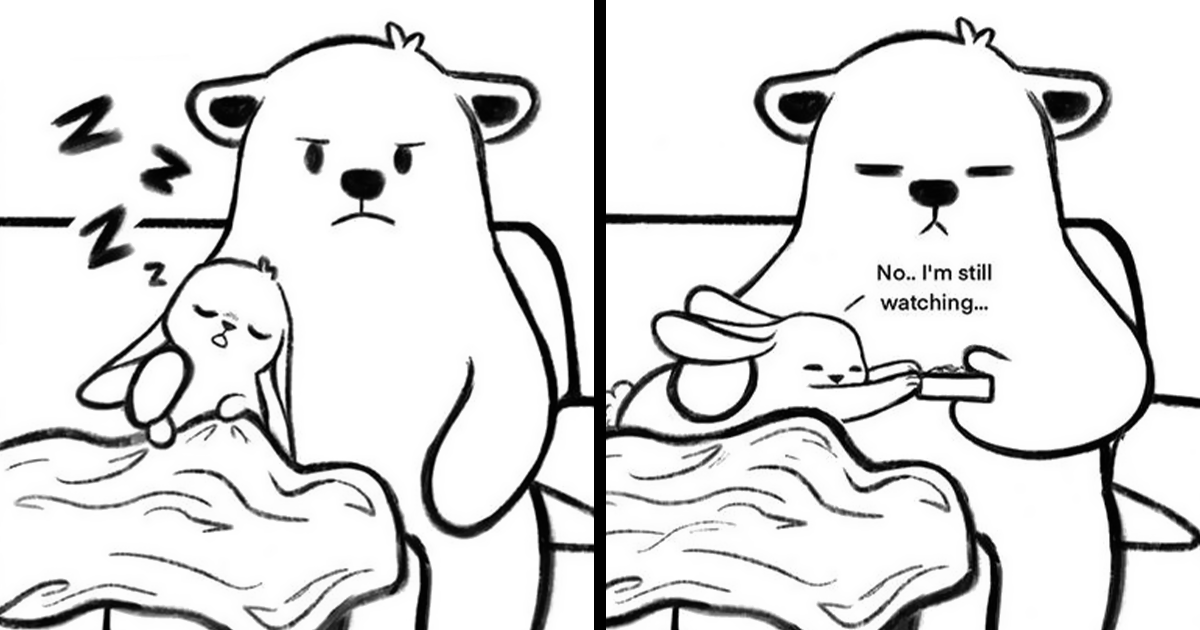
Love stories do not always need dramatic speeches, candlelit rooftops, or someone sprinting through an airport before security tackles them. Sometimes all they need is a small bunny, a gentle bear, a warm hug, and a suspiciously relatable argument about snacks. Artist Julie Sunnen, known online as Caspalpo, turns ordinary relationship moments into charming mostly wordless comics. Across 82 illustrations, her unlikely animal couple navigates affection, teasing, bad moods, lazy evenings, seasonal adventures, and the tiny acts of care that make a partnership feel real.
Meet the Artist Behind the Bunny and Bear Comics
Julie Sunnen is an illustrator from Luxembourg and the creator behind the Caspalpo webcomic. Her central characters are a little bunny and a much larger bear who behave less like woodland animals and more like the couple living next dooror possibly the couple currently arguing over who stole the blanket.
Sunnen had been interested in drawing since childhood and created comics when she was young. Although she stepped away from the hobby during her teenage years, her interest in art eventually returned. She later painted customized bags, glasses, shoes, and other objects before moving back toward illustration and sequential storytelling.
The name “Caspalpo” carries personal meaning. It came from a nickname her grandfather used for her, and she adopted it as her artistic identity after his death. What sounds like a cheerful fantasy word therefore has a tender family history behind it.
The first bunny-and-bear comics appeared in October 2019. Encouragement from early readers persuaded Sunnen to keep developing the characters, their personalities, and their adorably chaotic domestic universe. The original collection of 82 pictures introduced a much wider audience to the couple, while later installments continued their story with new situations and emotional beats.
Why a Bunny and a Bear Make Such a Delightful Couple
The visual contrast creates instant comedy
A rabbit and a bear are not an obvious romantic match. One is tiny, quick, and practically designed to disappear into a sweater pocket. The other is large enough to occupy most of the couch while claiming to be using “only one cushion.” That contrast gives the comics an immediate visual rhythm.
The bear can appear sturdy, calm, and protective, while the bunny often brings energetic expressions and dramatic reactions. Yet the expected roles are never completely fixed. Sometimes the smaller character becomes the bold one. Sometimes the bear needs reassurance. Their physical differences create jokes, but their changing emotional roles keep the relationship from becoming one-note.
Animal characters provide a universal mirror
Anthropomorphic animals have long helped storytellers explore human behavior without tying characters to a specific age, nationality, occupation, or fashion trend. A reader does not need to share the bunny’s hairstyle or the bear’s job title to recognize jealousy, exhaustion, affection, embarrassment, or the desperate need for one more hug.
Because the characters are simplified animals, people can project their own experiences onto them. One reader may identify with the easily chilled bunny. Another may see themselves in the patient bear. A third may recognize that they are somehow both characters before breakfast.
The Comics Celebrate the Small Moments of Real Love
Many romantic stories focus on milestones: the first date, the proposal, the wedding, or the grand reconciliation in the rain. Caspalpo’s relationship comics are more interested in what happens between those events.
The bunny and bear share naps, food, games, household routines, holiday preparations, awkward surprises, emotional slumps, and quiet evenings. They cuddle when the weather turns cold. They annoy each other with habits that have clearly survived multiple previous negotiations. They offer comfort without always needing a detailed explanation.
These scenes work because long-term relationships are built through repetition. Love is often expressed through remembering how someone takes their coffee, noticing that they are unusually quiet, sharing the last bite, or moving closer when they look cold. None of these actions requires a string quartet. Most do not even require pants with buttons.
Affection appears as attention
Relationship researchers often describe small attempts to gain a partner’s attention as bids for connection. A bid can be a question, a touch, a joke, a worried expression, or a request to look at something interesting. Responding warmly to those bids helps people feel seen.
The bunny and bear frequently communicate through these little signals. One character reaches out, looks discouraged, becomes excited, or quietly asks for closeness. The other responds with a hug, a shared activity, or simple presence. The emotional action may be tiny, but the message is large: “I noticed you.”
Playfulness keeps sweetness from becoming syrup
The comics are affectionate without floating away on a pink cloud of perfection. Humor gives the relationship texture. The couple teases, misunderstands, overreacts, gets distracted, and occasionally behaves like two lovable creatures who should not be trusted with an unlimited streaming subscription.
Shared humor is part of what makes intimate relationships feel alive. Laughing at an everyday inconvenience can turn it into a private memory. A minor disaster becomes “that thing we still joke about three years later,” which is one of romance’s less glamorous but surprisingly durable achievements.
How Mostly Wordless Comics Say So Much
One of the most distinctive qualities of Caspalpo is its limited use of dialogue. Sunnen has explained that dyslexia made words challenging for her, so she became accustomed to telling stories visually. What began as a practical response developed into a major creative strength.
The absence of lengthy captions makes the strips accessible across languages. Readers do not need to translate a speech balloon to understand a drooping posture, a surprised stare, a reluctant smile, or two characters leaning into each other after a difficult moment.
Body language becomes the dialogue
Sunnen uses ears, paws, eye direction, posture, spacing, and scale to communicate mood. The bunny’s ears can function almost like emotional punctuation marks. Raised ears suggest excitement or alarm; lowered ears can signal disappointment, worry, or exhaustion. The bear’s larger body creates opportunities for protective gestures, oversized embraces, and physical comedy.
The distance between the characters matters as well. A small gap can suggest tension. A sudden embrace resolves it. A character positioned alone in one panel and joined by the other in the next can communicate support without a single sentence.
Black-and-white artwork keeps the emotions clear
The restrained visual style prevents color and background detail from competing with the central action. Readers focus on expressions, gestures, and timing. This simplicity also makes each comic easy to view on a phone, where many webcomic fans discover and share artwork.
Simple does not mean effortless. Removing dialogue and decorative detail places greater pressure on composition. Every pose must be readable, every transition must make sense, and the final panel must deliver the emotional or comic payoff quickly.
Inside Julie Sunnen’s Creative Process
Sunnen keeps a sketchbook nearby so she can record ideas when they appear. This is sensible because inspiration rarely schedules an appointment. It tends to arrive while someone is shopping, trying to sleep, or shampooing their hair with no waterproof notebook available.
She develops the finished comics digitally on an iPad using Procreate. She has said that she tries to limit the production of a strip to roughly one to one-and-a-half hours. The time boundary helps her avoid becoming trapped in details that do not improve the story.
Ideas come from several places. Some strips are based on personal experiences, while others draw from situations shared by people around her. Readers also send suggestions, giving the project a community-driven element. A familiar relationship moment can travel from someone’s kitchen-table mishap to an illustrated bunny-and-bear adventure enjoyed around the world.
This process explains why the situations feel specific without becoming exclusive. The emotional core begins with something recognizable, while the animal characters and minimal dialogue open it to broader interpretation.
Why the 82 Bunny and Bear Pictures Feel So Relatable
Scrolling through a large collection creates an effect that a single comic cannot. Individual strips offer quick jokes or tender moments, but together they suggest the history of a relationship.
The couple does not merely pose for romantic snapshots. They move through different moods and seasons. They make each other laugh, provide comfort, share routines, and occasionally test the structural limits of patience. Repetition creates familiarity, allowing readers to feel that they know the pair.
The characters are imperfect but emotionally safe
Neither partner is presented as a flawless model of romantic behavior. They can be stubborn, sleepy, dramatic, needy, or distracted. Their mistakes, however, rarely threaten the warmth of the relationship. The world of the comic remains emotionally safe because affection continues beneath the joke.
This is an important part of the series’ appeal. Readers can recognize their less polished habits without feeling judged. The comics gently say that being ridiculous does not make someone unlovable. It merely makes them easier to use as material.
Specific details invite personal memories
A comic about cold weather may remind someone of stealing warmth from their partner. A scene involving food may recall a debate over the last snack. A sleepy strip may feel familiar to couples who begin movie night enthusiastically and wake up during the end credits with no understanding of the plot.
The more specific the situation, the more likely a reader is to think, “That is us.” This recognition encourages sharing. The comic becomes a friendly message between partners: “Look, someone has documented our strange behavior, except we are apparently woodland animals now.”
Why Wholesome Relationship Comics Thrive Online
Short webcomics fit naturally into social media feeds. They communicate quickly, work well on small screens, and can be understood without a large time commitment. A reader can enjoy a complete emotional arc while waiting for coffee or pretending to understand a video meeting.
Caspalpo also benefits from what might be called emotional shareability. People send content when it expresses something they want another person to understand. A sweet comic can function as affection, apology, teasing, reassurance, or a gentle request for cuddling.
Cute animal designs strengthen that response. Features such as rounded shapes, large heads, expressive eyes, and soft proportions tend to capture attention and encourage protective feelings. The artwork feels approachable before the reader has even interpreted the story.
Most importantly, the comics provide a brief emotional rest. Online spaces can be loud, argumentative, and exhausting. A quiet drawing of two characters caring for each other offers a small island of kindness. It does not solve the internet, but it improves several seconds of it.
What Aspiring Comic Artists Can Learn From Caspalpo
Begin with a clear emotional idea
A memorable strip does not require an elaborate plot. Start with one feeling or interaction: waiting for a reply, offering comfort, becoming jealous of a blanket, or discovering that your partner ate the emergency dessert.
Give characters contrasting qualities
Visual and personality contrasts generate stories naturally. Differences in size, energy, habits, or communication styles create opportunities for both conflict and affection. The goal is not to make characters incompatible but to show how they fit together in unexpected ways.
Use expressions before explanations
Before adding dialogue, check whether posture and facial expression already communicate the idea. Removing unnecessary text can make a comic faster, clearer, and easier to understand internationally.
Set limits on production time
A consistent comic series needs a sustainable workflow. Spending twenty hours polishing a background lamp that appears for half a panel may be artistically noble, but it is not always compatible with posting regularly or sleeping.
Collect ordinary experiences
Daily life contains endless material. Keep notes about small frustrations, affectionate habits, misunderstandings, and strange conversations. A good relationship comic often begins with a moment most people would normally forget.
The Experience of Reading All 82 Bunny and Bear Comics
Reading the complete collection feels less like studying a formal comic series and more like discovering a private relationship scrapbook. Each picture captures a tiny event, yet the accumulation creates the impression that the bunny and bear have been living together somewhere beyond the edge of the page.
At first, the visual contrast grabs the attention. The bear looks capable of carrying furniture up three flights of stairs, while the bunny appears capable of directing the operation and becoming impatient after twelve seconds. That difference creates an immediate comedic expectation. You begin looking for the ways their sizes will shape the joke: an oversized hug, a failed attempt to hide, or a tiny character occupying an unreasonable amount of emotional space.
After several strips, however, size matters less than personality. The reader starts recognizing patterns. One character may need warmth, reassurance, food, or attention. The other noticesor fails to notice until the situation becomes wonderfully obvious. These repeated behaviors create the same familiarity people develop with characters in a television series, even though Caspalpo uses far fewer words and much shorter scenes.
The wordless format also changes the reading pace. Instead of moving immediately from caption to caption, you pause over expressions. A tilted head, lowered ears, or hesitant paw can become the central sentence. You supply your own dialogue, which makes the experience unexpectedly personal. Two readers can view the same panel sequence and imagine slightly different conversations while still understanding the emotional outcome.
Some pictures produce instant recognition. You may remember warming cold feet against an unsuspecting partner, competing for blanket territory, bringing someone a snack, or agreeing to watch one episode and accidentally witnessing sunrise. Other strips work more quietly. A character simply stays nearby while the other feels sad, and the lack of a clever solution becomes the point. Support is shown as presence rather than repair.
The collection’s humor prevents the sweetness from becoming exhausting. The bunny and bear are loving, but they are not decorative greeting-card mascots frozen in permanent perfection. They have moods. They misunderstand situations. They want incompatible things at inconvenient times. One may be ready for adventure while the other has entered a committed relationship with the couch.
Those imperfections make the tender moments stronger. A hug feels meaningful because it follows frustration. A shared laugh works because the characters have just survived something silly. Care appears not as a flawless state but as a repeated decision to reconnect.
By the end of the 82 images, readers may feel as though they have watched an entire romance without encountering a traditional plot. There is no need for a villain, dramatic breakup, or last-minute airport chase. The story is the accumulation of mornings, meals, jokes, bad days, celebrations, and quiet gestures.
The experience leaves behind a comforting idea: a relationship does not become meaningful only during its largest moments. Its identity is built from hundreds of almost invisible exchanges. Caspalpo simply places those exchanges inside neat panels, gives them paws and ears, and reminds us to notice them.
Final Thoughts
Julie Sunnen’s bunny-and-bear relationship comics succeed because they reduce romance to its most recognizable ingredients: attention, humor, patience, vulnerability, and the occasional struggle for control of the couch.
The clean black-and-white artwork, expressive body language, and minimal dialogue allow the stories to cross language barriers. Meanwhile, the contrasting animal characters make familiar situations feel fresh. The result is a series that can be understood in seconds but remembered because it reflects something genuine.
Across 82 sweet pictures, Caspalpo shows that love rarely looks like a perfect movie scene. More often, it looks like noticing a bad mood, sharing food, staying close, laughing at nonsense, and offering a warm bear hug when your favorite bunny needs one.