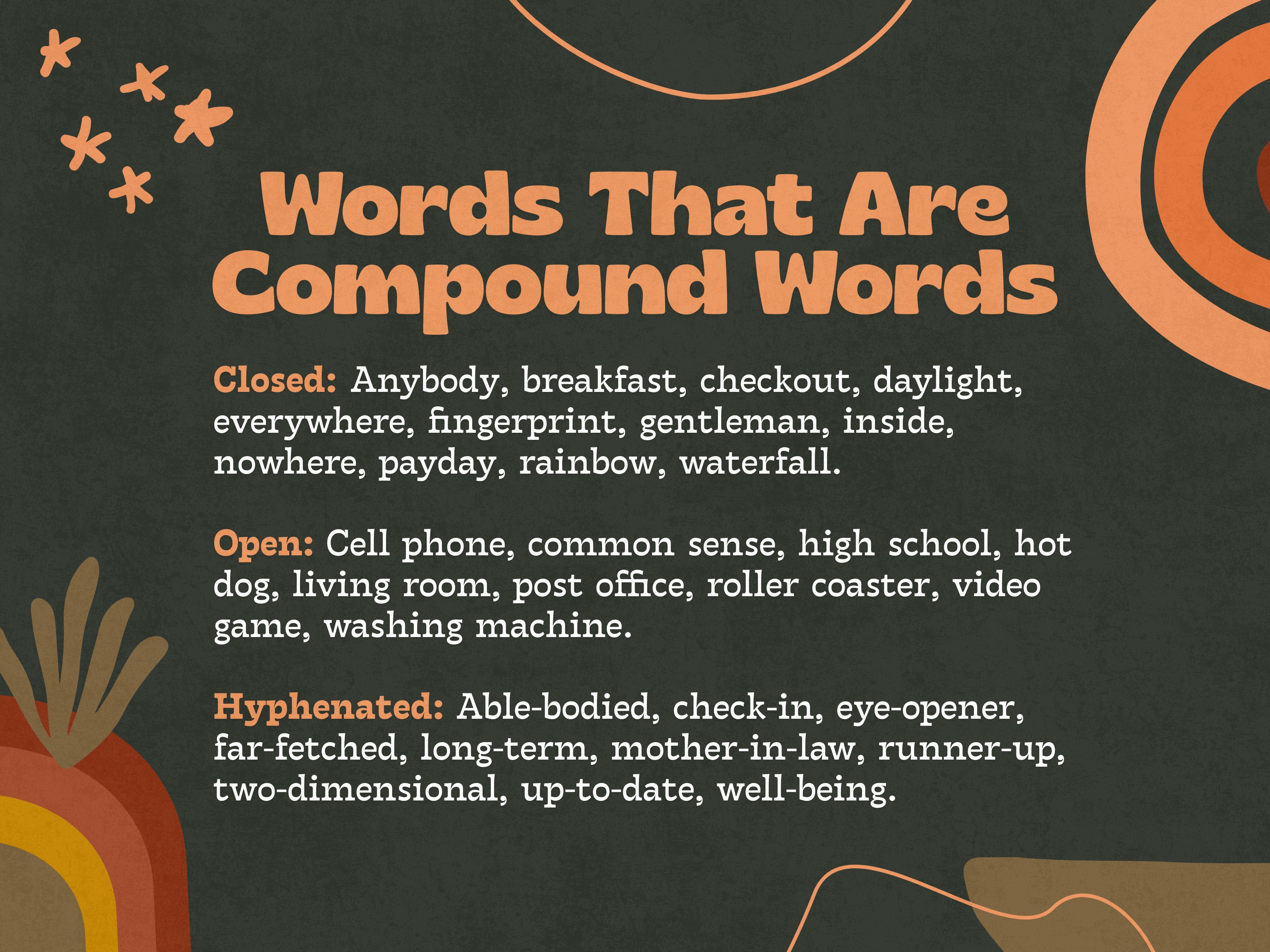
If you have ever stared at ice cream, sunflower, and mother-in-law and thought, “English, are you okay?” the answer is: mostly. Compound words are one of the most useful, common, and mildly chaotic parts of standard American English. They help us name everyday things, describe people and places, and turn two ordinary words into one hardworking idea. They also love making writers second-guess themselves at the keyboard.
This guide is built for anyone sorting a giant list of compound words, whether that list contains 83 entries or a mighty 830. The big idea is simple: compound words usually appear in three formsopen, closed, and hyphenated. The tricky part is that the form is not always permanent. Some compounds change over time, some depend on context, and some seem to wake up every morning and choose chaos.
Still, there is good news. Once you understand how compound words work, it becomes much easier to identify them, sort them, teach them, and use them naturally in your own writing. So let’s roll up our sleeves, sharpen our pencils, and politely wrestle a few hyphens into place.
What Are Compound Words?
A compound word is made by combining two or more words that work together as a single unit of meaning. In many cases, the new meaning is clear right away. A mailbox is a box for mail. A living room is a room for living, or at least for pretending the pile of laundry is decorative. In other cases, the meaning becomes more specialized. A firewall is not just a wall against fire, and a timeline is not always the same thing as a literal line showing time.
That is what makes compound words so useful. They compress meaning. Instead of using a long phrase, English often snaps two words together and creates a more efficient label. The result may be written as one word, two words, or a hyphenated form, but the key idea is the same: the parts combine to express one concept.
The Three Main Types of Compound Words
1. Open Compound Words
Open compound words are written as separate words, even though they function together as one idea. These are common in everyday English, and they often surprise people because they do not “look” like compounds at first glance.
Examples of open compound words include:
- ice cream
- high school
- living room
- post office
- coffee table
- real estate
- peanut butter
- field day
- health care
- vice president
- tape measure
- full moon
Open compounds are especially common with household terms, job titles, locations, and everyday expressions. They look roomy and relaxed, but make no mistake: they still behave like single ideas. That is why living room is not just any room that happens to be alive.
2. Closed Compound Words
Closed compound words are written as a single word. These often feel the most “official,” as if the two original words signed paperwork and merged their identities forever.
Examples of closed compound words include:
- sunflower
- notebook
- haircut
- toothpaste
- football
- rainbow
- mailbox
- eyeball
- keyboard
- classroom
- firefighter
- website
- underway
- username
- firewall
Closed compounds are extremely common in modern English, and many of them began life in open or hyphenated form. That is one reason English spelling feels slippery. Usage changes. A term that once needed a space may eventually close up as it becomes more familiar to readers.
3. Hyphenated Compound Words
Hyphenated compound words use a hyphen to join their parts. This form often appears when the writer needs clarity, wants to avoid confusion, or is using a compound as an adjective before a noun.
Examples of hyphenated compound words include:
- mother-in-law
- well-known
- part-time
- long-term
- full-time
- self-esteem
- user-friendly
- runner-up
- check-in
- editor-in-chief
- merry-go-round
- anti-American
- ex-husband
- forty-six
- two-thirds
Hyphenated compounds are the diplomats of the compound-word world. They step in when English wants both unity and readability. Without the hyphen, some expressions would look clumsy, confusing, or just plain rude to the eyeballs.
Why Some Compound Words Change Form
Here is where things get interesting. Compound words do not always stay in one form forever. As usage changes, a word may move from open to hyphenated to closed. That is not a mistake; it is language doing what language does bestevolving while pretending it had a plan all along.
For example, newer or less settled compounds are often hyphenated at first because the hyphen helps readers see the connection. Over time, if the expression becomes common enough, the hyphen may disappear and the word may close up. This is why dictionaries and style guides matter. They track usage, not just rules carved into grammatical stone tablets.
This also explains why one reference may prefer health care while another uses healthcare in specific contexts, or why one publication writes email while another still uses e-mail. Good writers do not panic when they see variation. They check a trusted reference and stay consistent.
How to Tell Whether a Phrase Is a True Compound Word
Not every two-word phrase is a true compound. Some are just two words standing next to each other, minding their own business. A real compound functions as one unit of meaning. Often, you cannot freely insert another word between its parts without breaking the idea.
For example, small talk is a true compound because it refers to polite, casual conversation. You cannot turn it into smaller talk and keep the same meaning. But a phrase like wet day behaves more like an ordinary adjective plus noun. It can become wetter day, which shows that it is not the same kind of fixed compound.
Stress can also help. In spoken English, many compounds place heavier stress on the first element. Compare GREENhouse with green HOUSE. One is a glass building for plants. The other could just be a house painted green. Tiny difference, big meaning.
Compound Words as Nouns, Verbs, and Adjectives
Compound words are flexible little overachievers. They can function as nouns, adjectives, and sometimes verbs.
Compound Nouns
These name people, places, things, or ideas: sunflower, post office, mother-in-law, firefighter, living room.
Compound Adjectives
These describe nouns and are often hyphenated before the noun: well-known author, full-time job, high-speed train, user-friendly design.
Compound Verbs
These combine words to form actions: proofread, underestimate, babysit, double-check.
Context matters a lot. A phrase may be hyphenated when it appears before a noun but left open after the noun. For example:
- The author is well known.
- She is a well-known author.
That little shift in position changes the punctuation. English loves a dramatic entrance.
Common Rules for Hyphenating Compound Words
There is no universal rulebook that solves every compound word on earth, but several patterns show up again and again in American style guides.
Hyphenate compound modifiers before a noun
Use a hyphen when two or more words work together as a single adjective before a noun: last-minute decision, chocolate-covered pretzels, high-quality fabric.
Usually do not hyphenate after the noun
When the same phrase comes after the noun, the hyphen often disappears: the decision was last minute, the pretzels were chocolate covered.
Do not usually hyphenate with -ly adverbs
Because readers already understand the relationship, phrases like highly respected teacher and carefully written essay usually stay open. The adverb is doing enough work already; it does not need a hyphen sidekick.
Use hyphens for certain prefixes and clarity cases
Hyphens often appear with forms like self-made, ex-wife, all-star, mid-1980s, anti-American, and re-create when the hyphen prevents confusion.
Use hyphens in compound numbers
Write numbers like twenty-one, forty-six, and ninety-nine with hyphens.
A Smart Way to Organize a List of 830 Compound Words
If you are building a master list of compound words, do not dump all 830 into one giant alphabetical stew. Sort them in a way that makes the list useful to readers, students, or search engines.
Here is a practical structure:
- Open compounds: ice cream, dining room, coffee shop, side dish, post office
- Closed compounds: toothbrush, bedtime, popcorn, skateboard, raindrop
- Hyphenated compounds: long-term, sister-in-law, old-fashioned, check-in, one-sided
- Context-dependent compounds: well known / well-known, high school / high-school student, under way / underway
- Newer or tech-related compounds: username, firewall, e-book, livestream, screenshot
This method helps readers understand not just what the words are, but how they behave. That is the difference between a list that sits there looking decorative and a list that actually teaches something.
Specific Examples That Show Why Form Matters
Compound words are not just spelling trivia. Their form can change meaning, tone, or readability.
- timeline vs. time line: these can carry different meanings depending on context.
- firewall vs. fire wall: one usually refers to digital security; the other can be literal.
- underway vs. under way: one often acts as an adjective, while the other may appear as an adverbial phrase.
- high school vs. high-school student: the noun phrase stays open, but the modifier before another noun is often hyphenated.
- well known vs. well-known: position in the sentence changes the punctuation.
That is why compound words matter so much in polished writing. They shape clarity. They affect search visibility. And they stop readers from wondering whether your “small business owner” is different from a “small-business owner.” Spoiler: it can be.
Why Compound Words Matter for Reading, Writing, and SEO
Compound words do more than decorate grammar quizzes. They strengthen vocabulary, improve spelling awareness, and help readers process meaning faster. For students, they offer a practical way to decode unfamiliar words by recognizing meaningful parts. For writers, they improve precision. For editors, they are the daily reminder that coffee is not optional.
They also matter in SEO content because search intent often depends on exact phrasing. A user may search for health care, healthcare, or health-care. A smart article recognizes the primary form, includes natural variation where appropriate, and stays consistent enough to look authoritative rather than scrambled.
In other words, compound words are tiny but powerful. They help language stay efficient, specific, and surprisingly expressive.
Real-Life Experiences with Compound Words
The funny thing about compound words is that most people do not notice them until one of them refuses to behave. I learned this the hard way while editing educational content, blog posts, and product copy that all used slightly different standards. One client swore by e-mail. Another insisted on email. A third used electronic mail exactly once and then, thankfully, never again. That was my first real lesson: compound words are not just grammar issues; they are style, audience, and consistency issues.
Later, while working on SEO content, compound words became even more interesting. Search data would show one form winning in traffic while a style guide preferred another. For example, people might search one version of a phrase thousands of times a month, while a publication’s editorial standard preferred a different spelling. That created a balancing act. The article had to sound polished, respect American usage, and still meet readers where they were searching. Compound words stopped being a classroom topic and started feeling like strategic little puzzles.
I also noticed how compound words affect confidence. New writers often hesitate around phrases like part time, part-time, and parttime because only one of those looks respectable at a job interview. The same thing happens with check in versus check-in, or log in versus login. Once writers understand the patternverb form here, noun or adjective form therethe fog begins to lift. Suddenly they are not guessing. They are choosing.
Teaching compound words to students brings a different kind of satisfaction. There is usually a moment when a learner realizes that sunflower really is just sun plus flower, and that a long scary word can be broken into parts that make sense. That moment matters. It turns vocabulary from memorization into problem-solving. It also makes reading less intimidating. You can almost see the brain go, “Wait, I know these pieces.”
And then there is everyday life, where compound words quietly run the show. You wake up in your bedroom, check your smartphone, shuffle to the coffee table, answer an email, and complain about your workday before breakfast. Compound words are everywhere, doing their jobs without applause. Honestly, they deserve better publicists.
Over time, my experience with compound words has become less about memorizing which form is “right” and more about reading for meaning, checking trusted references, and staying consistent. That is the best habit any writer can build. English will keep evolving. New compounds will appear. Old ones will close up, split apart, or pick up a hyphen like an accessory. But once you understand the logic behind them, they stop feeling random. They start feeling readable, teachable, anddare I say ita little fun.
Conclusion
Compound words may look small, but they do serious work in American English. They help us name objects, describe ideas, sharpen meaning, and write with more precision. Whether they appear as open compounds like ice cream, closed compounds like sunflower, or hyphenated compounds like long-term, the goal is the same: two or more parts acting as one meaningful unit.
If you are working through a list of 830 compound words, the smartest move is not memorizing every entry in a panic spiral. It is learning the patterns. Check the dictionary, watch the context, use hyphens where they add clarity, and stay consistent. Do that, and compound words become a lot less mysteriousand a lot more useful.