A patio does not need to be enormous to feel luxurious. In fact, some of the most charming outdoor spaces are barely bigger than a breakfast nook and still manage to look like they belong in a glossy design magazine. The secret is not square footage. The secret is visual breathing room, smart scale, and resisting the urge to treat your patio like a storage closet that happens to have sunshine.
Designers often say a patio should feel like an outdoor room. That means the same principles that work indoors also matter outside: proportion, traffic flow, color, focal points, lighting, and restraint. When these elements are ignored, even a perfectly decent patio can suddenly feel cramped, chopped up, and oddly stressful. Nobody wants to sip iced tea while feeling like they are sitting inside a furniture showroom’s clearance aisle.
The good news? Most mistakes that make a patio look small are easy to fix. You may not need a full renovation, a new deck, or a landscaping crew with matching shirts. Sometimes the solution is as simple as moving a bulky chair, editing your planters, choosing a lighter rug, or giving the eye one clean path across the space.
Here are six things that always make your patio look small, according to designers, plus practical ways to make your outdoor space feel bigger, calmer, and more inviting.
1. Oversized Furniture That Eats the Entire Patio
The fastest way to shrink a patio is to fill it with furniture that belongs on a resort terrace. A deep sectional, giant dining table, oversized umbrella, and chunky lounge chairs may look fabulous online, but if they leave you walking sideways like a crab, they are working against the space.
Scale is everything. Designers recommend choosing patio furniture that fits the footprint, not your fantasy guest list. A small patio usually benefits from slim frames, open bases, armless chairs, compact loveseats, nesting tables, and pieces that visually “float” instead of sitting heavily on the ground.
What to do instead
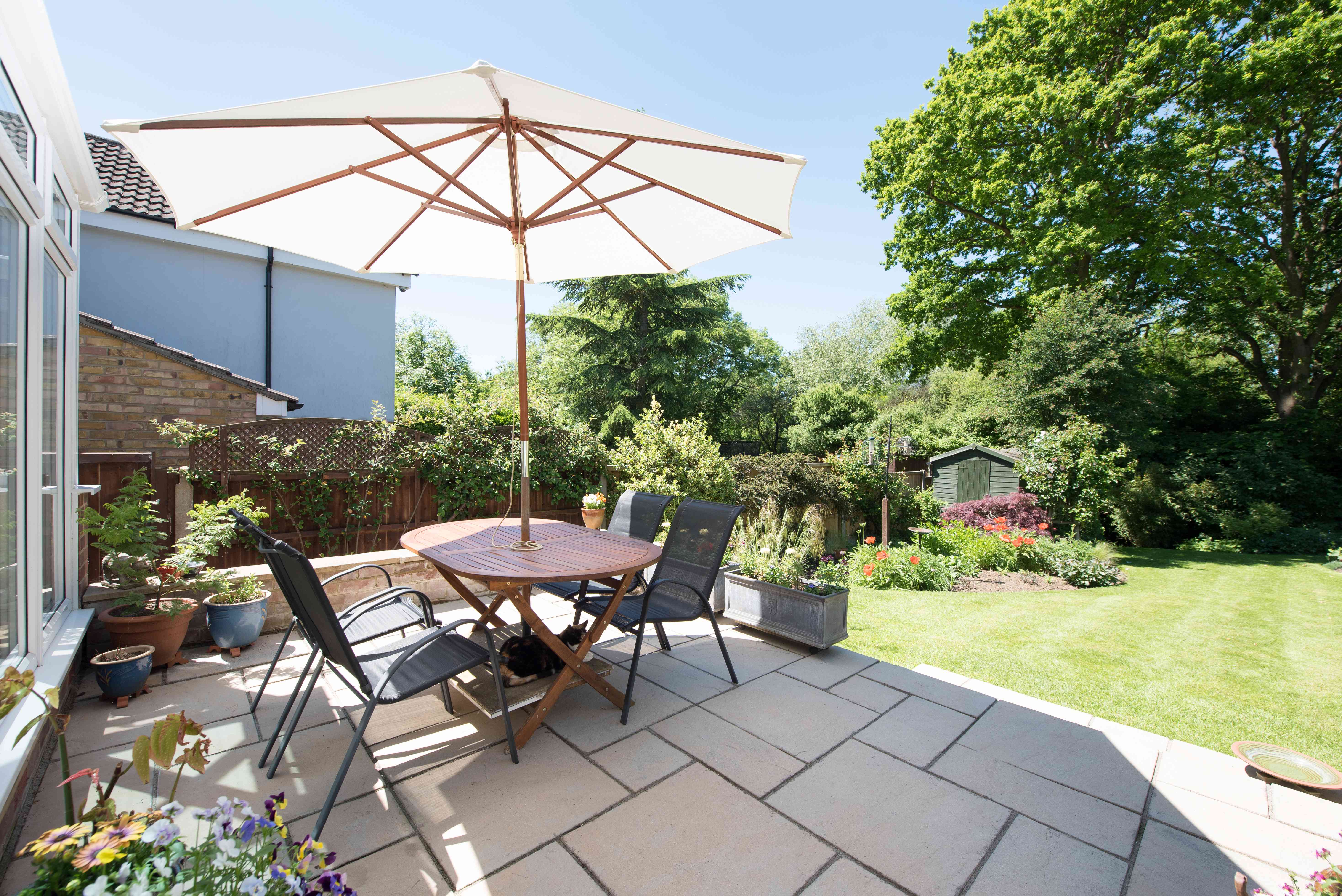
Choose furniture with legs instead of skirted bases. Open-leg designs reveal more flooring, which makes the patio feel larger. A bistro set, two lounge chairs with a small side table, or a narrow bench can create comfort without swallowing the layout.
For dining, consider a round table. Round shapes soften corners and improve flow, especially in tight areas. If you entertain occasionally but not every night, folding chairs or stackable seating can give you flexibility without permanent crowding.
Before buying anything, measure the patio and leave walking space around each piece. A beautiful chair is not so beautiful when every guest has to climb over it like a minor obstacle course.
2. Too Many Tiny Decor Pieces
Small patio, small decor, right? Not always. One of the most common patio decorating mistakes is using too many little items: mini lanterns, tiny pots, small statues, scattered candleholders, mismatched side tables, and decorative objects that multiply like garden gnomes with a secret agenda.
Individually, these pieces may be cute. Together, they create visual noise. The eye has nowhere to rest, and the patio starts to feel cluttered, even if there is technically still enough room to walk.
What to do instead
Edit aggressively. A small outdoor space looks larger when it has fewer, stronger design moments. Instead of seven tiny pots, use three medium planters in varying heights. Instead of several small accessories, choose one sculptural lantern, one outdoor rug, or one statement planter.
Designers often rely on grouping to create order. Try arranging planters in odd-numbered clusters, such as three or five, and keep materials consistent. Terracotta, matte black, concrete, or woven baskets can all work beautifully, but mixing every finish at once can make the patio feel busy.
Think of decor like seasoning. A little makes the space delicious. Too much and suddenly your patio tastes like chaos.
3. Blocking the Sight Lines
A patio feels larger when your eye can travel across it without interruption. Large objects placed in the center of the space can make the area feel chopped up and crowded. This includes bulky grills, oversized coffee tables, freestanding heaters, umbrella bases, tall planters, and storage boxes.
When sight lines are blocked, the brain reads the patio as smaller because it cannot take in the full space at once. Even a large patio can feel tight if every view is interrupted by something heavy or awkwardly placed.
What to do instead
Push larger items to the perimeter whenever possible. Place grills along an edge, tuck storage benches against a wall, and keep the middle of the patio as open as you can. If you need a coffee table, choose one with a slim profile or a transparent, woven, or open-frame design.
Low furniture also helps. A low sofa, compact chairs, and short planters keep the view open. If privacy is a concern, go vertical around the edges with trellises, climbing plants, or tall narrow planters rather than placing bulky barriers in the center.
The goal is not to make the patio empty. The goal is to make it easy for the eye and the body to move through the space.
4. Dark, Heavy Color Schemes Everywhere
Dark colors can be stylish, dramatic, and wonderfully modern. But when every surface on a small patio is darkthe flooring, furniture, cushions, fence, pots, umbrella, and rugthe space can feel visually compressed.
This does not mean you must ban black, charcoal, navy, or forest green. Designers use dark colors beautifully outdoors. The issue is balance. Too many dark, solid surfaces absorb light and make the edges of the patio feel closer than they really are.
What to do instead
Use lighter colors to open up the space. Soft neutrals, warm whites, pale grays, sand tones, light wood, and muted greens can make a patio feel brighter and airier. If you love dark furniture, pair it with light cushions, a natural fiber rug, pale planters, or reflective accents.
Another designer trick is to repeat colors from inside the home. When the patio color palette connects with the adjacent room, the transition feels seamless. The patio begins to read as an extension of your living area rather than a separate, boxed-in zone.
If you are nervous about light fabrics outdoors, look for performance materials designed for sun, moisture, and stains. Outdoor textiles have come a long way. They are no longer limited to scratchy beige cushions that feel like sitting on a polite potato sack.
5. Choppy Flooring and Too Many Materials
Flooring has a major impact on how large or small a patio feels. When the ground plane is visually broken up by too many materials, colors, patterns, or awkward transitions, the space can appear smaller. For example, a patio with mismatched pavers, a busy rug, patchy concrete, gravel borders, and random stepping stones may feel less intentional.
Designers often recommend continuity. A consistent floor surface helps the eye read the patio as one unified area. When flooring is calm and cohesive, everything above it looks more organized.
What to do instead
If you are renovating, choose one main flooring material and keep the pattern simple. Concrete, stone, brick, decking, porcelain pavers, pea gravel, or large-format tiles can all work, depending on your style and climate. The key is to avoid unnecessary visual breaks.
If a renovation is not happening anytime soon, use an outdoor rug to create unity. Pick a rug that is large enough for the main furniture legs to sit on it. A too-small rug can make the seating area look like it is floating awkwardly, while a properly scaled rug anchors the patio and makes it feel more finished.
For narrow patios, running boards, planks, or pavers lengthwise can visually stretch the space. For square patios, a simple grid or subtle pattern keeps things tidy without overwhelming the layout.
6. Forgetting Vertical Space
When the floor is limited, the walls, railings, fences, and overhead areas become valuable design real estate. A patio looks smaller when every item sits on the ground. Floor-only decorating quickly leads to crowding because plants, tables, storage, and lighting all compete for the same precious surface area.
Vertical design draws the eye upward, making the patio feel taller and more layered. It also frees up the floor, which is especially helpful in apartments, townhomes, narrow side yards, and compact back patios.
What to do instead
Use wall-mounted planters, hanging baskets, trellises, vertical herb gardens, slim shelving, string lights, sconces, or a pergola. Even one vertical element can change the feeling of the space.
Greenery is especially useful. Climbing jasmine, ivy, clematis, or other suitable vines can soften walls and fences. Tall narrow planters can create privacy without taking over the patio. Hanging plants add movement and charm while keeping the floor clear.
Lighting also works beautifully overhead. String lights, pendant lanterns, or wall sconces create ambiance without cluttering tables. A patio with layered lighting feels intentional, cozy, and larger because the eye notices depth rather than just square footage.
How Designers Make a Small Patio Feel Bigger
Once you remove the things that make a patio look small, the fun begins. A compact patio can become a stylish outdoor retreat when every item has a job and every design choice supports the overall mood.
Create one clear purpose
Ask yourself what the patio needs to do most often. Is it for morning coffee, family dinners, reading, container gardening, grilling, or evening drinks with friends? A small patio usually works best when it has one main purpose and maybe one secondary purpose.
Trying to fit a dining room, lounge, kitchen, greenhouse, yoga studio, and fire pit into one tiny patio will not make it multifunctional. It will make it confused. Choose the function that matters most and design around it.
Use fewer, better pieces
A small patio does not need a lot of furniture. It needs the right furniture. One comfortable loveseat may be better than four stiff chairs. One large planter may look better than a dozen tiny pots. One generous outdoor rug may do more for the space than several small mats.
Add softness
Outdoor spaces can feel harsh because of hard surfaces like concrete, brick, metal, and fencing. Cushions, pillows, rugs, plants, curtains, and warm lighting add softness. Softness makes a patio feel welcoming rather than cramped.
Keep storage hidden
Garden tools, extra cushions, kids’ toys, grilling accessories, and random outdoor odds and ends can quickly make a patio look smaller. A storage bench, deck box, or slim cabinet can hide the clutter while adding function.
Real-Life Experience: What Actually Makes a Patio Feel Larger
In real homes, patios rarely begin as perfect little design moments. They usually start as “the place where we put the extra chair,” “the place where the hose lives,” or “the place where plants go to be forgotten until they become crunchy.” The biggest lesson from working with small patios is that space is often not the real problem. Decision fatigue is.
Many homeowners buy patio items one at a time without a plan. First comes a chair because it was on sale. Then a plant stand because it looked cute. Then a rug that almost fits. Then a table that is slightly too large, but returning it sounds emotionally exhausting. After a few months, the patio is full, but it still does not feel finished. That is when people assume the patio is too small.
One of the most effective fixes is to remove everything and rebuild the space from scratch. Not permanentlyjust for an afternoon. Sweep the floor, look at the patio empty, and decide where the best view is. Maybe it faces the garden. Maybe it looks toward the sunset. Maybe it faces away from the neighbor’s recycling bins, which is also a valid design goal.
Then add back only the pieces that support the main purpose. For a coffee patio, two comfortable chairs and a small table may be enough. For a dinner patio, a compact dining set and wall-mounted lighting may matter more than lounge seating. For a plant lover’s patio, vertical shelves and railing planters may create beauty without stealing floor space.
Another practical experience: lighting changes everything. A patio that feels small and plain during the day can feel intimate and magical at night with warm string lights or lanterns. The trick is to avoid placing lighting only on tables. Tabletop lanterns are pretty, but they take up surface space. Overhead or wall-mounted lighting gives the glow without the clutter.
Plants also need strategy. Many people scatter pots around the patio edges, thinking they are decorating. But when every edge has a pot, the usable space slowly shrinks. Grouping plants in corners or using vertical planters creates a cleaner look. It also makes watering easier, which is a quiet but important victory. A beautiful patio should not require a 40-minute expedition with a watering can.
Finally, comfort matters more than perfection. A patio can be visually spacious but emotionally useless if nobody wants to sit there. Choose cushions that feel good, shade that actually works, and surfaces that are easy to clean. The best small patios are not the ones with the most expensive furniture. They are the ones that invite you outside for five minutes and somehow keep you there for an hour.
Conclusion
A patio looks small when the design works against the space. Oversized furniture, too many tiny accessories, blocked sight lines, dark-heavy palettes, choppy flooring, and ignored vertical space can all make an outdoor area feel tighter than it really is.
The fix is not always bigger square footage. It is smarter choices. Choose furniture with the right scale, simplify the decor, keep the center open, use lighter colors, create flooring continuity, and decorate upward. When you treat your patio like a real outdoor room, even a compact space can feel polished, relaxing, and surprisingly generous.
Small patios have one major advantage: they are easier to make cozy. With a focused layout, a few hardworking pieces, and just enough personality, your patio can become the place everyone wants to sit. Even if “everyone” is just you, a cold drink, and the smug satisfaction of finally moving that giant chair.