For most of rocket history, building a launch vehicle has looked less like “making a machine” and more like assembling a metallic orchestra where every bracket, weld, tube, valve, tank dome, injector, and engine chamber has to show up on time and hit the right note. One missing part can delay a launch. One imperfect weld can ruin a schedule. One tiny crack can turn a very expensive aerospace dream into a very public fireworks demonstration.
That is why the idea of 3D printing an entire rocket sounds so wildly attractive. Instead of manufacturing thousands of parts through casting, forging, machining, welding, and endless supply-chain gymnastics, what if a company could print major structures directly from digital designs? What if rocket engines, tanks, nozzles, thrust chambers, and even large body sections could be built layer by layer by enormous robotic printers? In theory, the result would be faster production, fewer parts, lower cost, rapid design changes, and fewer headaches for engineers who already drink enough coffee to qualify as liquid propulsion systems.
The best-known real-world example is Relativity Space, the California-based company that made global headlines with Terran 1, a rocket described as about 85% 3D printed by mass. In March 2023, Terran 1 launched from Cape Canaveral Space Force Station in Florida. It did not reach orbit, but it did pass through Max-Q, the point of maximum aerodynamic stress, proving that large 3D-printed rocket structures could survive one of the nastiest parts of launch. That was not a small achievement. In rocket terms, it was like showing up to a heavyweight fight wearing experimental shoes and still taking a punch.
What Does “3D Printing an Entire Rocket” Actually Mean?
When people hear “3D printed rocket,” they may picture a desktop printer slowly squirting plastic into the shape of a miniature spaceship. That is adorable, but no. Orbital rockets are not made like keychains, phone stands, or that one wobbly Baby Yoda your cousin printed in 2020.
In aerospace, 3D printing is usually called additive manufacturing. Instead of cutting material away from a block of metal, additive manufacturing builds a part layer by layer. In rocket manufacturing, that can involve metal powders melted by lasers, wire-fed metal deposition, or other advanced processes capable of creating strong, complex parts from aluminum alloys, copper alloys, nickel superalloys, titanium, and other materials that can tolerate violent temperatures, pressures, and vibrations.
For a rocket, “entirely 3D printed” does not mean every bolt, circuit board, sensor, battery, software package, seal, and wire harness comes out of a printer. Electronics, avionics, valves, fasteners, insulation, and many commercial components still come from specialized manufacturing processes. Instead, the phrase usually means the major structural and propulsion components are printed: tanks, domes, engine parts, chambers, nozzles, brackets, and large body sections.
Why Rocket Companies Fell in Love With Additive Manufacturing
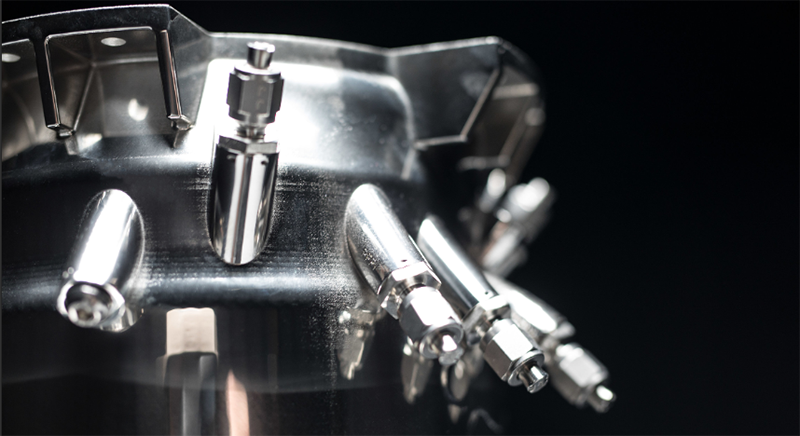
Rocket engines are a perfect playground for 3D printing because they are complicated in exactly the way printers like. A liquid rocket engine needs internal cooling channels, injectors that mix fuel and oxidizer with terrifying precision, complex manifolds, turbopump components, valves, and chambers that survive extreme heat. Traditional manufacturing can make these parts, but it often requires many separate pieces joined together.
Every joint, weld, and seam is a possible failure point. Every extra part adds inspection time. Every supplier adds schedule risk. A 3D printer can combine features that once required dozens or even hundreds of components into a single integrated part. NASA demonstrated this logic years ago with printed rocket engine injectors, showing how additive manufacturing could dramatically reduce part count and production time. That kind of simplification is catnip for aerospace engineers, except with more spreadsheets and fewer cats.
Fewer Parts, Faster Iteration
One of the biggest advantages of 3D printed rocket components is speed. In traditional aerospace manufacturing, changing a design can mean new tooling, new fixtures, new machining programs, new supplier quotes, and a fresh round of calendar misery. With additive manufacturing, engineers can revise a digital model and print a new version much faster.
This matters because rockets are not born perfect. They are tested, redesigned, retested, punished, inspected, redesigned again, and eventually trusted enough to ride a controlled explosion into the sky. Faster iteration helps teams learn quickly. A printed injector, chamber, or bracket can move from computer model to test stand in weeks rather than many months, depending on the part and certification requirements.
Complex Shapes Without Manufacturing Drama
Rocket parts often need shapes that are easy to imagine but miserable to manufacture. Curved cooling channels inside a combustion chamber are a good example. These channels carry cryogenic propellant around hot engine walls, keeping the chamber from melting while preheating the fuel before combustion. Traditional machining can create such geometry, but it may require multiple parts and tricky joining processes.
3D printing can build these internal features directly. That opens the door to more efficient cooling, lighter parts, and integrated structures that would be impractical or too expensive with older methods. In other words, additive manufacturing lets engineers design more like physicists and less like people negotiating with a cranky machine shop.
Relativity Space and the Terran 1 Milestone
Relativity Space became the poster child for the 3D printed rocket movement. Founded in 2015, the company built its brand around large-scale metal additive manufacturing, robotics, automation, and the dream of dramatically simplifying rocket production. Its giant metal printers, known as Stargate printers, were designed to fabricate large rocket structures with fewer parts and less traditional tooling.
Terran 1 was the company’s proof-of-concept vehicle. It stood roughly 110 feet tall and used liquid methane and liquid oxygen propulsion. By mass, about 85% of the rocket was 3D printed, including its engines and major structures. That alone made it one of the boldest manufacturing experiments in launch history.
The debut mission, nicknamed “Good Luck, Have Fun,” was wonderfully honest. That title sounded like something a gamer says before an impossible boss fight, which was oddly appropriate. The rocket lifted off from Launch Complex 16 at Cape Canaveral in March 2023. Its first stage performed well enough to push the vehicle through Max-Q and beyond the Karman line, the widely recognized boundary of space at 100 kilometers. The second stage did not complete the journey to orbit, but the test still delivered valuable data.
For Relativity, the main victory was structural validation. The printed body did not fold, crack, or embarrass itself during ascent. In a field where “it survived the hardest aerodynamic stress” is a serious compliment, Terran 1 gave additive manufacturing a powerful credibility boost.
Why Terran 1 Was Retired After One Flight
After Terran 1’s launch, Relativity made a strategic turn. Rather than continue flying the smaller Terran 1, the company shifted its focus to Terran R, a much larger reusable rocket aimed at the medium-to-heavy payload market. This was not an admission that 3D printing had failed. It was a business decision shaped by launch-market demand, competition, payload size, reusability, and the brutal economics of space transportation.
The small-launch market became crowded quickly. Many satellite customers wanted either dedicated small launches or rideshare options on larger rockets. At the same time, SpaceX’s Falcon 9 reset expectations for price, cadence, and reusability. To compete seriously, Relativity needed a bigger vehicle with stronger economics.
Terran R represents that pivot. The company has described it as a reusable medium-to-heavy-lift rocket launching from Cape Canaveral, with payload capacity designed to compete in a much larger market than Terran 1 could address. The manufacturing approach has also evolved. Instead of pushing every major structure toward maximum 3D printing, Relativity has moved toward a more practical hybrid strategy: use additive manufacturing where it provides the biggest advantage, especially in engines and complex components, while using proven traditional methods for large primary structures when they are cheaper, faster, or more scalable.
The Honest Truth: Printing a Rocket Is Not Magic
3D printing is powerful, but it is not a magic wand. Aerospace manufacturing is full of annoyingly real constraints: material properties, quality control, repeatability, inspection, thermal stresses, grain structure, fatigue life, surface finish, certification, and cost per kilogram. A printed part is not automatically better just because it sounds futuristic.
Printed metal parts can have tiny pores, residual stresses, rough surfaces, or anisotropic properties, meaning their strength may vary depending on direction. These issues can be managed through process control, heat treatment, machining, hot isostatic pressing, non-destructive inspection, and careful design. But they cannot be ignored. Rockets are extremely rude machines; they find weak points quickly and without mercy.
Scale Is Hard
Printing a small engine component is challenging. Printing a large tank section is another level of difficulty. Large structures must maintain dimensional accuracy, strength, weldability, and consistency across huge surfaces. They must also be produced at a cost and speed that makes business sense.
This is one reason the industry is moving toward selective use of additive manufacturing. The question is no longer “Can we print everything?” The smarter question is “What should we print?” For engines, injectors, chambers, nozzles, and complex manifolds, the answer is often yes. For simple cylinders, large tanks, or structures that traditional manufacturing already makes efficiently, the answer may be “maybe not, unless printing offers a clear advantage.”
NASA’s Role in 3D Printed Rocket Technology
NASA has been one of the key institutions proving that additive manufacturing belongs in serious propulsion work. At Marshall Space Flight Center and other NASA facilities, engineers have tested printed injectors, combustion chambers, nozzles, turbopumps, and advanced alloys. NASA’s Rapid Analysis and Manufacturing Propulsion Technology program, known as RAMPT, has focused on large-scale printed propulsion components and advanced materials that can tolerate extreme heat and pressure.
NASA’s work matters because it moves additive manufacturing beyond hype. Testing a printed rocket part on a stand is not the same as admiring it in a trade-show booth under flattering lights. Hot-fire testing exposes parts to conditions that are loud, hot, unstable, and deeply uninterested in marketing claims. When printed components survive repeated firings, the entire industry gains confidence.
NASA-developed alloys and manufacturing methods have also supported commercial progress. Terran 1’s Aeon engines used additively manufactured components, including copper alloy hardware designed to handle temperatures near those found inside a working rocket engine. These materials advances are crucial because printing a rocket is not just about the printer. It is about matching the right alloy, process, geometry, inspection method, and operating environment.
Other Companies Proving 3D Printed Rocket Parts Work
Relativity may have grabbed the biggest headlines for trying to print most of a rocket, but it is far from alone. Rocket Lab’s Rutherford engine is one of the strongest examples of additive manufacturing becoming operational rather than experimental. Used on the Electron rocket, Rutherford is known as a 3D printed, electric pump-fed orbital rocket engine. Its major components, including the thrust chamber, injector, pumps, and valves, are additively manufactured. Rocket Lab has flown hundreds of these engines, making Rutherford a major proof point for production-scale 3D printed propulsion.
SpaceX also helped push the technology forward with 3D printed SuperDraco engine chambers for Crew Dragon’s launch escape system. While SpaceX does not print entire rockets, its use of additive manufacturing in high-performance engine hardware shows how major aerospace companies adopt the technology where it solves a specific problem.
Ursa Major, Launcher, Elementum 3D, Beehive Industries, and other U.S.-connected aerospace and materials companies are also part of the broader ecosystem. Some focus on engines. Others focus on alloys, nozzles, chambers, turbomachinery, or supply-chain resilience. The trend is clear: additive manufacturing is becoming a normal tool in the rocket industry, not a novelty act wearing a shiny badge.
How 3D Printing Changes Rocket Design
The most interesting part of 3D printing is not that it makes old parts differently. It allows engineers to design new kinds of parts. Traditional manufacturing often forces engineers to simplify geometry so a machine can cut it, a mold can release it, or a welder can reach it. Additive manufacturing relaxes some of those constraints.
That means designers can create lightweight lattice structures, integrated channels, combined assemblies, organic curves, and parts with fewer joints. A rocket engine injector can be optimized for better mixing. A chamber can include more efficient cooling passages. A manifold can route fluid in ways that would make traditional machining groan dramatically.
For an entire rocket, this design freedom could lead to simpler architectures. Fewer parts mean fewer fasteners, fewer inspections, fewer vendors, and fewer chances for a part to be late because someone’s supplier’s supplier had a machine go down in Ohio. Supply-chain simplicity is not glamorous, but when you are building launch vehicles, it can be the difference between a rocket on the pad and a rocket trapped in PowerPoint.
Cost Savings: Real, But Not Automatic
One of the biggest promises of 3D printed rockets is lower cost. Additive manufacturing can reduce tooling, shorten development cycles, simplify inventory, and consolidate parts. But printing is not always cheaper. Large metal printers are expensive. Metal powder can be expensive. Post-processing can be expensive. Inspection can be expensive. Certification can be very expensive. The phrase “aerospace grade” is basically a cash register sound effect.
The best cost savings appear when printing replaces a complicated assembly with one integrated part, reduces development time, or enables performance that would otherwise require costly manufacturing. In rocket engines, this is often a strong business case. For large simple structures, traditional manufacturing may still win.
That is why the future is likely not “every rocket is entirely printed.” It is more likely “every competitive rocket uses additive manufacturing somewhere important.” The printing revolution is not about replacing every tool in the factory. It is about giving engineers a new tool sharp enough to change the shape of the factory itself.
Could Rockets Be Printed on the Moon or Mars?
The long-term dream behind 3D printing rockets goes beyond Earth. Advocates imagine using local materials on the Moon or Mars to build habitats, landing pads, spare parts, tools, and eventually spacecraft components. This idea is called in-situ resource utilization, which is the aerospace way of saying, “Use what you find there, because shipping everything from Earth is painfully expensive.”
Printing a full rocket on Mars is still far beyond current capability. A launch vehicle requires refined metals, precision electronics, valves, sensors, seals, propellant systems, test infrastructure, and quality control. Mars does not currently have a convenient industrial park with a coffee machine and next-day shipping.
Still, the logic is compelling. If humanity wants a permanent presence beyond Earth, manufacturing must eventually move off-world. Additive manufacturing is one of the most promising methods because it can turn digital designs into physical parts with relatively flexible equipment. The Terran 1 experiment did not put humanity on Mars, but it did test part of the industrial philosophy that future space settlements may need.
Experience Section: What Working Around a 3D Printed Rocket Mindset Teaches You
The most important experience connected to 3D printing an entire rocket is not simply watching a machine stack metal into a curved wall. It is learning how differently engineers think when manufacturing becomes digital. In a traditional shop, design changes can feel expensive before anyone even opens the CAD file. A new bracket might require new tooling. A redesigned injector might require a new casting process. A tank feature might be rejected because it is too difficult to weld or inspect. The manufacturing method becomes a cage around the design.
In an additive environment, that cage becomes wider. Engineers can ask better questions earlier. Can this assembly become one part? Can this internal channel improve cooling? Can this bracket lose mass without losing strength? Can this engine component be printed, tested, modified, and printed again before a traditional supplier has finished quoting the first version? That shift changes the tempo of development. It turns hardware into something closer to software: not easy, not instant, but much more iterative.
Anyone who has followed the 3D printed rocket story also learns humility. The first printed version of a part is rarely the final version. Print parameters matter. Material batches matter. Cooling rates matter. Post-processing matters. Inspection matters. A part can look gorgeous and still fail testing. Aerospace does not reward pretty parts; it rewards parts that perform repeatedly under awful conditions.
That is why Terran 1 remains such a useful lesson. It did not reach orbit, so the headline could have been failure. But hardware development is more nuanced. The mission proved that a mostly printed launch vehicle could lift off, pass through Max-Q, and deliver meaningful flight data. For a first-of-its-kind manufacturing demonstration, that is significant. It showed that additive manufacturing could handle large structural loads, while also reminding everyone that a rocket is a complete system. If propulsion, stage separation, valves, software, fluids, structures, and operations do not all work together, the vehicle does not care which part was innovative. It simply stops flying.
The best practical experience takeaway is this: 3D printing is not a shortcut around engineering discipline. It is an amplifier. If the design process is smart, printing can make it faster and more flexible. If the process is sloppy, printing can help produce bad ideas more quickly, which is not the kind of productivity anyone wants. The winning teams treat additive manufacturing as part of a full development system that includes analysis, materials science, testing, inspection, and operations.
There is also a cultural lesson. Rockets are usually built by large organizations with conservative processes because failure is expensive, dangerous, and occasionally visible from several counties away. Additive manufacturing brings a startup-style rhythm into a conservative field. That creates tension, but also progress. The companies that succeed will not be the ones that shout “3D printing!” the loudest. They will be the ones that know exactly when printing beats machining, when welding still makes sense, when a hybrid architecture is smarter, and when the simplest part is the best part.
In other words, the real experience of 3D printing an entire rocket is discovering that the future is not a printer replacing every engineer. It is engineers using printers to ask bolder questions, test faster, simplify smarter, and build machines that would have been nearly impossible to manufacture a generation ago. The rocket still has to fly. Gravity remains famously unimpressed by innovation decks.
Conclusion: The Future of the 3D Printed Rocket
3D printing an entire rocket is one of the most exciting manufacturing ideas in modern aerospace, but its real future is more practical than the slogan. Terran 1 proved that large printed rocket structures can survive launch conditions. NASA, Rocket Lab, SpaceX, Relativity Space, and many others have shown that printed rocket engines and components can perform in serious environments. The technology is no longer science fiction; it is part of the aerospace toolbox.
At the same time, the industry has learned that printing everything is not always the smartest answer. The strongest path forward is selective, intelligent additive manufacturing: print the parts that benefit from complexity, integration, faster iteration, and advanced materials. Use traditional manufacturing where it remains cheaper, stronger, faster, or easier to certify.
The phrase “3D printing an entire rocket” will continue to attract attention because it sounds bold, futuristic, and slightly ridiculous in the best possible way. But the deeper story is bigger than one rocket. It is about redesigning how aerospace hardware is imagined, tested, produced, and improved. Rockets may always be complicated. Thanks to additive manufacturing, building them may become a little less like assembling a million-piece metal puzzle and a little more like printing the first draft of humanity’s next industrial age.
Note: This article was created from synthesized public information from reputable U.S. aerospace, science, government, and technology sources, including NASA, Relativity Space, the FAA, Rocket Lab, the Smithsonian National Air and Space Museum, AP, Space.com, Wired, Axios, and related industry reporting.