“`
Every once in a while, the electronics world produces a headline that sounds like it escaped from a basement laboratory wearing safety goggles and a suspicious grin. “Light an LED with nothing” is one of those headlines. It has the exact flavor of internet alchemy: no battery, no obvious power supply, no tiny hamster on a treadmilljust an LED producing a faint glow from what appears to be thin air.
But this is not a miracle, a perpetual motion machine, or a secret way to cancel your electric bill. Sorry, utility-company haters. The project titled “2025 Component Abuse Challenge: Light An LED With Nothing” is a clever exploration of how sensitive modern LEDs can be and how much tiny, overlooked energy exists in the electrical environment around us. In the Hackaday spirit, it takes a humble component and asks, “What else can this little plastic gumdrop do when nobody from the datasheet department is watching?”
The result is a fun, brain-tickling experiment in component abuse, ambient electromagnetic fields, diode behavior, and the strange beauty of making electronics do the “wrong” thing correctly.
What Was the 2025 Component Abuse Challenge?
The 2025 Component Abuse Challenge was a Hackaday.io contest built around a wonderfully mischievous idea: use electronic parts in ways they were never officially meant to be used. The challenge celebrated projects such as LEDs acting as photosensors, capacitors behaving like microphones, resistors serving as heaters, and other delightful acts of engineering disobedience.
In normal engineering, we respect component ratings, application notes, and tidy block diagrams. In component abuse, we still respect physicsbut we politely ignore the component’s job title. A resistor may not have applied to be a heating element, but if it gets warm and that warmth is useful, congratulations, it has been promoted. An LED may have entered the factory as a light emitter, but under the right conditions it can also behave like a sensor, a photodiode, or, in this case, part of a tiny energy-harvesting demonstration.
The “Light An LED With Nothing” entry fits the challenge perfectly because it asks an irresistible question: how little energy does an LED need before it becomes visible? The answer is not zero. It is never zero. But it can be shockingly close to “you have to squint and use a camera” levels of small.
The Big Idea: No Power Source Does Not Mean No Power
The phrase light an LED with nothing is catchy, but the science is more precise: the LED is not being powered by nothing. It is responding to tiny currents induced by electric and electromagnetic fields in the surrounding environment. That distinction matters. “Nothing” is the magician’s patter; “ambient field energy” is the rabbit in the hat.
Homes, workshops, power supplies, chargers, lamps, appliances, and wiring all create electric or electromagnetic fields. Most of the time, these fields are too weak to do obvious work. They are background noise, like the refrigerator hum you only notice when it stops. But modern LEDs can be extremely efficient, especially certain green and blue types. Under dark conditions and with sensitive observation tools, even very small currents can produce a faint visible glow.
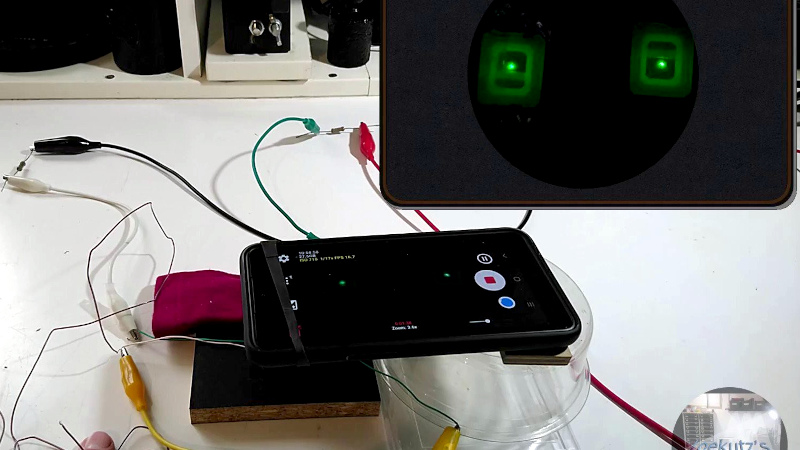
In the featured project, the maker explored this effect using LEDs, large-value resistors, wire acting as an antenna-like pickup, a phone camera, and magnification. The goal was not to create practical lighting. It was to reveal that “off” is sometimes more complicated than it looks.
Why LEDs Are Perfect for This Weird Trick
An LED, or light-emitting diode, is still a diode. That means it allows current to flow more readily in one direction than the other. When current passes through it in the forward direction, charge carriers recombine inside the semiconductor material and release energy as light. In normal use, designers add a current-limiting resistor or driver so the LED does not pull too much current and turn itself into a tiny plastic disappointment.
That is the boring, responsible version. It is also the version you want in real products.
The fun begins when we remember that real components are not ideal. LEDs have junction capacitance, leakage behavior, wavelength sensitivity, and diode rectification properties. Some LEDs can detect light like photodiodes. Some can produce faint light at currents far below what a beginner tutorial would consider useful. Some can even reveal environmental electrical activity when connected in sensitive arrangements.
In other words, an LED is not just a “light goes blink” component. It is a tiny semiconductor with a secret second career.
How Ambient Fields Can Make an LED Glow
The project can be understood through a simple analogy. Imagine an LED circuit as a tiny sailboat on a pond. A normal battery is like a strong motor. It pushes the boat wherever you want. Ambient electromagnetic fields are more like faint ripples and breezes. They are not enough to run a ferry service, but if your sailboat is light enough and your measuring tools are sensitive enough, you may see movement.
Wires and component leads can pick up energy from changing electric fields, especially near mains-powered devices or switching power supplies. The LED, because it is a diode, can act somewhat like a primitive rectifier. That is why Hackaday compared the effect to a very simple crystal radio idea: an antenna collects a tiny signal, and a diode helps turn that signal into a detectable effect.
The glow is faint. This is not a flashlight. It is more like a ghost whispering “electrons were here” from the corner of a dark room. A phone camera and magnifier help make the effect easier to observe because cameras can integrate low light in ways human eyes may miss.
What Makes This “Component Abuse” Instead of Ordinary Electronics?
Ordinary electronics says: “Use an LED with a proper resistor, a safe low-voltage source, and a clear design target.” Component abuse says: “What happens if the LED is also a detector, a rectifier, and a field indicator?”
The appeal is not that this is the best way to light anything. It absolutely is not. If your hallway light depends on ambient electromagnetic leakage, your midnight snack journey will end with bruised shins and regrettable cheese decisions. The appeal is that the project exposes hidden behavior. It turns a common component into a physics lesson.
That is the heart of the Hackaday challenge. The best entries are not merely silly. They teach something. They make a resistor, capacitor, transistor, LED, cable, or sensor reveal an unexpected property. They remind us that parts are not cartoon symbols on a schematic. They are physical objects living in a world of fields, temperature, leakage, capacitance, noise, and tolerances.
Why Modern LEDs Can Glow at Tiny Currents
LED efficiency has improved dramatically over the years. Many modern indicator LEDs are bright enough to be annoying at currents that older LEDs would have treated as a polite suggestion. A beginner might learn that a typical indicator LED runs around 10 to 20 milliamps, but that does not mean it becomes perfectly dark below that range. At microamp levelsor sometimes even lower under favorable conditionssome LEDs may still emit detectable light.
This is especially noticeable in dark environments. Human vision is incredibly adaptable, but cameras can be even more helpful when the light is weak. A glow that is invisible in a sunny room may become obvious through a magnified phone-camera view in darkness. The project’s cleverness lies partly in using modern observation tools to see what ordinary bench habits ignore.
There is also a psychological surprise. We tend to think of electronics as binary: powered or unpowered, on or off, alive or dead. Real circuits are messier. A disconnected wire can be an antenna. A diode can rectify. A capacitor can remember charge. A high-value resistor can allow a whisper of current. A supposedly dark LED may still be doing its tiny semiconductor yoga routine.
The “Free Energy” Trapand Why This Is Not That
Any project that says “LED” and “no power source” in the same sentence risks attracting free-energy fantasies like moths to a porch light. So let’s install a big blinking reality sign: this is not free energy in the impossible sense.
The energy comes from the environment. It may be coupled from nearby electric fields, switching power supplies, static charges, or other electromagnetic sources. The LED is not creating energy; it is responding to energy that already exists. Conservation of energy remains undefeated, which is rude of it but scientifically consistent.
That is actually what makes the project more interesting. Fake perpetual-motion claims usually collapse under basic measurement. This project invites measurement. It says, “Look closely. Something tiny is happening.” Instead of promising unlimited power, it reveals how little power is needed to make a modern LED barely visible.
Related Component Abuse Examples
LEDs as Sensors
LEDs can detect light under certain conditions because their semiconductor junction responds to incoming photons. Used like a photodiode, an LED can generate a small current or voltage when exposed to light. It will not outperform a proper photodiode in most practical designs, but it can be surprisingly useful for low-cost experiments, wavelength-selective sensing, and educational demonstrations.
Capacitors as Microphones
A capacitor stores charge between two conductive surfaces separated by an insulator. If one plate moves with sound pressure, the capacitance changes. That is the basic idea behind condenser microphones. A normal ceramic capacitor on your bench is not suddenly a studio mic, but the principle shows why “capacitor as microphone” belongs in the component-abuse hall of fame.
Resistors as Heaters
Resistors convert electrical energy into heat. Usually that heat is a design problem. In component abuse, it can become the point. The trick is remembering that heat also means power, temperature rise, and safety limits. A resistor used as a heater may be clever in a controlled demonstration, but it should not become a casual invitation to roast parts until your desk smells like regret.
Safety: The Part Where the Fun Keeps Its Shoes On
Electronics experiments can be fascinating, but safety matters. Ambient-field LED demonstrations should stay firmly in low-energy, observation-focused territory. Avoid mains wiring, exposed line voltage, improvised high-voltage setups, or anything involving household power conductors. If a project’s humor depends on “probably safe,” translate that as “not safe.”
The best way to enjoy the “Light An LED With Nothing” idea is as a concept: LEDs are sensitive, fields exist around powered devices, and tiny currents can create visible effects. That lesson does not require dangerous shortcuts. The real prize is understanding, not proving you can make a component suffer in front of an audience.
Why This Project Matters
At first glance, lighting an LED with ambient fields seems like a novelty. It will not replace lamps, batteries, solar panels, or the glow of your laptop at 2 a.m. when you promised yourself you would sleep early. But as a learning project, it is excellent.
It teaches that components have hidden behaviors. It shows that measurement tools shape what we can observe. It makes electromagnetic fields less abstract. It reminds beginners that a circuit is not only a schematic; it is also geometry, environment, impedance, leakage, capacitance, and sensitivity.
For experienced engineers, it is a cheerful reminder that the real world keeps receipts. The “ideal diode” from a textbook is useful, but the actual LED on the bench has quirks. Those quirks can be problems, features, or contest entries, depending on your mood and how much coffee is involved.
SEO Takeaway: The Beauty of Useless-Looking Experiments
The phrase 2025 Component Abuse Challenge: Light An LED With Nothing works because it sounds impossible. Then the explanation makes it better: it is not magic, but physics wearing a funny hat. That is why projects like this travel well online. They combine curiosity, skepticism, humor, and a clear visual payoff.
For makers, the lesson is simple: do not dismiss tiny effects. Many useful technologies began as someone noticing a small, annoying, or “irrelevant” behavior. Noise becomes data. Leakage becomes a sensor. A diode becomes a detector. A faint LED glow becomes a doorway into electromagnetic fields.
Experience Notes: What This Topic Teaches in the Real World
Anyone who has spent time around electronics eventually learns that components are much stranger than their labels. A beginner sees a resistor, capacitor, diode, and LED as separate characters with separate jobs. After a few projects, those neat job descriptions start leaking around the edges. The resistor warms up. The capacitor holds a charge longer than expected. The LED glows dimly when it was supposed to be off. The jumper wire behaves like an antenna because apparently even a piece of copper wants a side hustle.
That is why the “Light An LED With Nothing” idea feels so familiar to many makers. It resembles those bench moments when a circuit does something technically wrong but emotionally hilarious. You disconnect the power and a light fades slowly instead of snapping off. You touch an amplifier input and hear hum. You wave a hand near a sensitive node and the reading changes. You move a cable and the circuit suddenly behaves like it has opinions. At first, these moments feel like bugs. Later, they become lessons.
The most valuable experience connected to this topic is learning to respect small signals. In school-style examples, signals are clean and components are obedient. On a real workbench, everything couples to everything else a little bit. Nearby power wiring, chargers, monitors, fluorescent lamps, switching supplies, and even your own body can influence a high-impedance circuit. That does not mean the universe is haunted. It means impedance matters, shielding matters, grounding matters, and measurement changes the thing being measured.
Another useful lesson is humility. The LED in this project is not acting like a lamp in the normal sense. It is acting like a sensitive semiconductor device responding to tiny energy sources. That distinction teaches better thinking. Instead of saying, “This LED lights with nothing,” a careful observer says, “This LED is revealing a small amount of coupled energy that I did not previously notice.” The second sentence is less clickable, but it is also how engineers avoid fooling themselves.
There is also a creative lesson. Component abuse is not about being reckless. It is about asking better questions. What happens outside the recommended use case? Which non-ideal property can be useful? What does the component do when pushed gently into the weird zone? That mindset helps with debugging, prototyping, repair, and invention. A maker who understands hidden behavior can often solve problems with fewer parts, better intuition, and fewer dramatic sighs over a breadboard.
Finally, this topic is a reminder that wonder still belongs in electronics. Not every project needs to become a product. Some projects are valuable because they make people look again at something ordinary. An LED is one of the first components many people ever use. It blinks, it indicates, it celebrates the successful upload of code. Seeing it glow from ambient fields gives that familiar part a second life. It turns a five-cent component into a tiny science exhibit. That is the best kind of maker magic: not fake magic, not dangerous magic, but the kind where reality itself turns out to be more interesting than the myth.
Conclusion
2025 Component Abuse Challenge: Light An LED With Nothing is a perfect example of why maker culture remains so entertaining and educational. The project does not break physics. It does something better: it makes physics visible. By showing that LEDs can respond to tiny currents induced by ambient fields, it transforms a common component into a miniature detector of the invisible electrical world around us.
The project is not a blueprint for practical lighting and should not be treated as a reason to experiment with unsafe electrical sources. Its real value is curiosity. It reminds us that components are physical devices with hidden talents, that “off” is sometimes a matter of measurement scale, and that the best experiments often begin with a question that sounds slightly ridiculous.
In the end, lighting an LED with “nothing” is really about learning to see the something that was there all along.
“`