Movies ask us to believe many extraordinary things. A billionaire can build a flying armored suit in a cave. A paleontologist can outrun a genetically engineered dinosaur while wearing office shoes. An ordinary family sedan can launch across a collapsing bridge, land on all four wheels, and continue driving without so much as an illuminated check-engine light.
Fine. That is entertainment. We bought the popcorn, and we accepted the terms.
But some movie science mistakes appear so frequently that they have become cinematic laws of nature. Space is deafening. Chloroform works faster than a light switch. A defibrillator can revive anyone, including people whose hearts have apparently resigned three scenes earlier. Meanwhile, radiation is less a medical hazard than an express delivery service for superpowers.
Here are 13 annoying ways movies keep getting science wrong, why the real science works differently, and how filmmakers could make scenes more believable without draining all the fun from them.
1. Space Battles Sound Like Heavy-Metal Concerts
Movie spacecraft rarely explode quietly. They detonate with a thunderous boom, followed by roaring engines, screaming lasers, and enough bass to make every asteroid vibrate.
There is one small problem: sound needs matter through which to travel. On Earth, sound waves move by vibrating air molecules. Most of space is an extremely thin vacuum, so there is no dense atmosphere available to carry those waves toward a nearby pilot or movie audience.
An astronaut might hear vibrations transmitted through a spacecraft’s structure or sounds generated inside a pressurized cabin. Two ships firing at each other across empty space, however, would not hear the external blasts. A scientifically accurate battle would be eerily silent, interrupted only by alarms, breathing, radio communication, and the pilot whispering, “That repair estimate is going to be brutal.”
Scientific grounding: NASA explains that sound waves cannot travel through the vacuum of space without a medium.
2. Exposure to Space Makes People Instantly Explode or Freeze
Another favorite movie scenario involves an unfortunate character being exposed to vacuum. Depending on the director, the person either explodes like an overfilled balloon or freezes into a human-shaped ice cube before shattering dramatically.
Neither outcome would happen instantly. Human skin and connective tissue are strong enough to keep the body from bursting apart. A person also would not immediately freeze because vacuum is an inefficient conductor of heat. Without surrounding air, body heat cannot rapidly escape through convection.
Vacuum exposure would still be a catastrophic emergency. Oxygen deprivation would quickly cause loss of consciousness, exposed moisture could begin to vaporize, and tissues could swell. The experience would be dangerous and potentially fatal, just not in the tidy, effects-friendly way movies usually portray it.
Scientific grounding: NASA states that a person in vacuum would not explode or instantly freeze, although oxygen loss and decompression would rapidly become life-threatening.
3. Zero Gravity Is Treated Like a Relaxing Indoor Pool
In movies, long-term life in microgravity looks delightful. Crew members float through spotless corridors, perform graceful flips, and arrive on another planet apparently ready to sprint, fight, and carry heavy equipment.
Real microgravity is much harder on the human body. Because muscles no longer work continually against Earth’s gravity, they can weaken. Weight-bearing bones also lose mineral density unless astronauts follow demanding exercise and nutrition programs. Balance, cardiovascular function, vision, fluid distribution, and coordination may also change.
NASA astronauts spend substantial time exercising because floating is not a magical wellness retreat. It is closer to living in an environment where the gym follows you around and quietly threatens your skeleton.
A realistic movie crew returning from a long mission might need medical evaluation and rehabilitation before beginning a heroic foot chase. That would be less convenient for the screenplay, but far kinder to human physiology.
Scientific grounding: NASA reports significant muscle weakening and average monthly mineral-density losses in weight-bearing bones during extended microgravity exposure.
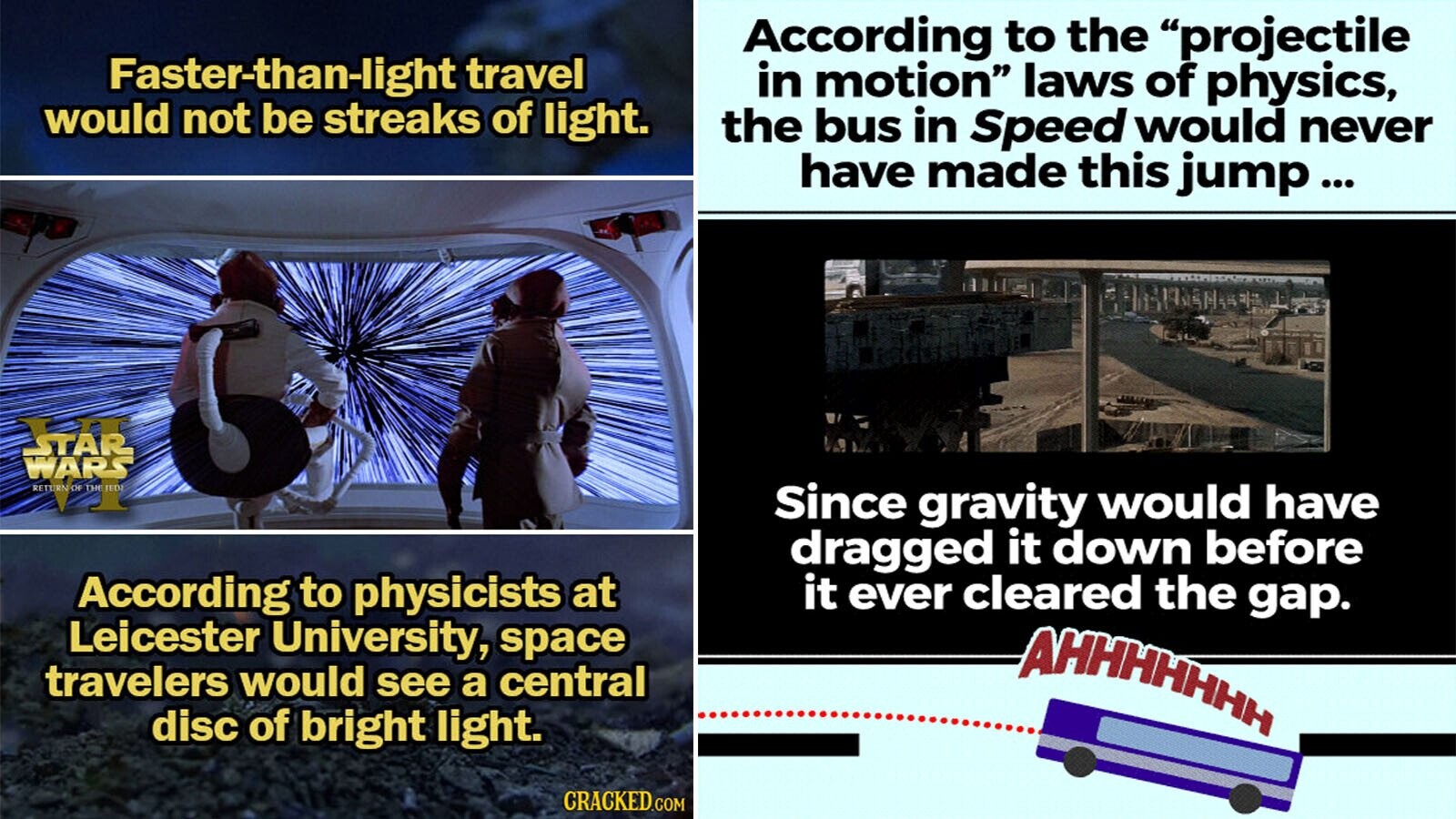
4. Faster-Than-Light Travel Has No Consequences
Science-fiction characters frequently travel between distant star systems in the time it takes to finish a tense conversation. Someone presses a glowing button, the stars become decorative spaghetti, and the ship arrives before anyone needs another cup of coffee.
According to special relativity, the speed of light in a vacuum is a fundamental limit for matter and information moving through ordinary space. Accelerating an object with mass closer and closer to light speed requires increasingly enormous amounts of energy. Reaching or exceeding that speed through conventional acceleration is not simply an engineering challenge awaiting a bigger engine.
Ideas involving wormholes or warped spacetime are explored theoretically, but they are not established transportation systems hiding in a government warehouse. Movies are free to invent new physics, of course. It would simply be nice if the script admitted that the heroes had discovered revolutionary physics instead of treating interstellar travel like changing lanes on an interstate.
Scientific grounding: NASA describes light’s constant vacuum speed and the immense difficulty of accelerating matter to near-light speed.
5. Lava Behaves Like Glowing Orange Water
Movie heroes love standing beside lava. They balance on tiny rocks, trade emotional speeches over molten rivers, and occasionally hang above the surface long enough to reconsider every major decision they have made.
Real lava is not merely hot liquid with an orange color filter. It is molten rock capable of igniting, burying, surrounding, and destroying objects in its path. Even without direct contact, radiant heat can make approaching an active flow extremely dangerous.
Lava also varies in viscosity. Some flows move relatively smoothly, while others form rough, broken masses. A person falling into it would not necessarily sink like someone entering a swimming pool. The encounter would involve intense heat, burning gases, and severe thermal injury long before a dramatic full-body submersion.
Standing inches from lava for a heartfelt goodbye is therefore less “tragic heroism” and more “aggressively ignoring heat transfer.”
Scientific grounding: The USGS explains that lava’s extreme temperature can ignite, bury, surround, or destroy objects in its path.
6. Heroes Can Outrun Explosions
Every action hero eventually runs from an explosion. The expanding fireball remains conveniently five feet behind, providing flattering orange lighting while gently lifting the hero onto a soft landing.
Real explosions are not just theatrical flames. A detonation can produce a rapidly moving pressure wave, intense heat, flying debris, structural collapse, and violent acceleration of nearby objects. Injuries may affect the lungs, ears, brain, skin, and internal organs even when a person is not struck directly by the visible fireball.
Turning away at the perfect moment does not make someone resistant to pressure, fragments, or heat. Nor does jumping transform a blast into a dramatic transportation service.
A more realistic survivor would need distance, substantial shielding, and luck. Sunglasses and emotional determination are not recognized forms of blast protection.
Scientific grounding: CDC and NIOSH materials describe blast overpressure, heat, debris, and violent displacement as major causes of explosion injuries.
7. Defibrillators Restart Flatlined Hearts
In movie hospitals, a patient flatlines, a doctor shouts for the paddles, and everyone steps away from the bed. One dramatic shock later, the monitor produces a reassuring beep.
Defibrillation does not work like jump-starting a dead car battery. A shock is used for certain abnormal electrical rhythms, particularly ventricular fibrillation and pulseless ventricular tachycardia. It attempts to stop chaotic electrical activity so the heart’s natural control system may resume an organized rhythm.
A flatline, medically known as asystole, is considered a nonshockable rhythm. Treatment focuses on high-quality CPR, medications, airway management, and identifying potentially reversible causes. Repeatedly shocking a true flatline would waste valuable time.
Hollywood keeps doing it because “Continue compressions and administer epinephrine” apparently lacks the emotional sparkle of two metal paddles and a shouted number.
Scientific grounding: American Heart Association guidance distinguishes shockable rhythms from nonshockable cardiac-arrest rhythms and emphasizes appropriate CPR and resuscitation care.
8. CPR Makes People Wake Up and Start Talking
Cinematic CPR often follows a predictable schedule: five hurried chest compressions, one emotional plea, and a sudden cough. The revived person then sits upright and asks what happened.
Actual CPR is performed when a person is unresponsive and not breathing normally. Its purpose is to circulate some oxygenated blood until defibrillation or advanced medical care can address the underlying problem. Proper adult compressions are forceful, delivered about 100 to 120 times per minute, and continue until help takes over or the person shows clear signs of life.
Even when resuscitation succeeds, recovery may involve hospitalization, pain from chest compressions, weakness, neurological effects, rehabilitation, and treatment of the condition that caused cardiac arrest. Survivors generally do not pop up like someone who briefly misplaced consciousness.
CPR can save a life. It does not usually restore a character in time to finish the chase scene.
Scientific grounding: AHA guidance describes the required compression depth and rate, while survivor information documents physical and cognitive recovery after cardiac arrest.
9. Being Knocked Unconscious Is a Harmless Nap
Movie guards are constantly knocked unconscious. A hero taps one on the head, lowers him gently behind a decorative plant, and assumes he will awaken later with nothing worse than professional embarrassment.
Loss of consciousness after a blow to the head may indicate a traumatic brain injury. Symptoms can include confusion, memory problems, headache, dizziness, nausea, balance difficulties, speech changes, seizures, and worsening neurological problems. Some complications may not be immediately obvious.
Repeated head trauma is especially concerning. The henchman who gets knocked out in Act One, wakes up, and receives another blow in Act Three does not need a witty final line. He needs emergency medical assessment.
Movies use unconsciousness as a convenient pause button because realistic brain injuries would complicate the plot. Unfortunately, the brain does not include a sleep-mode switch behind the left ear.
Scientific grounding: CDC guidance identifies loss of consciousness and neurological changes after a head impact as possible signs of concussion or more serious brain injury.
10. Chloroform Works Instantly and Safely
A villain places a chloroform-soaked cloth over someone’s face, the victim struggles for approximately three seconds, and then collapses into a perfectly manageable sleep. Later, the person wakes up tied to a chair with no apparent medical consequences.
Real chemical incapacitation is neither that immediate nor that predictable. Chloroform exposure may cause dizziness, fatigue, headache, breathing difficulty, unconsciousness, organ damage, or death, depending on concentration and duration. Safely delivering just enough to produce rapid unconsciousness without causing severe poisoning would be extremely difficult.
The victim would also resist, turn away, hold their breath, or disrupt the cloth’s seal. Human beings generally become less cooperative when someone unexpectedly applies suspicious fabric to their face.
Movie chloroform is essentially a magic spell disguised as laboratory equipment. Real chloroform is a dangerous toxic substance, not a portable off switch.
Scientific grounding: CDC’s Agency for Toxic Substances and Disease Registry describes dizziness, breathing problems, unconsciousness, liver and kidney damage, and death at high exposures.
11. DNA and Fingerprints Produce Instant, Infallible Matches
Movie detectives place a partial fingerprint or microscopic DNA sample into a computer. A collection of faces flashes across the screen, dramatic music accelerates, and the machine announces a 100% match before the detective’s coffee cools.
Forensic evidence can be extremely valuable, but real analysis involves collection procedures, contamination controls, laboratory processing, interpretation, comparison, quality assurance, and reporting. DNA mixtures may contain genetic material from several people, while trace samples can be incomplete or difficult to interpret.
Fingerprint examination also includes human judgment. Partial, distorted, smudged, or low-quality prints may not provide a simple answer, and examiners can disagree. Scientific conclusions are usually expressed with carefully defined limitations rather than a giant red screen reading “SUSPECT CONFIRMED.”
Evidence strengthens an investigation. It does not automatically solve motive, opportunity, context, or the awkward question of why every movie database contains information on every person alive.
Scientific grounding: NIST explains the interpretation challenges associated with DNA mixtures and acknowledges potential errors and human factors in fingerprint examination.
12. Scientists Can Predict Earthquakes to the Exact Minute
Disaster movies frequently feature a misunderstood scientist who studies a screen, notices one unusual line, and announces that a magnitude 9.2 earthquake will strike downtown at 4:17 p.m.
Scientists can identify hazardous faults, estimate long-term probabilities, study earthquake sequences, and operate early-warning systems that detect an earthquake after it begins. What they cannot currently do is reliably predict the exact date, time, location, and magnitude of a future major earthquake.
Early warning is not the same as prediction. It uses instruments to recognize seismic waves already in progress and may provide seconds of warning before stronger shaking reaches another location. That can be enormously useful, but it is not a crystal ball.
The real science is based on probability, monitoring, engineering, and preparedness. Unfortunately, “There is an elevated long-term hazard” does not persuade a movie mayor to cancel the grand opening of a suspiciously large skyscraper.
Scientific grounding: The USGS states that major earthquakes cannot currently be predicted by exact time, location, and magnitude, although probabilities and early warnings are possible.
13. Radiation Creates Superpowers Overnight
Movie radiation is remarkably generous. It creates giant insects, glowing monsters, telepathy, super strength, and occasionally a hero with unusually complicated personal responsibilities.
Ionizing radiation can damage molecules and DNA, but uncontrolled exposure does not provide carefully selected improvements. Cells may repair the damage, die, or survive with changes that increase the risk of cancer. A sufficiently high whole-body dose delivered over a short period can cause acute radiation syndrome, organ damage, or death.
Mutations are also not customized upgrades. A random genetic change is far more likely to do nothing usefulor cause harmthan to produce laser vision and perfect abdominal muscles.
Radiation remains valuable in medicine, industry, research, and power generation when properly controlled. It is powerful physics, not a character-development vending machine.
Scientific grounding: CDC information explains that ionizing radiation can damage DNA, kill cells, contribute to later cancer, and cause acute radiation syndrome at high doses.
Why Bad Movie Science Keeps Surviving
Filmmakers are usually not trying to teach a science course. They are trying to communicate danger, speed, scale, and emotion within a limited amount of screen time. A silent space explosion may feel less powerful. A realistic forensic analysis might require weeks. A medically accurate resuscitation could interrupt the story with emergency transport, intensive care, and months of rehabilitation.
The bigger problem is repetition. Once enough movies use the same shortcut, audiences begin to treat it as reality. That can produce harmless misconceptions, such as expecting space to be noisy, but it may also create inaccurate beliefs about head injuries, CPR, toxic chemicals, radiation, and emergency medicine.
Scientific accuracy does not have to make entertainment dull. In many cases, reality offers better suspense. Silent space combat would force filmmakers to use breathing, warning alarms, and visual storytelling. Realistic forensic uncertainty could create genuine investigative tension. An earthquake warning measured in seconds could be more frightening than a scientist calmly predicting one three days in advance.
Movies do not need to become documentaries. They simply need to remember that real science is often stranger, harsher, and more dramatically useful than the shortcuts replacing it.
Bonus Experience: Watching Movies After Learning the Real Science
Learning how movies get science wrong changes movie night in a very specific way. You do not necessarily enjoy films less, but you become the person everyone quietly regrets inviting.
The transformation begins innocently. A spaceship explodes, and you think, “That would be silent.” You do not say it aloud. You are still a pleasant guest. Then the hero is thrown into space and freezes immediately. Your eyebrow rises. Someone notices.
By the time a doctor shocks a flatline, self-control has abandoned the building.
“That is a nonshockable rhythm,” you announce.
Nobody responds. The movie continues. You interpret the silence as an invitation to explain ventricular fibrillation.
Soon, every familiar scene becomes an accidental science quiz. A detective enhances a six-pixel reflection into a readable license plate. A criminal uses chloroform like a sleep-scented handkerchief. A hero receives a blow to the skull, remains unconscious for an hour, and awakens with flawless balance and complete knowledge of the plot.
You begin imagining the realistic aftermath. The action hero does not stroll away from the explosion; the emergency department evaluates him for burns, blast injuries, hearing loss, and internal trauma. The guard knocked unconscious behind the plant does not rejoin the final battle; he is undergoing neurological observation. The astronaut returning from an extended mission does not immediately fight an alien in Earth’s gravity; she asks for a chair and a physical therapist.
This awareness can be annoying, but it also creates a deeper appreciation for movies that make an effort. When a space scene uses silence, it feels enormous and unsettling. When medical workers continue compressions instead of producing miraculous instant recovery, the emergency feels more serious. When scientists discuss uncertainty instead of offering perfect predictions, they sound like real professionals rather than wizards with calculators.
Accurate details can also make fictional worlds more convincing. Audiences will accept impossible technology when the story establishes rules and follows them. A film can invent faster-than-light travel, artificial gravity, or exotic radiation. The important part is acknowledging that something extraordinary is happening. One sentence about a fictional field generator can be more satisfying than pretending established physics simply took the afternoon off.
The best response is not to reject every scientifically inaccurate film. It is to separate realism from entertainment. Some movies aim for technical credibility. Others feature giant reptiles punching skyscraper-sized robots, at which point a detailed objection about square-cube scaling may not improve the evening.
So enjoy the explosion. Cheer for the revived hero. Accept that the crime laboratory owns a computer connected to every database on Earth. Just remember that the real universe follows different rulesand, inconveniently for Hollywood, it does not rewrite them because the background music has reached its loudest note.
Editorial note: This article synthesizes established information from authoritative U.S. scientific, medical, geological, forensic, and space-research organizations. The wording and analysis are original and intended for general educational purposes.