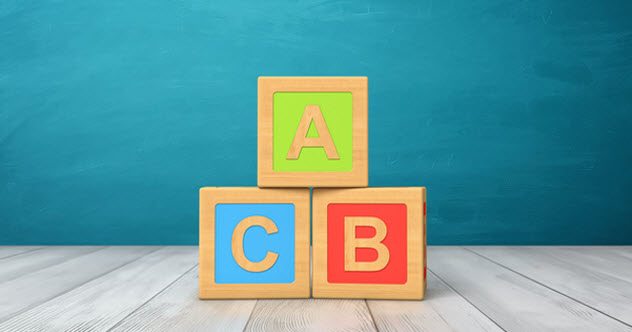
English has one of the world’s most widely used alphabetsand one of its most entertainingly unreliable spelling systems. Twenty-six letters are expected to represent roughly 44 speech sounds, hundreds of spelling patterns, numerous regional accents, and words borrowed from nearly every language willing to leave its vocabulary unattended.
That is a heroic workload for a fairly small alphabet.
Consider the letters in though, through, thought, tough, and cough. The same four-letter ending behaves differently in nearly every word. Meanwhile, queue uses five letters to produce one syllable that could be written with a single Q. English spelling often feels less like a system and more like a historical museum whose exhibits have escaped their cases.
Improving the English alphabet would not mean erasing the language’s history or forcing every speaker to pronounce words identically. It would mean creating clearer relationships between written symbols and spoken sounds while preserving readability, meaning, and regional variety. The following ten proposals range from practical adjustments to full-blown alphabet renovation.
Why Does the English Alphabet Need Improvement?
The modern English alphabet contains 26 letters inherited primarily from the Latin writing system. Spoken English, however, contains many more distinct sounds than those letters can represent individually. As a result, English relies heavily on digraphs such as sh, ch, th, and ng, along with larger letter combinations such as ough and tion.
The problem is not simply that English has complicated words. It is that the same letter can represent several sounds, while the same sound can be represented by many spellings. The letter C sounds different in cat, cent, and ocean. The long A sound appears in cake, rain, day, they, eight, and great. English gives readers clues, but sometimes those clues appear to have been left by a raccoon walking across a keyboard.
Spelling also preserves useful information. Related words such as electric, electricity, and electrician retain similar spellings even though the letter C changes pronunciation. Any serious English alphabet reform must therefore balance pronunciation, word history, meaning, and ease of learning.
1. Give Each Letter One Main Sound
The most important improvement would be a simple principle: one letter should have one primary sound. At present, English letters frequently moonlight in several unrelated jobs.
The letter A represents different vowel sounds in cat, father, about, call, and cake. The letter G is hard in game, soft in giant, and silent in sign. Y may function as a consonant in yes, a short vowel in myth, or a long vowel in happy.
A revised system could assign one basic sound to each letter and use consistent marks or letter combinations for variations. For example, A might always represent the vowel in cat, while long A could be written as ā or aa. Readers would still need to learn vocabulary, but they would not have to guess which personality a letter had chosen that morning.
2. Retire Cor Give It a Unique Job
C is arguably the alphabet’s most replaceable employee. Its hard sound in cat can be represented by K, while its soft sound in city can be represented by S. In many words, C performs work that another letter already knows how to do.
Benjamin Franklin noticed this redundancy when he proposed a reformed English alphabet in the 18th century. His plan removed C along with several other letters he considered confusing or unnecessary.
Modern reformers could follow that approach, turning cat into kat and center into senter. Another option would be to keep C but assign it exclusively to the sound currently written ch. Under that system, chair might become cair, while city would become sity.
C would not disappear; it would finally receive a job description.
3. End Q’s Dependence on U
Q is almost always followed by U in native English spelling, usually creating the sound heard at the beginning of quick. That makes Q less like an independent letter and more like the first half of a package deal.
A more efficient English alphabet could allow Q to represent the entire kw sound by itself. Quick would become qik, queen could become qeen, and question might begin with a single productive symbol rather than two letters pretending not to be inseparable.
Alternatively, English could retire Q and write the sound transparently as KW: kwik, kween, and kwest. This version would require no new symbol and would immediately show readers which sounds to pronounce.
Loanwords and names could retain Q where culturally appropriate. Alphabet reform should improve communication, not arrive at someone’s family name carrying a demolition permit.
4. Make X More Transparent
X usually represents a combination of sounds rather than one unique sound. In box, it represents KS. In exam, it often represents GZ. At the beginning of xylophone, it sounds like Z. One letter is doing the work of two letters, except when it decides to impersonate a third.
The simplest improvement would be to spell these sounds directly. Box could become boks, exam could become egzam, and xylophone could become zylophone.
English could then retire X or reassign it to a sound that lacks a dedicated symbol. For instance, X might represent the sound in measure, vision, and genre, which is currently written with several different combinations. Reusing X this way would give it a unique purpose instead of letting it occupy valuable alphabet space as a decorative abbreviation.
5. Bring Back Separate Letters for the Two TH Sounds
The letters TH represent at least two different sounds. Compare thin with this, or breath with breathe. The first sound is unvoiced; the second is voiced. English spelling usually gives readers no obvious way to distinguish them.
Old English had letters that could help solve this problem: thorn, written Þ or þ, and eth, written Ð or ð. A modernized system could assign thorn to the sound in thin and eth to the sound in this.
Under that proposal, three could become þree, while there could become ðere. The distinction would be visible immediately.
These symbols may initially look unusual, but so did @ before email made it famous. Give a character enough screen time and people will eventually act as though it has always lived on the keyboard.
6. Add Single Letters for SH, CH, NG, and ZH
English frequently uses two letters to represent one consonant sound. Common examples include SH in ship, CH in chair, and NG in sing. The sound in measure or vision, often called the ZH sound in pronunciation guides, does not even have one standard spelling.
A more phonetic English alphabet could add individual symbols for these sounds. The International Phonetic Alphabet already uses symbols such as ʃ for SH, ŋ for NG, and ʒ for the sound in measure. English would not necessarily have to adopt those exact characters, but they demonstrate that one-symbol solutions are possible.
Using single letters would shorten words and make decoding easier. Sing could end in ŋ rather than NG, and ship could begin with a dedicated symbol instead of a two-letter team.
The keyboard would need a modest update, but keyboards have survived emojis, currency symbols, and a button devoted entirely to capitalization. They can handle a few useful consonants.
7. Give the Schwa Its Own Letter
The schwa is the relaxed, neutral vowel heard in unstressed syllables. It appears at the beginning of about, the end of sofa, and in countless other everyday words. Linguists usually represent it with the symbol ə.
Despite being extremely common in spoken English, the schwa has no dedicated letter in the standard alphabet. It may be spelled with A, E, I, O, U, Y, or sometimes no clearly pronounced vowel at all.
Adding ə to ordinary English spelling could clarify the pronunciation of unstressed syllables. About might become əbout, while sofa could become sofə. This would be especially useful in dictionaries, language-learning materials, names, and early reading books.
At last, the most common background vowel in English would receive official recognition instead of continuing its career as an unpaid substitute.
8. Create a Consistent System for Vowels
English vowel spelling is where optimism goes to be tested. Five traditional vowel letters, plus occasional assistance from Y, must represent a much larger collection of vowel sounds. The result is a maze of silent E rules, vowel teams, exceptions, historical spellings, and words that appear to be setting traps.
A revised alphabet could distinguish short and long vowels with consistent marks. Short A could remain A, while long A could become Ā. Similar pairs could include E and Ē, I and Ī, O and Ō, and U and Ū. Another approach would use doubled vowels: made could become maad, while mad would remain unchanged.
No system would perfectly cover every American, British, Canadian, Australian, or regional pronunciation. However, a consistent vowel framework could provide a dependable base, with optional variations for major dialect differences.
English does not need every speaker to sound alike. It merely needs spelling to stop acting surprised that accents exist.
9. Mark Word Stress When It Matters
English spelling rarely shows which syllable receives the strongest stress, even though stress can affect pronunciation and meaning. Compare the noun record with the verb record, or the noun present with the verb present. The spelling stays the same while the stress shifts.
A small accent mark could remove the ambiguity: récord for the noun and recórd for the verb. Stress marks would be particularly valuable in dictionaries, textbooks, scripts, public-speaking materials, and resources for English learners.
They would not need to appear in every ordinary sentence. Like accent marks in pronunciation guides, they could be used when confusion is likely. This optional layer would improve the alphabet without turning every grocery list into an advanced linguistics exam.
10. Redesign Visually Confusing Letters
An improved English alphabet should consider appearance as well as pronunciation. Several characters are easy to confuse, particularly in certain fonts. Lowercase L, uppercase I, and the number 1 may look nearly identical. Uppercase O and zero can also become difficult to distinguish. The pairs b and d, p and q, or rn and m create additional challenges for beginning readers and digital displays.
Clearer standard letterforms could increase accessibility. A zero might always include a slash or dot. Uppercase I could retain horizontal bars. Fonts used in schools, transportation systems, medicine, and public safety could follow readability standards that keep similar symbols visibly distinct.
The alphabet could also reduce the dramatic visual differences between uppercase and lowercase forms such as A and a or G and g. Children should not have to learn that some lowercase letters are essentially the uppercase letters’ distant cousins visiting under assumed names.
Could a Reformed English Alphabet Actually Work?
Alphabet reform is easier to design than to implement. English is used across countries, industries, educational systems, software platforms, legal archives, and enormous collections of printed material. A sudden replacement would create confusion on a scale usually reserved for airport construction.
There is also no single English pronunciation. A perfectly phonetic spelling for a speaker in Boston may not match the pronunciation of a speaker in Texas, London, Lagos, Mumbai, or Sydney. Phonetic spelling can unintentionally favor one accent and make others appear incorrect.
The strongest solution would therefore be gradual and optional. Schools could introduce supplemental phonetic symbols alongside conventional spelling. Dictionaries and language-learning apps could provide a simplified display mode. New spellings could become accepted alternatives rather than mandatory replacements.
This is similar to changes that have already succeeded in American English. Noah Webster promoted spellings such as color instead of colour and center instead of centre. Reform did not arrive in one dramatic afternoon. It spread through schools, dictionaries, publishers, and ordinary use.
Experiences With a Better English Alphabet
The Experience of a Beginning Reader
Imagine a child seeing the word night for the first time. Under the current spelling system, the child must learn that K is silent, GH is silent, and I represents its “long” sound. The word contains five letters but only three obvious speech sounds. A simplified version such as nīt would let the child connect each written element directly to pronunciation.
The experience would not eliminate the need for instruction. Children would still learn vocabulary, grammar, comprehension, and the relationships between words. However, early reading could involve less guessing. Instead of memorizing why said, paid, and maid do not share the same vowel, learners could spend more attention understanding the sentence.
The Experience of an English-Language Learner
An adult learning English may recognize a word in writing yet hesitate to say it aloud. Words such as colonel, choir, island, and Wednesday provide few dependable clues to their everyday pronunciation. This can make intelligent, fluent learners feel less capable than they actually are.
A pronunciation-friendly alphabet would make independent learning easier. A dedicated schwa letter, visible stress marks, and consistent vowel symbols would help learners practice unfamiliar words without consulting an audio recording every time. Conventional spelling could remain beside the phonetic version, preserving access to existing books and documents while providing a useful bridge into spoken English.
The Experience of a Reader With Dyslexia
People with dyslexia have varied experiences, and no alphabet redesign would remove every reading difficulty. Still, clearer sound-symbol relationships and less visually confusing typography could reduce unnecessary obstacles. Distinct forms for lowercase B and D, uppercase I and lowercase L, or O and zero could make text easier to identify accurately.
More predictable spelling could also reduce the number of irregular words that must be memorized individually. The goal would not be to “fix” the reader. It would be to stop requiring the reader to perform additional detective work because the writing system refuses to label its clues properly.
The Experience of a Teacher or Editor
A teacher using a reformed alphabet would gain new tools but also face a significant transition. Students would need to understand both traditional spelling and simplified notation. Historical books, websites, and official documents would continue using the conventional alphabet, so replacing it completely would be impractical.
A dual system would offer a better experience. Teachers could use phonetic symbols to explain pronunciation, then connect those symbols to standard spellings. Editors could accept selected simplified forms as variants while preserving established spelling in formal contexts. Reform would become an additional literacy tool rather than a linguistic eviction notice.
The Experience of Typing and Reading Online
Digital technology could make alphabet improvement easier than it would have been in Franklin’s day. Software keyboards can add new characters without rebuilding a printing press. Search engines can recognize alternate spellings, and browsers can display a simplified text layer while storing the original version underneath.
At first, users would probably complain about unfamiliar symbols, accidentally type thorn while attempting an emoji, and debate whether the schwa deserved its own key. That is normal. Every writing technology creates an adjustment period. Predictive text, autocorrect, hashtags, and emojis once seemed strange too; now people use them while walking into furniture.
The most successful alphabet reform would quietly make communication easier. It would not demand that everyone abandon familiar spelling. It would offer clearer options and allow useful forms to spread naturally.
Conclusion: Improvement Without Erasing History
English’s alphabet is not broken, but it is carrying centuries of repairs, additions, borrowed parts, and spelling decisions made before modern pronunciation settled into place. Its irregularities preserve history and relationships between words, yet they also create avoidable difficulty for children, language learners, teachers, and many adult readers.
A better English alphabet could assign clearer sounds to letters, reduce redundant characters, restore useful symbols for TH, introduce letters for common digraphs, recognize the schwa, regularize vowels, show stress, and improve visual accessibility.
The best reform would be gradual rather than compulsory. Traditional spelling could remain available while phonetic alternatives appear in education, dictionaries, accessibility tools, and digital interfaces. English would keep its history without requiring every new reader to personally excavate it.
And perhaps one day, through, though, thought, and tough will finally agree to attend the same spelling meeting.
Editorial note: The proposals in this article are exploratory rather than prescriptive. English pronunciation varies widely across regions and communities, so any practical reform should preserve dialect diversity and remain compatible with conventional spelling.