Ask ten people where they would put a surprise pile of money, and at least several will say, “I’d buy a houappreciation. Someone’s uncle will confidently recommend a duplex despite having never owned anything more complicated than a lawn mower.
Housing occupies a special place in the American imagination because it is not merely an investment. A home is shelter, a lifestyle choice, a savings mechanism, a leveraged asset, andoccasionallya building that waits until Friday evening to reveal a plumbing emergency.
That combination helps explain why real estate investing remains so attractive. Stocks may offer liquidity, bonds may provide predictable income, and savings accounts may deliver peaceful sleep. Housing, however, promises something unusually powerful: the ability to use an asset every day while potentially building wealth through it.
That does not mean every property is a good investment. It means housing has structural, financial, and emotional characteristics that make it feel more compelling than almost any other asset class.
Housing Does Several Jobs at the Same Time
Most investments have one primary purpose. A stock represents ownership in a company. A bond is a loan that produces interest. Gold sits somewhere safe and looks important.
A home is different. It provides a place to live while also serving as a potential store of value. An investment property may produce rental income, appreciate over time, qualify for certain tax deductions, and give its owner direct control over improvements and operations.
Housing is also an expense people must address whether they invest or not. Everyone needs somewhere to live. Because housing has historically been the largest spending category for American households, buying can feel like converting a necessary monthly expense into ownership rather than sending the entire payment to a landlord. “I have to pay for housing anyway” argument is emotionally persuasive. It is not always mathematically correctrenting can be the better financial choicebut it makes homeownership feel practical rather than speculative.
Mortgage Payments Create a Forced-Savings System
One of housing’s strongest features is the way a traditional mortgage gradually turns monthly payments into home equity.
With a fixed-rate mortgage, part of each principal-and-interest payment covers interest, while another portion reduces the outstanding loan balance. Early payments are interest-heavy, but the amount applied to principal generally increases as the loan matures. creates a form of forced savings. A homeowner does not need to wake up every month feeling unusually disciplined. The mortgage schedule handles part of the wealth-building process automatically.
A Simple Equity Example
Imagine that a buyer purchases a $400,000 home with an $80,000 down payment and a $320,000 mortgage. Over time, three things may increase the owner’s equity:
- The mortgage principal is gradually repaid.
- The property may appreciate.
- Renovations or improved management may raise its market value.
If the property later becomes worth $450,000 and the mortgage balance has fallen to $300,000, the owner has approximately $150,000 in gross equity before selling costs and taxes. That is the appeal in one tidy calculation: ordinary payments can slowly create a substantial asset.
Renters can absolutely build wealth by investing the difference between renting and owning. The awkward part is that “invest the difference every month for 20 years” requires more consistent behavior than most people care to admit. A mortgage is less flexible, but that rigidity can be financially useful.
Leverage Can Magnify the Return on Cash Invested
Housing is one of the few major assets that ordinary consumers can purchase with a large amount of borrowed money at relatively long repayment terms.
Consider the same $400,000 property purchased with $80,000 down. If its value rises 3%, the property gains $12,000. Compared with the $80,000 down payment, that represents a 15% gross increase before financing costs, transaction expenses, maintenance, and taxes.
This is leverage doing what leverage does: making changes in the asset’s value much larger relative to the investor’s original cash contribution.
Unfortunately, leverage does not sign a contract promising to work only in the owner’s favor. If the property’s value falls, the percentage loss on the owner’s equity can also be magnified. A highly leveraged buyer who must sell during a downturn may lose the down payment, improvement costs, and additional money at closing.
Leverage makes housing exciting, but it also turns poor timing and weak cash reserves into serious risks.
Home Prices Tend to Reward Patient Owners
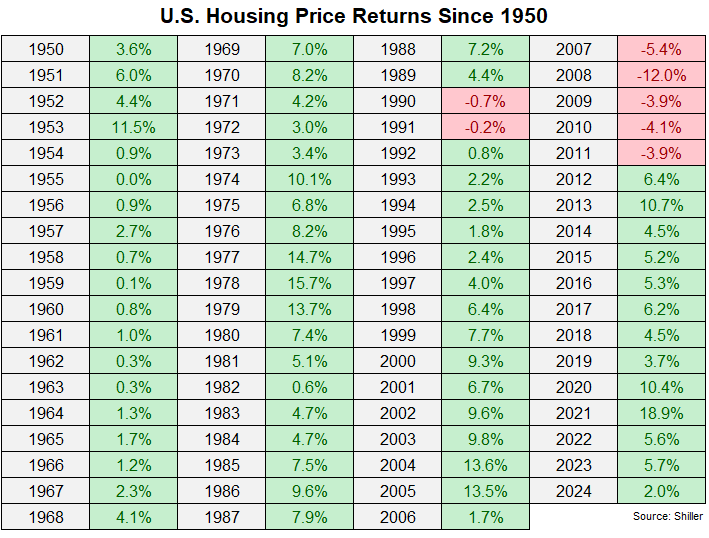
Real estate investors often describe housing as an appreciating asset. Over long periods, home values may rise because of population growth, household formation, wage growth, inflation, land scarcity, construction expenses, zoning restrictions, and demand for desirable locations.
Recent national data illustrate why the appreciation narrative remains appealing, even in a slower market. The Federal Housing Finance Agency reported that U.S. house prices increased 1.7% between the first quarter of 2025 and the first quarter of 2026, with gains recorded in 42 states. while, the median price of an existing U.S. home reached approximately $440,600 in June 2026. That number does not mean every owner made money, but it demonstrates how large the housing asset class has become. available inventory can support prices as well. In the first quarter of 2026, the national homeowner vacancy rate was only 1.1%, indicating that relatively little owner housing sat vacant and available for sale. l, national averages are not personal guarantees. A property in a growing employment center can perform very differently from a similar-looking home in an area losing jobs and residents. The real estate market is not one market; it is thousands of local markets wearing the same name tag.
Rental Property Can Produce Several Types of Return
An owner-occupied home primarily provides housing and equity growth. A rental property can add recurring income to the equation.
A well-purchased rental may generate returns from four sources:
- Monthly cash flow after operating expenses and debt payments
- Mortgage principal reduction funded partly by tenant rent
- Long-term property appreciation
- Potential tax benefits associated with operating and depreciating the property
This combination is difficult to find in simpler investments. A rental owner can collect income today while holding an asset that may become more valuable tomorrow.
The important number, however, is not gross rent. It is net operating income after vacancy, maintenance, management, taxes, insurance, utilities paid by the owner, association fees, legal costs, and capital expenditures.
A property renting for $2,500 a month does not produce $30,000 in annual profit merely because a calculator can multiply by twelve. Roofs, water heaters, vacancies, and local governments would all like to join the calculation.
Fixed-Rate Debt Can Become More Comfortable Over Time
A fixed-rate mortgage can provide long-term predictability. The principal-and-interest portion of the payment remains constant, even if wages, rents, and general prices increase.
Property taxes, insurance, utilities, and maintenance can still rise, so homeownership costs are never completely fixed. Nevertheless, locking in the largest portion of the payment may protect an owner from the full effect of future rent increases.
This benefit becomes more noticeable after years of income growth. A mortgage payment that feels intimidating in year one may consume a smaller percentage of household income in year ten, assuming earnings rise and the borrower avoids repeated cash-out refinancing.
Financing conditions matter enormously, though. As of July 23, 2026, the average U.S. rate on a 30-year fixed mortgage was 6.58%. At rates near that level, buyers must be especially careful not to assume that modest appreciation will automatically overcome interest and ownership costs. Tax Code Can Favor Rental Real Estate
Rental property owners may generally deduct eligible operating expenses such as mortgage interest, real estate taxes, insurance, maintenance, utilities, and depreciation, subject to applicable tax rules and limitations. eciation is particularly interesting because it allows an investor to allocate the cost of the residential structurenot the landover a specified recovery period. This noncash expense may reduce taxable rental income even when the property’s market value has not declined.
Tax benefits should never rescue a fundamentally bad deal. Saving part of a dollar in taxes is not a victory if the investor lost the entire dollar through weak cash flow, excessive repairs, or an inflated purchase price.
Tax treatment also depends on property use, income, ownership structure, holding period, and current law. A qualified U.S. tax professional should review any significant real estate strategy.
Housing Feels Safer Because It Is Tangible
Investors can see a house, walk through it, repair it, rent it, insure it, and argue about the kitchen cabinets. That physical presence creates a sense of control.
Unlike a shareholder with a microscopic interest in a public company, a property owner can directly influence the asset. Painting, remodeling, improving energy efficiency, adding a bedroom where legally permitted, screening tenants carefully, or managing expenses may increase income or value.
This is especially attractive to entrepreneurial investors. They do not have to wait for a corporate executive to improve performance. They can create value themselvessometimes with thoughtful renovations, and sometimes by removing the mysterious carpet installed in a bathroom in 1987.
The downside is that control comes with responsibility. A stockholder is not called at midnight because a pipe has burst. A landlord might be.
Homeownership Is Closely Connected to Household Wealth
For many American families, home equity is one of the largest components of net worth. Federal Reserve research found that rising net housing wealth contributed substantially to net-worth growth among much of the income distribution between 2019 and 2022. he first quarter of 2026 alone, the aggregate value of real estate on household balance sheets increased by approximately $0.8 trillion, even as the value of directly and indirectly held equities declined. e patterns reinforce the cultural belief that buying a home is a major step toward financial security. A paid-off or lightly mortgaged home can reduce housing expenses in retirement, provide borrowing capacity during emergencies, or become an asset transferred to heirs.
However, the connection between homeownership and wealth does not prove that buying automatically causes every household to become richer. Homeowners often differ from renters in income, age, savings, and financial stability. Outcomes also vary significantly by neighborhood, purchase price, mortgage terms, maintenance quality, and length of ownership.
Housing Offers Emotional Returns That Financial Models Miss
A spreadsheet can estimate mortgage interest, cash flow, and appreciation. It cannot fully measure the value of stability, privacy, control, community ties, or the freedom to paint a bedroom an alarming shade of orange without requesting permission.
For families, a home may provide continuity for schools, relationships, pets, hobbies, and caregiving. For retirees, it may offer familiarity and independence. For immigrants and first-generation buyers, ownership may represent security and achievement as much as financial return.
These benefits are real even when they do not appear in an investment calculation. They also explain why people sometimes accept lower financial returns from a home than they would demand from a purely financial asset.
Why Housing Is Not Automatically a Great Investment
The enthusiasm surrounding real estate can make its weaknesses easy to overlook.
It Is Illiquid
A stock can usually be sold in seconds. Selling a home may require preparation, repairs, showings, negotiations, inspections, financing approval, and weeks of closing work. In a weak market, the process may take months.
It Concentrates Risk
A homeowner may place most of their net worth in one building, in one neighborhood, within the same local economy that provides their job. Brookings has noted that housing is both illiquid and undiversified, while local home values can be connected to local labor-market conditions. major employer leaves town, an owner could face job insecurity and falling property demand at the same time.
Transaction Costs Are High
Buying and selling may involve lender fees, appraisals, inspections, title services, transfer taxes, commissions or other agent compensation, moving costs, and repairs. These costs are a major reason short ownership periods can produce disappointing results.
Ownership Costs Keep Changing
The mortgage is only one line in the budget. Buyers must account for property taxes, homeowners insurance, mortgage insurance when applicable, association fees, utilities, repairs, and regular maintenance. The Consumer Financial Protection Bureau specifically advises buyers to include these expenses when estimating affordability. e non-mortgage expenses have become particularly important. Harvard’s 2026 housing report found that U.S. property taxes rose 31% between 2019 and 2025, while average monthly homeowners insurance premiums increased 72%. ces Can Fall
Housing does not appreciate on command. Prices can decline because of overbuilding, population loss, high interest rates, environmental risks, weak employment, unaffordable insurance, deferred maintenance, or an economic downturn.
The right lesson is not that housing is unsafe. It is that a successful real estate investment needs adequate cash reserves, conservative assumptions, sensible financing, and enough time to survive an unfavorable cycle.
How to Evaluate a Housing Investment Rationally
A buyer should separate the emotional desire to own property from the financial quality of a specific deal.
Calculate the All-In Monthly Cost
Include principal, interest, property taxes, insurance, association fees, utilities, maintenance, and a reserve for major replacements. For a rental, add vacancy, management, leasing, legal, accounting, and turnover costs.
Stress-Test the Numbers
Ask what happens if the property sits vacant, insurance increases, a tenant stops paying, a roof requires replacement, or the property value remains flat for five years. A deal that works only under cheerful assumptions is not an investment plan. It is fan fiction.
Study Local Fundamentals
Review employment diversity, household growth, housing construction, neighborhood safety, schools, transportation, taxes, insurance availability, natural-hazard exposure, and local landlord regulations.
Protect Liquidity
A down payment should not consume every available dollar. Owners need emergency savings because property expenses have an almost supernatural ability to arrive in groups.
Plan to Hold Long Enough
Longer ownership gives appreciation and principal repayment more time to offset transaction costs. Buyers expecting to relocate soon should compare ownership with renting carefully rather than assuming buying is always superior.
Real-World Experiences: What Housing Investors Often Learn
The following composite experiences reflect common situations faced by homeowners and small real estate investors. They illustrate why housing can be rewarding without pretending that every closing ends with dramatic music and instant wealth.
The Buyer Who Won by Staying Put
Consider a couple who buys a modest home after comparing dozens of listings. The first year feels financially uncomfortable. Their mortgage payment is higher than their previous rent, the yard appears to grow weeds professionally, and the air-conditioning system demands an expensive repair before the first summer is over.
For several years, the property’s value barely moves. Friends who invest in technology stocks tease them about their slow, boring house. The couple keeps making payments, maintains the property, and avoids borrowing against the equity for vacations or new cars.
A decade later, the result looks different. Their incomes have increased, but the principal-and-interest payment has not. The mortgage balance is lower, comparable rents have risen, and the neighborhood has benefited from new employers and transportation improvements.
Their success did not come from predicting the perfect moment to buy. It came from purchasing within their means, holding through an uneventful period, and allowing time to do most of the work. Housing rewarded patience rather than brilliancewhich is encouraging news for those of us who cannot predict next Tuesday.
The Landlord Who Confused Rent With Profit
Another investor buys a small rental after seeing a social-media video promising “passive income.” The property rents quickly, and the first payment feels like free money.
Then reality begins submitting invoices. A tenant moves out unexpectedly. The unit needs paint, flooring, appliance repairs, cleaning, and several weeks of advertising. Property taxes increase, and the insurance renewal is higher than expected. The investor discovers that rental income is passive in roughly the same way a sleeping toddler is quiet: technically true, but conditions may change without notice.
After the expensive first year, the owner changes strategy. Future rent projections include vacancy, maintenance, management, and capital reserves. A separate bank account holds money for repairs. Tenants are screened consistently, and preventive maintenance receives more attention.
The property eventually becomes profitable, but the owner’s most valuable return is education. Gross rent is a headline; net cash flow is the story.
The Investor Who Made Money by Not Buying
A third buyer finds a renovated property in a fashionable neighborhood. The photographs are beautiful, the open house smells suspiciously like fresh cookies, and competing offers create pressure to act immediately.
Instead, the buyer runs conservative numbers. At the asking price, the expected rent barely covers the mortgage, taxes, and insurance. There is no meaningful allowance for vacancy or repairs. The roof is old, the neighborhood has substantial new construction planned, and the deal depends on rapid appreciation.
The buyer walks away. The property later sells to someone else, so there is no triumphant discount or cinematic victory. Yet keeping the down payment liquid allows the buyer to purchase a less glamorous duplex the following year at a price supported by actual rental income.
This experience highlights an underrated principle: real estate wealth is often protected at the moment an investor declines a weak deal. Housing may be everyone’s favorite investment, but “favorite” should never mean “buy at any price.”
Conclusion
Housing remains a favorite investment because it combines financial utility with everyday usefulness. It can create equity through mortgage repayment, amplify returns through leverage, produce rental income, offer potential tax advantages, and provide emotional benefits that no brokerage statement can measure.
It can also concentrate wealth in one illiquid asset while producing unpredictable expenses, significant transaction costs, and exposure to local economic or environmental risks.
The most successful owners usually avoid treating a home as a lottery ticket. They buy at a manageable price, maintain adequate reserves, study the local market, use conservative financing, and hold long enough for principal reduction and economic growth to matter.
Housing is not magical. It is simply one of the rare investments people can live in, improve, finance over decades, rent to others, and eventually pass to the next generation. That unusual combination is why Americans continue to love real estateeven while standing in a hardware store on Saturday morning, holding a broken faucet and questioning every decision that led them there.
Note: This article is provided for general educational purposes and should not be considered personalized investment, legal, mortgage, or tax advice. Real estate outcomes and tax treatment vary by property, location, financing structure, and individual circumstances.