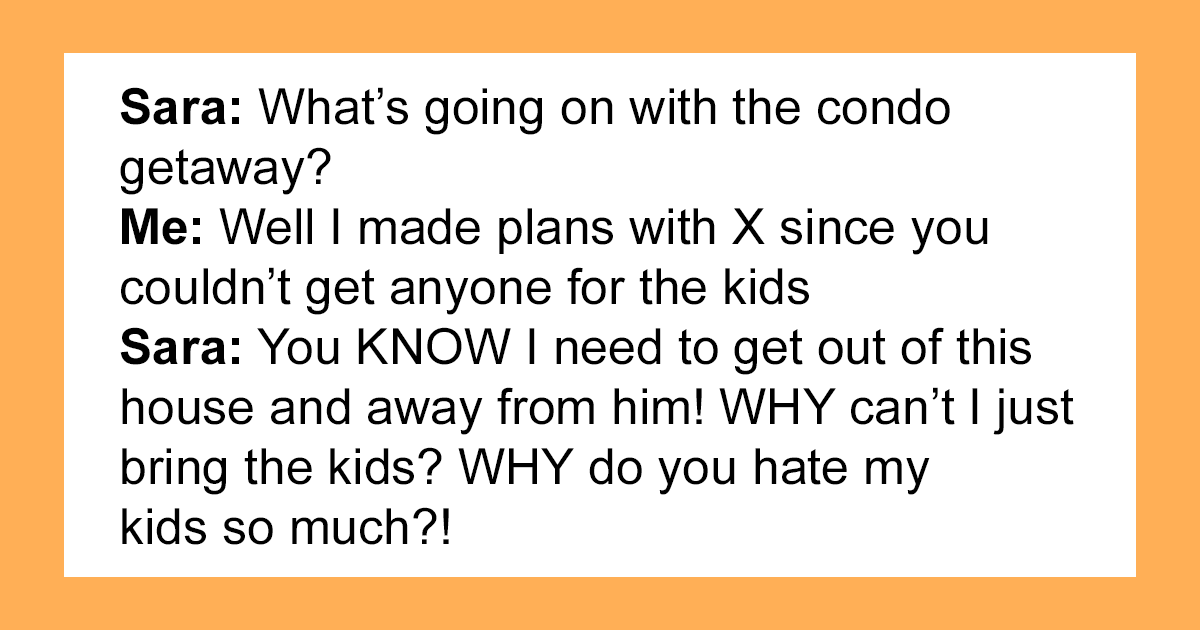
Some internet stories are messy in a fun, pass-the-popcorn way. Others are messy in a way that makes half the comment section yell, “Oh no, this is not about the vacation.” This story belongs squarely in category two.
At first glance, the conflict sounds simple enough: a woman wants to join a trip, but her friend doesn’t want the kids to come. Cue hurt feelings, raised voices, and a dramatic emotional weather system rolling across the group chat. But scratch the surface for about three seconds and the real plot twist appears: the husband apparently refuses to watch his own children, the mother sounds desperate for a break, and the friend who planned the trip is suddenly expected to turn an adults-only getaway into Parenting: The Beach Edition.
That is why this story hit such a nerve online. It isn’t really about one trip. It’s about what happens when one parent becomes the default parent, when a partner treats solo childcare like a rare act of battlefield courage, and when friends are expected to absorb the consequences of a couple’s broken division of labor. In other words, it is about modern family life, invisible work, and the very shaky bridge between empathy and boundaries.
Also, let’s say the quiet part out loud: watching your own children is called parenting. Not babysitting. Not “helping.” Parenting. Gold star stickers are not issued for remaining in the same zip code as your offspring.
Why This Story Feels So Familiar
Whether every detail of a viral post is perfectly documented or not, the emotional setup feels painfully believable because so many families live some version of it. One parent carries the planning, the school details, the appointments, the emotional triage, the snack diplomacy, the birthday calendar, and the endless mental tabs open in their brain. The other parent may love the kids, sure, but somehow still behaves like the operations manager of family life is somebody else.
That imbalance matters. When one person becomes the default parent, even simple plans start to feel complicated. A coffee date turns into sitter logistics. A weekend away becomes a hostage negotiation. A basic wish for adult time gets recast as selfish, unrealistic, or anti-family. That is how resentment grows legs.
In this story, the mother’s reaction reads less like a villain monologue and more like the cry of someone who feels trapped. That does not make her behavior fair. It does make it understandable. People who feel unsupported at home often start looking for relief anywhere else: from friends, from grandparents, from last-minute favors, from the magical kingdom of “Can’t they just come this once?”
The trouble is, relief borrowed from the wrong place usually arrives with a side of collateral damage.
This Was Never Just About Bringing The Kids
When someone says, “Why can’t I just bring the kids?” it can sound reasonable on the surface. After all, kids travel. Families travel. Some children are delightful little beach goblins who can build a sandcastle, demand five snacks, and somehow still look photogenic by sunset.
But an adults-only trip and a trip with children are not the same product in different packaging. They are different vacations entirely.
Kids change the schedule
Adults can wander. Kids need structure. Adults can eat dinner at 9 p.m. Kids may hit meltdown o’clock at 6:17. Adults can nap after brunch and spontaneously decide to go dancing later. Kids introduce bedtime, supervision, packing lists, backup clothes, and the constant possibility that someone will cry because a french fry looked at them wrong.
Kids change the energy
Even well-behaved children change the emotional temperature of a trip. Adults censor themselves more. Conversation shifts. Activities narrow. Noise rises. Rest becomes more theoretical than actual. And if the parent who brought the kids is already overwhelmed, everyone else often ends up absorbing the tension.
Kids change the labor
This is the part people pretend not to notice. Bringing children into a group trip rarely affects only the parent. It affects whoever is nearby when a child needs help, entertainment, supervision, patience, snacks, or a witness to an elaborate story about a shell they found. Even generous friends can start to feel less like guests and more like unpaid assistant camp counselors in linen pants.
So no, the friend who said no was not necessarily being cruel. She may simply have been protecting the trip she agreed to take.
The Husband Problem Is The Real Earthquake
If the husband truly refuses to ever watch the kids alone, that is the biggest problem in the whole story by a mile. Not the vacation. Not the friend. Not even the argument. The marriage.
A parent who acts like solo childcare is impossible creates a system where the other parent is never fully off-duty. That means no true rest, no reliable independence, and no realistic ability to show up in friendships, work, or personal life as a whole person. It is exhausting to parent. It is even more exhausting to parent while also managing another adult’s refusal to parent.
This dynamic can hide behind a lot of excuses. He’s bad at bedtime. The kids prefer mom. He works long hours. He gets overwhelmed. He doesn’t know the routine. He’s just not as good at it. And yet, mysteriously, nobody says this about mothers. Mothers are expected to figure it out, fast, tired, and with a granola bar in one hand.
That is why so many readers hear stories like this and think: the friend is not the villain, she is just the nearest available wall that the mother is crashing into.
Why The Friend Is Allowed To Have Boundaries
Friendship is not a legal obligation to turn every personal plan into a community support service. A good friend can be compassionate and still say no. In fact, some friendships survive precisely because one person was brave enough to say no before resentment got moldy.
The friend in this story was not saying, “I hate your children.” She was saying, “I do not want this particular trip to become a trip with children.” Those are not the same sentence, no matter how emotionally convenient it might be to pretend otherwise.
There is also a bigger social awkwardness here: parents are often judged if they leave their kids behind, but friends are also judged if they don’t want kids included. It is a lose-lose setup wrapped in guilt. The result is that many people stop saying what they actually mean. They hint. They dodge. They say maybe when they mean absolutely not. Then, when the truth finally emerges, it arrives wearing combat boots.
Healthy boundaries sound boring, but they are often the only thing standing between a minor disappointment and a friendship-ending disaster. “I love you, but I want this to stay adults-only” is a boundary. “You have to let me bring my kids because my husband won’t parent” is not a boundary. It is a pressure campaign.
The Invisible Load Behind One Explosive Question
The most revealing line in the whole headline is not about the friend. It is the mother asking why she can’t just bring the kids. That little word, just, is doing backflips.
Just bring the kids.
Just shift the vibe.
Just adjust the plans.
Just understand.
Just help me carry what my partner will not.
That is what makes the story resonate. The mother is not merely asking for flexibility. She is asking the outside world to compensate for a shortage inside her own home. And that is where so many women get stuck: their partners underperform, their children still need them, and their social world becomes the backup generator.
But backup systems fail too. Friends get tired. Siblings stop picking up the phone. Grandparents have limits. Coworkers cannot keep covering. The house of cards eventually wobbles, and when it does, people often blame the nearest person who said no instead of the person who never stepped up in the first place.
What Each Person Could Have Done Better
The mother
She had every right to want a break. She did not have the right to demand that someone else redesign the trip around her crisis. A better move would have been honesty without pressure: “I don’t have childcare, I’m embarrassed, I’m overwhelmed, and I may need to sit this one out.” That would have been sad, yes, but also adult. Sometimes maturity looks suspiciously like disappointment with better posture.
The husband
He needed to parent his children. Fully. Competently. Without acting like he deserved a parade route for knowing where the pajamas live. If one parent cannot leave the house because the other refuses to manage alone, that is not a scheduling hiccup. That is a structural failure.
The friend
If she was direct, she probably did the right thing. Still, direct does not have to mean icy. There is room for kindness: “I love you, and I know you need a break. But I really want this to stay child-free. Let’s plan something else soon that works better.” Boundaries land better when they are clear and humane, not vague and resentful.
Adults-Only Time Is Not Anti-Kid
Some of the most exhausted parents in America need to hear this in twelve-foot letters: wanting time away from your children does not make you a bad parent. It makes you a human being with a nervous system.
Friend trips, date nights, solo walks, quiet hotel rooms, brunches where nobody asks for your straw and then somehow cries about having your straw, all of that can be healthy. Parents do not stop being people when they have children. In fact, losing every non-parent identity is one of the fastest routes to burnout.
The irony in stories like this is that the mother probably wanted the same thing the friend wanted: peace, adult conversation, and a short break from constant caregiving. The difference is that the friend tried to protect those conditions, while the mother, stuck in survival mode, tried to drag her entire problem set into the getaway and hope it would somehow still feel restful. Spoiler: it would not.
The Bigger Lesson Behind The Vacation Drama
This story works as internet drama because it has clear sides. But real life is sloppier. The mother may be overwhelmed. The friend may be frustrated. The husband may be the real source of the problem. The kids may simply be kids, doing the very normal child thing of requiring care. Nobody wins if the conversation stops at, “Was the friend too harsh?”
The better question is this: why do so many mothers reach a point where a girls’ trip starts feeling like their only escape hatch?
That question leads straight to the real subjects: unequal labor, emotional overload, social expectations, and the still-stubborn cultural habit of treating fathers as optional substitutes instead of equal parents. Until those things improve, stories like this will keep showing up online, dressed as petty disputes when they are really distress flares.
So yes, the friend was allowed to say no. And yes, the mother likely needed help. Both things can be true at once. But the person who most needed to hear “absolutely not” may have been the husband, long before the vacation ever came up.
Related Real-Life Experiences That Make This Story Hit Even Harder
If this headline made people react with a little too much passion, it is probably because many readers have lived a version of it already. Not the exact beach trip, maybe. Not the exact friend group. But the same emotional geometry shows up everywhere.
There is the mom who cannot attend a one-hour birthday dinner because her husband says he is “not comfortable” doing bedtime alone. Translation: she stays home, the pasta gets cold in the restaurant, and everyone politely pretends this is a scheduling issue instead of a giant neon sign flashing inequality.
There is the friend who hosts an adults-only cabin weekend after six straight months of hearing, “We should totally get away sometime.” She books the place, plans the meals, buys the wine, and then, three days before departure, someone asks if two children and a tablet with no headphones can “just tag along.” Suddenly the organizer is cast as cold-hearted for wanting the event she actually planned.
There is the woman who goes on a family vacation with another couple and learns, too late, that “family vacation” secretly means she will help entertain children while the parents drift in and out of relaxation mode like suspiciously carefree cruise directors. She comes home more tired than when she left and spends the next year declining group trips with the enthusiasm of a person avoiding tax fraud.
There is also the quieter experience many mothers talk about but rarely advertise: the mental preparation required to leave home for even a short break. It is not just packing a bag. It is making the lunch plan, setting out the pajamas, writing the emergency numbers, texting reminders, pre-answering questions, locating the medicine, labeling the snacks, and praying nobody calls to ask where the extra socks are. By the time she leaves, she has already done enough project management to qualify for a promotion.
On the flip side, there are child-free friends who genuinely love their friends’ kids, buy them birthday gifts, kneel down to hear their dinosaur stories, and still do not want every brunch, weekend, and vacation to become family programming. That does not make them selfish. It makes them honest. Adults are allowed to want adult spaces. Friendship does not require permanent access for strollers, sticky fingers, and the soundtrack of someone yelling “Mom!” from another room every forty seconds.
And then there are the parents who have figured out a healthier rhythm, and their stories feel like tiny beams of hope. The dad who says, “Go. I’ve got the kids.” The couple who alternate weekends off. The family that treats both parents as fully trained adults, not one manager and one occasional substitute teacher. The friend who says, “No worries, let’s reschedule,” without shame or drama. Those stories are less viral, of course, because functional behavior is terrible clickbait. But they matter. They prove this kind of conflict is not inevitable.
That may be the most useful takeaway of all. The problem is not that parents need breaks. The problem is when the system around them makes those breaks nearly impossible, then expects everyone else to absorb the fallout. Once you see that pattern, stories like this stop looking like random online meltdowns and start looking like what they really are: a snapshot of how badly some families still divide care, time, and freedom.
Conclusion
The internet loves a juicy vacation argument, but this one sticks because it reveals something deeper than travel etiquette. A friend’s adults-only boundary collided with a mother’s desperation for relief, and behind both of them stood an even bigger issue: a husband who apparently refuses to parent solo. That is the real reason this story feels so loaded.
No, the friend did not have to turn the trip into a kid-friendly retreat. Yes, the mother deserved empathy. And yes, a parent who cannot leave the house because their partner will not manage the children alone is dealing with a much bigger crisis than one missed vacation. If this story teaches anything, it is that the real fix is not forcing friends to be more flexible. It is building homes where both parents carry the work, both adults respect boundaries, and nobody has to beg for one peaceful weekend like they are applying for diplomatic immunity.