Every major sporting event has its own highlight reel: the impossible comeback, the emotional celebration, the celebrity reaction shot, and, occasionally, the one fan who accidentally auditions for the role of Internet Villain of the Week. At the 2025 US Open, that role was filled not by a double fault, a heated umpire exchange, or a dramatic racket smash, but by a courtside souvenir moment involving a tennis cap, a young fan, and a grown man who looked like he had just mistaken the Arthur Ashe spotlight for a checkout lane at a clearance sale.
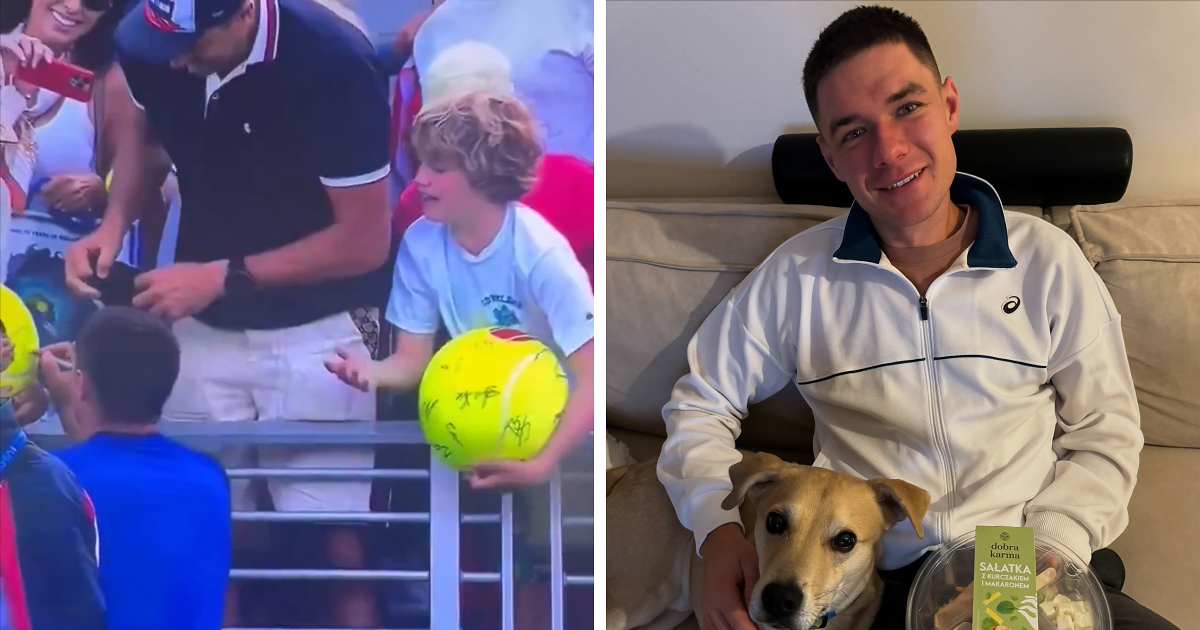
The viral incident unfolded after Polish tennis player Kamil Majchrzak scored a thrilling second-round victory over ninth-seeded Karen Khachanov. Fresh off one of the biggest wins of his career, Majchrzak did what many athletes do after a long, emotional match: he signed autographs and tried to give a piece of memorabilia to a young fan. The item was simplea hat. The meaning, however, was enormous. To a child at the US Open, a signed cap from a player after a five-set battle is not just fabric and stitching. It is a trophy, a story for school, and possibly the reason a kid spends the next decade pretending the garage door is a practice wall.
Then came the grab. Cameras caught an adult man taking the hat before the child could fully receive it. The moment spread across social media with the speed of a Novak Djokovic return, and viewers quickly turned the clip into a public trial of manners, entitlement, and how not to behave when a kid is standing beside you. The man was later identified in reports as Polish businessman Piotr Szczerek, associated with the paving company Drogbruk. He later apologized publicly, saying he believed the hat was intended for his sons and that he had made a serious mistake.
What Actually Happened at the US Open?
The setting matters. This was not a random practice court or a quiet autograph line. It happened after a dramatic US Open match in New York, where Majchrzak rallied to defeat Khachanov in a five-set marathon. That kind of win brings chaos: cameras, fans leaning over railings, players moving quickly, kids calling for signatures, and adults suddenly acting like limited-edition tennis gear comes with retirement benefits.
Majchrzak appeared to sign or prepare the hat for a young fan named Brock. Video showed the child standing near the courtside barrier, waiting for the gift. In the crowded split second that followed, the adult beside him reached in, took the cap, and placed it away. The boy’s disappointment was visible enough that the Internet did not need subtitles. Within hours, the clip was circulating on TikTok, X, Instagram, Facebook, Reddit, and news sites, gathering the usual ingredients of a viral scandal: outrage, detective work, jokes, screenshots, and people saying “I’m not usually online, but…” while very much being online.
The phrase “US Open hat snatcher” quickly became the headline-friendly label. It was short, dramatic, and easy to understand. It also captured why people reacted so strongly. The object was small, but the optics were enormous: an adult taking a keepsake that many believed was meant for a child. In the court of public opinion, that is roughly as popular as cutting in line at a school bake sale and then complaining the brownies are too chewy.
Why the Internet Connected It to Coldplay
The line “Where’s Coldplay when you need them?” is not about tennis strategy, unless Chris Martin has secretly developed a wicked backhand. It is a joke referencing another 2025 viral moment: the Coldplay concert “kiss cam” incident involving executives from the tech company Astronomer. That video also spread widely, drew intense public attention, and became a shorthand for one uncomfortable truth of modern life: cameras are everywhere, and public behavior can become global content before you have time to say, “Please delete that.”
In the US Open hat story, the Coldplay reference works because both incidents involve high-profile adults, public settings, and video clips that became instant reputation storms. The joke suggests that if Coldplay’s camera could expose one awkward corporate moment, maybe the band should be on standby at every sports venue, grocery store, airport boarding gate, and children’s birthday party. The Internet loves a callback, and this one had just enough sting to travel.
But beneath the humor is a serious lesson: public behavior is no longer local. A bad moment in row three can become a headline in multiple countries. The smartphone crowd is not just watching; it is documenting, replaying, zooming, captioning, translating, and occasionally adding dramatic music for emotional seasoning.
The Man Identified and the Apology That Followed
After online users and media outlets identified the man as Piotr Szczerek, the backlash became more intense. The story expanded from “rude fan at tennis match” into “business executive caught in viral controversy.” That shift is important because leadership roles come with an unspoken social contract. People expect executives, owners, and public figures to demonstrate judgment, especially in situations involving children. Fair or not, the crowd tends to ask: if this is how someone acts over a hat, how do they act when the stakes are actually high?
Szczerek later issued an apology, saying he mistakenly thought the cap was meant for his sons, who had reportedly been asking for autographs. He acknowledged that his actions hurt the child and disappointed fans. He also said the hat was returned and that he had apologized personally. In crisis-communication terms, that was the necessary move: admit fault, avoid attacking critics, clarify false claims, and make restitution.
Still, the apology arrived after the clip had already built its own momentum. That is the difficult part of viral reputation damage. Once a simple story has a villain, a victim, and a clear visual, it becomes very hard to reframe. The public sees the clip before it reads the explanation. The meme arrives before the context. The joke travels faster than the apology. By the time the formal statement appears, the Internet has already written the first three drafts of the character profile.
Kamil Majchrzak Turned the Story Around
The best part of the incident came not from the outrage, but from the response by Majchrzak. After learning what happened, the Polish player helped locate the young fan and later met with him. Brock received a replacement signed hat and additional US Open gifts. The photos and videos from that reunion gave the story the happy ending people wanted: the child smiled, the player showed kindness, and the Internet briefly remembered that it is allowed to cheer for something wholesome without adding a conspiracy thread.
Majchrzak’s response mattered because it shifted the emotional center of the story. Instead of leaving the moment as a sour viral clip, he created a better final scene. In sports, athletes often talk about inspiring the next generation. This was exactly that, but without the polished commercial voiceover. A player noticed a disappointed kid and fixed what he could. That kind of gesture is small in cost but massive in impact.
It also reminded fans that athletes are often juggling more than we see. Majchrzak had just endured a physically demanding match, was managing media attention, and later had to leave the tournament because of injury. Even so, he took time to make sure a young fan did not remember the US Open only as the day an adult took his souvenir. That is classy. That is memorable. That is the sort of public-relations lesson no consultant can manufacture.
Why a Hat Became Such a Big Deal
Some people inevitably asked, “Why is everyone so worked up? It was just a hat.” Technically, yes. And a wedding ring is just metal, a diploma is just paper, and the last slice of pizza is just bread with toppingsuntil someone else takes it. Objects become important because of what they represent. At a Grand Slam, a signed hat from a player can represent access, inspiration, and a once-in-a-lifetime memory.
The public reaction was not only about the cap. It was about fairness. Most people understand the basic rule: when a player gives something to a kid, adults should not compete for it like it is the final avocado at brunch. Sports memorabilia can make people act strangely, especially when cameras are rolling and adrenaline is high, but there is a difference between enthusiasm and entitlement.
The clip hit a nerve because it showed a familiar social frustration. Everyone has seen an adult elbow into a children’s space, ignore a queue, talk over someone smaller, or grab a benefit meant for someone else. The US Open moment was not unusual because the behavior was unimaginable. It went viral because it was instantly recognizable.
The Reputation Lesson for Executives and Public Figures
For business leaders, the incident became a case study in modern accountability. A person’s title does not stay neatly inside the office. In an age of viral video, an executive’s public behavior can reflect on a company within minutes. A single awkward clip can drag a brand name into headlines even when the company has nothing to do with the event.
That does not mean every viral controversy deserves permanent punishment. People make mistakes, and public shaming can become excessive. But it does mean leaders should understand the visibility of their actions. The standard is not perfection. The standard is awareness, humility, and the ability to repair harm quickly. In this case, the apology and return of the hat were important, but the delay allowed outrage to harden.
What a Better Response Looks Like
A stronger response in a viral situation usually has four parts: act quickly, take responsibility, correct the harm, and avoid sounding defensive. The best apology does not say, “I am sorry you misunderstood.” It says, “I caused harm, I understand why people are upset, and I have taken steps to make it right.” The more a statement tries to litigate every detail, the more it can sound like a cross-examination instead of remorse.
For public figures, the lesson is simple: the camera may not always be fair, but it is always hungry. If you behave generously, the camera may catch that too. If you behave poorly, congratulations, you may be tomorrow’s trending noun.
Sportsmanship Is Not Just for Players
Fans often talk about sportsmanship as if it belongs only to athletes. Players are expected to shake hands, respect officials, control their emotions, and lose gracefully. But spectators have a version of sportsmanship too. It means not heckling children, not fighting over foul balls, not pushing past smaller fans for autographs, and not treating memorabilia like a stock portfolio.
The US Open hat incident became a reminder that fan culture works best when adults make room for kids. Children at sporting events are not obstacles to better selfies. They are the future audience, the future players, and sometimes the most sincere people in the venue. When an athlete tries to give a child a souvenir, the adult response should be easy: smile, clap, and maybe take a photo from a respectful distance.
There is also a practical reason to behave well: everyone has a camera. But the better reason is simpler. It is nice to not be the reason a child cries at a tennis match.
The Happy Ending: Brock Got His Moment
Thankfully, Brock did not remain just “the kid from the viral hat video.” Majchrzak found him, met him, and gave him a replacement cap and other gifts. That meeting changed the tone of the story. It gave viewers something to root for beyond punishment. It also proved that the most powerful part of a viral story is not always the bad behavior. Sometimes it is the repair.
In many ways, Brock’s final memory may now be even bigger than the original gift. He did not just receive a signed hat; he met the player again, became part of a global conversation, and saw thousands of strangers support him. That does not erase the unpleasant moment, but it does transform it. The story ended not with a stolen souvenir, but with an athlete showing exactly why fans fall in love with sports.
Experience-Based Takeaways: What This Moment Teaches Anyone Who Has Ever Sat Near the Action
Anyone who has attended a live sports event knows the strange electricity of being close to the athletes. The closer you sit, the more normal adults begin to behave like golden retrievers who have just heard the word “treat.” A player walks over with a towel, wristband, ball, or cap, and suddenly everyone’s arm shoots into the air. People who were calm five seconds earlier become souvenir hunters with Olympic-level stretching ability.
That excitement is understandable. Live sports create emotional pressure. You paid for the ticket, traveled to the venue, waited through lines, bought a drink that cost roughly the same as a small appliance, and now a player is standing ten feet away. The moment feels rare. You want proof you were there. You want a story. You want something that turns “I saw that match” into “Look what I got.”
But experience also teaches a better rule: read the room. If a player is clearly handing something to a child, let the child have it. If a ball lands between you and a kid, consider the possibility that your adult life will continue without that ball. If you already own a car, pay taxes, and know what a mortgage rate is, you can probably survive not winning a tug-of-war over a signed cap.
The best fan experiences often come from generosity rather than grabbing. Many people remember the adult who lifted them up to see a player, the stranger who passed a ball down the row, or the parent who told them to hold the program out at just the right time. Those memories last because they make the event feel communal. A stadium is not just a place where people watch sports; it is a temporary neighborhood. Good neighbors do not steal hats from children. They point and say, “Hey, I think he is trying to give that to you.”
There is also a personal dignity angle. Viral fame is unpredictable, but public character is built in small seconds. Nobody wakes up hoping to become a meme for poor manners. Yet that is exactly why the little choices matter. Step back. Let the kid get the autograph. Laugh at yourself. Clap for the player. Save your competitive instincts for the parking-lot exit, where everyone mysteriously becomes a Formula 1 strategist.
For parents, coaches, and young fans, the US Open incident is a useful teaching moment. It shows kids that disappointment happens, but it also shows that people can make things right. Majchrzak’s follow-up with Brock is the part worth emphasizing. One adult’s mistake created the problem; another adult’s kindness repaired it. That is a better lesson than outrage alone.
For event organizers, the episode is another reminder to protect autograph zones and child-focused interactions. Clear barriers, staff guidance, and player-assistance protocols can reduce awkward scrambles. For fans, the reminder is even easier: when the souvenir is meant for someone else, keep your hands to yourself and your dignity fully zipped.
And for anyone thinking, “Surely nobody will notice,” please remember: someone will notice. The camera will notice. The Internet will notice. A bored person in another time zone with editing software and strong opinions will definitely notice. So be the person who makes the clip better, not the person who gives headline writers a nickname that follows you around like gum on a sneaker.
Conclusion
The US Open hat snatcher story became viral because it was simple, visual, and emotionally clear. A tennis player tried to reward a young fan. An adult took the moment. The Internet reacted. The man was identified, apologized, and returned the hat. Then Kamil Majchrzak stepped in and gave Brock the happy ending the story needed.
In the end, the incident says less about a single cap than it does about public behavior in the camera age. Fame can arrive by accident, but character is revealed by instinct. The best move, on court or off, is still the simplest one: be gracious, make room for kids, and never let a souvenir turn you into the reason people ask, “Where’s Coldplay when you need them?”