Every now and then, history does not politely wait in a museum drawer. Sometimes it pops out of the ground while someone is doing construction in a backyard. That is exactly the kind of wonderfully inconvenient surprise that happened in Pombal, Portugal, where fossilized bones found on private property may belong to one of the largest dinosaurs ever discovered in Europe.
The animal in question was likely a giant sauropod: a long-necked, long-tailed, four-legged herbivore built like a walking suspension bridge with a snack habit. Early estimates suggested it may have reached about 82 feet long and 39 feet tall, making it a serious contender for Europe’s heavyweight dinosaur crown. Scientists have been careful with their wording, though. This is not a “case closed, cue the confetti cannon” situation. Paleontology moves slowly, and giant fossils are not exactly pocket-sized evidence.
Still, the discovery is thrilling because it combines three irresistible ingredients: an accidental find, a gigantic Jurassic animal, and the possibility that Europe’s dinosaur record still has enormous secrets buried beneath ordinary places.
A Backyard Discovery With Jurassic-Sized Consequences
The story began in 2017, when a property owner in Pombal, a city in central Portugal, noticed fossilized bone fragments while carrying out construction work. Instead of tossing them aside like weird rocks with attitude, the owner contacted researchers. That decision turned a routine building project into a paleontological investigation.
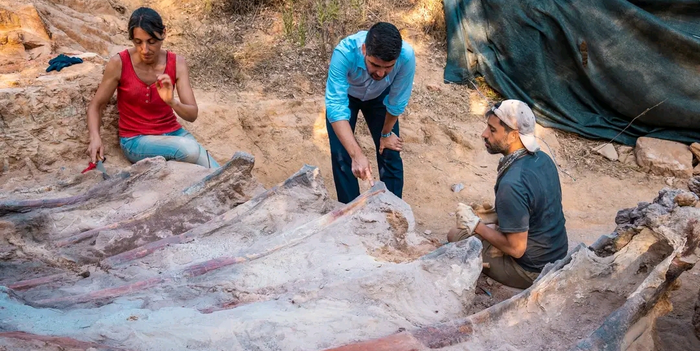
Initial excavation began the same year, but the bigger headline arrived later. In August 2022, Portuguese and Spanish paleontologists returned to the Monte Agudo paleontological site and uncovered major parts of the skeleton, including vertebrae and ribs. The remains were not scattered randomly. Some ribs appeared preserved in their original anatomical position, which is unusually valuable because it helps researchers understand how the skeleton was arranged in life.
For scientists, that is a big deal. A single isolated bone can tell you something. A connected set of ribs and vertebrae tells you much more. It is the difference between finding one puzzle piece under the couch and finding a whole corner of the puzzle already assembled.
What Kind of Dinosaur Was It?
The dinosaur appears to have been a sauropod, the famous group of plant-eating dinosaurs known for enormous bodies, long necks, long tails, and sturdy column-like legs. Sauropods include some of the biggest land animals ever known, from Diplodocus and Brachiosaurus to titanosaurs that could make modern elephants look like gym towels with ears.
Researchers have suggested the Pombal fossil may belong to a brachiosaurid sauropod. Brachiosaurids are especially recognizable because many had longer front limbs than hind limbs, giving them a high-shouldered posture. Imagine a giraffe crossed with a crane, then give it a tail, a tiny head, and the ability to ruin your lawn in one step. That is the general sauropod vibe.
Portugal already has a famous brachiosaurid connection: Lusotitan atalaiensis, a Late Jurassic dinosaur known from incomplete remains. Lusotitan lived in prehistoric Portugal and is estimated at around 21 meters long. The Pombal dinosaur, if the early size estimates hold, could have been even larger, which explains why paleontologists and dinosaur fans are paying attention.
How Big Are We Talking?
The most widely reported estimate for the Pombal specimen is about 25 meters long and 12 meters high, or roughly 82 feet long and 39 feet tall. That is not just “large.” That is “your measuring tape has given up and gone home” large.
To picture it, imagine a dinosaur nearly as long as two city buses parked nose to tail. Its rib cage alone would have been huge enough to make the average living room feel emotionally inadequate. Reports noted that some ribs were around 10 feet long, which is taller than many ceilings. If you found one in your backyard, you would not think, “Ah, yes, science.” You would think, “Why is there a fossilized canoe under my patio?”
But size estimates in paleontology require caution. Scientists must compare incomplete bones with better-known relatives, account for missing parts, and avoid the temptation to crown a champion too early. Dinosaurs did not leave behind driver’s licenses listing height and weight, which is frankly inconsiderate.
Could It Really Be Europe’s Largest Dinosaur?
The phrase “could be” matters. Europe already has several giant sauropod contenders, including Turiasaurus riodevensis from Spain. Turiasaurus has often been described as the largest dinosaur found in Europe so far, with estimates reaching roughly 30 to 39 meters in length in some summaries. That means the Pombal dinosaur may not automatically beat every previous record by length alone.
However, the Pombal discovery is still remarkable because of the apparent preservation of its ribs and vertebrae, the possibility of additional skeleton parts nearby, and its potential connection to brachiosaurid dinosaurs in the Late Jurassic of Portugal. Even if it does not permanently steal the “largest ever” title, it could become one of the most important giant sauropod discoveries in Europe.
This is how paleontology works. A fossil can be record-breaking, record-complicating, or record-improving. All three options are scientifically exciting, even if only one makes the loudest headline.
Why Portugal Is a Dinosaur Hotspot
Portugal may not be the first place many people imagine when they think of giant dinosaurs, but it should be on the map. The western Iberian Peninsula preserves important Late Jurassic rocks, including formations that have produced dinosaur bones, tracks, eggs, and other fossils. Around 145 to 150 million years ago, this region was part of a dynamic landscape filled with rivers, floodplains, plants, and animals.
In other words, it was not just a quiet prehistoric postcard. It was an ecosystem full of movement. Long-necked sauropods browsed vegetation. Predators likely patrolled the area. Smaller dinosaurs, reptiles, and early mammals filled out the background cast. If a nature documentary had existed back then, the soundtrack would have been dramatic, and something with teeth would definitely have appeared before the commercial break.
The Pombal region’s fossil record helps scientists reconstruct these ancient environments. Each new discovery adds detail to the picture: what animals lived there, how they grew, how they moved, and how European dinosaur communities compared with those in North America, Africa, and Asia.
Why Sauropods Became So Enormous
Sauropods are the all-time champions of “go big or go extinct later.” Their size was not random. Several biological features helped them reach gigantic proportions.
They Had Efficient Bodies
Sauropods had small heads compared with their bodies, which may have reduced the weight supported by their long necks. Many sauropods also had air-filled spaces in their bones connected to respiratory systems, making their skeletons lighter than solid bone structures of the same size.
They Ate Plants at Industrial Scale
A giant herbivore needs a lot of food, and sauropods were built to process huge quantities of vegetation. Their long necks may have helped them feed across wide areas without moving the entire body constantly. When your body weighs many tons, every unnecessary step is basically a budget meeting with gravity.
Size Was a Defense
Adult sauropods were difficult targets for predators. A fully grown giant did not need sharp claws or armor to make a statement. Its sheer mass was the statement. A predator looking at an adult sauropod may have thought, in dinosaur terms, “Perhaps I will eat something smaller and less shaped like a building.”
What Makes This Fossil Scientifically Valuable?
The Pombal fossil is not exciting only because it is big. Big gets attention, but preservation tells the story. The discovery includes parts of the axial skeleton, especially vertebrae and ribs. These bones can help researchers estimate body size, identify the dinosaur’s group, and understand how it compares with other European sauropods.
The fact that some ribs were found in their original positions is especially useful. Fossils are often moved, crushed, scattered, or damaged over millions of years. Water currents, scavengers, sediment pressure, and geological movement can all rearrange remains. Finding bones that still preserve something close to their original anatomical layout is like receiving a message from the Jurassic with fewer missing words.
Researchers also noted that more of the skeleton may still be present at the site. Future excavation could reveal limb bones, additional vertebrae, or other elements that help narrow down the dinosaur’s identity. A large leg bone, for example, could dramatically improve size estimates. A skull would be even more valuable, though sauropod skulls are often rare because they were smaller, lighter, and more easily separated from the body after death.
The Importance of Careful Scientific Language
Headlines love superlatives: biggest, oldest, weirdest, most terrifying, most likely to make your coffee nervous. Science loves evidence. That is why responsible researchers describe the Pombal dinosaur as a possible largest sauropod or possible largest dinosaur discovered in Europe.
That careful language is not boring. It is honest. Fossils must be prepared, studied, measured, compared, and often published in peer-reviewed research before a claim becomes solid. A giant rib cage is powerful evidence, but it is not the whole dinosaur. Until researchers can compare enough material, the title remains exciting but provisional.
This is one reason dinosaur science keeps changing. New fossils appear. Old estimates get revised. Species are renamed. Family trees are rearranged. Paleontology is less like reading a finished encyclopedia and more like assembling a library during an earthquake while the books are made of stone.
European Giants Beyond Pombal
The Pombal sauropod belongs to a broader story of giant dinosaurs in Europe. Spain’s Turiasaurus remains one of the continent’s most famous large sauropods. Portugal’s Lusotitan shows that brachiosaurid dinosaurs were present in the region during the Late Jurassic. More recently, researchers described Garumbatitan morellensis from Spain, an Early Cretaceous sauropod that adds more evidence that the Iberian Peninsula was home to diverse long-necked giants.
Together, these dinosaurs show that Europe was not a minor stage in dinosaur evolution. It hosted large, varied, and scientifically important sauropods across different periods. The continent’s fossil record may be patchy compared with some famous dinosaur regions, but “patchy” does not mean “empty.” Sometimes the missing pieces are simply waiting under a field, quarry, cliff, or backyard.
Why This Discovery Captures the Imagination
Part of the magic is the setting. A dinosaur found in a remote desert is exciting. A dinosaur found in someone’s backyard is relatable chaos. It reminds us that deep time is not always locked behind museum glass. Sometimes it is beneath ordinary ground, under places where people build homes, plant gardens, and argue with weeds.
The Pombal discovery also invites a humbling thought: humans live on the surface of a planet with a very long memory. Beneath our roads, farms, and neighborhoods are traces of vanished worlds. A backyard can become a doorway to the Jurassic. A construction project can uncover a creature that walked the Earth roughly 145 million years ago.
That is not just science. That is perspective with a shovel.
What Happens Next?
The next steps involve careful preparation and study. Fossils must be stabilized, cleaned, documented, and compared with known dinosaur species. Researchers will look at bone shapes, proportions, internal structures, and geological context. They may also search for additional remains at the site.
If more of the skeleton is found, scientists could better determine whether this dinosaur belongs to a known genus such as Lusotitan, represents a related brachiosaurid, or possibly points to something new. That is the exciting part: the discovery is already impressive, but it may still have more to say.
For now, the Pombal sauropod stands as one of Europe’s most fascinating giant dinosaur finds. Whether it becomes the official largest or remains one of the largest, it has already earned a place in the story of prehistoric Europe.
Experiences and Reflections: What This Discovery Feels Like Up Close
Imagine standing beside a fossil rib longer than a person is tall. The first reaction would probably be silence. Not dramatic movie silence, but the practical kind where your brain briefly forgets how to file the information. A bone that large does not feel like an object at first. It feels like architecture.
That is what makes giant dinosaur discoveries so memorable. They change scale. Most of daily life is measured in manageable units: chairs, doors, cars, backpacks, grocery bags. Sauropods break that mental measuring system. A single rib can feel like furniture. A vertebra can resemble a sculpted stone machine part. A full animal becomes almost impossible to imagine without comparisons, and even the comparisons start sweating.
For anyone who has visited a natural history museum, this is the sensation that giant skeletons create. You walk into a hall, look up, and suddenly childhood returns wearing hiking boots. The adult mind knows it is looking at fossils, casts, measurements, and reconstructions. The kid inside simply thinks, “That thing was real?”
The Pombal dinosaur adds another layer because it was not discovered during a glamorous expedition with helicopters and dramatic hats. It began with construction work. That everyday beginning makes the story more powerful. It suggests that discovery is not always distant. Sometimes the ancient world is separated from the modern one by a thin layer of soil and the curiosity to ask, “What exactly did I just find?”
There is also a lesson here about patience. Fossil discoveries are often announced in exciting terms, but the real work takes years. Bones must be removed without damage. Sediment must be studied. Measurements must be checked. Comparisons must be made with museum specimens and published research. The public wants quick answers: Is it the biggest? What species is it? Can we name it something cool by Tuesday? Science replies, politely, “Please hand me a brush and several years.”
That patience is part of the wonder. A dinosaur that lived more than 100 million years ago does not need to rush for our news cycle. It has already waited through continental shifts, climate changes, erosion, burial, and rediscovery. A few more years of careful study is not a delay. It is respect.
For readers, the best way to experience a story like this is to treat it as an unfolding mystery rather than a finished trophy announcement. The Pombal sauropod may become Europe’s largest confirmed dinosaur discovery. It may turn out to be one of several giants from a region richer in fossils than previously understood. It may help clarify how brachiosaurids lived in Late Jurassic Portugal. Any of these outcomes would be exciting.
And perhaps the most delightful takeaway is this: the world is still not done surprising us. Even in places where people live, work, and build, the deep past remains underfoot. The next major fossil discovery might not happen in a distant wilderness. It could begin with a homeowner, a construction project, and a very strange-looking rock that turns out to be part of a dinosaur large enough to make Europe’s fossil record stand a little taller.
Conclusion
The possible largest dinosaur ever discovered in Europe is more than a spectacular headline. It is a reminder that paleontology is alive, unfinished, and occasionally hiding in someone’s backyard. The Pombal sauropod may have been a massive brachiosaurid-like herbivore from the Late Jurassic, stretching around 82 feet long and standing nearly 39 feet tall. Its preserved ribs and vertebrae could help scientists better understand Portugal’s ancient ecosystems and Europe’s giant dinosaurs.
Whether this fossil ultimately claims the official title or not, it already matters. It shows that Europe’s dinosaur story is bigger, richer, and more surprising than many people realize. And frankly, any discovery that turns backyard construction into a Jurassic investigation deserves a standing ovationpreferably from a safe distance, because those ribs are enormous.