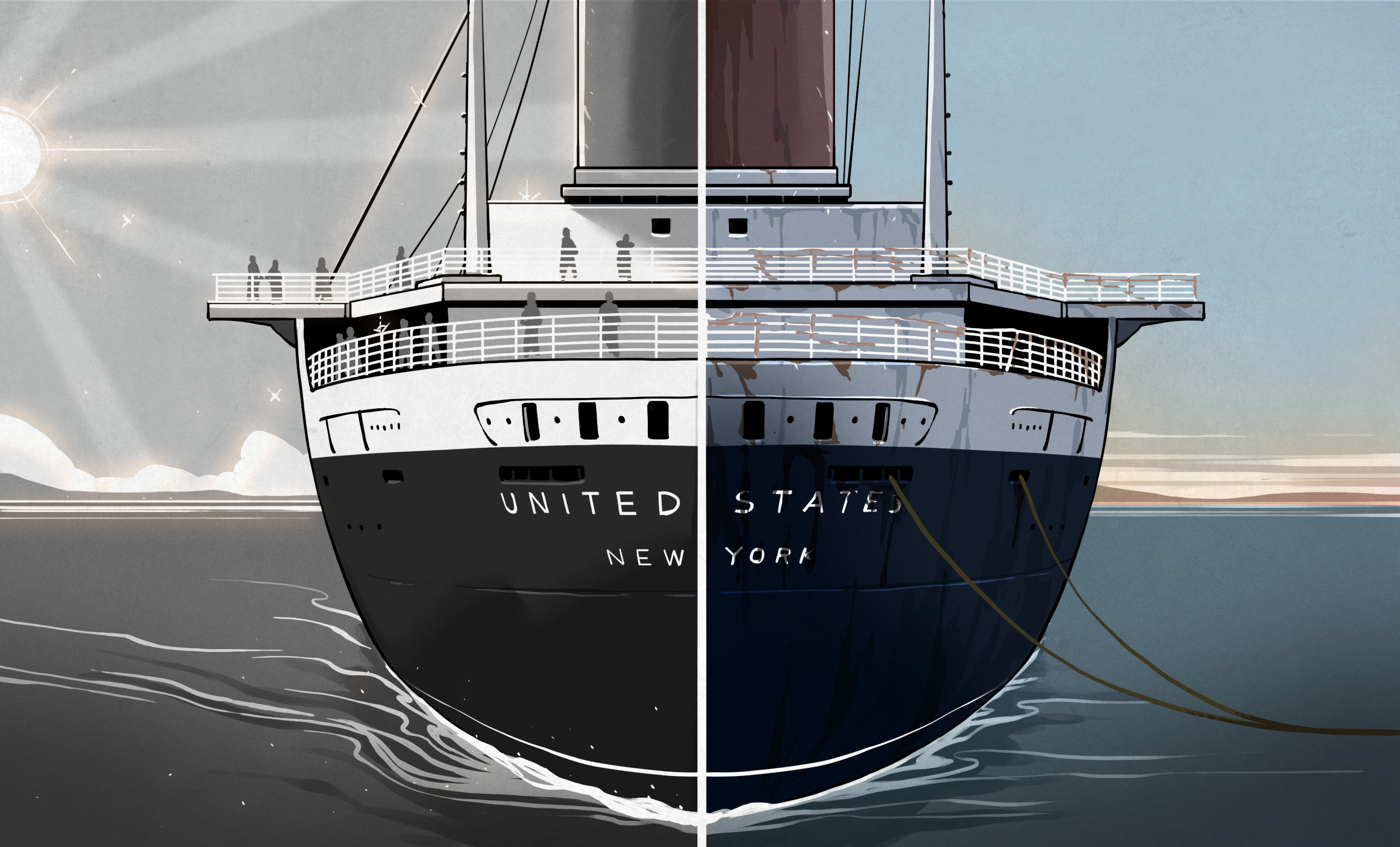
The SS United States is not just an old ship with peeling paint and a heroic name. She is a 990-foot argument in steel and aluminum that America once believed the future could be fast, elegant, fireproof, and proudly built at home. For decades, she sat along the Philadelphia waterfront like a sleeping skyscraper, too large to ignore and too expensive to save. Now, after years of preservation campaigns, legal battles, engineering proposals, and public heartbreak, America’s flagship is being prepared for a new role beneath the waves as an artificial reef off Florida’s Gulf Coast.
That plan may give the ship a second life as marine habitat and a diving destination. It may also mark the end of the last surviving great American ocean liner as a visible, walkable, above-water monument. For people who love maritime history, mid-century design, engineering, Cold War ambition, or simply very large machines that look good in photographs, the moment feels bittersweet. The SS United States was built to cross oceans faster than anything else in passenger service. Today, she is racing against time itself.
Why the SS United States Still Matters
The SS United States entered service in 1952, during a period when ocean liners were still symbols of national prestige. These ships were not merely transportation. They were floating embassies, technological showcases, luxury hotels, national advertisements, and, in the case of the SS United States, potential military assets. She was designed by the legendary naval architect William Francis Gibbs, a man whose obsession with safety and speed produced one of the most extraordinary ships ever launched.
On her maiden voyage, the SS United States crossed the Atlantic from New York to Europe in three days, 10 hours, and 40 minutes, breaking the record previously held by the RMS Queen Mary. She captured the Blue Riband, the unofficial but fiercely respected prize for the fastest transatlantic crossing by an ocean liner. More than 70 years later, she still holds the transatlantic speed record for an ocean liner. In plain English: nobody built a faster passenger liner, and then the age of jet travel came along and changed the game before anyone could seriously try.
The ship was more than fast. She was America’s largest ocean liner, measuring about 990 feet long, longer than the Titanic and nearly as tall as the Chrysler Building if stood on end. Her engines reportedly produced enormous power, allowing her to slice through the Atlantic at astonishing speed. During trials, she reached more than 38 knots. That is roughly 44 miles per hour, which may not impress a sports car driver until you remember we are talking about a floating city with dining rooms, lounges, crew quarters, propellers the size of small apartments, and enough mid-century glamour to make a cocktail glass nervous.
A Cold War Machine in a Dinner Jacket
One reason the SS United States was so remarkable is that she lived a double life. To passengers, she was a luxurious transatlantic liner. To military planners, she was a potential troopship that could be converted quickly in an emergency. Built with Cold War readiness in mind, she could carry thousands of troops if needed. That military purpose shaped her design from the beginning.
Gibbs wanted a ship that was fast, safe, and unusually fire-resistant. Large portions of the vessel used lightweight aluminum rather than heavier materials, saving thousands of tons. Wood was avoided almost entirely because Gibbs was deeply concerned about shipboard fires, a fear rooted in the long history of maritime disasters. The result was a liner with modern materials, strict compartmentalization, and a practical toughness hidden beneath sleek public spaces.
This mixture of luxury and defense planning makes the SS United States one of the clearest physical symbols of postwar America. She belonged to an era when the United States wanted to prove it could outbuild, outrun, and out-engineer the world. She was a passenger ship, yes, but she was also a national statement: America could make something huge, beautiful, useful, and terrifyingly fast.
The Golden Age Passengers: Presidents, Stars, and the Mona Lisa
The SS United States attracted a passenger list that reads like someone shook a history textbook and a Hollywood magazine together. Four U.S. presidents sailed aboard her: Harry Truman, Dwight Eisenhower, John F. Kennedy, and Bill Clinton, who traveled as a young Rhodes Scholar. Famous passengers included Marilyn Monroe, Duke Ellington, Walt Disney, Judy Garland, Cary Grant, Bob Hope, Salvador Dalí, Grace Kelly, and many others.
Even the Mona Lisa crossed the Atlantic aboard the ship in 1963 on her way to American exhibitions. That fact sounds invented by a museum gift shop, but it is real. One of the world’s most famous paintings traveled on one of the world’s most famous liners, proving once again that the SS United States had a talent for making history look stylish.
In her prime, the ship represented the glamour of ocean travel: formal dining, polished service, sea air, deck chairs, dramatic departures, and the civilized panic of deciding what to wear while the Atlantic is doing cartwheels outside your window. But her career was shorter than her legend. Commercial jet travel rapidly changed passenger expectations. By 1969, the SS United States was withdrawn from service. She had completed only 17 years as an active liner, yet those 17 years were enough to make her immortal.
From Flagship to Forgotten Landmark
After retirement, the SS United States entered the long, complicated afterlife common to many historic ships. She changed owners, lost much of her interior, and became the subject of ambitious reuse plans that never quite found enough money, political will, or practical momentum. Ideas came and went: hotel, museum, event venue, mixed-use waterfront attraction, restored liner, and more. Each plan had romance. Each plan also had a price tag large enough to make accountants reach for a chair.
The SS United States Conservancy worked for years to protect the ship and keep her story alive. The vessel was added to the National Register of Historic Places because of her national significance, even though she had not yet reached the usual age threshold at the time. That recognition mattered. It confirmed what preservationists had long argued: this was not scrap metal with funnels. This was a nationally important artifact of American design, engineering, transportation, and Cold War history.
Still, recognition does not pay dockage fees. For nearly three decades, the ship sat in Philadelphia. To some locals, she became a beloved landmark. To others, she looked like the world’s largest parking problem. Legal disputes over her berth eventually forced the issue. The ship had to move, and moving a 990-foot ocean liner that has not sailed under her own power since the Nixon administration is not exactly like calling a tow truck. It is more like asking a small city to leave quietly by water.
The Artificial Reef Plan: Rescue, Loss, or Both?
The current plan calls for the SS United States to become an artificial reef off Florida’s Gulf Coast, near the Destin-Fort Walton Beach region. Okaloosa County acquired the ship and began preparing her for deployment. Before a vessel can be sunk as a reef, hazardous materials must be removed. Fuel, wiring, plastics, glass, and other materials have to be addressed so the ship can meet environmental standards. As of spring 2026, local reporting indicated that remediation work had been completed, while final federal approvals from agencies such as the U.S. Army Corps of Engineers and the Environmental Protection Agency were still part of the process.
Supporters of the reef plan argue that it prevents a worse fate: scrapping. Once underwater, the ship could become the world’s largest artificial reef, providing habitat for marine life and attracting divers, anglers, researchers, and tourists. Florida already has a strong artificial reef program, and the SS United States would be a spectacular addition. Her size alone would make her an underwater landmark, a kind of maritime cathedral for fish, coral growth, and adventurous divers with waterproof cameras.
Critics see the plan differently. To them, sinking the ship means losing the last chance to preserve America’s greatest ocean liner as an accessible historic site. A reef may honor the ship in one way, but it also makes most of her inaccessible to the general public. You cannot easily bring schoolchildren, veterans, former passengers, architects, or casual tourists through an underwater liner sitting in the Gulf. Unless, of course, the school has a scuba program, which seems unlikely unless the principal is unusually bold.
The hard truth is that both sides have a point. Reefing is not the same as saving the ship as a museum. But neither is scrapping. The artificial reef plan may be the compromise history often receives when perfect solutions run out of money.
The Museum Plan and the Importance of Memory
One hopeful part of the current plan is the development of a land-based SS United States Museum and Visitor Experience. Major components, including the ship’s iconic funnels, are expected to be preserved for display. Those funnels are not small decorative pieces; they are towering visual symbols of the ship’s speed and identity. Preserving them on land gives future visitors a physical connection to the liner even if the hull itself rests below the surface.
A strong museum could do more than display artifacts. It could explain why the SS United States mattered in the first place. Visitors should learn about William Francis Gibbs, Newport News Shipbuilding, the Blue Riband, the Cold War, the decline of ocean liner travel, and the human stories of passengers and crew. The museum could also explore the uncomfortable question at the center of this story: why does America struggle to preserve its modern engineering landmarks?
We preserve battlefields, mansions, and presidential homes with great seriousness, as we should. But industrial and transportation history often has a harder road. Ships require constant maintenance. They rust. They need berths, insurance, inspections, security, paint, utilities, and a small army of experts. They do not sit politely on a shelf. They demand money even while doing nothing. That is why the fate of the SS United States is not only a maritime issue. It is a lesson in how difficult it is to preserve large-scale twentieth-century heritage.
What We Lose If We Lose Her
If the SS United States disappears below the waterline, America loses more than a ship-shaped silhouette. We lose one of the last chances to walk through the physical remains of the country’s ocean liner age. We lose a direct link to the moment when ships, not jets, carried the glamour of international travel. We lose a masterpiece of American naval architecture that combined commercial elegance with military readiness. We lose a stage on which presidents, artists, immigrants, students, soldiers, celebrities, and ordinary travelers crossed the Atlantic in style.
There is also a deeper emotional loss. The SS United States was built when the country believed engineering could be patriotic. Not in a slogan-on-a-bumper-sticker way, but in a tangible, riveted, turbine-powered way. She was not merely named after the United States. She embodied a national mood: confident, restless, modern, competitive, and maybe just a little overcaffeinated.
Her decline tells another American story: the difficulty of caring for what previous generations built. We admire ambition after the fact, but we often hesitate when the maintenance bill arrives. The SS United States is a monument to speed, but her preservation struggle has been painfully slow. That contrast is part of her tragedy.
Why This Story Still Has Power
The public fascination with the SS United States proves that historic machines can still move people. Many people never sailed on her. Many were born long after she stopped carrying passengers. Yet the ship continues to inspire strong feelings because she represents something rare: excellence at full scale. She was not an app, a concept, or a digital rendering. She was built. She worked. She crossed the Atlantic faster than any ocean liner before or since. She made noise, burned fuel, carried people, threw spray, and left a wake.
In a digital age, there is something almost shocking about that kind of achievement. The SS United States reminds us that innovation used to have a physical presence so large it could be seen from across a river. You could point to it and say, “There. That is what we made.” No password required.
Whether her next chapter unfolds as a reef, a museum, or a combination of both, the challenge is to keep the story alive. A ship can be submerged, but memory should not be. The SS United States deserves more than a footnote, more than nostalgia, and more than a sad shrug about costs. She deserves interpretation, documentation, public education, and serious attention from anyone who cares about American history.
Experiences and Reflections: Standing Before a Giant We Nearly Forgot
To understand the emotional force of the SS United States, imagine standing near her after decades of silence. She no longer gleams as she did in 1952. Her paint is weathered, her windows dark, her interiors largely gone. Yet her size still does something to the mind. Most historic objects ask you to lean in. This one makes you step back. Then back again. Then one more step, because the ship is still not fitting comfortably into your field of vision.
Seeing a vessel like this is different from seeing a photograph. In photos, the SS United States can look elegant, almost simple: two red, white, and blue funnels, a long black hull, a crisp superstructure. In person, the scale is humbling. You begin to understand that people did not merely board this ship; they entered a world. There were routines, uniforms, menus, announcements, engineering watches, luggage carts, dining schedules, and weather reports. Somewhere in that vast structure, someone looked out at gray Atlantic water and felt either deeply glamorous or deeply seasick, possibly both.
The experience also creates a strange sadness. The ship is so obviously important that the question becomes uncomfortable: how did we let her reach this point? The answer is not simple. Preservation costs are brutal. Waterfront space is expensive. Modern safety codes are complex. Historic ships are famously difficult to adapt. Still, standing before the SS United States, logic does not completely soften the blow. You feel the gap between what the ship was and what the ship became.
That gap is where reflection begins. The SS United States teaches that heritage is not automatically saved by admiration. People can love a landmark for years and still lose it if no practical plan emerges. Love is necessary, but so are engineers, donors, permits, business models, environmental reviews, political support, and, regrettably, spreadsheets. Every historic preservation story has a romance department and a plumbing department. The plumbing department usually wins.
Yet there is also hope in the ship’s coming transformation. If the reef plan proceeds, divers may one day descend through blue-green water and see the vast outline of America’s flagship becoming part of a living ecosystem. Fish will move through spaces once shaped by human ambition. Coral and marine growth may soften steel edges. The liner that once crossed the Atlantic with celebrities and presidents may host snapper, amberjack, barracuda, and curious divers instead. That is not the ending preservationists dreamed of, but it is not oblivion.
The most meaningful experience connected to the SS United States may be the realization that history is not always preserved in the form we prefer. Sometimes it survives as a museum artifact. Sometimes as a record. Sometimes as a place name. Sometimes as a reef. The responsibility now is to make sure the story remains vivid and accurate. Future generations should know that this ship was not just big. She was brilliant. She was not just fast. She was revolutionary. She was not just abandoned. She was loved, fought over, argued about, and mourned before she was transformed.
Perhaps that is the final lesson of the SS United States: greatness does not protect itself. If we want to keep the best evidence of American imagination, we must act before the paint peels, before the rent dispute, before the emergency fundraising campaign, before the towline is attached. The SS United States may soon belong partly to the sea. But her meaning belongs to us, and that is still something we can save.
Conclusion
The SS United States remains one of the most important ocean liners ever built because she combined speed, safety, beauty, and national purpose in a way no other American passenger ship did. Her possible transformation into the world’s largest artificial reef is both a practical rescue and a cultural heartbreak. It may protect her from the scrapyard, but it also closes the door on a dream many preservationists held for decades: seeing America’s flagship restored as a living, above-water landmark.
Still, the story is not over. If her artifacts are preserved, her museum is built thoughtfully, and her history is told with the seriousness it deserves, the SS United States can continue to inspire. The ship that once crossed the Atlantic faster than any ocean liner may now carry a different cargo: memory, caution, pride, and the urgent reminder that great things are easier to build than to save.
Note: This article is based on current public information available as of May 26, 2026. Details about the SS United States artificial reef deployment may change as federal approvals, environmental reviews, and local project timelines develop.