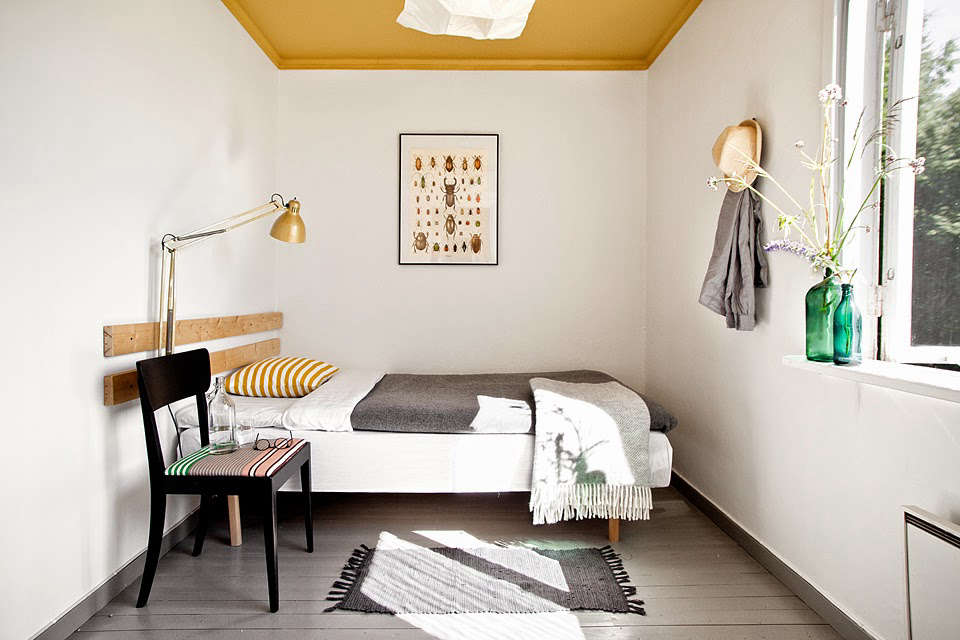
Some bedrooms work very hard to prove they are stylish. They have twelve throw pillows, three kinds of wallpaper, a chandelier with its own zip code, and a bedside table that appears afraid to hold an actual glass of water. The bedroom at Sågverket in northern Sweden takes the opposite route. It barely raises its voiceand somehow looks better because of it.
Originally featured as a room worth stealing ideas from, the Sågverket bedroom belongs to a waterfront hospitality property in northern Sweden. Its memorable ingredients include a muted yellow-and-gray color scheme, painted wood flooring, a slender metal bed, striped bedding, a homemade timber headboard, paper lighting, simple artwork, and humble accessories.
The result is a particularly useful example of Scandinavian bedroom design because it does not rely on pristine white walls and expensive designer furniture. Instead, it combines functional pieces, honest materials, subdued color, and just enough imperfection to feel human. Here is how to recreate the atmosphere without turning your bedroom into a Scandinavian furniture showroom.
Why the Sågverket Bedroom Still Looks Fresh
Scandinavian interiors are often described with familiar words such as minimal, natural, and functional. Those descriptions are accurate, but they can make the style sound more rigid than it actually is. Historically, Scandinavian modern design paired practical furniture and clean lines with natural materials and warmth, partly as a response to long Nordic winters and limited daylight.
The Sågverket bedroom demonstrates that warmth especially well. It is restrained, but it is certainly not sterile. The golden-yellow accents keep gray surfaces from feeling chilly. Textiles soften the metal bed. Wood introduces irregularity. A botanical or scientific-style print adds character without creating visual chaos.
In other words, the room understands a decorating principle many of us discover only after buying too much stuff: a bedroom does not need more objects. It needs better relationships between the objects it already has.
Start With a Muted Yellow and Gray Color Palette
The most recognizable feature of this Swedish bedroom is its combination of subdued yellow and gray. Remodelista originally suggested a muted goldenrod similar to Farrow & Ball’s Sudbury Yellow alongside a stone gray resembling Purbeck Stone for the painted floor.
The important lesson is not the precise paint brand. It is the balance.
Choose an Earthy Yellow, Not Lemon Yellow
For a Sågverket-inspired bedroom, look for mustard, ochre, muted goldenrod, wheat, or dusty yellow. The ideal shade should appear slightly aged rather than cheerful enough to direct airport traffic.
Use yellow selectively. A wall section, lamp, pillowcase, striped sheet, or small piece of furniture can provide enough color. When a strong accent appears only a few times, it gains visual importance.
Anchor the Room With Soft Gray
Gray works particularly well on painted timber floors because it preserves the texture and seams of the boards while creating a quieter visual foundation. If painting hardwood is not an option, a gray flat-weave rug can produce a similar grounding effect.
Warm gray, putty, mushroom, and stone tones generally pair better with mustard yellow than icy blue-gray does. Scandinavian interiors commonly rely on whites, grays, browns, and other nature-derived shades, using deeper or earthier colors as accents.
Keep the Bed Visually Light
A massive upholstered bed would completely change this room’s personality. The original look uses a thin metal frame with very little visual weight. That allows the bedding, painted surfaces, and headboard to remain visible.
If you are recreating the style, consider a narrow steel or iron bed in brass, aged gold, black, bronze, or another subdued metallic finish. A simple wood platform can also work, especially in a contemporary bedroom.
The key is avoiding unnecessary bulk.
Scandinavian bedrooms frequently emphasize streamlined furniture, clear floor area, natural materials, and functional layouts. The simplicity creates breathing room while textiles bring back the comfort that pure minimalism sometimes loses.
Build the World’s Least Complicated Headboard
One of the best details at Sågverket is also one of the easiest to imitate: the basic wooden headboard effect. The original inspiration featured simple dimensional lumber rather than an elaborately upholstered statement piece.
This works because unfinished or lightly finished timber contributes texture without demanding attention.
A Simple DIY Approach
You can create a similar feeling with a pair of smooth wood boards or a small assembly of horizontal boards mounted securely behind the bed. Sand every surface carefully, soften sharp edges, and use a clear matte finish, oil, or subtle stain if you want protection without hiding the grain.
If wall mounting is involved, make sure the structure is properly anchored. Rustic charm is lovely; receiving a two-by-four on the forehead at 2:14 a.m. is less authentically Scandinavian.
Do not obsess over matching every piece of wood in the room. Slight differences in grain and tone can make a pared-back space feel collected rather than purchased as a single furniture package.
Layer Bedding Without Building a Pillow Mountain
The Sågverket look relies heavily on textiles, but the bed remains casual. White sheets, mustard stripes, charcoal or gray wool, and a textured throw create layers without requiring decorative pillow gymnastics.
This approach fits the broader Scandinavian tradition of using natural textiles to warm up otherwise restrained rooms. Linen, cotton, wool, leather, and wood routinely add depth while allowing the palette to remain quiet.
Use Three Textile Layers
A practical formula is surprisingly simple:
- Start with white, cream, or natural cotton or linen sheets.
- Add one muted colored blanket or duvet in mustard, charcoal, taupe, or gray.
- Finish with a wool, cotton, or herringbone throw that introduces visible texture.
Resist making everything match perfectly. A narrow stripe next to a woven blanket looks more relaxed than a complete coordinated bedding collection.
Make Paper Lighting Look Intentional
Paper lighting is one of the cleverest parts of this Swedish bedroom. A lightweight paper shade provides volume overhead without appearing heavy, expensive, or overly formal. The original room also incorporated a small yellow clamp-style task light.
This creates layered illumination: one soft ambient source plus one directional light where it is useful.
Lighting deserves special attention in Scandinavian interiors because limited seasonal daylight has historically made brightness and atmosphere important design considerations. Better Homes & Gardens recommends multiple sources of light rather than depending exclusively on a single central fixture.
For your own room, try a rice-paper pendant, linen shade, pleated paper lamp, or softly diffused globe. Add a clamp lamp, wall light, or compact bedside fixture for reading.
The goal is glow, not interrogation-room brightness.
Add One Piece of Slightly Curious Art
Instead of filling the walls with generic inspirational typography, the Sågverket room uses the kind of scientific or natural-history illustration that looks as if somebody rescued it from an old classroom.
This is an excellent strategy for minimalist bedrooms.
Vintage botanical illustrations, insect charts, maps, educational diagrams, monochrome photographs, and old sketches add personality while remaining visually disciplined. A simple black or wood frame keeps the artwork connected to the rest of the room.
One interesting image is often more powerful than a gallery wall containing fifteen pieces competing for attention.
Bring in a Traditional Wooden Chair
A modest wooden chair provides another important layer. In the original interpretation, the chair referenced traditional Swedish furniture rather than glossy contemporary bedroom seating.
This combination of older forms with clean modern elements prevents Scandinavian interiors from becoming anonymous. Designers frequently point out that Nordic rooms can accommodate vintage pieces, handcrafted details, patina, and different eras as long as the overall composition stays restrained.
Look for a simple spindle-back chair, painted farmhouse chair, rush-seat chair, or secondhand wooden side chair. It can serve as a reading seat, clothes landing zone, or bedside surface.
Yes, theoretically it is a chair. Realistically, by Wednesday it may be wearing your jeans.
Use Small Accessories That Have a Job
The accessories in the Sågverket room are notably ordinary: glass bottles, simple vessels, lighting, art, and textiles rather than a collection of purely decorative objects.
That functional quality is fundamental to successful Scandinavian interior design. House Beautiful describes the style as a combination of minimalism, coziness, and usefulness, while HGTV similarly highlights minimalism and functionality as defining traits.
On a bedside table, you might need only a drinking bottle, lamp, book, and small ceramic dish. A glass vase can hold a branch or seasonal flowers. A basket can store extra blankets.
When deciding whether an object belongs, ask two questions: Does it perform a function? If not, does it contribute enough character to justify the space it occupies?
If the answer is no to both, it may be ready for another room.
Finish With a Flat-Weave or Swedish-Style Rag Rug
The original look includes a traditional-style rag rug, another practical choice that introduces stripe, texture, and heritage without making the room overly polished.
Flat-weave rugs are especially effective in modest bedrooms because they visually anchor the bed without adding excessive bulk. Try charcoal, faded navy, natural beige, black, or a restrained stripe.
Leave some flooring visible around the rug. Scandinavian rooms often benefit from a little empty space; covering every square inch can make the design feel heavier.
How to Recreate the Sågverket Bedroom on a Realistic Budget
You do not need collectible Swedish furniture to capture the atmosphere. In fact, focusing too aggressively on brands can miss the point.
Start with paint and textiles, because they influence the largest visual areas. Then simplify the furniture you already own. Remove unnecessary pieces before buying replacements.
For a budget-friendly transformation, concentrate on these elements:
- A warm gray, stone, or off-white foundation
- One mustard or ochre accent
- A thin metal or uncomplicated wood bed
- Crisp cotton or relaxed linen bedding
- A wool or textured throw
- A DIY natural-wood headboard
- A paper pendant or diffused ceiling light
- A functional task lamp
- One vintage-style framed print
- A secondhand wood chair
- A flat-woven rug
Natural materials are particularly effective because they create visual richness without requiring ornament. Dwell’s coverage of Scandinavian-inspired interiors repeatedly emphasizes muted color, natural materials, craftsmanship, and simple furniture as reliable tools for creating warmth.
The Secret Is Restraint, Not Emptiness
Minimalism is sometimes interpreted as an instruction to own practically nothing. Scandinavian interiors demonstrate a more livable idea: own fewer visible things, but make those things comfortable, useful, tactile, or meaningful.
The Sågverket bedroom does not look unfinished. It looks edited.
Textures prevent the sparse arrangement from feeling cold. Yellow prevents gray from becoming gloomy. Wood softens metal. Old-fashioned artwork contrasts with practical contemporary pieces. None of these details is dramatic individually, but together they create a room that feels unusually complete.
That balance is what designers sometimes describe through the Swedish idea of lagomroughly, an appropriate amount rather than too much or too little. House Beautiful notes that this sense of balance can help combine minimalist and cozy elements while also allowing old and new objects to coexist naturally.
Real-World Experience: What It Feels Like to Live With the Sågverket Look
Recreating a room like this teaches an interesting lesson: the transformation often begins when you remove something rather than when you purchase something.
Imagine starting with a typical bedroom containing matching nightstands, a bulky bed, several decorative cushions, framed prints on every available wall, a large rug, multiple baskets, and miscellaneous objects accumulated over the years. Nothing is necessarily wrong with any individual piece, yet together they create constant low-level visual noise.
The first step toward the Sågverket feeling is editing. Clear the bedside surfaces. Remove decorative pillows you never actually use. Take down art that exists primarily because the wall looked empty. Suddenly you notice the shape of the bed, the floorboards, daylight across the wall, and the texture of the blanket.
That alone can make a bedroom feel noticeably calmer.
Next comes color. Adding a muted mustard accent is surprisingly effective because it introduces warmth without demanding an entirely new palette. A yellow reading lamp, throw, pillowcase, or narrow stripe in the bedding can completely change a gray-and-white room. The color feels cheerful, but because it is dusty rather than bright, it avoids looking juvenile.
Natural wood provides another immediate improvement. Even an inexpensive piece of properly sanded lumber behind the bed can add more character than an elaborate mass-produced headboard. Knots, grain, and subtle imperfections become decoration themselves.
Living with simplified furniture also changes how you use the space. A lightweight wooden chair is easier to move beside a window when reading. A small bedside table encourages you to keep only essentials nearby. A glass bottle makes water part of the room’s visual arrangement instead of another piece of packaging to hide.
Lighting may produce the biggest nighttime difference. A paper pendant diffuses light broadly, while a small bedside or clamp lamp creates a focused pool of brightness. Instead of switching between darkness and one aggressive ceiling fixture, you can adjust the room according to what you are doing.
The bedding experience matters too. Scandinavian-inspired bedrooms tend to look better when blankets are allowed to appear relaxed. Linen can wrinkle. Wool can have texture. A throw can sit imperfectly across the foot of the bed. You stop spending ten minutes arranging cushions whose primary purpose appears to be blocking access to the mattress.
After a few weeks, the most enjoyable feature of this approach may be how easy the room is to reset. Fewer accessories mean fewer things to dust and rearrange. An uncluttered floor is easier to clean. Bedding provides most of the softness, so seasonal updates can be as simple as changing a blanket or pillow cover.
Most importantly, a Sågverket-inspired bedroom does not require visitors to understand a specific design trend. Someone unfamiliar with Scandinavian interiors may simply describe it as comfortable, quiet, warm, and unpretentiouswhich is arguably a much better achievement than hearing, “Wow, this is extremely on-trend for 2026.”
A good bedroom should continue working long after the algorithm has found a new aesthetic to obsess over.
Conclusion: Steal the Thinking, Not Just the Furniture
The most useful lesson from the Sågverket bedroom is not that you need a particular Swedish chair, paint color, lamp, or blanket. It is that strong bedroom design can emerge from a surprisingly small collection of thoughtful decisions.
Begin with a calm gray or neutral foundation. Introduce muted mustard yellow for warmth. Choose furniture with simple silhouettes. Add wood, wool, cotton, linen, and other tactile materials. Use lighting at different heights. Keep artwork limited but interesting. Let practical objects look attractive enough to remain visible.
And most importantly, leave a little space around everything.
That is what gives this low-key Swedish bedroom its confidence. Nothing appears desperate for attention, yet the room has far more personality than many interiors assembled from dramatically more expensive ingredients.
Sometimes stealing a look does not mean copying every object. It means stealing the rules that made the original work.
Note: This article is an independently written design analysis based on the documented Sågverket bedroom and broader research from established U.S. home, architecture, and interior-design publications. Product availability and original historical pricing may have changed.