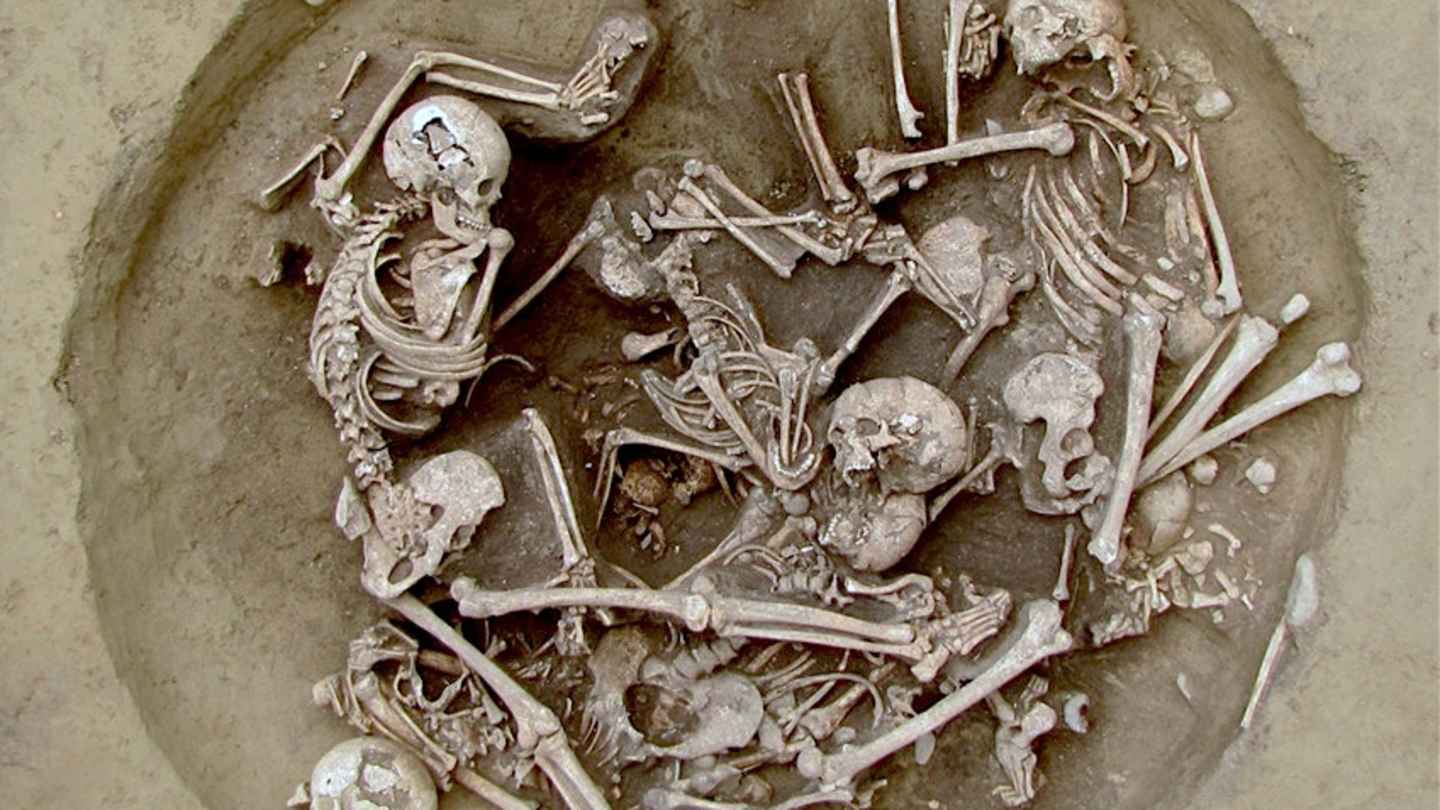
Prehistory has a branding problem. Many people still imagine the Stone Age as a long, grainy stretch of simple farming, small villages, and the occasional goat with a bad attitude. But archaeology keeps crashing that peaceful fantasy like an uninvited relative at Thanksgiving. The latest reminder comes from northeastern France, where researchers studying Neolithic human remains found evidence that violence in Europe more than 6,000 years ago may have been organized, symbolic, and terrifyingly public.
The headline is dramatic, and it earns its drama honestly. At two sites in Alsace, Achenheim and Bergheim, archaeologists analyzed human remains dating to roughly 4300 to 4150 BCE and found a disturbing pattern: people who appear to have been treated very differently in death, with some showing signs of severe interpersonal violence and others buried more normally. The researchers argue that these victims were likely outsiders caught up in conflict, and that at least some of what happened afterward may reflect early martial “victory celebrations” rather than simple burial.
That does not mean we can confidently picture full-time “armies” marching under matching banners while a Stone Age general barked orders from a hilltop. Archaeology is powerful, but it is not a time machine with subtitles. What the evidence does suggest is something both narrower and, in a way, more chilling: organized groups were capable of capturing enemies, humiliating them, displaying power through their bodies, and turning violence into a public statement. In other words, the roots of warfare in prehistoric Europe may have been more social, more theatrical, and more politically meaningful than many people once assumed.
The Study Behind the Headline
The newest interpretation comes from a multi-isotope study of 82 individuals from the Neolithic sites of Achenheim and Bergheim. By comparing chemical signatures preserved in bones and teeth, researchers reconstructed aspects of diet, mobility, and geographic origin. This matters because ancient violence is not just about broken bones; it is about who the victims were, whether they belonged to the local community, and why they were treated one way instead of another.
At both sites, the team found meaningful differences between victims and non-victims. The victims appear to have lived different kinds of lives, eaten somewhat different foods, and moved across different landscapes. In plain English: they do not look like a random cross-section of the local population. They look more like outsiders.
That distinction is one reason this case stands out. Archaeologists have long debated whether unusual Neolithic pit burials represented sacrifice, social exclusion, expedient disposal, or conflict. Here, the chemical evidence strengthens the conflict hypothesis. The researchers suggest that some of the complete skeletons may represent captives brought back alive and killed locally, while isolated upper limbs may have been taken from people who died elsewhere in battle or raids and later displayed as trophies before burial. It is a grim interpretation, but it fits the pattern better than ordinary funeral practice.
Why Researchers Think This Was Organized Violence
Not a Normal Burial Pattern
One of the strongest clues is context. These remains were not laid out with the care usually seen in standard burials of the period. Instead, bodies and body parts were placed in pits in ways that appear haphazard, deliberate, and socially meaningful all at once. That may sound contradictory, but it is not. A burial can be chaotic in appearance and still be highly intentional in message.
Researchers have also noted that the treatment of the dead in these pits does not align neatly with known Neolithic massacres or executions. The combination of excessive violence, non-normative burial, and isolated left upper limbs is unusual enough to force a broader interpretation. This is where the phrase “martial victory celebrations” enters the conversation. The idea is not simply that people were killed. It is that some of their bodies were used to communicate triumph, revenge, and group solidarity.
Outsiders Versus Locals
The isotope results sharpen the story. Non-victims buried near the same communities tended to cluster more tightly, suggesting more local and stable lifeways. Victims, by contrast, showed more variation, which points to different origins or more mobile lives. The researchers argue that these were socially remote enemies, not beloved community members receiving an unusual send-off.
That distinction matters because it changes the emotional logic of the site. If the dead were outsiders, then the pits may preserve not just a massacre but a ritualized statement about who belonged and who did not. Violence, in that reading, became a performance of community identity. The dead were not only defeated; they were turned into symbols.
What the Bones Can Tell Us, and What They Cannot
This is where good archaeology resists becoming bad historical fan fiction. Bones can reveal trauma, timing, dietary differences, and movement. They can support strong interpretations about conflict, capture, and humiliation. But they cannot give us speeches, battle plans, or certainty about motive.
So, did Stone Age “armies” brutalize their victims? Possibly, if by armies we mean organized fighting groups acting collectively and strategically. Probably not, if we mean permanent professional militaries in the later historical sense. The evidence supports organized intergroup violence, likely tied to raids, territorial pressure, and public post-conflict ritual. That is already significant enough without adding bronze helmets the size of SUVs.
It is also worth noting that archaeologists increasingly use demographic patterns to interpret violent events. A mass grave filled mostly with women and children may point to one kind of attack. A grave tilted toward young adult men may point to failed raiders, prisoners, or combatants. A burial mixing outsiders, unusual body treatment, and local burial space may signal capture, trophy-taking, or ritualized punishment. In this case, the demographic and isotopic data both support the idea that the people in the pits were not all from the same local community and were not all treated equally.
Why Neolithic Europe May Have Been So Tense
Territory, Farming, and Competition
The Neolithic was not just a period of stone tools and cereal crops. It was also an era of land claims, settlement boundaries, livestock management, and increasing investment in place. Once people build houses, store grain, bury relatives nearby, and mark territory, conflict can get serious very quickly. Suddenly the argument is not over a nice berry patch. It is over fields, access, prestige, survival, and memory.
Other archaeological work from Europe supports the idea that violence was not rare in these farming societies. Sites in Germany, Croatia, Spain, and elsewhere have revealed massacres, executions, repeated trauma, and evidence that conflicts may have unfolded over extended periods rather than in one single bad afternoon. In northern Spain, one mass grave from about 5,400 to 5,000 years ago has been interpreted as possible evidence of sustained conflict, with both healed and unhealed injuries suggesting repeated violence over time. In Germany, the Halberstadt grave has been read as possible evidence of execution involving nonlocals. Earlier still, the Schöneck-Kilianstädten mass grave suggests that some early farming communities were capable of large-scale lethal attacks.
Climate Stress and Mobility
Some researchers also connect late Neolithic unrest to wider patterns of mobility and environmental stress. That does not mean climate “caused” violence in any simple way. Human beings are much too inventive for that. But periods of climatic instability can increase movement, pressure resources, and heighten tensions between neighboring groups. Archaeologists discussing the Alsace findings have pointed to a broader period of unrest in Europe around the late fifth millennium BCE, when settlement disruptions and mobility seem to increase.
Put simply, when people are moving, boundaries harden. When boundaries harden, outsiders become easier to fear. And when fear joins politics, ritual can become a weapon.
Other Sites That Make This Story Hard to Ignore
The Alsace remains matter partly because they do not stand alone. Archaeology has been building a harsher picture of prehistory for years. The site of Nataruk in Kenya, often cited in debates about the earliest warfare, showed that lethal group violence long predates states and written records. The Potocani mass grave in Croatia complicated the picture further by showing that not every prehistoric massacre looks like combat; some seem more like organized killing of mixed groups. And recent work from Serbia on an Iron Age mass grave dominated by women and children shows that selective violence and symbolic burial could coexist in deeply unsettling ways.
These examples do not all tell the same story. That is the point. Ancient violence was not one thing. Sometimes it looks like raid. Sometimes massacre. Sometimes execution. Sometimes a burial that seems almost respectful after a ruthless event. The Alsace pits stand out because they appear to combine conflict, outsider status, trophy-taking, and public ritual in one place. That combination makes the case especially important for understanding how social groups turned violence into meaning.
Why This Discovery Matters Today
It matters because it ruins one of our favorite myths: that brutality arrived only after civilization became more complex. The evidence from Neolithic Europe suggests something less comforting. Even in small-scale farming communities, people could sort the world into insiders and outsiders, kill collectively, and use the bodies of enemies to communicate power. That is not a modern invention. It is a very old human temptation.
But this discovery also matters for a more hopeful reason. By studying how violence was organized in the past, archaeologists help us see that warfare is not some mysterious instinct that floats outside culture. It is shaped by identity, territory, ritual, inequality, and storytelling. And if culture helps make violence, culture can also help unmake it. The same species that staged dominance in a village center also built cemeteries, rituals of care, and systems of alliance. Prehistory contains both warnings and alternatives.
Experience and Reflection: What Finds Like This Feel Like
There is also a human experience wrapped around discoveries like this, and it is worth lingering there for a moment. Reading about Neolithic violence in a journal article is one thing. Standing in front of photographs, excavation plans, and reconstructed life histories is another. Even through a screen, these sites have a way of collapsing time. Suddenly the Stone Age stops feeling “primitive” and starts feeling painfully familiar. You are not looking at abstract data points. You are looking at evidence that someone, somewhere, decided another group was less worthy of dignity.
For archaeologists, that experience must be especially intense. Their work is technical, disciplined, and methodical. They measure isotopes, assess trauma, compare burial positions, and debate interpretations with admirable caution. But beneath all that science is an unavoidable emotional fact: they are piecing together the last moments of real people. They are trying to read fear, hierarchy, and community through the cold grammar of bone.
There is something almost haunting about the mismatch between method and subject. A lab report may sound clinical, yet the human reality behind it is anything but. A sulfur value here, a fracture pattern there, a burial placement that does not match accepted norms, and slowly an entire social scene begins to emerge. Outsiders. Captives. Public violence. Ritual display. Community spectators. It is less like discovering a grave and more like overhearing the end of an argument that happened 6,000 years ago.
For modern readers, the experience can be unsettling in a different way. We often like the distant past because it feels simple. It lets us pretend our worst behaviors belong to “later” history: empires, kings, conquest, propaganda. But prehistoric archaeology keeps reminding us that social cruelty does not require bureaucracy. You do not need a palace to stage humiliation. You do not need a written ideology to create an enemy. Sometimes all it takes is a boundary, a grievance, and a group willing to turn pain into a message.
And yet these discoveries are not merely dark. They also reveal the extraordinary power of science to restore lost human stories without romanticizing them. The people in these pits were once reduced to anonymous remains. Now, through chemistry, context, and comparison, they regain part of their biography. We may never know their names, languages, or exact final hours, but we can say more than “someone died here.” We can say they moved across landscapes, ate different foods, belonged to particular social worlds, and became caught in violence that meant something to the people around them.
That is the strange emotional balance of archaeology at its best. It can be sobering without becoming sensational. It can confront cruelty without turning it into spectacle. It can recover evidence of dehumanization while quietly restoring humanity to the dead. In that sense, the most powerful experience related to this topic is not shock. It is recognition. The past is not foreign land. It is a mirror with older clothes, rougher tools, and some very familiar instincts staring back at us.
Conclusion
The remains from Achenheim and Bergheim do not prove the existence of modern-style armies, but they do suggest that late Stone Age Europe knew organized conflict, outsider targeting, and ritualized violence well enough to leave unmistakable marks in the archaeological record. The real significance of the discovery is not just that people were killed. It is that their deaths may have been transformed into public theater, social memory, and political messaging.
That makes this one of the most compelling prehistoric case studies in recent years. It pushes the conversation beyond “Were people violent?” and toward a tougher, more revealing question: how did early communities use violence to define themselves? The answer, if the evidence holds, is bleakly sophisticated. Long before history books, human groups were already turning victory into spectacle and enemies into symbols. The Stone Age, it turns out, was not short on strategy, symbolism, or cruelty. It was just short on public relations.