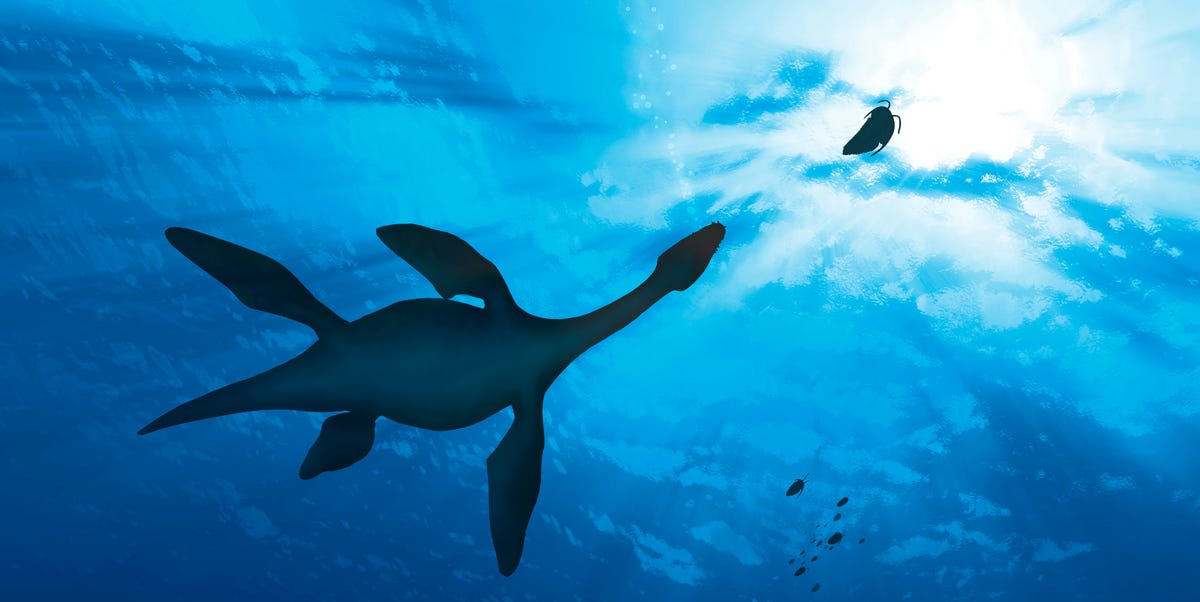
For generations, dinosaurs were imagined as land-based celebrities of the prehistoric world: stomping through fern forests, roaring at inconvenient moments, and generally behaving like the heavyweight champions of dry ground. Water was supposed to be the territory of other ancient reptiles, such as plesiosaurs, mosasaurs, and ichthyosaurs. Dinosaurs, the old story went, might wade, drink, or accidentally fall into rivers, but they were not built for serious underwater action.
That simple picture has now become much more interesting. New fossil discoveries and fresh anatomical studies show that at least some dinosaurs were not afraid to get wet. In fact, several lineages appear to have developed real aquatic or semi-aquatic adaptations. They may have swum, dived, hunted fish, and moved through water with bodies shaped by the same evolutionary pressures that shaped modern diving birds, crocodiles, and aquatic mammals.
The most exciting evidence comes from dinosaurs such as Natovenator polydontus, Halszkaraptor escuilliei, and the famous sail-backed Spinosaurus. Together, they reveal that dinosaur swimming was not a cartoon gag. It was a serious survival strategy, and the fossils are finally detailed enough for scientists to understand how it worked.
The Old Idea: Dinosaurs Were Mostly Land Animals
Most non-avian dinosaurs were indeed terrestrial. Their skeletons show strong legs, upright posture, weight-bearing hips, and bodies built for walking, running, browsing, chasing, or defending themselves on land. Sauropods grew to enormous sizes on land. Tyrannosaurs dominated land-based food chains. Horned dinosaurs and duck-billed dinosaurs were built for life across floodplains and forests, not deep-water diving.
That is why the idea of swimming dinosaurs was controversial for so long. Paleontologists knew that modern birds are dinosaurs and that many birds swim beautifully. Penguins, ducks, cormorants, auks, and loons are living proof that dinosaur descendants can master water. But finding convincing evidence among non-avian dinosaurs was much harder.
A dinosaur footprint trackway might suggest an animal paddled through shallow water, but a brief swim is not the same thing as an aquatic lifestyle. A dog can swim across a pond; that does not make it an otter. Scientists needed stronger clues: streamlined bodies, special limb proportions, dense bones for diving, fish-catching jaws, retracted nostrils, or tails that could push against water efficiently.
Natovenator: The Duck-Sized Dinosaur That Changed the Conversation
The biggest breakthrough came from Natovenator polydontus, a small theropod dinosaur from Late Cretaceous Mongolia. Its name means “many-toothed swimming hunter,” which is a wonderfully direct way of saying, “Yes, this dinosaur probably knew what it was doing in water.”
Natovenator was not a giant monster. It was roughly duck-sized, with a long neck, a lightly built body, and jaws packed with many small teeth. At first glance, it may sound like someone assembled a dinosaur from leftover bird, lizard, and fishing-tool parts. But the fossil’s weirdness is exactly what makes it important.
The key evidence lies in its ribs. In many land theropods, the rib cage creates a deeper, less streamlined body. In Natovenator, the ribs were arranged in a way that flattened and streamlined the torso from top to bottom, similar to the body shape seen in diving birds. A streamlined body reduces drag, allowing an animal to move through water more efficiently. That matters underwater, where every awkward bump and bulky surface fights against forward motion.
Scientists also noticed similarities between Natovenator and modern water birds. Its body plan suggests it may have swum through shallow water and hunted small fish or other quick aquatic prey. It probably was not a deep-ocean torpedo like a tuna, but it may have behaved more like a small diving bird, entering water to chase food and using its compact body to reduce resistance.
Halszkaraptor: The Strange Swan-Necked Raptor
Before Natovenator, another Mongolian dinosaur had already made paleontologists raise their eyebrows so high they practically needed scaffolding. That dinosaur was Halszkaraptor escuilliei, a small raptor-like animal with a bizarre mixture of traits.
Halszkaraptor had a long, flexible neck, a snout suited for detecting or catching prey, forelimbs that may have helped in swimming, and a body that looked unlike the classic image of a speedy land predator. When researchers studied the fossil using advanced scanning techniques, they found features resembling those of aquatic reptiles and swimming birds.
This did not mean Halszkaraptor was a dinosaurian penguin. It still belonged to the broader group of raptorial dinosaurs related to famous animals like Velociraptor. However, it appears to have occupied a special lifestyle: partly terrestrial, partly aquatic. Think less “deep-sea dinosaur submarine” and more “small, nimble shoreline hunter with a suspiciously good relationship with water.”
The discovery of Natovenator strengthened the case for this unusual group. Because Natovenator preserves a clearer body shape, it helped scientists see that some halszkaraptorine dinosaurs were not just oddballs. They may have been genuinely adapted for swimming and aquatic hunting.
Spinosaurus: The Giant Fish Hunter With a Complicated Swimming Story
No discussion of dinosaurs underwater can ignore Spinosaurus. This enormous predator has been at the center of one of paleontology’s liveliest debates. It had a crocodile-like snout, conical teeth suited for gripping slippery fish, retracted nostrils, dense bones in some studies, and a tall sail along its back. It was larger than Tyrannosaurus rex in length, though comparisons between giant predators always come with a few fossil-sized asterisks.
In 2020, researchers described a paddle-like tail in Spinosaurus aegyptiacus. Experiments using tail models suggested that this tall, flexible tail could generate more thrust in water than the tails of typical land-based theropods. That finding gave strong support to the idea that Spinosaurus was capable of swimming and may have used its tail for aquatic movement.
Then came bone-density research. Many animals that dive underwater have unusually dense bones. Heavy bones help reduce buoyancy, making it easier to submerge without popping back up like a beach ball with teeth. Studies comparing spinosaurid bones with those of living and extinct animals found that Spinosaurus and Baryonyx had dense bone structure consistent with subaqueous foraging.
But science rarely stops at the first dramatic headline. Other researchers argued that Spinosaurus may not have been a fully aquatic pursuit predator. A detailed reappraisal proposed that it was better understood as a semi-aquatic bipedal fish hunter that frequented shorelines, river margins, and shallow waterways. In this interpretation, Spinosaurus could swim and exploit water-rich habitats, but it may not have chased prey underwater like a crocodile-shaped dolphin with a sail.
The New Spinosaurus mirabilis Discovery Adds a Fresh Twist
In 2026, scientists described Spinosaurus mirabilis, a new spinosaurid species from Niger. This dinosaur had a dramatic scimitar-shaped head crest, interlocking fish-trap teeth, and evidence of life in an inland river environment. Its discovery matters because it supports the idea that spinosaurs were strongly tied to water, especially fish-rich rivers and wetlands, without necessarily proving that they were fully aquatic deep-water hunters.
Spinosaurus mirabilis appears to have been a giant wading predator, something like a nightmarish heron scaled up to the length of a bus. Its jaws and teeth were specialized for catching fish. Its nostrils were positioned in a way that helped it breathe while keeping much of the snout near or in the water. Yet the overall picture points toward shallow-water hunting rather than constant underwater pursuit.
That nuance is important. When people hear “swimming dinosaur,” they may imagine a creature living like a whale. But dinosaur water adaptations probably came in many forms. Some may have dived. Some may have paddled. Some may have ambushed fish from riverbanks. Some may have swum only when useful. Evolution does not hand every aquatic animal the same instruction manual.
How Scientists Know a Dinosaur Could Swim
1. Streamlined Bodies
Water is much denser than air, so shape matters. A streamlined body lets an animal move with less drag. In Natovenator, the orientation of the ribs suggests a flattened, hydrodynamic torso similar in principle to modern diving birds. That is one of the clearest clues that scientists are not merely guessing.
2. Dense Bones
Diving animals often have dense bones that act like built-in ballast. This helps them stay submerged. The dense bones found in some spinosaurids suggest that they spent meaningful time in water and may have hunted below the surface. However, dense bones alone do not tell the whole story; they must be interpreted alongside body shape, limb design, habitat, and feeding anatomy.
3. Fish-Catching Teeth and Jaws
Several suspected swimming or semi-aquatic dinosaurs had long jaws and small, conical, or interlocking teeth. These are useful for grabbing slippery prey. A steak knife is great for slicing; a fish trap needs a different design. Spinosaurs especially had jaws that looked far more suitable for catching fish than for tearing chunks from large land animals.
4. Tail and Limb Function
The tail of Spinosaurus may have helped push the animal through water, while the forelimbs of smaller halszkaraptorines may have played a role in paddling or maneuvering. Scientists compare these structures with living animals, use computer models, and sometimes test physical models to estimate how much thrust or control a body part could generate.
5. Fossil Habitat
Where a fossil is found also matters. Dinosaurs preserved in ancient river, delta, or coastal deposits may have lived near water. But environment alone is not proof. Plenty of land animals die near rivers. The strongest conclusions come when habitat evidence lines up with anatomy, diet, and biomechanics.
Were These Dinosaurs Actually Underwater Hunters?
The answer is: some probably were, but not all in the same way. Natovenator appears to be one of the best candidates for a small dinosaur that swam and perhaps dived after prey. Halszkaraptor likely had an amphibious lifestyle, using both land and water. Spinosaurus was clearly connected to aquatic food webs, but whether it was a frequent underwater pursuit predator or mainly a shallow-water ambush hunter remains debated.
This is not a weakness in the science. It is how science gets better. Paleontologists do not simply declare, “Case closed, the dinosaur had swim goggles.” They test ideas against new fossils, new models, and new comparisons. When better evidence appears, the story becomes sharper.
Today, the best interpretation is that non-avian dinosaurs experimented with water more than once. Some evolved streamlined bodies. Some evolved dense bones. Some evolved fish-catching jaws. These adaptations did not turn every dinosaur into an aquatic specialist, but they show that the boundary between land and water was more flexible than once believed.
Why Swimming Dinosaurs Matter
Swimming dinosaurs change how we understand the Mesozoic world. Ancient ecosystems were not divided neatly into “land animals over here” and “water reptiles over there.” Rivers, lakes, wetlands, deltas, and coastlines were busy zones where animals crossed ecological boundaries.
For a predator, water offered opportunity. Fish were abundant. Shorelines concentrated prey. Shallow rivers created ambush points. A dinosaur that could swim, wade, or dive had access to meals unavailable to strictly land-based competitors. In evolutionary terms, that is a very tempting buffet.
These discoveries also remind us that dinosaurs were far more diverse than their movie reputations suggest. They were not just roaring giants and armored tanks. Some were small, feathered, agile, strange, elegant, and highly specialized. A duck-sized swimming raptor may not sell as many action figures as T. rex, but scientifically, it is every bit as thrilling.
Experience Section: Imagining a Dinosaur Beneath the Water
To understand why this topic feels so exciting, imagine standing at the edge of a quiet Cretaceous wetland. The air is warm, heavy, and full of insect noise. Ferns crowd the bank. The water looks still at first, except for tiny ripples spreading under mats of floating plants. Somewhere nearby, a small fish darts too close to the surface. Then the water breaks.
A small feathered dinosaur slips forward, not crashing into the pond like a clumsy chicken in a bathtub, but entering with purpose. Its body is narrow and smooth. Its long neck curves like a living question mark. Its jaws snap shut with needle-like teeth around a fish that never had time to update its life plans. This is the world that Natovenator invites us to picture.
The experience is powerful because it changes the emotional texture of dinosaurs. We are used to imagining them from the ground up: feet shaking soil, tails swinging through trees, heads rising above the canopy. Swimming dinosaurs force us to imagine them from below the surface. We picture bubbles, suspended silt, flashes of scales, and a predator’s shadow passing through green water.
In a museum, fossils can look still and silent. Ribs sit behind glass. Teeth rest in careful rows. A tail vertebra becomes an object with a label. But once you understand what those bones mean, the display comes alive. A flattened rib cage is no longer just a rib cage; it is evidence of drag reduction. Dense bone is not just heavy bone; it is a possible diving tool. A long jaw full of conical teeth becomes a fishing device shaped by millions of years of trial and error.
For students, writers, fossil fans, and curious readers, this is where paleontology becomes almost cinematic. The facts do not make dinosaurs less magical. They make them more believable. A swimming dinosaur is not a fantasy creature invented to spice up a movie sequel. It is an animal reconstructed from anatomy, geology, physics, and comparison with living species.
There is also a useful lesson in the debate itself. The story of Spinosaurus shows that science is not a straight road with one sign reading “Correct Answer This Way.” It is more like tracking an animal along a muddy riverbank. One footprint suggests swimming. Another suggests wading. A tail bone suggests propulsion. A body model suggests instability in deep water. A new species found far inland changes the map again.
That uncertainty is not disappointing. It is the adventure. Each fossil is a clue, and each clue sharpens the image. The final picture may never be as simple as “dinosaurs could swim” or “dinosaurs could not swim.” Instead, the real answer is richer: some dinosaurs became shoreline hunters, some may have dived, some likely paddled, and some evolved bodies that made water part of their daily lives.
So the next time someone says dinosaurs ruled the land, you can politely agreeand then add that a few of them also slipped beneath the surface. Somewhere in the fossil record, the age of dinosaurs includes not only thunderous footsteps but also quiet ripples.
Conclusion
Scientists now understand dinosaur swimming better because the evidence has become more specific. Natovenator shows a streamlined body that strongly suggests swimming ability. Halszkaraptor reveals that some raptor-like dinosaurs may have lived amphibious lives. Spinosaurus and its relatives show how fish-eating giants evolved dense bones, specialized jaws, unusual tails, and close ties to river systems.
The biggest takeaway is not that all dinosaurs swam underwater. They did not. The real discovery is more fascinating: some dinosaurs crossed the boundary between land and water in different ways. They waded, paddled, dived, ambushed, and hunted along ancient waterways. The dinosaur world was not dry, simple, or predictable. It was wet, weird, and wonderfully alive.