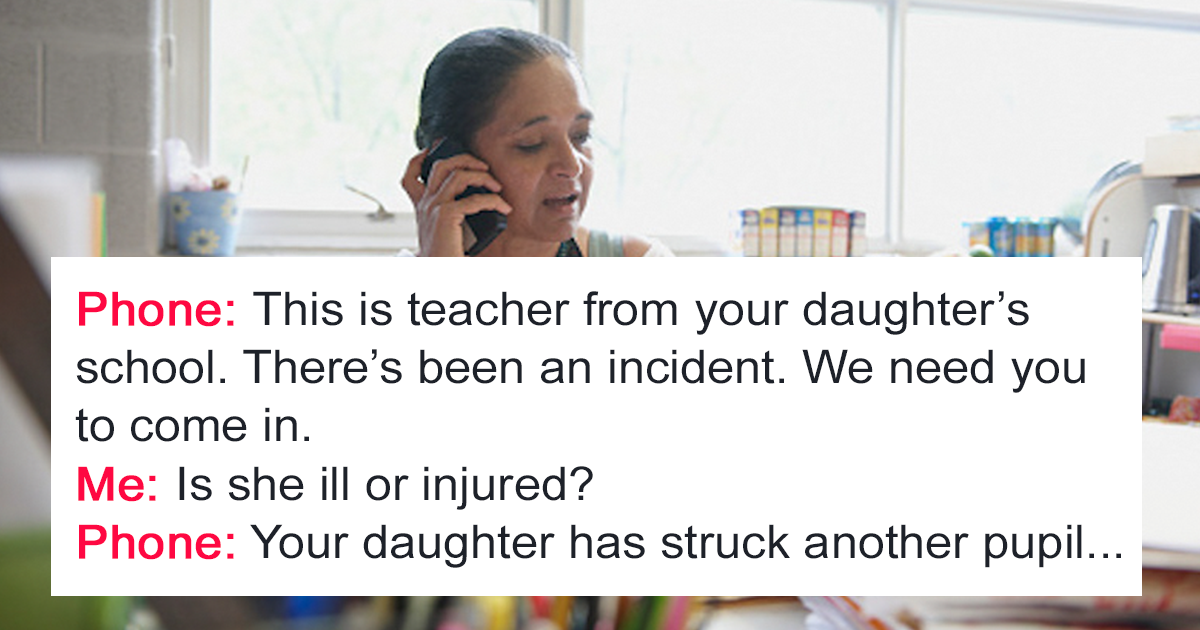
When the school calls home to report that a student hit another child, the front office usually braces for one of three reactions: denial, defensiveness, or a full-blown speech that begins with, “Well, what did the other kid do first?” So when this mom answered the phone and calmly said, “Thank you for telling me. My daughter is going to be held accountable, and I want to know how we make this right,” the adults on the other end were caught off guard.
That response is the real twist in this story. Not because accountability is rare in theory, but because in real life it can feel as uncommon as a quiet cafeteria. Many parents love their children so fiercely that they confuse protection with excuse-making. But schools, pediatric experts, and child behavior specialists keep coming back to the same point: when a child hurts another student, the best adult response is calm, clear, and focused on safety, responsibility, and repair.
In other words, the surprising reaction is not outrage. It is leadership.
Why the Mom’s Response Matters So Much
Let’s be honest: no parent enjoys getting that call. It can feel embarrassing, upsetting, and personal. Suddenly, you are not just hearing about a behavior problem. You are hearing something that seems to reflect on your parenting, your child’s character, and your household all at once. That emotional pileup is exactly why many adults react too fast.
But the smartest parents know something important: a child can do a bad thing without being a bad kid. Hitting is serious. It cannot be brushed off as “kids being kids.” At the same time, one aggressive incident does not automatically define a child forever. The goal is not to slap a permanent label on the student. The goal is to understand what happened, protect everyone involved, and teach the child how to handle conflict without using their hands like punctuation marks.
That is why the mother’s reaction surprised the school. She did not minimize the behavior. She did not immediately ask for loopholes. She did not launch a courtroom drama from the pickup line. She understood that discipline works best when adults stay steady.
What Effective Parents Do After a School Fight
1. They stay calm before they start asking questions
The first useful response is usually something simple: “Is everyone safe?” That question tells the school two things. First, the parent cares about the harmed student as well as their own child. Second, the parent is thinking clearly enough to focus on safety instead of theatrics.
Once everyone is safe, a calm parent asks for facts: What happened before the incident? Where did it happen? Who saw it? Was this part of a larger pattern or a one-time explosion? Calm adults get better information. Angry adults get fragments, assumptions, and a headache.
2. They do not confuse love with automatic defense
Children need loyal parents, but they do not need parents who turn into public relations managers every time they mess up. Defending a child from every uncomfortable consequence can actually teach the wrong lesson: that the rule matters less than the spin.
The strongest response sounds more like this: “I love my child. I also expect better from my child.” That sentence is not cold. It is healthy. It tells the child that love stays put even when behavior needs correcting.
3. They focus on accountability, not humiliation
Some adults hear “consequence” and imagine a dramatic punishment montage. But useful discipline is not about making a child miserable enough to remember your speech forever. It is about helping the child understand the harm, learn a replacement skill, and make a plan for next time.
A parent who says, “You are grounded for the next twenty years, and don’t blink in my direction,” may feel powerful in the moment. But a parent who says, “You are going to repair the harm, lose privileges for now, and practice what to do when you are angry,” is usually doing the more effective work.
What Schools Need to Hear From Parents
School staff are not just looking for an apology. They are looking for partnership. Teachers and administrators need to know whether home and school are rowing in the same direction or playing a spirited game of tug-of-war with a child in the middle.
The most helpful parent responses usually include four messages:
First: “I take this seriously.”
Second: “I want the facts.”
Third: “My child will be accountable.”
Fourth: “Let’s talk about how to prevent this from happening again.”
That kind of response lowers tension immediately. It also makes it easier for the school to share what it can, explain policy, and create a follow-up plan. Good schools are not interested only in punishment. They are trying to restore safety and prevent the next incident.
The Conversation Mom Should Have at Home
If the school makes the first call, the parent’s job is to make the next conversation count. That means no screaming from the driver’s seat and no conducting the entire disciplinary process in the grocery store parking lot. Timing matters. Privacy matters. Tone matters.
Start with facts, not accusations
A strong opening might be: “The school called and said you hit another student. I want to hear what happened from your point of view.” That gives the child a chance to explain without assuming that explanation will erase responsibility.
Sometimes children say they were teased, excluded, embarrassed, or provoked. Those details matter. They do not make hitting acceptable, but they do help adults understand the trigger. A child who lacks coping skills often uses physical behavior when language, frustration tolerance, or self-control gives out.
Name the behavior clearly
Once the child has talked, the parent needs to be direct: “You were wrong to hit.” No vague mush. No motivational poster voice. Clear language helps children connect behavior to consequences.
This is also the moment to separate feeling from action. A parent can say, “You are allowed to feel angry. You are not allowed to hit when you feel angry.” That distinction matters because kids need to know that emotions are real, but actions are still choices.
Ask the repair questions
After the behavior is named, the conversation should move toward repair:
What harm was done?
How do you think the other student felt?
What should happen now?
What can you do differently next time?
These questions build empathy and problem-solving. They also move the child from “I got in trouble” to “My actions affected another person.” That is a big shift, and a useful one.
Practice a replacement plan
Children do not magically develop self-control because an adult gave a speech with excellent volume control. They need a script and a plan. For example:
“If someone crowds you, step back.”
“If someone insults you, find an adult.”
“If you feel hot, shaky, or ready to explode, ask for a break.”
“If a conflict starts, use words like ‘Stop’ or ‘Leave me alone’ and walk away.”
Yes, it sounds basic. That is because many important things are basic. Seat belts are basic. Soap is basic. Breathing before reacting is basic. Basic does not mean unimportant.
Consequences That Actually Teach Something
If a child hits another student, consequences should be real, but they should also be connected. Random punishment often creates resentment. Linked consequences create learning.
Useful consequences may include:
Loss of a privilege tied to trust or self-control, such as screen time.
A written reflection on what happened and what should happen next time.
A sincere apology, when appropriate and not forced in a performative way.
Repairing damaged property, replacing broken items, or participating in a constructive school response.
A behavior plan with check-ins at home and school.
The point is not to create a child who is scared of being caught. The point is to help create a child who can stop, think, and choose a different action before the problem gets physical.
When Hitting Signals a Bigger Problem
Sometimes an incident is exactly what it looks like: a bad decision in a hot moment. Other times, aggressive behavior is a flare shot into the sky. It can signal stress, bullying, trauma, sleep problems, learning difficulties, mood issues, attention problems, social struggles, or a growing pattern of explosive reactions.
Parents should pay closer attention when the behavior is repeated, intense, happens across settings, or begins interfering with school, friendships, and family life. If the child seems chronically angry, unsafe, impulsive, or unable to recover after minor frustrations, it may be time to go beyond discipline and seek evaluation or support.
That does not mean a parent is failing. It means a parent is noticing. Those are very different things.
How Schools and Families Can Work Together Better
The best outcomes usually happen when home and school stop treating each other like rival news networks. A child who hits at school needs consistency, not mixed messaging. If school says, “Use words,” but home says, “Well, sometimes you just have to swing,” the child is going to choose the lesson with more adrenaline.
Effective collaboration often includes:
A shared description of what happened.
A shared expectation for future behavior.
A plan for adult support during high-risk times, such as recess, lunch, or transitions.
A way to communicate progress without making every day feel like a parole hearing.
A focus on skill-building, not only punishment.
This is where the mother’s reaction becomes especially powerful. By aligning herself with the school’s goal of safety and learning, she models maturity for everyone involved, including her daughter.
The Real Surprise Wasn’t the Phone Call
The surprising part of this story is not that a child made a bad choice. Kids do that every day, sometimes before breakfast. The surprise is that the mom responded with something more effective than denial and more useful than rage. She responded with accountability.
She did not say, “My daughter would never.” She said, in effect, “My daughter did, and now we deal with it.” That response protects the other student, supports the school, and helps her own child grow. It turns a messy moment into a teachable one.
That is what good parenting often looks like in real life. It is less dramatic than internet headlines and much more valuable. It is not about winning the phone call. It is about raising a child who knows how to repair harm, manage anger, and return to school safer than before.
And honestly, that kind of reaction should not be surprising. It should be the standard.
Related Experiences Parents and Teachers Often Recognize
One of the most common experiences teachers describe is the split-second shift in a phone call when they realize whether a parent is coming in as a partner or an opponent. They may begin with a routine report about a hallway scuffle, and within seconds the conversation either becomes productive or turns into a full-contact blame tournament. Educators often say the most memorable parents are not the loudest ones. They are the ones who ask thoughtful questions, listen carefully, and follow through later.
Parents, meanwhile, often describe a different kind of emotional whiplash. At first, they feel shock. Then embarrassment. Then a strong urge to protect their child from everyone and everything, including consequences. But after that first wave passes, many admit that the most useful step was slowing down. Some say the hardest part was hearing that their child was not the victim in that moment. Others say the turning point came when they stopped asking, “How do I make this disappear?” and started asking, “What does my child need to learn from this?”
Another experience families talk about is discovering that the hitting incident was not truly random. Maybe the child had been bottling up frustration for weeks. Maybe there was teasing on the bus, conflict during group work, or ongoing stress at home. Sometimes the student was struggling academically and felt embarrassed. Sometimes the child had poor impulse control and reacted before thinking. In those situations, the school call did not create the problem; it revealed it. That realization can be painful, but it is often the beginning of more honest support.
Teachers also notice that children respond differently depending on what happens after the incident. A child whose parent says, “Tell me the truth, and we’re going to fix this,” often returns to school with a clearer sense of responsibility. A child whose parent spends the evening attacking the school, mocking the rules, or blaming everyone else may come back more defensive and less willing to repair the damage. Kids pay close attention to which adults are actually in charge and which adults are simply angry.
School counselors often describe the most successful follow-up moments as surprisingly ordinary. They are not big movie-scene breakthroughs. They are small, repeated experiences: a student practicing how to walk away, a teacher noticing early signs of frustration, a parent using the same calm language at home, a check-in before recess, a written apology that sounds genuine instead of forced, or a quiet conversation in which the child finally admits, “I was mad and I didn’t know what to do.” Those small moments add up.
Many families also report that accountability improves trust rather than damaging it. Children may be upset when privileges are removed or when they are asked to apologize and reflect, but they also learn something deeply stabilizing: the adults in their lives mean what they say. Rules are real. Harm matters. Repair is possible. For many kids, especially those who act before thinking, that kind of consistency becomes a source of security rather than just discipline.
There are also experiences where the incident becomes a signal that more support is needed. Some parents say the school fight was the moment they finally pursued counseling, behavioral therapy, or a pediatric evaluation. Looking back, they often realize there had been warning signs all along: explosive reactions, trouble with peers, constant irritability, difficulty recovering from disappointment, or repeated conflict with siblings. The school phone call was unpleasant, but it forced action that eventually helped the child in a bigger way.
The shared lesson in many of these experiences is simple: the incident matters, but the adult response matters just as much. A parent does not need a perfect script. They need steadiness, honesty, and a willingness to work with the school instead of against it. That is often the difference between a child who only remembers getting caught and a child who actually learns how to do better next time.
Note: This article uses a headline-style, composite scenario rather than claiming a single verified viral incident. The guidance and analysis are based on real U.S. recommendations about student aggression, bullying response, school discipline, child mental health, and family-school collaboration.