“`
In 1983, the average electronics workbench had a certain personality: warm solder, paper manuals, a few mysterious resistors hiding under the mat, and, if you were lucky, a hulking oscilloscope with a glowing cathode-ray tube that looked like it might also receive messages from Mission Control. Then along came an advertisement for something called the Pocket-O-Scope, a tiny solid-state oscilloscope that claimed to fit in your hand, weigh only four ounces, and make CRT oscilloscopes “obsolete.” Bold? Absolutely. Accurate? Let’s not make the Tektronix collectors spill their coffee.
The 1983 pocket oscilloscope is one of those retro gadgets that sits beautifully between genius and “Wait, did this thing actually ship?” It promised a portable test instrument long before modern handheld digital oscilloscopes became normal. It used a small LED display instead of a CRT, offered a 5 MHz bandwidth, and targeted technicians and hobbyists who wanted waveform visibility without dragging around a bench instrument the size of a dorm-room microwave.
Today, the Pocket-O-Scope is fascinating not because it replaced traditional oscilloscopes overnightit did notbut because it shows how engineers and marketers were already dreaming about pocket electronics before the technology was truly ready to make that dream effortless. It was a gadget from the future, mailed from the past, with a coupon and a 90-day warranty.
What Was the 1983 Pocket Oscilloscope?
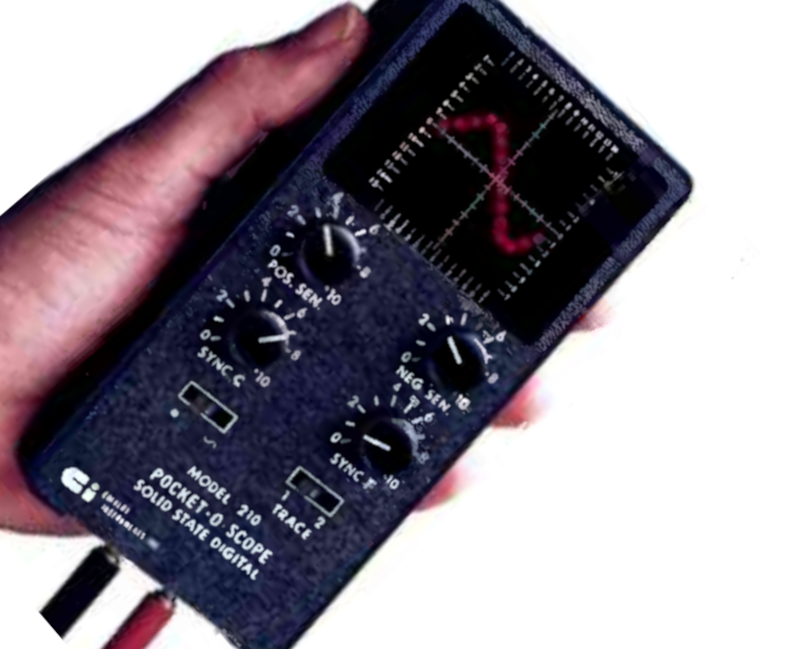
The 1983 pocket oscilloscope was advertised by Calvert Instruments Incorporated as the CI Model 210 Pocket-O-Scope. The ad presented it as a revolutionary solid-state digital LED oscilloscope designed for hobbyists, field technicians, and anyone who wanted a portable way to view electrical waveforms.
At the time, oscilloscopes were usually built around cathode-ray tubes. A CRT scope produced a bright analog trace by steering an electron beam across a phosphor screen. This made for a beautiful display, but it also required size, voltage, shielding, careful calibration, and power. Even “portable” oscilloscopes could be chunky, heavy, and awkward enough to make a toolbox reconsider its life choices.
The Pocket-O-Scope took a different route. Instead of a CRT, it used a 1.5-inch-square LED display with 210 points. In modern terms, that sounds microscopic. In 1983 marketing language, it was “high resolution.” Both statements can be true, especially if you have a generous sense of humor and perhaps a magnifying glass.
Key Specifications That Made It Stand Out
The Pocket-O-Scope’s advertised specifications were surprisingly ambitious for such a small device. It claimed a 5 MHz bandwidth, which meant it could be useful for many basic analog, audio, radio, and low-speed digital troubleshooting tasks. It was not a lab-grade high-frequency monster, but it was far more than a blinking novelty.
Advertised Features
The Pocket-O-Scope was promoted as a fully solid-state instrument with battery or AC adapter operation. It included automatic zero-voltage centering, automatic sweep positioning, overload protection, free-run or locked image response, and a time base ranging from 0.1 microseconds to 0.5 seconds. The ad also mentioned single-trace capability, a half-channel dual-trace mode, signal inversion, external input/output expansion, and factory calibration.
The package pricing was also part of the story. The basic unit with standard probes was advertised at $179.95 plus postage. A fuller package with carrying case, AC adapter, standard probes, high-voltage probes, and a 200-page oscilloscope training manual was offered for $249.95. Adjusted for modern purchasing power, that premium package was not cheap; it landed in the neighborhood of a serious tool purchase, not an impulse buy next to the solder wick.
The 210-Point LED Screen
The display is the most charming part of the design. A 210-point LED matrix was a clever way to remove the CRT, reduce weight, and create something genuinely pocketable. But it also created obvious limits. A classic CRT trace is continuous, glowing, and capable of showing subtle changes in brightness and shape. A sparse LED display turns a waveform into a dotted approximation. Imagine replacing cursive handwriting with a Lite-Brite board. Useful? Sometimes. Elegant? In its own blocky little way.
Why a Pocket Oscilloscope Was a Big Deal in 1983
To understand why the Pocket-O-Scope mattered, you have to remember what electronics looked like in the early 1980s. Personal computers were exploding into homes and schools. CB radios, audio gear, televisions, arcade machines, synthesizers, and early microcontroller projects were everywhere. Hobby electronics magazines were thick with mail-order ads promising miracles in kit form. Some miracles were real. Some required “minor assembly,” three evenings, and emotional resilience.
An oscilloscope was one of the most powerful tools a technician could own. A multimeter could tell you a voltage was present. A scope could show you what that voltage was doing over time. Was a power supply rippling? Was an audio signal clipping? Was a clock line oscillating? Was a trigger pulse arriving late like a bus in bad weather? The oscilloscope answered those questions visually.
The trouble was that scopes were expensive and bulky. A bench oscilloscope was a commitment. A portable oscilloscope existed, but “portable” often meant “has a handle” rather than “slips into a jacket pocket.” The idea of a four-ounce scope was therefore exciting. It suggested a future where diagnostic tools traveled with the technician instead of waiting back at the bench.
The Pocket-O-Scope vs. Traditional CRT Oscilloscopes
The Pocket-O-Scope’s bold claim that CRT oscilloscopes had become obsolete was more marketing fireworks than engineering reality. CRT scopes still had enormous advantages in display fidelity, bandwidth, analog responsiveness, and user trust. A well-made Tektronix or Hewlett-Packard scope could show fine waveform detail that a tiny LED matrix could only hint at.
Still, the Pocket-O-Scope was not trying to win every battle. It was trying to win a very specific one: size. If you needed a quick signal check in the field, a small instrument could be more valuable than a superior instrument sitting on a bench five miles away. That is the logic behind modern handheld test tools too. The best tool is not always the most powerful; sometimes it is the one you actually brought with you.
Where CRT Scopes Still Ruled
Classic CRT oscilloscopes offered smooth real-time traces, better visual intuition, and a larger graticule for measurement. They were excellent for seeing signal behavior at a glance. Engineers learned to read those green traces like weather reports. A jittery line, a fuzzy edge, a ringing transientthese were clues that the analog display made easy to interpret.
Where the Pocket-O-Scope Had an Edge
The Pocket-O-Scope’s edge was portability. Four ounces is astonishingly light compared with most professional scopes of the era. Battery operation added field usefulness. Its simple controls also suggested a tool designed for quick checks rather than deep laboratory analysis. For a hobbyist testing audio circuits or a technician confirming whether a signal existed, that could have been enough.
A Retro Gadget Wrapped in Mystery
One reason the 1983 pocket oscilloscope remains so intriguing is that Calvert Instruments is not a household name in test equipment history. Tektronix, Hewlett-Packard, Fluke, and B&K Precision left long paper trails and surviving product ecosystems. Calvert Instruments, by contrast, feels like a company that stepped into the spotlight, shouted “Pocket oscilloscope!” and then disappeared backstage before anyone could ask too many questions.
Collectors and electronics historians have found the advertisements, but actual units appear to be rare, if they exist in meaningful numbers at all. That does not automatically mean the device was vaporware; many small-run technical products were sold through magazine ads and vanished without much documentation. But the uncertainty adds to the gadget’s legend. It is part instrument, part artifact, part mail-order ghost story.
This uncertainty also makes the Pocket-O-Scope a perfect retro gadget. The best retro devices are not always the ones that dominated the market. Sometimes they are the oddballs that reveal what people wished technology could become.
How It Fits Into Oscilloscope History
The Pocket-O-Scope was not the first portable oscilloscope, and it was not the final word in handheld measurement. Tektronix had already developed compact battery-powered “miniscope” models in the 1970s, including the 211, a small analog CRT scope. Those instruments were heavier than the Pocket-O-Scope but far more conventional and professionally documented.
By the late 1980s and 1990s, portable digital instruments became more practical. Better LCDs, faster analog-to-digital converters, improved batteries, and compact microprocessors changed everything. Eventually, handheld scopes became ordinary tools. Today, you can buy pocket-sized digital oscilloscopes with color screens, USB charging, waveform storage, automatic measurements, and features that would have sounded like science fiction to a 1983 hobbyist reading a magazine ad under a desk lamp.
In that sense, the Pocket-O-Scope was early to the party. Maybe too early. It had the right idea: shrink the oscilloscope, make it solid-state, and bring waveform viewing into the field. The technology ecosystem simply needed more time to catch up.
Why Hobbyists Still Love the Idea
Retro electronics enthusiasts are drawn to devices like the Pocket-O-Scope because they show ambition. Modern gadgets are sleek, optimized, and often sealed shut. Older gadgets show their compromises proudly. You can almost hear the design meeting: “What if we replace the CRT with LEDs?” “How many LEDs?” “Enough to call it high resolution.” “Wonderful. Print the coupon.”
There is also a tactile appeal. A pocket oscilloscope from 1983 belongs to an era when electronics felt physical. You mailed checks. You clipped magazine ads. You read manuals. You learned by probing circuits and occasionally discovering, with great personal clarity, why grounding matters.
The Pocket-O-Scope also represents the democratic side of test equipment. Big laboratory scopes were intimidating and expensive. A pocket-sized scope suggested that waveform analysis could belong to students, garage inventors, TV repair techs, and weekend experimenters. It made the oscilloscope feel less like a shrine and more like a tool.
What Could You Actually Use It For?
Assuming a working Pocket-O-Scope performed close to its advertisement, it would have been useful for basic signal tracing and quick troubleshooting. Audio circuits, simple oscillators, sensor outputs, power supply checks, low-frequency digital pulses, and educational demonstrations would all fit within its likely comfort zone.
It would not be ideal for serious high-speed digital analysis, detailed RF work, or precision measurements requiring a large display and stable triggering. The LED matrix would limit waveform detail, and the control set was simplified. But for “Is there a waveform here?” or “Is this signal roughly the shape I expect?” it could have been extremely handy.
That distinction still matters today. Not every oscilloscope task requires a 500 MHz bench instrument with deep memory and automatic serial decoding. Sometimes you just need to know whether the patient has a pulse. The Pocket-O-Scope was essentially a stethoscope for circuitstiny, imperfect, and potentially very useful.
The Marketing: Brave, Loud, and Very 1983
The Pocket-O-Scope advertisement is a time capsule of 1980s electronics marketing. It used big promises, technical confidence, and just enough futuristic language to make a hobbyist reach for a wallet. “CRT oscilloscopes just became obsolete” is the kind of line that deserves both admiration and a raised eyebrow.
But marketing bravado was common in the mail-order electronics world. Magazine ads had to compete with kit computers, satellite TV receivers, miracle antennas, educational courses, alarm systems, and gadgets that claimed to do more before breakfast than a lab full of equipment did all week. Subtlety was not the house style.
Even so, the ad’s core idea was strong. It identified a real pain point: oscilloscopes were too large and expensive for many casual users. It offered a memorable solution: a digital LED scope small enough for a pocket. Whether the product became a commercial success or not, the pitch understood the future of electronics tools.
Why the 1983 Pocket Oscilloscope Still Matters
The Pocket-O-Scope matters because it predicted a direction, not because it conquered a market. Modern electronics work is filled with portable instruments: handheld oscilloscopes, USB logic analyzers, pocket spectrum analyzers, tiny multimeters, and phone-connected diagnostic tools. The idea that a technician should carry serious measurement power in a pocket is now normal.
In 1983, that idea was still daring. The Pocket-O-Scope compressed a bench concept into a personal format. It challenged the assumption that a waveform display needed a glass tube and a heavy chassis. It may have been limited, but it was thinking along the right axis: smaller, lighter, more accessible.
That is why retro gadgets deserve attention. They are not merely old objects. They are evidence of technological desire. They show what people wanted before supply chains, batteries, displays, and chips could fully deliver it.
Experience Notes: Living With the Idea of a 1983 Pocket Oscilloscope
Using a gadget like the Pocket-O-Scope, or even imagining it on a real 1980s workbench, changes the way you think about measurement. Modern tools spoil us. A current entry-level digital oscilloscope may offer automatic measurements, waveform capture, USB export, cursor readouts, math functions, and a display large enough to show every little wobble in a signal. The Pocket-O-Scope asks for a different relationship: slower, more patient, more interpretive.
The first experience would likely be surprise at the size. A four-ounce oscilloscope would feel less like a serious instrument and more like a gadget from a spy movie, except the spy is troubleshooting a doorbell transformer. You would connect the probes, power it up, and stare at the LED grid, waiting for dots to become meaning. There is charm in that. The display would not hand you the answer. It would invite you to squint, adjust, think, and compare.
That process is educational. A simplified instrument forces the user to understand the basics: volts over time, sweep rate, triggering, amplitude, and signal shape. You cannot hide behind menus when the interface gives you only a few controls. In that way, the Pocket-O-Scope could have been a wonderful teaching tool. It reduced the oscilloscope to its central magic trick: electricity made visible.
On a practical repair bench, the experience would depend heavily on expectations. A technician diagnosing a dead audio amplifier might find it useful for tracing signal flow from input to output. A radio experimenter might use it for rough oscillator checks. A student building a 555 timer circuit could see pulses appear and feel the satisfying little thrill of theory becoming light. But anyone expecting the smooth detail of a full CRT scope would quickly meet the limits of the LED matrix.
The emotional experience is the real treasure. Retro test equipment makes you aware of how much engineering is about compromise. Every feature has a cost: power, size, price, reliability, readability, calibration, or complexity. The Pocket-O-Scope chose portability above all else. That choice made it imperfect, but also memorable.
It also reminds us that innovation is rarely a clean parade of obvious winners. Some ideas arrive early and awkwardly. Some vanish, then reappear decades later in better form. The pocket oscilloscope concept eventually became practical because displays improved, batteries improved, microcontrollers became cheap, and digital sampling matured. The 1983 version was like an opening joke in a story the industry would finish later.
If you are a modern maker, the lesson is encouraging. Today’s strange prototype may be tomorrow’s normal tool. A small LED oscilloscope in 1983 looked wildly ambitious. A pocket digital scope today looks ordinary. That should make every garage inventor smile. The future often begins as a weird little rectangle with too many promises and not quite enough pixels.
Conclusion
The 1983 Pocket-O-Scope is a delightful piece of retro gadget history: part practical test instrument, part bold advertisement, part mystery. Its 5 MHz bandwidth, 210-point LED display, tiny body, and battery-powered design showed a real understanding of where electronics tools were headed. It did not make CRT oscilloscopes obsolete, but it did point toward the handheld digital instruments we now take for granted.
For collectors, makers, and electronics-history fans, the Pocket-O-Scope is worth remembering because it captures a specific moment when portability became a dream worth selling. It was not just a small oscilloscope. It was a pocket-sized announcement that the workbench was about to get mobile.
“`