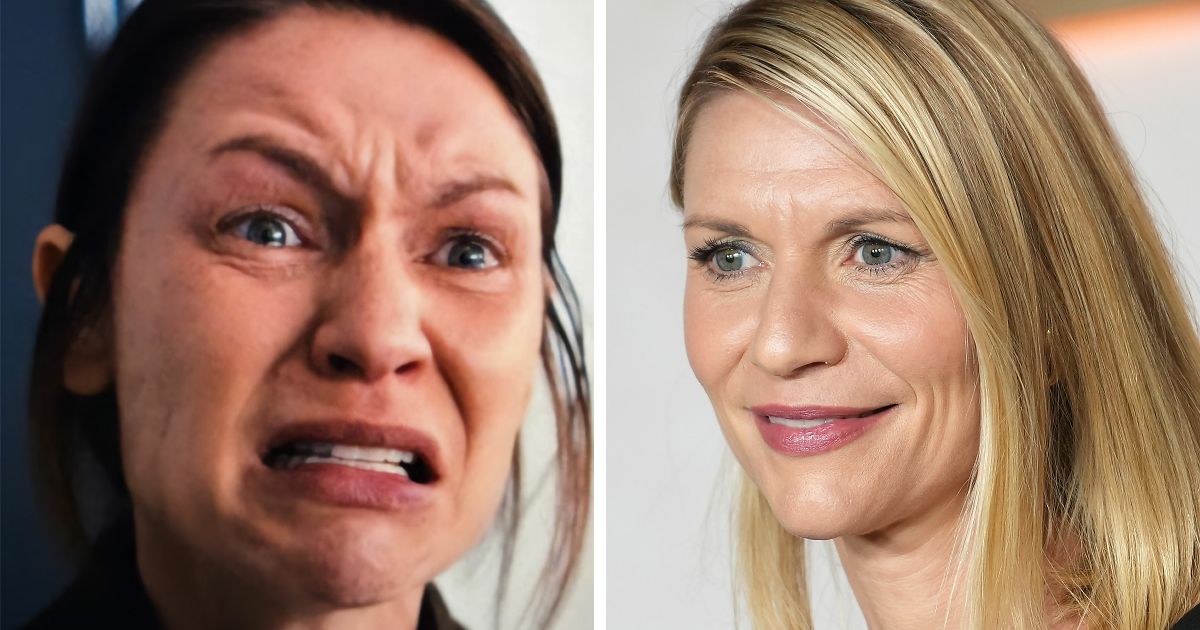
Every few years, the internet rediscovers something it cannot resist turning into a full-blown cultural debate: Claire Danes acting with her entire face. Not just the eyes. Not just the voice. The whole face. In Netflix’s The Beast in Me, that conversation is back with a vengeance, and this time the obsession is focused on one very specific area: her lower lip and chin.
Yes, that trembling, tightening, almost volcanic little quiver. The one that makes some viewers say, “Wow, that is devastating,” and others say, “Please, somebody hand me a stress ball.” It is the facial movement currently driving people a little bonkers, and the reason is actually more interesting than a simple “love it or hate it” reaction.
Because what people are really reacting to is not just a chin. They are reacting to Claire Danes’ signature emotional style, the close-up-heavy design of The Beast in Me, and a performance that refuses to sand down grief into something pretty, polished, or socially comfortable. In other words, viewers are not just staring at a facial tic. They are staring at what happens when an actor lets emotion look messy on camera.
What Part of Claire Danes’ Face Are People Talking About?
Let’s get right to it: the part of Claire Danes’ face getting the most attention in The Beast in Me is her lower lip and chin, especially when they begin to tremble during emotionally intense scenes. It is part of the larger phenomenon long known online as the “Claire Danes cry face,” but in this show it feels sharper, more visible, and somehow more unavoidable.
That is partly because The Beast in Me gives Danes plenty of opportunities to play distress in extreme close-up. She stars as Aggie Wiggs, an acclaimed author who has receded from public life after the death of her young son. She is grieving, blocked, isolated, and circling the emotional drain when Nile Jarvis, a wealthy and deeply suspicious neighbor, moves in next door. He may be a murderer. He may be a manipulator. He may also be the only thing that has made Aggie feel alive in years. Healthy? No. Great television? Absolutely.
So when viewers notice Danes’ chin tightening like it has its own emotional subplot, that is not random. The show is practically aiming a spotlight at it. Aggie’s whole internal life is written onto her face, and Danes does not play pain with a tasteful little tear and a tasteful little sigh. She plays it as if emotion is trying to physically force its way out.
Why It Stands Out So Much in The Beast in Me
1. The show is built around emotional close-ups
The Beast in Me is not a breezy ensemble mystery where characters exchange exposition and then politely move on to the next clue. It is a tense psychological thriller built on discomfort, obsession, and the strange electricity between two damaged people. That means the camera spends a lot of time lingering on Aggie’s face while she is thinking, doubting, flinching, grieving, and trying not to fall apart.
When a show uses that many intimate close shots, every micro-expression becomes louder. A raised eyebrow becomes a headline. A tiny lip movement becomes a talking point. And Danes is not an actor who gives you blank neutrality in close-up. She gives you weather systems.
2. Aggie is supposed to look emotionally frayed
Aggie Wiggs is not meant to glide through this story looking filtered, serene, and camera-ready. She is a woman whose life has calcified around loss. Her marriage has fractured. Her sense of self has collapsed. Her writing career is stalled. Her fascination with Nile is not a cute neighborhood hobby; it is a dangerous substitute for processing her own pain.
That matters, because viewers sometimes mistake character design for actor habit. Aggie’s physical tension is part of the role. She is wound tight all the time. Her body looks braced for impact because, emotionally, it is. Danes’ face reflects that constant state of internal compression. The chin quiver is not just “a thing she does.” In this series, it becomes a signal that Aggie is barely holding the walls up.
3. Claire Danes has always been an unusually expressive actor
This did not begin with The Beast in Me. Anyone who watched My So-Called Life, Romeo + Juliet, Homeland, or even Fleishman Is in Trouble knows Danes has never been a minimalist in the frozen-face sense. She is expressive in a muscular way. Emotion does not just appear in her eyes; it ripples across her mouth, jaw, and forehead like a full-body event that accidentally got trapped in a close-up.
That is why the internet has been fascinated by her so-called cry face for years. Her screen emotion is memorable because it is specific. Plenty of actors cry. Fewer cry in a way that becomes instantly recognizable from one frame. Danes does.
And in a media landscape where many performances are calibrated to look flattering first and truthful second, her style can feel almost rebellious. She is willing to look strained, odd, raw, and even a little unbeautiful if that is what the scene needs. Hollywood often sells “vulnerability” in a heavily moisturized package. Danes sometimes sells it like a cracked window in a storm.
Why Some Viewers Love It and Others Cannot Stop Complaining
The split reaction is not hard to understand. For one group of viewers, Danes’ face reads as thrillingly alive. They see an actor who lets emotion fully register, without Botox-smooth restraint or prestige-TV coolness. To them, her trembling chin is not distracting. It is evidence. Evidence that Aggie is feeling something real, ugly, and uncontrolled.
For another group, the very thing that makes Danes distinctive also makes her polarizing. They notice the repeated lower-lip and chin tension and begin anticipating it. Once that happens, the performance can stop feeling organic and start feeling like a recognizable acting signature. When viewers begin watching for the move instead of through it, irritation arrives quickly.
That is the curse of having a signature. If you are bland, no one notices. If you are specific, people build a whole internet discourse around one muscle in your face.
There is also a modern viewing habit at play here. Many people no longer watch performances holistically. They isolate moments, freeze frames, clips, and facial quirks, then debate them as standalone objects. An expression that would pass naturally in the emotional flow of a scene becomes “the thing she always does” once it is chopped into memes, reaction posts, and side-by-side comparisons.
The Real Reason the Chin Quiver Feels So Intense
Here is the deeper answer: the chin quiver lands so hard because it is attached to a face that is not hiding anything. Danes looks like a person having feelings, not like a celebrity carefully managing the optics of feeling.
That matters more than it sounds. A lot of screen culture has trained audiences to expect women, especially women over 40, to remain visually controlled even while portraying emotional chaos. Danes does not really do that in The Beast in Me. Her face is allowed to crease, tremble, harden, and look tired. That makes every expression more legible, and therefore more discussable.
Some viewers are responding to the performance. Some are responding to the rarity of a face that can still move this much. Some are responding to their own discomfort with grief that does not package itself neatly. And some are just having a very online moment with a chin. All of those things can be true at once.
It is also worth noting that Danes herself has spoken over the years about how her face naturally registers feeling. She has never seemed particularly interested in making emotion prettier for public consumption. That self-awareness is part of why the current reaction feels less like a scandal and more like the latest chapter in a very Claire Danes-specific tradition: audiences being both mesmerized and slightly unnerved by how fully she commits.
How The Beast in Me Makes the Conversation Even Bigger
Aggie is basically a pressure cooker with a library card
Aggie is not a neutral vessel. She is a bruised, intellectually restless, emotionally starving woman who becomes fixated on a neighbor she knows could be monstrous. That fixation makes her face do a lot of contradictory work at once. Fear and desire. Revulsion and fascination. Suspicion and recognition. Danes has to play all of that with tiny shifts, and the mouth and chin become crucial parts of the machinery.
In a simpler role, the same facial habit might barely register. In Aggie, it becomes central because the entire character lives in ambivalence. She is always swallowing something: rage, grief, curiosity, self-disgust, attraction to danger. The lower face becomes the battlefield.
The chemistry with Matthew Rhys amplifies everything
Danes is also not acting into empty space. Matthew Rhys gives Nile Jarvis a slippery, unnerving charisma that constantly destabilizes Aggie. Their scenes feel like a duel played in whispers, pauses, and tiny facial adjustments. When Rhys turns on the charm or the menace, Danes answers not with theatrical speeches but with visible internal conflict. The camera catches that conflict in her jaw before it reaches her dialogue.
That is one reason critics responded so strongly to the pair. Even when reviews disagreed about the show’s plotting, many praised the performances and the cat-and-mouse dynamic. Danes’ face is not a side issue in that dynamic. It is one of the reasons it works.
The styling keeps things raw
Another reason the reaction feels louder is the show’s styling. Aggie is not presented with glossy armor. Her look is subdued, worn-in, and emotionally unvarnished. Without the distraction of glamorous styling, the audience sees every flicker more clearly. That includes the now-famous lip-and-chin tremor.
To some viewers, that naturalism is refreshing. To others, it is jarring because it strips away the visual buffer that usually softens emotional performance. Either way, it puts Danes’ expressiveness front and center.
So, Is It Bad Acting? Not Even Close
You can find a performance distracting without it being bad. That distinction matters. Claire Danes’ work in The Beast in Me may not be subtle in the “vanishes into the wallpaper” sense, but it is precise, intentional, and deeply tied to character. She is not randomly twitching her way through scenes. She is externalizing a woman whose emotional life has become impossible to contain.
Bad acting usually feels false, generic, or disconnected from the role. Danes’ performance feels like the opposite. If anything, it is almost too connected. Too willing to let us see the strain. Too willing to make the audience uncomfortable. That can be a dealbreaker for some viewers, but it is also why others cannot look away.
And honestly, in an era when so many performances are praised for being “restrained” simply because they are quiet, there is something refreshing about an actor who reminds us that pain often looks weird. Grief is not elegant. Obsession is not photogenic. Suspicion does not always arrive with a cool, controlled stare. Sometimes it arrives with a wobbling chin and a face that looks like it is arguing with itself.
The Bigger Cultural Reason People Are So Fixated
The obsession with Danes’ face says as much about viewers as it does about Danes. We are living in a time when audiences are hyper-trained to inspect faces. Social media, filler discourse, skin discourse, aging discourse, camera filters, freeze frames, screenshot culture, and endless “what happened to her face?” conversations have turned facial movement into a public referendum.
So when an actress appears on a major Netflix thriller with a face that still moves vividly, people notice. Some cheer because it feels honest. Some recoil because they are not used to seeing so much uncontrolled expression. Some cannot even explain why they are bothered; they just know the chin has them in a chokehold.
That is why the reaction to The Beast in Me became bigger than one performance detail. It touched a nerve about what viewers expect women to look like when they suffer onscreen. Danes does not flatten pain into a glamorous abstraction. She lets it crumple the architecture.
Final Verdict: The Face Is the Point
So why is part of Claire Danes’ face in The Beast in Me driving people insane? Because the lower lip-and-chin quiver has become the lightning rod for everything the show is doing: grief, discomfort, intimacy, obsession, realism, and the unsettling power of a performer who lets emotion register without vanity.
It stands out because the camera notices it. It lingers because Aggie is built from tension. It sparks debate because Danes has a famously expressive style. And it becomes a full internet fixation because modern audiences are incapable of leaving one distinctive facial movement alone for even five minutes.
Some viewers will call it distracting. Others will call it fearless. The smartest answer is probably that it is both memorable and deeply characteristic of Claire Danes as an actor. You may not always enjoy what her face is doing, but you are definitely not going to forget it.
And in prestige thriller land, where too many performances evaporate the second the credits roll, that is not a flaw. That is a superpower.
Related Viewing Experience: What Watching Claire Danes in The Beast in Me Actually Feels Like
Watching Claire Danes in The Beast in Me is a very specific kind of television experience. It is not the soothing, background-noise version of streaming where you fold laundry, answer three texts, and still somehow know what is happening. This show keeps yanking your attention back to Aggie’s face like it owes the camera money.
At first, the experience is almost deceptively simple. You meet Aggie in a state of grief so settled it feels architectural. She is not just sad. She is inhabited by sadness. Danes plays that not with melodramatic explosions, but with a face that seems permanently on the verge of flinching. You start to notice the tension around her mouth before you consciously register why. Then the chin quiver shows up, and suddenly you realize this performance is going to live very close to the skin.
That can be unnerving. It can also be weirdly intimate. There are moments when Aggie looks less like a TV character and more like someone you accidentally saw having a private emotional reaction they never meant to display. The experience of watching her becomes slightly voyeuristic, which is fitting for a show about observation, suspicion, and emotional trespassing.
Then Matthew Rhys enters the frame and everything gets stranger. Their scenes do not play like normal thriller dialogue scenes. They feel like two brilliant people sniffing for weakness while pretending to be civilized. In that context, Danes’ face becomes a running commentary track. You can see Aggie resisting Nile, studying Nile, judging Nile, and recognizing something of herself in Nile, sometimes all in one shot. It is a little like watching an internal monologue leak through the jawline.
What makes the viewing experience so sticky is that Danes never fully resolves Aggie into one readable mood. She is raw, but guarded. Angry, but hollowed out. Drawn to danger, but disgusted by that attraction. Her face keeps cycling through tiny shifts that make you lean in harder than you expected. Even when the plot takes a turn that feels pulpy, her performance keeps the emotional stakes feeling bruisingly real.
There is also a strange relief in watching an actress who does not seem committed to looking camera-beautiful in every frame. Danes is still magnetic, obviously, but the magnetism comes from presence rather than polish. That changes the experience as a viewer. You stop admiring and start reading. You are not just looking at her; you are trying to decode her.
By the end, whether you loved the chin quiver, hated it, or wanted to file a formal complaint against it, the experience lands in the same place: you remember it. You remember Aggie’s face the way you remember a line reading, a twist ending, or a song cue that arrived at exactly the right moment. It gets under your skin because it feels too alive to ignore. That is why people keep talking about it. Not because it is perfect, but because it makes watching feel like participation rather than passive consumption. In the age of half-watching everything, that is its own kind of miracle.