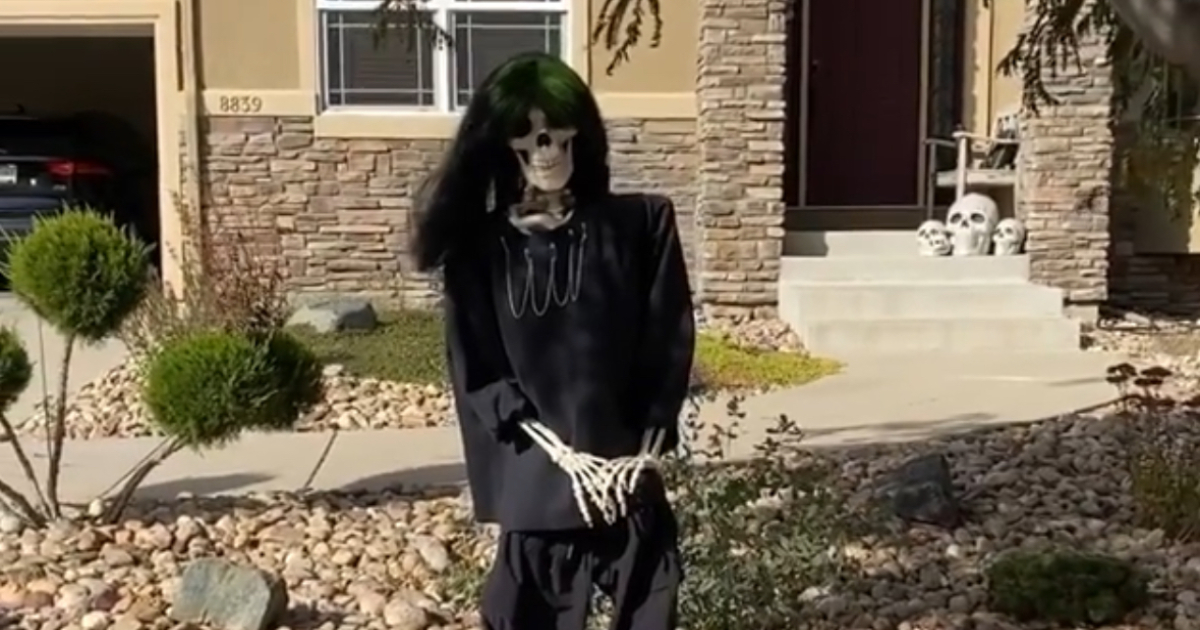
Most people decorate for Halloween by placing a pumpkin on the porch, stretching fake cobwebs over a bush, and calling it a successful haunting. Texas mom Amy Moses took a considerably more ambitious approach. Instead of creating one Halloween skeleton display and leaving it untouched until November, she gave her plastic residents a completely new life every day of October.
One morning, the skeletons might be practicing yoga. The next, they could be riding bicycles, enjoying a picnic, playing Twister, selling lemonade, or attempting some other activity that becomes instantly funnier when performed by people with no muscles, organs, or apparent concern for personal dignity.
The project became known as Keeping Up With the Bones, a name that perfectly captured the suburban sitcom energy of the scenes. What began as a playful family decoration grew into a neighborhood attraction and an online favorite. Children watched for each new setup, adults shared photographs, and the Bones family became busier in death than many of us are while fully alive.
How a Plastic Skeleton Family Became an October Tradition
Moses, a mother of two from Lumberton, Texas, reportedly began creating daily skeleton scenes after a friend suggested posing the decorations in funny situations. The idea was simple: take ordinary household life and recreate it with a family whose smiles are permanently attached.
The first displays appeared in October 2015. By the following Halloween season, Moses had become more organized. She kept notes on her phone, created a calendar of possible scenes, and collected ideas throughout the year. Some arrangements could be completed quickly, while the most complicated reportedly took about an hour.
That preparation mattered because inventing 31 original Halloween skeleton ideas is harder than it sounds. “Skeleton holding a pumpkin” gets you through day one. After that, the creative department has to work overtime.
The scenes followed the lives of Mr. and Mrs. Bones as they moved through romance, marriage, family life, household chores, exercise, recreation, and occasional public embarrassment. Props often came from objects already available around the house. A bicycle, picnic blanket, roll of toilet paper, wheelchair, yoga mat, game board, or lemonade pitcher could become the foundation for the next miniature episode.
Moses’s children helped arrange the characters, while her husband often discovered the finished scene through a photograph or social media post after leaving for work. That behind-the-scenes detail made the tradition feel less like a polished commercial production and more like what it really was: a family having an unusually productive amount of fun with plastic bones.
The Funniest Scenes Worked Because They Felt Familiar
The most memorable displays were not necessarily the most expensive or elaborate. Their humor came from recognition. Viewers understood the situation immediately, then noticed that the participants happened to be anatomically incomplete.
Everyday Chores Became Visual Jokes
A skeleton doing laundry is amusing because laundry already feels endless enough to follow someone into the afterlife. Skeletons gardening, cleaning, exercising, or caring for skeletal children turn routine suburban tasks into silent comedy.
One especially popular scene involved a skeleton sitting on a toilet while another held the toilet paper. According to Moses, children passing the house on a school bus reacted enthusiastically. The bus driver may have been less delighted, presumably because maintaining order is difficult when an entire vehicle of children has just witnessed a bathroom emergency involving the undead.
Movement Made the Figures Seem Alive
The skeletons were frequently posed in the middle of an action rather than simply seated beside a pumpkin. They performed yoga poses, played limbo, rode bicycles, and competed in games. Bent elbows, tilted skulls, crossed legs, and well-placed props gave each static scene a sense of movement.
This is one reason posable skeleton decorations are so effective. A slight change in posture can suggest confidence, exhaustion, surprise, romance, or the unmistakable regret of someone who agreed to try a difficult yoga position without possessing any connective tissue.
The Displays Told an Ongoing Story
Individual scenes were entertaining, but the larger narrative encouraged people to return. Mr. Bones proposed. The couple married. They expected a remarkably skinny child. Their growing family then faced the same celebrations, chores, hobbies, and domestic complications as their living neighbors.
That continuity transformed the yard into a seasonal series. Each morning provided a new episode, while October 31 functioned like the season finale. The audience did not merely look at decorations; it followed characters.
Why the Daily Skeleton Displays Captured So Much Attention
The concept succeeded because it combined three powerful ingredients: surprise, repetition, and community participation.
A traditional Halloween yard remains visually impressive, but it eventually becomes part of the scenery. A changing display resets the viewer’s attention. Neighbors begin wondering what will appear tomorrow. Children check the yard from the school bus. Dog walkers slow down. Drivers learn that a familiar lawn may now contain skeletons hosting a tea party, operating a construction site, or making questionable decisions with lawn equipment.
Social media expanded that local anticipation. A photograph could be enjoyed by people far beyond the neighborhood, and each new scene gave followers another reason to comment or share. Similar projects have also gone viral when families posed skeletons gardening, camping, sunbathing, doing laundry, teaching a child to ride a bicycle, and caring for chickens.
The idea fits perfectly with the visual nature of modern Halloween culture. A skeleton tableau can communicate its joke in seconds. Viewers do not need instructions, dialogue, or a ten-minute introduction beginning with, “So, Mr. Bones has been under a lot of pressure at work lately.” The photograph delivers the story immediately.
Why Skeletons Are Perfect Halloween Storytellers
Skeletons have been associated with mortality, the supernatural, and the boundary between life and death for centuries. They eventually became familiar symbols in Halloween art, costumes, greeting cards, movies, and decorations. Modern displays often soften their darker symbolism by placing skeletons in cheerful, ridiculous, or recognizably human situations.
That contrast creates the comedy. A skeleton is visually connected with death, but Mr. Bones is worried about his lemonade stand, bicycle lesson, picnic, or yoga routine. The figure is spooky enough for Halloween yet friendly enough to entertain children.
Skeletons are also wonderfully flexible characters. They have no fixed age, fashion style, occupation, or personality. Add a cowboy hat and one becomes a rancher. Add a briefcase and another becomes an exhausted commuter. Place one beside a grill and it becomes a suburban dad who has been cooking the same hamburger since approximately 1847.
Daily Decorating Turns Halloween Into a Family Ritual
Research on family routines and rituals suggests that repeated traditions can help organize family life and create a sense of stability, identity, and shared meaning. A daily skeleton challenge may look silly from the sidewalk, but the process behind it can become a meaningful family activity.
Children can suggest scenes, search for props, dress the characters, and help take photographs. Adults handle planning, securing decorations, and ensuring that ambitious skeletal stunts do not collapse onto the mail carrier. Everyone contributes to the same evolving project.
Over time, the displays produce a collection of family memories. People may forget which candy they received or which mass-produced costume they wore, but they are likely to remember the October when a skeleton got married on the lawn or spent Tuesday morning trapped in a wheelbarrow.
The tradition can also connect a household with its neighborhood. A creative display gives people something harmless to discuss. It creates a reason for families to walk past the house, exchange ideas, and share reactions. In a time when many neighborhood interactions are limited to a polite wave from behind a windshield, a ridiculous skeleton scene can become surprisingly effective social glue.
Skeleton Decorating Has Become Big Halloween Business
Elaborate home displays are no longer a tiny corner of Halloween culture. National Retail Federation data for 2025 estimated total U.S. Halloween spending at $13.1 billion. Decorating the home or yard was among the holiday’s most popular activities, and consumers were expected to spend billions of dollars on decorations.
Giant skeletons, animated figures, projection effects, inflatables, and social-media-friendly props have encouraged homeowners to begin decorating earlier and more dramatically. Yet the enduring appeal of projects like Keeping Up With the Bones shows that creativity can matter more than scale.
A 12-foot skeleton is impressive, but it is still standing in one place. A standard-size skeleton operating a tiny roadside taco stand has a plot.
How to Create Your Own Daily Skeleton Challenge
Recreating the idea does not require a warehouse full of professional props. The strongest displays use clear storytelling, recognizable activities, and objects people already understand.
Choose a Small Cast
Begin with one to three posable skeletons. A small cast is easier to arrange and gives each character a recognizable role. You might create a parent skeleton, child skeleton, pet skeleton, or perpetually confused neighbor who appears whenever the story needs someone to hold a rake.
Plan Scenes Before October
Write 20 to 31 ideas on a calendar or in a notes app. Alternate complicated scenes with easy ones. After building a skeleton rock concert on Monday, you will appreciate Tuesday’s simpler concept, “Skeleton reads newspaper and regrets everything.”
Useful themes include sports, school, cooking, camping, movie parodies, yard work, office life, family vacations, board games, famous paintings, and seasonal activities. Local events can also provide inspiration, but avoid scenes that could be mistaken for real emergencies or accidents.
Reuse Household Objects
Look through closets, garages, toy boxes, and kitchen cabinets before buying additional decorations. Old hats, scarves, sports equipment, cardboard boxes, folding chairs, baskets, artificial food, and children’s toys can all become props.
Thrift stores are useful for inexpensive clothing and unusual objects. Broken instruments, outdated electronics, old picture frames, and mismatched kitchenware may be useless to the living but represent premium possessions in the skeleton economy.
Make Each Scene Readable at a Glance
A successful display should communicate one central joke. Avoid adding so many objects that viewers cannot identify what is happening. Pose the skeletons with clear gestures, keep important props visible, and photograph the scene from the angle most people will see from the sidewalk.
Secure Everything Safely
Use stakes, weather-resistant ties, or fishing line to stabilize outdoor figures. Keep sidewalks, stairs, driveways, and paths free of cords and props. Battery-powered lights are generally safer around decorations than open flames, and electrical products should be rated for their intended indoor or outdoor use.
Wind deserves special respect. A lightweight skeleton that looks charming on the porch can become a surprisingly determined airborne creature during a storm. Bring delicate props inside when severe weather is expected and inspect the display regularly for loose pieces.
Experiences Inspired by a Month of Skeleton Scenes
The most interesting part of attempting a daily skeleton display is how quickly the project develops a life of its own. At first, the household may approach it as a simple decorating challenge. The first scene is carefully planned, photographed from several angles, and proudly shared. Everyone congratulates themselves. October appears manageable.
By the fourth or fifth day, the family begins looking at ordinary objects differently. A laundry basket is no longer merely a laundry basket; it is a boat, prison cell, hot-air balloon basket, or emergency bathtub for someone without skin. A rake becomes a guitar. A cardboard package becomes a television. The house gradually turns into an unofficial prop department.
Children often become enthusiastic creative directors. Their suggestions may not respect budgets, gravity, weather, available space, or the basic limitations of skeleton joints. A child may casually request a scene involving a pirate ship, six dragons, a working volcano, and a skeleton moon landing before breakfast. Negotiation becomes part of the tradition.
The daily deadline also teaches an important creative lesson: not every idea needs to be enormous. Some of the funniest scenes can be assembled in minutes. A skeleton caught stealing candy, sleeping through an alarm, waiting beside an empty coffee cup, or tangled in holiday lights tells a complete story without a complicated set.
Neighbors add another dimension. Once people realize the display changes every day, they begin checking it deliberately. Parents may adjust their walking route. Children may guess what tomorrow’s scene will be. Someone will inevitably offer a prop, an idea, or a detailed explanation of how the skeleton’s tennis grip is anatomically incorrect.
There are also difficult mornings. Rain may destroy a cardboard sign. Wind may rearrange a romantic dinner into what appears to be a skeletal restaurant brawl. A carefully balanced figure may collapse moments after the photograph is taken. On busy days, inspiration can vanish entirely.
Those small failures often become part of the experience. A fallen skeleton can inspire a hospital scene. A broken chair can become a construction project. An unexpected pile of leaves can become a spa, swimming pool, or extremely low-budget vacation resort.
As Halloween approaches, the family may feel both proud and slightly exhausted. Thirty-one scenes require imagination, patience, cooperation, and an impressive willingness to carry plastic bodies across the yard before work or school. Yet the final collection of photographs tells a story larger than any single setup.
The images capture children contributing ideas, adults solving ridiculous practical problems, neighbors stopping to laugh, and an ordinary front yard becoming a shared seasonal landmark. When the skeletons finally return to storage, the lawn looks strangely empty. The family may enjoy the rest, but planning for next October has probably already begun.
A Halloween Display With Plenty of Heartand No Organs
Amy Moses’s daily skeleton scenes became memorable because they were inventive without feeling distant or overproduced. They used familiar objects, ordinary family activities, and a dependable sense of humor. More importantly, the project invited other people into the fun.
The Bones family demonstrated that Halloween decorating can be more than placing objects around a yard. It can become storytelling, performance, family ritual, neighborhood entertainment, and a month-long experiment in finding new uses for old household clutter.
Anyone can place a skeleton on a porch. Giving that skeleton a marriage, hobbies, children, household responsibilities, and an increasingly complicated social calendar takes commitment. Fortunately, Mr. and Mrs. Bones have all eternity to keep up.
Note: This article is an original synthesis of public reporting, historical resources, family-ritual research, decorating guidance, and Halloween safety recommendations. All descriptions have been independentl rewritten for publication.