Note: This article is written from synthesized, real-world information drawn from reputable U.S. craft, museum, woodworking, toy-safety, design, and home-improvement references. No source links are included so the content remains clean for web publishing.
Why Miniature Wooden Houses Are Having a Big Moment
Miniature wooden houses are proof that tiny things can cause very large emotional reactions. A house small enough to sit on a shelf can still make people stop, stare, smile, and whisper, “I need one,” as if they have just discovered affordable real estate in a parallel universe. Whether you call them wooden dollhouses, mini wooden cottages, architectural models, fairy garden houses, holiday village homes, or handmade wooden house decor, these small-scale structures have a surprisingly wide appeal.
Part craft project, part design object, part storytelling machine, a miniature wooden house can be a toy, a collectible, a gift, a seasonal decoration, a model-making exercise, or a nostalgic little escape from grown-up life. In a world full of screens, alerts, and furniture that requires twelve Allen-wrench steps, miniature houses offer something refreshingly tactile: wood grain, glue, sanding dust, paint, patience, and the satisfying feeling of building a tiny roof that will never need actual storm insurance.
The popularity of miniature wooden houses has grown alongside several trends: the renewed interest in handmade crafts, the tiny house movement, minimalist home decor, Montessori-style wooden toys, fairy gardens, DIY kits, and realistic dollhouse collecting. Social media has also helped turn miniatures into a visual obsession. A perfectly lit wooden cottage with a working porch light and a tiny mug on the table can gather more attention than a full-size kitchen remodel. The scale may be small, but the charm is absolutely not playing small.
What Are Miniature Wooden Houses?
Miniature wooden houses are small-scale representations of homes, cottages, cabins, townhouses, barns, shops, or fantasy dwellings made mostly from wood or wood-based materials. They may be designed for play, display, collecting, education, architecture, seasonal decorating, or hobby building. Some are simple block-style houses with painted windows. Others are detailed replicas with shingles, staircases, furniture, wallpaper, doors that open, and lights that actually work.
The phrase can cover several categories. A child’s wooden dollhouse is usually larger, durable, and designed for hands-on play. A collector’s dollhouse may follow a strict scale and include highly detailed furniture. A model house may be used by architects, students, or designers to study form and proportion. A tiny decorative wooden house may sit on a mantel, bookshelf, tiered tray, Christmas village display, or nursery shelf. A fairy garden house may be weathered, mossy, and whimsical enough to make you suspect a gnome has a mortgage.
Wood is the star material because it feels warm, natural, sturdy, and timeless. Unlike thin plastic pieces, wood can be sanded, painted, stained, carved, repaired, and customized. It ages well when properly finished, and even a few small imperfections can add character. A slightly crooked hand-painted window on a miniature cottage does not look like a mistake; it looks like the house has stories and possibly a tiny resident who bakes bread on weekends.
A Short History of Dollhouses and Miniature Homes
Miniature houses have a much longer history than many people realize. Before they became children’s toys, dollhouses and cabinet houses were often adult possessions. Wealthy families used them to display craftsmanship, domestic ideals, furniture styles, and status. In Europe, early cabinet-style miniature houses were sometimes built as detailed showpieces, not toys to be dragged across the floor by a toddler wearing one sock.
In the United States, miniature houses became tied to both play and collecting. One famous example is Faith Bradford’s Dolls’ House at the Smithsonian’s National Museum of American History. It is a five-story miniature home with 23 rooms and more than a thousand miniature objects, built at the classic scale of one inch to one foot. That kind of detail shows why miniatures are not just cute decorations. They can preserve design history, family life, craft traditions, and imagination in a form small enough to fit behind glass.
Today, miniature wooden houses sit at the intersection of old-fashioned craft and modern creativity. Some makers use hand tools and traditional joinery. Others use laser cutters, CNC machines, 3D printing, LED wiring, printable wallpapers, and online templates. The result is a hobby that welcomes everyone from serious woodworkers to beginners who just want to glue together a charming cottage without accidentally attaching the roof upside down.
Common Types of Miniature Wooden Houses
1. Wooden Dollhouses
Wooden dollhouses are among the most familiar miniature homes. They are often made from plywood, MDF, poplar, pine, or engineered wood panels. Play-focused dollhouses are typically built for durability, with open fronts, large rooms, and furniture that can survive enthusiastic interior design by a five-year-old. Collector dollhouses, on the other hand, may include delicate trim, realistic staircases, individual shingles, miniature lighting, and period-specific decor.
2. Mini Wooden Village Houses
Mini wooden village houses are popular for seasonal displays, especially Christmas villages, winter mantels, farmhouse decor, and Scandinavian-inspired shelves. These houses are often simple silhouettes: pitched roofs, little windows, painted doors, and soft neutral colors. They work beautifully in clusters because repetition makes them look like a tiny neighborhood where everyone probably knows who borrowed the snow shovel.
3. Fairy Garden Houses
Fairy garden houses lean into whimsy. They may have rounded doors, bark roofs, mushroom accents, twig fences, moss, pebbles, or rustic paint finishes. While some are made for outdoor use, many wooden versions are best kept in covered areas unless properly sealed. Untreated wood and rain have a complicated relationship, and rain usually wins.
4. Architectural Model Houses
Architectural miniature houses are built to study design, layout, massing, and proportion. Students and professionals often use materials such as basswood, balsa wood, chipboard, foam board, and thin plywood. These models may not be decorated like dollhouses, but they are valuable tools for understanding how a structure feels in three dimensions. A miniature roofline can reveal design issues long before a full-size contractor says, “That will be expensive.”
5. DIY Wooden House Kits
DIY kits are ideal for beginners because the pieces are pre-cut and the instructions usually explain where the walls, roof, floors, and trim belong. Some kits are simple enough for older children with adult supervision. Others are complex hobby kits with miniature furniture, lighting, fabric, paper accessories, and detailed assembly steps. A good kit should include clear diagrams, accurate cuts, and materials that fit without requiring the builder to develop psychic woodworking powers.
Understanding Scale: The Secret Language of Miniatures
Scale is one of the most important concepts in miniature wooden houses. It determines how large the house, furniture, dolls, doors, windows, and accessories should be in relation to real life. Without a consistent scale, a miniature living room can accidentally look like a sofa showroom for giants.
The most common collector scale is 1:12, also called one-inch scale. In this scale, one inch in the miniature world represents one foot in real life. That means a six-foot-tall person would be represented by a six-inch doll. This scale is popular because it allows for satisfying detail without requiring the eyesight of a hawk and the patience of a watchmaker.
Other common scales include 1:6 for fashion dolls, 1:16 for some vintage-style playhouses, 1:24 for half-scale miniatures, 1:48 for quarter-scale houses, and 1:144 for micro miniatures. Smaller scales save space and can be adorable, but they also demand more precision. A 1:144 wooden house is charming until you drop a door piece and spend twenty minutes wondering whether it is on the floor or has entered another dimension.
Best Woods and Materials for Miniature Wooden Houses
The best material depends on the purpose of the house. For a child’s toy, durability and safety matter most. For a display piece, fine detail and finish quality may be more important. For an architectural model, clean cuts and straight edges are everything.
Basswood
Basswood is a favorite for miniature builders because it is light, smooth, and easy to cut. It holds detail well and is less fuzzy than some softer woods. It is excellent for walls, trim, furniture, shutters, porch rails, and small architectural features.
Balsa Wood
Balsa is extremely lightweight and easy to cut, making it useful for quick models and delicate elements. However, it dents easily and may not be the best choice for a playhouse that will face real-world toddler engineering tests.
Birch Plywood
Thin birch plywood is strong, stable, and attractive. It is commonly used for dollhouse walls, floors, roofs, and kit construction. It can be painted or stained, and it holds up better than very soft woods.
MDF
MDF is smooth and affordable, often used in commercial dollhouses and DIY projects. It paints beautifully but can be heavy and does not love moisture. Builders should sand and cut it carefully, ideally with dust control, because fine dust is part of the MDF experience and not the fun part.
Poplar, Pine, and Craft Boards
Poplar and pine boards are useful for larger dollhouses, shelves, simple village houses, and sturdy handmade gifts. They are widely available at home improvement stores and can be cut with basic woodworking tools. For clean miniature work, choose straight boards with minimal knots.
Design Ideas for Miniature Wooden Houses
The best miniature wooden houses begin with a clear design personality. A tiny structure can feel modern, rustic, coastal, Victorian, farmhouse, woodland, Scandinavian, industrial, cottagecore, or storybook depending on its shape and finishes.
For a modern miniature house, use clean lines, flat or simple gable roofs, natural wood, black window frames, and minimal furniture. For a rustic cabin, choose stained wood, exposed beams, tiny logs, stone-look chimneys, and warm lighting. For a beach cottage, try pale blue, white, sandy beige, porch railings, shutters, and a miniature surfboard leaning by the door. For a woodland fairy house, add bark texture, moss, twig ladders, and round windows. For a Christmas village, keep the shapes simple and let white paint, glitter snow, bottle-brush trees, and warm LEDs do the heavy lifting.
Small details make the biggest difference. A tiny mailbox, flower box, welcome mat, porch bench, wreath, lantern, or stack of miniature firewood can turn a plain wooden structure into a believable home. The trick is restraint. Add enough detail to create personality, but not so much that the house looks like it lost a fight with a craft drawer.
How to Build a Simple Miniature Wooden House
A basic miniature wooden house can be built with thin plywood or craft boards, wood glue, clamps, sandpaper, a small saw or craft knife, acrylic paint, and a ruler. The simplest design uses five main pieces: front wall, back wall, two side walls, and roof sections. Add a base if you want the house to stand more securely.
Step 1: Choose the Size and Style
Decide whether the house will be decor, a dollhouse, a village piece, or a model. For shelf decor, a house between four and ten inches tall is easy to display. For dollhouse play, scale and room size matter more.
Step 2: Sketch the Shape
Draw the front wall first. A rectangle with a triangle roof peak is the easiest classic house shape. Mark windows and doors before cutting. This helps prevent the classic beginner error of creating a front door that is somehow smaller than the windows.
Step 3: Cut and Sand
Cut pieces slowly and sand all edges. Miniatures reveal rough edges quickly because everything is close-up. Smooth edges also make painting easier and reduce splinters.
Step 4: Assemble the Structure
Use wood glue for clean joints and clamps to hold pieces while drying. For larger houses, small brads or pins can add strength. Always test-fit pieces before gluing. Wood glue is wonderfully loyal once dry, which is great unless the wall is attached backward.
Step 5: Paint, Stain, and Decorate
Prime if needed, then paint or stain in thin layers. Add details such as trim, shutters, roof shingles, tiny curtains, or furniture. Seal the finished piece if it will be handled often or displayed where dust and sunlight are regular visitors.
Safety Tips for Miniature Wooden Houses
If a miniature wooden house is intended for children, safety matters as much as charm. Small detachable pieces can be choking hazards for children under three. Paints, finishes, glues, batteries, magnets, lights, and cords should be chosen carefully. Toys sold in the United States must meet safety requirements related to small parts, sharp points, toxic materials, labeling, and other risks.
For young children, choose sturdy wooden houses with large accessories, rounded edges, non-toxic finishes, and no fragile decorations. Avoid tiny beads, loose shingles, small knobs, button batteries, or delicate furniture that can snap apart. For older children, supervised kits can be wonderful, but sharp tools and hot glue should be handled by adults or used with close guidance.
For adult collectors, safety is more about tools and materials. Use eye protection when cutting or sanding. Work in a ventilated space when painting, staining, or using spray finishes. Keep sharp blades covered. Do not underestimate the ability of a tiny craft knife to cause a full-size injury.
Decorating With Miniature Wooden Houses
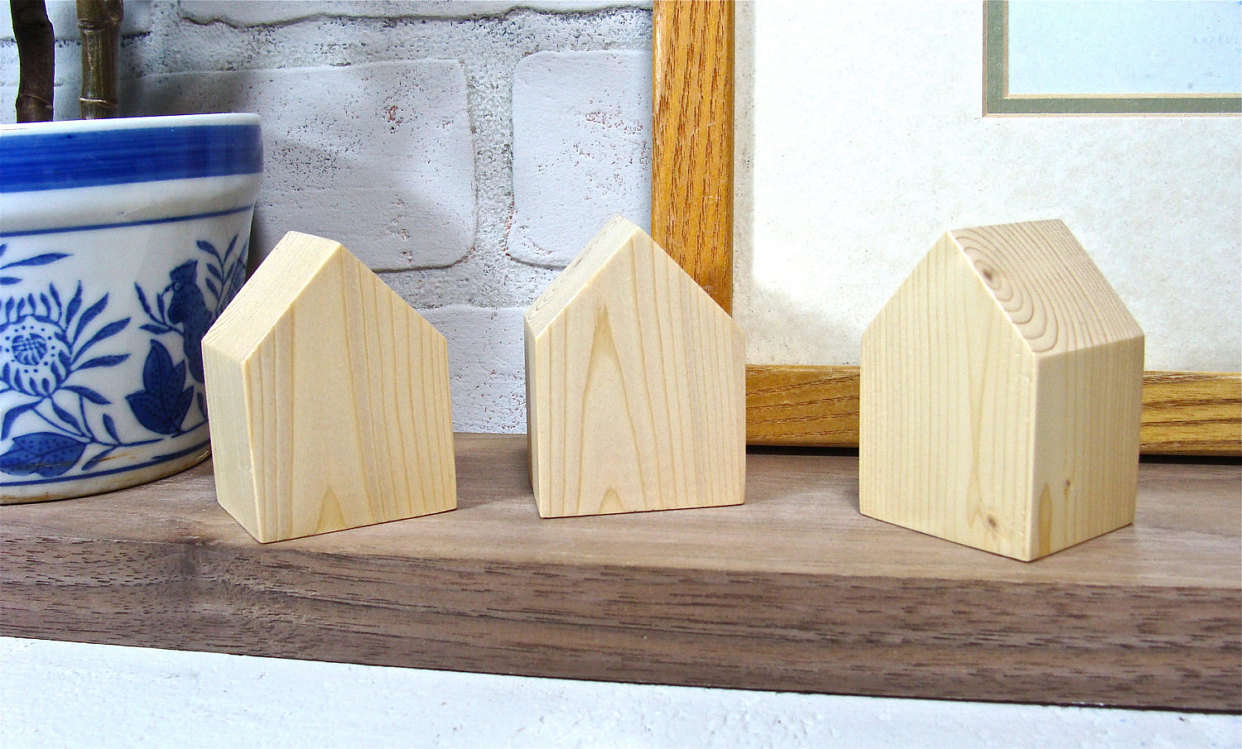
Miniature wooden houses are easy to style because they work in almost every room. A row of natural wood houses can warm up a modern bookshelf. Whitewashed cottages can soften a nursery. Rustic cabins can create a cozy holiday display. A tiny village on a mantel can look festive in December and charming all winter if you remove the obviously Christmas-only pieces.
Try grouping houses in odd numbers, such as three, five, or seven. Vary the heights and roof shapes so the display feels natural. Add small trees, pebbles, dried flowers, battery candles, or fabric snow depending on the season. Keep the color palette simple if you want a sophisticated look. Natural wood, white, black, gray, sage green, and warm brown are easy to blend with most home decor styles.
Miniature houses also make meaningful gifts. A small wooden replica of someone’s first home, family cabin, bakery, bookstore, or dream cottage can feel deeply personal. House portraits in miniature form are especially popular for anniversaries, housewarming gifts, memorial keepsakes, and wedding presents. A full-size house may be impossible to wrap, but a miniature version fits nicely in a box and does not require property taxes.
Why Miniature Wooden Houses Are Great for Creativity
Building or decorating a miniature wooden house exercises many skills at once. It involves measuring, planning, color selection, spatial thinking, storytelling, patience, and problem-solving. For children, a wooden dollhouse encourages imaginative play, social storytelling, fine motor skills, and language development. For adults, miniature building can be calming, absorbing, and deeply satisfying.
The hobby is also flexible. Beginners can start with simple unpainted wooden houses and acrylic paint. Intermediate makers can add trim, shingles, wallpaper, lighting, and furniture. Advanced miniaturists can create realistic aging, working doors, tiny hinges, miniature joinery, and historically accurate interiors. There is always another skill to learn, which is both inspiring and dangerous for anyone with limited storage space.
Buying vs. Building: Which Is Better?
Buying a miniature wooden house is best when you want a polished result quickly, need a safe toy from a reputable brand, or prefer decorating over construction. Building is better when you want full customization, enjoy hands-on work, or need a specific size and style. Kits offer a middle path: some creative control without starting from a blank sheet of wood.
When buying, check the material, scale, dimensions, recommended age, finish quality, and whether furniture is included. For handmade pieces, look for clean edges, solid joints, smooth sanding, and non-toxic finishes if children will use them. For kits, read reviews about fit and instruction clarity. A beautiful kit with confusing instructions can turn a relaxing weekend project into a tiny wooden puzzle with emotional consequences.
Care and Maintenance
Miniature wooden houses need gentle care. Dust them with a soft brush, microfiber cloth, or small makeup brush. Keep them away from damp areas unless they are sealed for outdoor use. Avoid direct sunlight for long periods because paint and wood tones can fade. If a piece breaks, wood glue usually handles simple repairs. For delicate collector houses, use reversible or minimal adhesives when possible so future restoration remains easier.
Store seasonal houses in sturdy boxes with tissue paper or bubble wrap. Label accessories so the tiny wreath, chimney, fence, and porch chair do not vanish into the mysterious craft-supply underworld. If the house has battery lights, remove batteries before long-term storage to prevent corrosion.
Experience-Based Tips for Enjoying Miniature Wooden Houses
The first thing you learn from working with miniature wooden houses is that small does not always mean simple. In fact, tiny projects can be hilariously honest. A crooked cut on a full-size fence might hide behind landscaping. A crooked cut on a four-inch cottage sits right there in the spotlight, waving politely. That is why patience matters more than expensive tools. Measuring twice and cutting once is good advice; measuring twice, breathing once, checking the roof angle again, and then cutting is even better.
One of the best experiences is starting with a plain wooden house blank. These little unfinished houses are humble, affordable, and full of possibility. A basic block with a pitched roof can become a snowy cabin, a beach cottage, a tiny bakery, a haunted house, a Scandinavian village home, or a miniature version of your grandparents’ farmhouse. The transformation is quick enough to feel rewarding but detailed enough to feel personal. It is the rare project where a small amount of paint can produce a large amount of pride.
For beginners, the most enjoyable approach is to build a small collection around a theme. For example, create five little wooden houses in different heights and paint them in soft white, warm gray, sage green, natural stain, and charcoal. Add simple windows with a paint pen, glue on tiny doors, and finish with matte sealer. Place them on a shelf with a few bottle-brush trees or dried flowers. Suddenly, you have a tiny neighborhood that looks curated rather than cluttered. Congratulations: you are now mayor.
Another useful experience is learning that lighting changes everything. A miniature wooden house with a small battery LED inside instantly feels warmer and more magical. Cut-out windows glow softly, and the house becomes more than an object; it becomes a scene. For safety, battery-operated LED tea lights or low-heat mini lights are usually better than anything that produces heat. Never use an open flame inside or near a wooden miniature unless your design goal is “adorable fire hazard.”
Texture also adds realism. Sanding the edges lightly after painting can create a weathered cottage look. Thin strips of wood can become siding. Coffee stirrers can become porch boards. Popsicle sticks can become fences, floors, shutters, or roof shingles. Cardboard can be used as a template before cutting wood. Scrapbook paper can become wallpaper. Fabric scraps can become rugs or curtains. The best miniature makers are often part artist, part woodworker, and part person who refuses to throw away a good-looking cereal box.
If you are making miniature wooden houses with children, keep the project simple and let perfection leave the building. Kids care more about story than symmetry. A child may paint a purple roof, orange door, and twelve windows because “a dragon family lives there.” That is not a design mistake; that is world-building. Use large pieces, washable paint, and safe glue. Let children decorate with stickers, felt, paper, and chunky wooden shapes. The result may not appear in an architectural magazine, but it will have more personality than half the beige houses on the internet.
For adult hobbyists, the most rewarding miniature wooden houses often connect to memory. Recreating a childhood home, a favorite vacation cabin, a beloved bookstore, or a dream tiny house gives the project emotional weight. You do not need to copy every detail. Focus on recognizable features: the red front door, the porch swing, the steep roof, the flower boxes, the stone chimney, or the funny little window above the kitchen sink. Miniatures work because they capture the feeling of a place, not just its measurements.
Finally, the best advice is to let the hobby stay joyful. It is easy to compare your first handmade cottage to professional miniaturists whose tiny kitchens include working drawers and fruit bowls smaller than sunflower seeds. Admire them, learn from them, and then return to your own workbench. Every miniature wooden house teaches something: how wood behaves, how colors interact, how glue dries, how scale works, and how much personality can fit into a structure smaller than a shoebox. That is the real magic. Miniature wooden houses invite us to slow down, look closely, and build a world where even the smallest roof can shelter a very big imagination.
Conclusion
Miniature wooden houses are more than cute objects. They are tiny stages for design, storytelling, memory, craftsmanship, and play. They can be simple enough for a beginner, detailed enough for a serious collector, safe enough for children when properly designed, and stylish enough for modern home decor. From wooden dollhouses and fairy cottages to architectural models and decorative village houses, these mini structures prove that creativity does not need a lot of square footage.
Whether you buy one, build one from a kit, or cut your own pieces from basswood and plywood, a miniature wooden house offers the satisfaction of making a place by hand. It asks you to notice scale, texture, color, proportion, and detail. It also gives you permission to enjoy something small, quiet, and charming in a world that often insists everything must be bigger, faster, and louder. Sometimes the best house on the block is the one that fits on your bookshelf.