Some phrases stroll politely into pop culture. Others kick open the door wearing Capitol couture, holding a microphone, and sounding far too cheerful about everyone’s chances of doom. “May the odds be ever in your favor” belongs to the second category.
At first glance, the phrase sounds like a fancy version of “good luck.” And yes, that is the quick meaning. But in pop culture, especially through The Hunger Games, it has become much more than a glittery blessing before a difficult challenge. It is a line loaded with irony, social criticism, dark humor, and the uncomfortable reminder that not every competition is fair just because someone announces it with a smile.
Today, people use “May the odds be ever in your favor” before exams, job interviews, office raffles, Black Friday shopping, fantasy football drafts, airport security lines, and family board game nights that become emotionally dangerous after the second round. The phrase works because it is dramatic, funny, recognizable, and just a little ominous. It turns ordinary stress into a mini dystopian ceremony, which is sometimes exactly what Monday morning deserves.
What Does “May the Odds Be Ever in Your Favor” Mean?
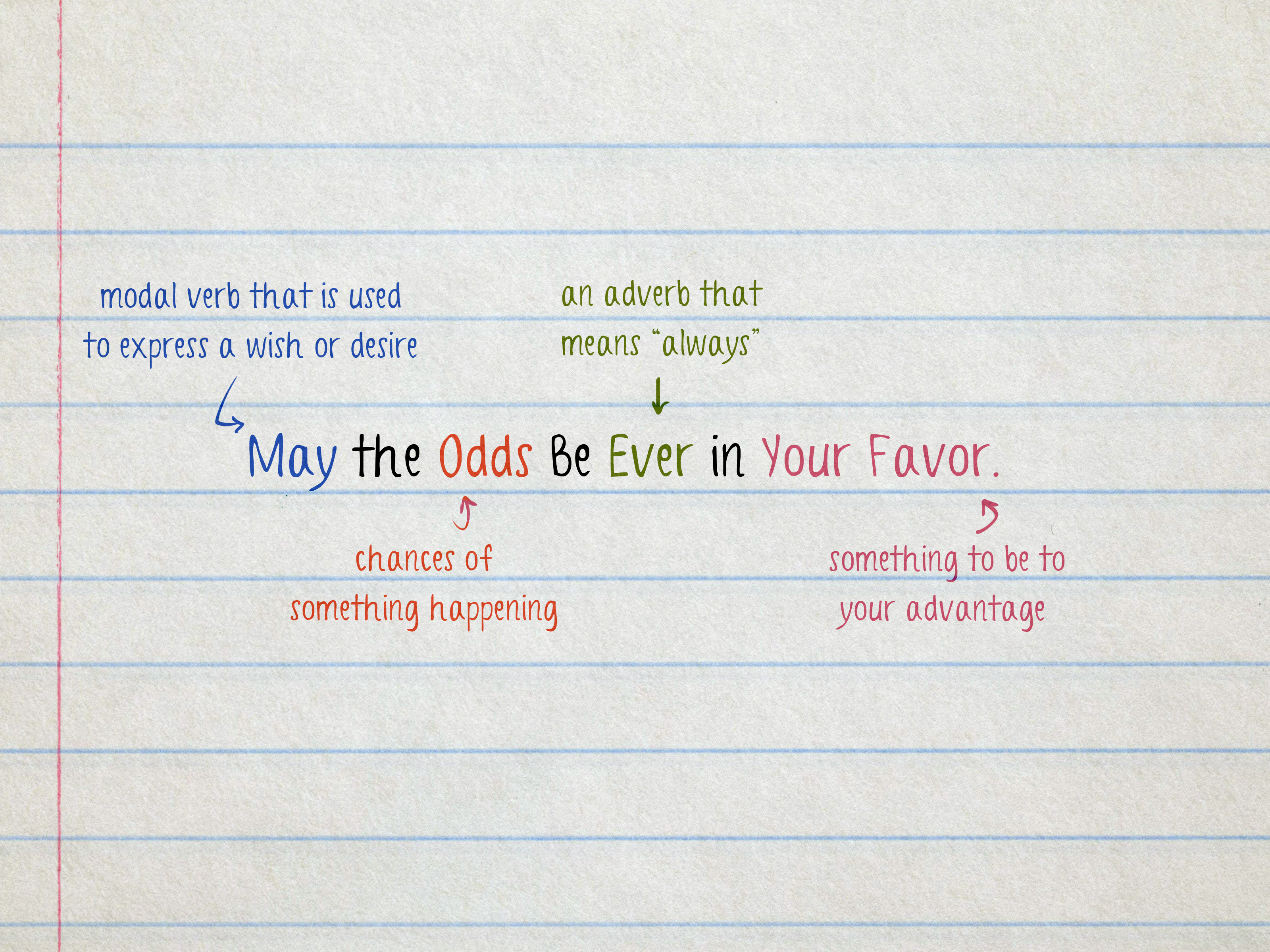
The basic meaning of “May the odds be ever in your favor” is: I hope luck is on your side, or I hope you have the best possible chance of succeeding. The word “odds” refers to probability, chances, or the likelihood that something will happen. When the odds are “in your favor,” success is more likely than failure.
But this phrase is not a plain old “good luck.” It sounds ceremonial, almost royal. The word “may” gives it the feeling of a blessing. The word “ever” makes it sound grand and permanent, as if fortune itself has been asked to sign a long-term lease. That elevated wording is part of why the line became so memorable. It is elegant, theatrical, and weirdly useful when someone is about to do something stressful, risky, or mildly ridiculous.
Where Did the Phrase Come From?
The phrase became famous through Suzanne Collins’s dystopian series The Hunger Games. In the story, the nation of Panem is ruled by the wealthy Capitol, while the surrounding districts live under oppression and scarcity. Each year, children are selected through a public lottery called the reaping and forced to compete in a televised fight for survival.
In the 2012 film adaptation, Effie Trinket, played by Elizabeth Banks, delivers the line with polished Capitol cheer: “Happy Hunger Games, and may the odds be ever in your favor.” That contrast is the engine of the quote’s power. Effie’s tone is bright, fashionable, and festive, while the situation is horrifying. The result is a sentence that sounds polite on the surface but reveals the cruelty of the world behind it.
In other words, the phrase is not famous only because it is catchy. It is famous because it captures one of the central tensions of The Hunger Games: the Capitol turns suffering into entertainment and then decorates it with manners.
Why the Quote Became a Pop Culture Staple
Pop culture loves lines that can travel. A good quote needs to work outside its original story, and this one packed its bags immediately. “May the odds be ever in your favor” is short enough to remember, dramatic enough to repeat, and flexible enough to apply to almost any situation involving uncertainty.
Taking a final exam? May the odds be ever in your favor. Waiting for concert tickets to drop? May the odds be ever in your favor. Entering a group chat where someone has typed “we need to talk”? Truly, may every known and unknown odd be in your favor.
The line also has built-in irony. People rarely use it for situations where success is genuinely guaranteed. They use it when the outcome feels chaotic, unfair, or dependent on luck. That is why it became a favorite meme phrase: it makes everyday inconveniences feel like a televised survival challenge, but in a way that is playful rather than melodramatic.
The Deeper Meaning: Luck, Power, and Unfair Systems
The phrase may sound like a blessing, but in The Hunger Games, it is also a warning. The Capitol says “may the odds be ever in your favor” as if the Games are a fair contest. They are not. The tributes do not begin with equal training, equal resources, or equal support. Some districts are richer, some tributes are better prepared, and the Capitol controls the rules, the arena, the cameras, and the narrative.
That makes the quote deeply ironic. It pretends that survival is about luck when the system itself is designed to produce suffering. The “odds” are not neutral. They have been arranged by people in power.
This is why the phrase still feels relevant beyond the books and movies. In real life, people often talk about opportunity as if everyone starts from the same line. But many situations involve hidden advantages: money, connections, education, timing, health, geography, social status, and plain old luck. The phrase reminds us that chance is never just chance when the game board is built unevenly.
Why Effie Trinket Makes the Line So Memorable
Effie Trinket is not the only person associated with the phrase, but she is the face most fans remember. Her character is a walking contradiction: cheerful yet chilling, organized yet absurd, fashionable yet morally disconnected. She speaks the language of ceremony while participating in a system that treats children as entertainment.
That is what makes the quote stick. If a villain snarled it, the line would be obvious. If a hero whispered it, the line would be sentimental. Effie delivers it like a pageant host announcing door prizes. That mismatch gives the phrase its pop culture electricity.
She is not saying “good luck” in a cozy, supportive way. She is performing optimism for a society that has confused spectacle with justice. Her bright delivery turns the sentence into satire.
How the Phrase Works as a Meme
Online, “May the odds be ever in your favor” became a meme because it is perfect for exaggerated situations. The internet loves to frame small problems as epic disasters. A student opening a 40-question quiz they forgot about? Hunger Games. A shopper refreshing a limited-edition sneaker page? Hunger Games. A parent trying to assemble a toy kitchen on Christmas Eve with 312 screws and one mysterious wooden peg? Absolutely Hunger Games.
The phrase often appears in GIFs, reaction images, captions, and social media posts. It is usually used with a wink. The speaker is not truly comparing a stressful email inbox to a dystopian death match. Well, probably not. But the exaggeration makes the stress funny and instantly understandable.
This is the secret of a strong meme phrase: it compresses a shared feeling into a recognizable cultural shortcut. You do not need to explain the whole scene. The quote does the heavy lifting.
Common Ways People Use the Phrase Today
1. Before a Difficult Challenge
The most common use is before someone faces a challenge with an uncertain outcome. It could be a test, audition, interview, competition, or application process. The phrase adds humor while acknowledging that the situation may be tough.
2. When the System Feels Unfair
People also use the line when a process feels stacked against them. Examples include online ticket queues, housing applications, school admissions, or corporate promotions. The phrase suggests, “This may technically be a process, but let’s not pretend it is gentle.”
3. As Dark Humor
Because the original context is grim, the phrase carries a darkly comic edge. It lets people joke about pressure without sounding completely defeated. It is dramatic enough to be funny, but familiar enough not to sound too intense.
4. As a Fandom Reference
For fans of The Hunger Games, the quote signals shared cultural knowledge. It can be used affectionately, sarcastically, or nostalgically. Like “I volunteer as tribute,” it belongs to a small group of lines that escaped the story and became everyday shorthand.
Why the Phrase Still Matters in Modern Culture
The Hunger Games has remained relevant because it is not only about survival games. It is about media spectacle, political messaging, inequality, celebrity culture, rebellion, and the way audiences can become numb to suffering when it is packaged as entertainment.
Suzanne Collins has explained that the idea for the story came from channel surfing between reality television and war coverage, a contrast that blurred in an unsettling way. That origin helps explain why “May the odds be ever in your favor” feels so sharp. It sounds like something from a game show, but the stakes are life and death.
Modern audiences understand that blend. We live in a world where serious events are filtered through screens, headlines, clips, reaction videos, trending topics, and commentary. Tragedy and entertainment often sit uncomfortably close together. The phrase captures that discomfort with almost impossible efficiency.
Pop Culture Examples and Everyday Situations
Imagine a friend is about to register for college classes, and only one seat remains in the course they need to graduate. “May the odds be ever in your favor” is the perfect sendoff. It is supportive, but it also recognizes the chaos of the situation.
Or picture an office holiday party where everyone is forced into a “fun” gift exchange with rules no one understands. Someone unwraps a decent coffee mug. Someone else steals it. A third person produces a 14-page interpretation of the rules. At that moment, the phrase fits because the event has transformed from cheerful bonding into low-budget Panem with cookies.
Another example: online shopping during a major sale. The website crashes, the cart empties itself, the discount code fails, and suddenly your toaster oven purchase feels like a test of character. “May the odds be ever in your favor” turns frustration into comedy.
Is the Phrase Positive or Negative?
The answer is: both. Literally, it is positive. It wishes someone luck. Culturally, it is more complicated. It often implies that the person is entering a stressful, unpredictable, or unfair situation.
That double meaning is why the phrase works so well. A simple “good luck” is warm. “May the odds be ever in your favor” is warm with dramatic lighting, a suspicious anthem, and the possibility that someone in a wig is controlling the scoreboard.
Use it when you want to be encouraging but also funny. Avoid it in deeply serious situations where the dark humor might feel insensitive. It is great for exams, games, contests, applications, and mild chaos. It is not ideal for moments that require sincere comfort without irony.
What the Phrase Says About Us
The popularity of this line says something interesting about modern life. People recognize that many systems are competitive, performative, and uncertain. We compete for attention, jobs, housing, scholarships, followers, tickets, reservations, and sometimes basic peace and quiet. The phrase gives us a funny way to admit that the world can feel like a game whose rules were written by someone else.
But it also gives us language for resilience. Even when the odds are bad, the phrase does not say, “Give up.” It says, “Go in anyway.” That is part of the appeal. It acknowledges the risk while still sending the person forward.
Experience Section: Living With the Phrase in Real Life
The funny thing about “May the odds be ever in your favor” is that it has become useful in situations that are nowhere near Panem but somehow feel spiritually related. Anyone who has ever waited in an online queue for concert tickets knows the feeling. You begin as a civilized person with tea and optimism. Ten minutes later, you are refreshing three devices, bargaining with the Wi-Fi router, and wondering whether your laptop can sense fear.
I have seen the phrase used before final exams, and honestly, it fits too well. A hallway full of students before a major test has a very specific energy: silence, panic, highlighters, and the smell of iced coffee making promises it cannot keep. Someone says, “May the odds be ever in your favor,” and suddenly everyone laughs because the drama is accurate. No one is actually being sent into an arena, but the emotional soundtrack is doing a lot.
The phrase also shows up in workplaces. It might appear before annual performance reviews, budget meetings, software launches, or the terrifying moment when someone says, “Let’s go around the room and introduce ourselves.” There is always that one colleague who posts the quote in the chat before a chaotic project deadline. It works because it is not pretending the challenge is easy. It says, “This may get strange, but at least we have jokes.”
Family events provide another natural habitat. Try using it before a big holiday dinner when twelve people have opinions about seating, three people are “just asking questions” about politics, and one uncle has decided the turkey should rest for either ten minutes or two business days. “May the odds be ever in your favor” feels less like a quote and more like a public service announcement.
Even simple errands can earn the phrase. Going to the DMV without an appointment? May the odds be ever in your favor. Calling customer service during peak hours? May the odds be ever in your favor. Trying to find a matching sock in a laundry basket that has clearly developed its own political system? Absolutely, may the odds be ever in your favor.
What makes the phrase last is not just fandom nostalgia. It gives people a way to laugh at uncertainty. It turns stress into a shared joke, and shared jokes are underrated survival tools. When people quote it, they are usually saying, “I see the challenge. I see the absurdity. I hope you win anyway.” That is a surprisingly kind message wrapped in dystopian glitter.
In real life, the odds are not always fair. Some people begin with advantages, some face obstacles they did not choose, and some days feel rigged before breakfast. But humor gives us a little breathing room. The phrase lets us name the unfairness without collapsing under it. It is a wink, a warning, and a cheer all at once.
So the next time someone you know is about to face a stressful task, you could say “good luck.” That would be nice. But if the moment calls for drama, sparkle, and just a tiny shadow of doom, you know what to say. May the odds be ever in their favor.
Conclusion: More Than a Catchy Hunger Games Quote
“May the odds be ever in your favor” means “good luck,” but its pop culture meaning reaches much deeper. From The Hunger Games to memes, social media, school hallways, office chats, and everyday jokes, the phrase has become a stylish way to talk about uncertainty, competition, and unfair systems.
Its staying power comes from contrast. It sounds elegant, but it comes from a brutal fictional world. It wishes people well, but it hints that the game may already be rigged. It is funny, but it carries a serious critique of spectacle, inequality, and the way power can disguise cruelty as tradition.
That is why the phrase continues to thrive. It is not just a quote. It is a mood, a meme, a warning, and a strangely comforting sendoff for anyone stepping into chaos with a brave face and questionable odds.