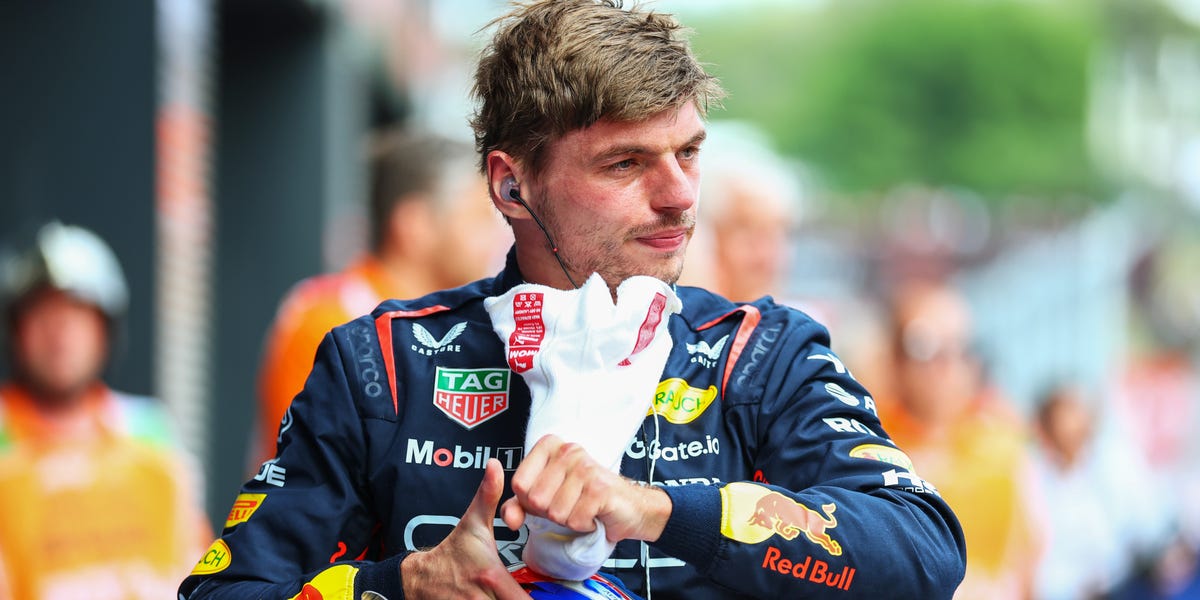
Max Verstappen is not famous for wrapping opinions in bubble wrap. Whether he is discussing Formula 1 regulations, car balance, or traffic encountered at roughly the speed of a commercial aircraft, the four-time world champion usually gets to the point. His verdict on front-wheel drive was especially direct: it is “really boring,” feels like “anti-driving,” and, in his estimation, may be the “worst thing ever.”
The comments came during a Ford Performance film featuring Verstappen and automotive journalist Chris Harris. Their conversation accompanied some very serious machinery, including a Ford RS200 and an 815-horsepower Mustang GTD. Against that rear-wheel-drive backdrop, the humble front-driven hatchback was never likely to receive a standing ovation.
Still, Verstappen’s criticism opens a genuinely interesting debate. Front-wheel drive dominates the everyday-car market, powers several legendary hot hatches, and has produced remarkably quick Nürburgring laps. Is FWD truly an enemy of driving enjoyment, or does it simply demand a style that clashes with Verstappen’s instincts?
What Max Verstappen Actually Said About Front-Wheel Drive
The discussion took place in a roughly half-hour Ford Performance video filmed at Circuit du Sambuc in France. Harris asked Verstappen about different vehicle behaviors and the techniques required to drive them quickly. When the conversation reached front-wheel-drive cars, Verstappen did not request a diplomatic timeout.
He described FWD as boring and unnatural from a driver’s perspective. He also mentioned trying front-wheel-drive cars in simulators, where he found the experience particularly unrewarding. His complaint was not that an FWD car cannot be fast. Instead, he disliked the way it must be driven to extract that speed.
Verstappen explained that a quick front-wheel-drive car often favors what racers call a V-shaped line. Rather than carrying the car through one long, flowing arc, the driver completes more of the braking and rotation early, points the vehicle toward the exit, and applies power when the front wheels are relatively straight.
Imagine drawing a broad letter U through a corner in a balanced rear-wheel-drive sports car. Now sharpen the bottom of that U until it resembles a V. That sharper approach reduces the time during which the front tires must steer and transmit heavy engine torque simultaneously. Efficient? Yes. Romantic? Apparently not if your name is Max.
Why Verstappen Naturally Prefers Rear-Wheel Drive
Verstappen has spent his career in vehicles built around rear-wheel-drive behavior. Racing karts send power to the rear axle. Formula 1 cars do the same, and the FIA’s technical regulations explicitly require the transmission to drive only the two rear wheels.
That background shapes a driver’s instincts. In a rear-wheel-drive car, the front tires primarily steer while the rear tires deliver power. The driver can use the accelerator to adjust the vehicle’s attitude, manage rear slip, and help rotate the car toward the exit. A small amount of oversteer may be corrected or even deliberately encouraged.
For a driver with Verstappen’s car control, that interaction is part of the entertainment. The machine does not merely follow a path; it responds to a conversation conducted through the steering wheel, pedals, and seat. Occasionally the conversation includes tire smoke and language unsuitable for a family minivan commercial.
Rear-wheel drive also benefits from weight transfer during acceleration. As a vehicle accelerates, load moves rearward. In an RWD car, that added load presses the driven tires into the road and helps them transmit power. In a front-wheel-drive car, acceleration removes some load from the tires being asked to pull the vehicle.
Why Front-Wheel-Drive Handling Feels Different
The Front Tires Have Too Many Jobs
Every tire has a limited amount of available grip. Engineers often illustrate this with a friction circle: a tire can devote its traction to acceleration, braking, cornering, or a mixture of those demands, but it cannot provide an unlimited amount of everything at once.
On a front-wheel-drive car, the front tires steer, handle much of the braking, and deliver engine power. Accelerate hard while cornering, and those tires may run out of grip. The usual result is understeer, in which the car follows a wider path than the driver intended. Turning the steering wheel farther generally does not solve the problem. It merely gives the front tires an even more ambitious to-do list.
Understeer Is Predictable but Not Always Exciting
Automakers often tune road cars to understeer because it is comparatively stable and understandable. When the front end begins to push wide, most drivers instinctively reduce speed. By contrast, sudden oversteer can require quick countersteering and careful throttle control.
That predictability is helpful during a rainy commute. On a racetrack, however, it can feel restrictive. A highly skilled driver may prefer a car that rotates readily and allows its balance to be adjusted with power. Verstappen’s “anti-driving” description reflects this performance perspective, not the needs of someone transporting groceries through a February snowstorm.
Power Can Interfere With Steering
Powerful FWD cars can also produce torque steer, the tugging or pulling felt through the steering wheel under acceleration. Unequal driveshaft geometry, road surfaces, suspension movement, and differences in traction between the front tires can all contribute.
Modern engineering has greatly reduced the problem. Limited-slip differentials distribute torque more effectively, while specialized steering knuckles and suspension geometry separate steering forces from power delivery. Brake-based torque vectoring can slow an inside wheel and help the car turn. Electronics now perform enough quiet corrections to qualify as an invisible pit crew.
The Case for Front-Wheel Drive
Calling FWD the worst thing ever is excellent television, but it is not a complete engineering assessment. Front-wheel drive became popular because it solves several real-world problems extremely well.
A transverse engine, transmission, and differential can be packaged together near the front axle. Without a long driveshaft or bulky rear differential, designers gain passenger and cargo room. The layout generally uses fewer components, weighs less, costs less to manufacture, and can reduce mechanical losses compared with a more complex drivetrain.
With the engine’s mass resting over the driven wheels, many front-engine FWD cars also provide useful traction when pulling away on wet or snowy roads. Proper winter tires remain more important than drivetrain branding, but the basic layout can be reassuring in slippery everyday conditions.
Most owners are not attempting to trim three-tenths from a qualifying lap on the way to the pharmacy. They want an affordable car with a roomy cabin, predictable handling, and respectable fuel economy. For that assignment, front-wheel drive is less “worst thing ever” and more “employee of the month.”
Fast FWD Cars Challenge Verstappen’s Verdict
The strongest response to Verstappen’s opinion comes from cars such as the Honda Civic Type R, Volkswagen Golf GTI, Ford Fiesta ST, Ford Focus ST, Mini Cooper, and Hyundai Elantra N. These models demonstrate that driven wheels alone do not determine whether a car is engaging.
The Civic Type R is a particularly awkward witness for the prosecution because Verstappen previously appeared in promotional material connected with Honda’s front-driven performance model. That history produced predictable online jokes after his Ford interview. Promotional responsibilities, however, do not require a racing driver to adopt a drivetrain layout as a personal favorite forever.
Honda’s engineering also proves how far FWD performance has progressed. The Civic Type R uses a limited-slip differential and sophisticated front-suspension geometry to reduce wheelspin, understeer, and torque steer. A European Type R S recorded a 7:44.881 lap around the 12.94-mile Nürburgring Nordschleife in 2023.
In May 2026, the Volkswagen Golf GTI Edition 50 narrowly improved that benchmark with a 7:44.523 lap. Its combination of 321 horsepower, specialized chassis tuning, forged wheels, and track-focused tires moved the FWD record forward by just over three-tenths of a second. That is a microscopic margin around such a long circuitand fairly convincing evidence that front-wheel drive can hurry.
How to Drive a Front-Wheel-Drive Car Quickly
Complete the Important Braking Early
A fast FWD lap begins with disciplined entry speed. Charging into a corner too quickly overloads the front tires and creates understeer before the driver even considers the accelerator. Strong braking in a straight line establishes a manageable speed and loads the front axle.
Use Trail Braking Carefully
Gradually carrying a small amount of braking into the corner can keep weight over the front tires and help the car rotate. The technique must be smooth. A sudden lift or abrupt brake input can unload the rear axle and cause lift-off oversteer. Yes, a front-wheel-drive car can oversteer; physics enjoys refusing simple labels.
Aim for a Clean Rotation
The driver should avoid piling on additional steering after the front tires begin to slide. Reducing speed or slightly easing the steering angle can restore grip. In a well-tuned hot hatch, careful weight transfer may encourage the rear of the car to rotate, pointing the nose toward the exit.
Straighten the Wheel Before Full Power
This is the heart of Verstappen’s V-style description. Once the car is rotated, the driver unwinds the steering and applies power decisively. Straighter front wheels can devote more of their available grip to acceleration, allowing the differential and tires to pull the car out of the corner efficiently.
The technique is not less skillful than driving an RWD car; it rewards a different collection of skills. Precision, patience, weight-transfer management, and restraint matter more than showy throttle rotation. The fastest lap may look almost uneventful from outside, which is often motorsport’s way of hiding hard work.
Is Max Verstappen Right?
He is right about his preference. Rear-wheel drive gives an elite driver more ways to manipulate vehicle balance with the accelerator, and it separates propulsion from steering. For someone raised in karts and Formula 1 cars, front-wheel drive can feel limiting, especially in a simulator that may not reproduce subtle chassis sensations through the seat.
But “worst” is entertainment, not an objective category. FWD remains efficient, affordable, spacious, and predictable. At the performance end, carefully engineered hot hatches can be ferociously quick while delivering a distinctive form of driver involvement.
The real lesson is that speed and enjoyment do not come from one component. Tires, suspension geometry, differential tuning, weight distribution, steering feedback, damping, brakes, and driver technique work as a system. A poor rear-wheel-drive car does not become brilliant merely because the power travels backward. Likewise, an excellent FWD chassis does not become boring because its driveshafts are located near the radiator.
Related Driving Experiences: What FWD and RWD Feel Like in Practice
On ordinary streets, many drivers barely notice that a car is front-wheel drive. The layout reveals itself gradually: a reassuring pull away from a wet intersection, a spacious cabin in a compact body, and stable behavior when an entrance ramp is taken with slightly more enthusiasm than the coffee cup would prefer. At sensible speeds, a well-developed FWD car feels natural, secure, and pleasantly uncomplicated.
An autocross course exposes more of its personality. Tight turns arrive quickly, leaving little time to settle the chassis. Enter a slalom too fast and the front tires begin to scrub, the steering grows less effective, and the car pushes toward the outside cones. The productive response is to reduce the demand on the tiresnot crank in another armful of steering and hope they discover hidden grip.
Once drivers learn to brake earlier and rotate the car before accelerating, the experience changes. A short lift can transfer load forward, sharpening the response. Gentle trail braking may help the rear follow the front more eagerly. With the car pointed toward the next gate, the driver unwinds the steering and commits to the throttle. A good limited-slip differential then pulls the vehicle forward with surprising aggression.
During longer track sessions, front-tire management becomes central. The outside front tire handles a tremendous share of the work, particularly in a heavy, powerful car. Repeatedly entering corners too quickly builds heat, increases wear, and produces progressively worse understeer. Smooth drivers preserve the tire, maintain consistent lap times, and frequently pass more dramatic drivers who spent their rubber budget during the opening laps.
A rear-wheel-drive car communicates differently. With the front axle focused on steering, the initial response may feel cleaner. Applying power at the exit loads the rear tires, and additional throttle can tighten or widen the car’s attitude depending on available grip. When the rear begins to slide, the driver balances steering correction against accelerator input. It feels interactive and adjustablethe qualities that likely make RWD so attractive to Verstappen.
The same freedom can become a liability. An inexperienced driver who applies too much power may create rapid oversteer, especially on cold or wet tires. Stability control can help, but electronic rescue is not an invitation to audition for a drift video beside a public-road guardrail.
Sim racing adds another layer. Without real acceleration, vibration, and pressure through the seat, drivers rely heavily on steering feedback, sound, and visual motion. An FWD car’s gradual understeer may therefore feel numb or frustrating in a simulator. A rear-driven car often communicates oversteer more theatrically through the wheel and screen, making its behavior easier to detectand more entertaining to catch.
The most useful experience is switching between layouts in a controlled environment. Doing so reveals that neither drivetrain eliminates the need for skill; each punishes different mistakes. FWD penalizes excessive entry speed and impatient throttle application. RWD penalizes careless power delivery and slow reactions to rear slip. AWD adds traction but introduces its own weight, balance, and complexity.
Verstappen’s verdict makes perfect sense from the cockpit he occupies. For everyone else, the better question is not whether front-wheel drive is universally good or bad. It is whether a particular car communicates clearly, rewards improvement, and suits the job. If it makes an ordinary commute enjoyable or turns a track session into an afternoon of learning, the driven axle has already done something right.