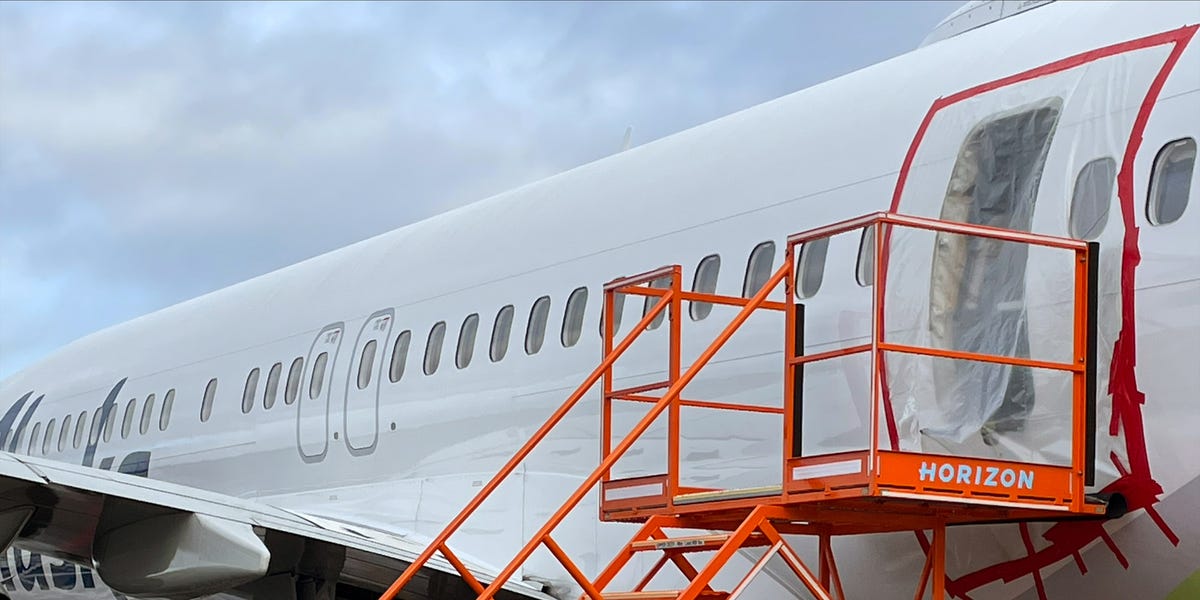
When a large section of an airplane separates in flight, travelers understandably begin asking urgent questions. Was the aircraft poorly maintained? Did the crew overlook a warning? Was the door design fundamentally unsafe? In the case of Alaska Airlines Flight 1282, the answer ultimately led investigators away from routine airline maintenance and directly into the aircraft factory.
On January 5, 2024, a Boeing 737-9 operating as Alaska Airlines Flight 1282 departed Portland International Airport for Ontario, California. Roughly six minutes after takeoff, while climbing through about 14,830 feet, the left mid-exit door plug separated from the fuselage. The sudden opening caused rapid depressurization, deployed oxygen masks, damaged the cabin, and sent loose objects out of the aircraft. The pilots returned safely to Portland.
All 177 people aboard survived. Seven passengers and one flight attendant received minor injuries. That outcome was remarkably fortunate, especially because two seats next to the opening were unoccupied. Aviation safety is built on engineering, procedures, and redundancy, but on this flight, luck also managed to secure a boarding pass.
Early reporting cautiously suggested that manufacturing issues might have caused the incident. The National Transportation Safety Board’s final report, adopted in June 2025, removed much of that uncertainty. Investigators concluded that four critical bolts had been removed during factory work and were never reinstalled. The accident was not simply a mysterious mechanical failure. It was the result of breakdowns in documentation, training, quality assurance, management, and regulatory oversight.
What Exactly Is a Door Plug?
The part that separated was not an ordinary passenger door that someone could accidentally open by bumping the wrong handle. It was a mid-exit door plug installed in an opening that can accommodate an additional emergency exit.
Airlines using high-density seating configurations may require that extra exit to satisfy evacuation regulations. Alaska Airlines configured its 737-9 aircraft with fewer seats, so the opening was filled with a permanent-looking plug. Inside the cabin, trim panels made the area resemble an ordinary section of wall with a window.
The plug was designed to fit into the fuselage opening and rest against multiple stop fittings. Cabin pressure pushed the structure outward against those fittings. Four bolts and their associated hardware prevented the plug from moving vertically. This distinction matters because the bolts were not intended to carry the full pressurization load. Their job was to keep the plug properly positioned so that the stop fittings could do theirs.
Without the bolts, normal vibration and repeated pressurization cycles allowed the plug to move upward by tiny amounts over multiple flights. Eventually, it rose far enough to disengage from the stop fittings. Once that happened, cabin pressure supplied the final and extremely unwelcome push.
The Manufacturing Timeline Behind Flight 1282
The plug originally arrived with its bolts installed
The investigation found that the fuselage, frame, and door plug had been manufactured in accordance with the applicable engineering drawings. Spirit AeroSystems assembled the fuselage and initially installed the plug with the required upper guide-track bolts, vertical-movement arrestor bolts, washers, nuts, and cotter pins.
The fuselage was then shipped to Boeing’s 737 production facility in Renton, Washington. At this stage, the plug was properly secured. That finding narrowed the critical failure window considerably: the hardware was present when the fuselage reached Boeing but missing when the finished airplane was delivered to Alaska Airlines.
Five damaged rivets triggered nonroutine rework
At the Renton factory, workers identified workmanship problems involving five rivets in the fuselage frame immediately forward of the door plug. Spirit personnel assigned to the Boeing facility were responsible for repairing those rivets, but access to the area required the plug to be opened.
Opening the plug was not as simple as swinging open a household door. Workers first had to remove the four bolts and related hardware designed to prevent vertical movement. Because the plug had already been accepted as properly installed, disturbing it should have triggered Boeing’s formal parts-removal process.
That process required a removal record documenting what had been taken apart, what restoration work was necessary, and which quality-assurance inspections had to be completed before the aircraft could move forward. No such record was generated.
The plug was closed, but the hardware was not restored
After the rivet repair, the plug was placed back into its closed position. A factory photograph later reviewed by investigators showed the plug closed with attachment hardware visibly absent from several locations. The final report concluded that the four securing bolts and related parts were never reinstalled.
Because there was no removal record, the production system did not automatically call for the missing hardware to be replaced or for a quality inspector to verify the completed installation. The airplane continued through assembly, testing, delivery, and commercial service with a major structural component effectively resting in place without the hardware intended to keep it there.
The NTSB could not determine exactly who opened and closed the plug. Personnel with experience performing that task were not on duty during important portions of the rework, and employees interviewed after the accident could not identify who completed the closure. Investigators also learned that factory security video from the relevant period had been overwritten under Boeing’s normal retention practices.
Why the Missing Bolts Were Not Caught
Four missing bolts sound like an error that should have been obvious. In a well-controlled production system, they should have been. The deeper problem was that several safety barriers failed together.
An overly complicated removal procedure
Boeing’s instruction for removing previously accepted parts exceeded 50 pages and included numerous hyperlinks, exceptions, and decision points. Investigators found that it contained more guidance explaining when the process was unnecessary than clearly explaining when workers were required to use it.
A safety procedure can be technically complete and still fail in practice. If employees need the patience of a tax attorney and the navigation skills of a wilderness guide to determine whether a record is required, the procedure is not functioning as an effective production tool.
Boeing had revised the instruction 11 times between 2013 and 2023. Internal audits had repeatedly identified problems involving unauthorized removals, inadequate control of removed parts, and inconsistent documentation. Those warning signs did not produce sufficiently effective corrective action before Flight 1282’s aircraft entered production.
Training and experience gaps
The NTSB found that Boeing did not provide adequate training, guidance, and oversight to ensure consistent compliance with the removal process. The company had also experienced a reduction in overall workforce experience, particularly following pandemic-era disruptions, retirements, hiring challenges, and rapid workforce rebuilding.
Aircraft manufacturing depends on skilled employees, but it cannot depend on tribal knowledge alone. A production system should remain safe when a veteran retires, a new worker joins a team, or a task crosses from one shift to another. Good documentation acts as the factory’s memory. In this case, that memory experienced a rather consequential blank spot.
No independent inspection was triggered
Had the removal process been properly documented, the record would have required restoration steps and quality-assurance signoffs. Those checks would have created opportunities to discover the missing bolts before delivery.
Instead, the lack of paperwork made the work nearly invisible to the production system. The plug appeared closed, interior panels eventually covered the area, and the aircraft moved forward. This is why manufacturing experts treat paperwork as part of the product rather than administrative decoration. A missing form can become missing hardware, and missing hardware can become a hole in an airplane.
The NTSB’s Final Probable-Cause Finding
The NTSB determined that the probable cause was the in-flight separation of the plug resulting from Boeing Commercial Airplanes’ failure to provide adequate training, guidance, and oversight. Those failures prevented manufacturing personnel from consistently following the parts-removal process intended to ensure that removed bolts and hardware were reinstalled.
The agency also identified ineffective FAA surveillance and audit planning as a contributing factor. Federal oversight failed to identify and ensure correction of recurring, systemic nonconformance problems associated with Boeing’s removal procedures. In other words, the factory’s controls failed, and the regulatory system did not catch those failures soon enough.
Was Alaska Airlines Maintenance Responsible?
The evidence did not support that conclusion. Alaska Airlines received the aircraft from Boeing on October 31, 2023, and placed it in service on November 11. By the accident date, it had accumulated approximately 510 flight hours and 154 cycles.
Investigators found no evidence that Alaska Airlines had performed maintenance, inspection, or modification work requiring the left door plug to be opened after delivery. The NTSB also determined that the plug’s gradual upward displacement would not have been detectable during a routine exterior preflight inspection.
The aircraft had experienced pressurization-system AUTO FAIL warning lights on earlier flights. Alaska responded by restricting the airplane from certain extended-range operations while additional troubleshooting was arranged. However, the NTSB found no evidence that those warnings were caused by the plug’s movement or predicted its separation.
Following the accident, Alaska grounded its fleet of 65 Boeing 737-9 aircraft, increased oversight of airplanes still in production, and strengthened inspections of newly delivered aircraft.
How Regulators and Boeing Responded
The FAA grounded 171 affected 737-9 aircraft shortly after the incident. Before returning to service, each airplane had to undergo enhanced inspections covering bolts, guide tracks, fittings, fasteners, door plugs, and surrounding components. Any damage or abnormal condition had to be corrected.
The agency also blocked Boeing from expanding 737 MAX production until regulators were satisfied that the company had addressed its quality-control problems. Additional FAA inspectors were placed on factory floors, production audits were expanded, and Boeing was ordered to develop a comprehensive safety and quality improvement plan.
Boeing introduced additional inspections, expanded employee training, increased supplier oversight, simplified certain production instructions, and developed new safety metrics. The company also began work with Spirit AeroSystems on design improvements intended to provide additional protection against plug movement even if critical hardware is missing.
Those changes are important, but the central lesson is not that manufacturers simply need more inspectors standing at the end of the line. Quality must be built into each step. Inspection is valuable, but it should confirm a controlled process rather than play a very expensive game of “find the missing bolt.”
Why the Incident Was So Serious
The separation occurred at a relatively low altitude compared with typical airline cruising levels. The pressure difference between the cabin and outside air would have been substantially greater at 30,000 or 35,000 feet. The aircraft was also still close to Portland, allowing the pilots to return quickly.
Seats 26A and 26B beside the opening were empty. Nearby passengers were wearing seat belts, and no one was standing in the aisle at the moment of decompression. Clothing, headrests, trim panels, and personal belongings were pulled toward or through the opening, demonstrating the forces involved.
The episode also renewed attention on children under age two traveling on an adult’s lap. Three lap-held children were aboard, although all were seated several rows from the opening and were not injured. The NTSB reiterated that children are safest in their own seats using approved child-restraint systems.
Experience-Based Lessons From the Flight 1282 Incident
For passengers: routine safety habits are not theatrical props
Many frequent travelers treat the safety briefing as background audio while negotiating with a stubborn charging cable. Flight 1282 showed why those familiar instructions matter. Keeping a seat belt fastened while seated reduces the risk of being thrown during turbulence or rapid decompression. Knowing where the nearest exits are remains useful even when the emergency involves an opening that was not supposed to be an exit.
Passengers should also understand how oxygen masks work. Pulling a mask toward the face starts the flow on many systems, and the reservoir bag may not visibly inflate even though oxygen is being supplied. Adults traveling with children should secure their own masks first so they remain conscious and capable of helping others.
Families with infants can draw another practical lesson from the event. Holding a child may feel secure during an ordinary flight, but a person’s arms are not an engineered restraint system. Purchasing an additional seat and using an FAA-approved child safety seat provides significantly better protection during turbulence, rejected takeoffs, hard landings, or sudden decompression.
For flight crews: training must resemble the real emergency
The pilots and flight attendants aboard Flight 1282 responded professionally under extraordinarily difficult conditions. Noise from the open fuselage, oxygen-mask use, communication problems, and the sudden opening of the cockpit door complicated coordination. The crew still descended, stabilized the aircraft, evaluated the situation, and landed safely.
The investigation nevertheless identified opportunities to improve realistic oxygen-mask training and cockpit communication procedures. Reading about emergency equipment is not the same as using it while alarms sound, breathing through a mask, and trying to hear another crewmember over a roaring cabin. Scenario-based practice builds the muscle memory that crews need when an ordinary workday suddenly becomes international news.
For manufacturers: unfinished work must remain visible
The factory experience offers perhaps the most important lesson. Whenever a completed installation is disturbed, the production system must clearly identify what was removed, who authorized the work, who performed it, what remains unfinished, and who verified restoration.
Visual controls can help. Tagged hardware, protected storage containers, conspicuous incomplete-work markers, electronic signoffs, shift-handover requirements, and photographs of critical installations make hidden errors harder to pass downstream. Software should also prevent production steps from being closed when mandatory restoration or inspection records remain incomplete.
Workers need simple instructions written for the factory floor rather than procedures that read like a treaty negotiated by twelve committees. They must also be able to stop work or report uncertainty without fearing that schedule pressure will be treated as more important than safety.
For executives and regulators: measure risk, not merely output
Production totals, delivery targets, traveled work, rework hours, and schedule performance are useful business indicators. They are not complete measures of safety. Leaders also need to track repeat defects, unauthorized removals, documentation failures, employee proficiency, inspection escapes, supplier discrepancies, and whether corrective actions actually prevent recurrence.
Regulators face a similar challenge. Audits that verify the existence of a procedure may miss whether employees understand or follow it. Effective oversight must examine recurring patterns, visit multiple shifts, observe real work, speak privately with front-line employees, and confirm that previously identified problems have genuinely been corrected.
Flight 1282 demonstrates that catastrophic risk can hide inside an ordinary-looking production exception. Five rivets needed repair. A plug had to be opened. A record was not created. Four bolts were not replaced. Each step may have appeared small in isolation. Together, they produced an airborne emergency that endangered 177 people.
Conclusion
The Alaska Airlines Flight 1282 door-plug incident was not caused by a single defective bolt, an airline maintenance mistake, or an unforeseeable structural event. It resulted from a chain of manufacturing and oversight failures that allowed a properly installed plug to be opened, incompletely restored, and delivered without its four securing bolts.
The final investigation transformed the original question from whether manufacturing issues may have been involved to how those issues passed through so many expected safeguards. Boeing’s complicated procedures, inadequate training, weak documentation, ineffective quality controls, and incomplete corrective actions were central. The FAA’s oversight failed to recognize and resolve the systemic problem before the aircraft entered service.
Aviation became extraordinarily safe by learning from incidents without accepting fortunate outcomes as proof that existing systems are good enough. Flight 1282 landed safely, but its lasting value will depend on whether manufacturers, airlines, regulators, and industry leaders convert its lessons into durable production discipline. Airplane parts should remain attached because the system guarantees itnot because everyone aboard happened to have a very lucky Friday.
Research note: This article reflects the NTSB’s final June 2025 findings and synthesizes information from official NTSB and FAA records, Alaska Airlines and Boeing updates, congressional oversight materials, and reporting by major U.S. news organizations. The final findings supersede early speculation published immediately after the accident.