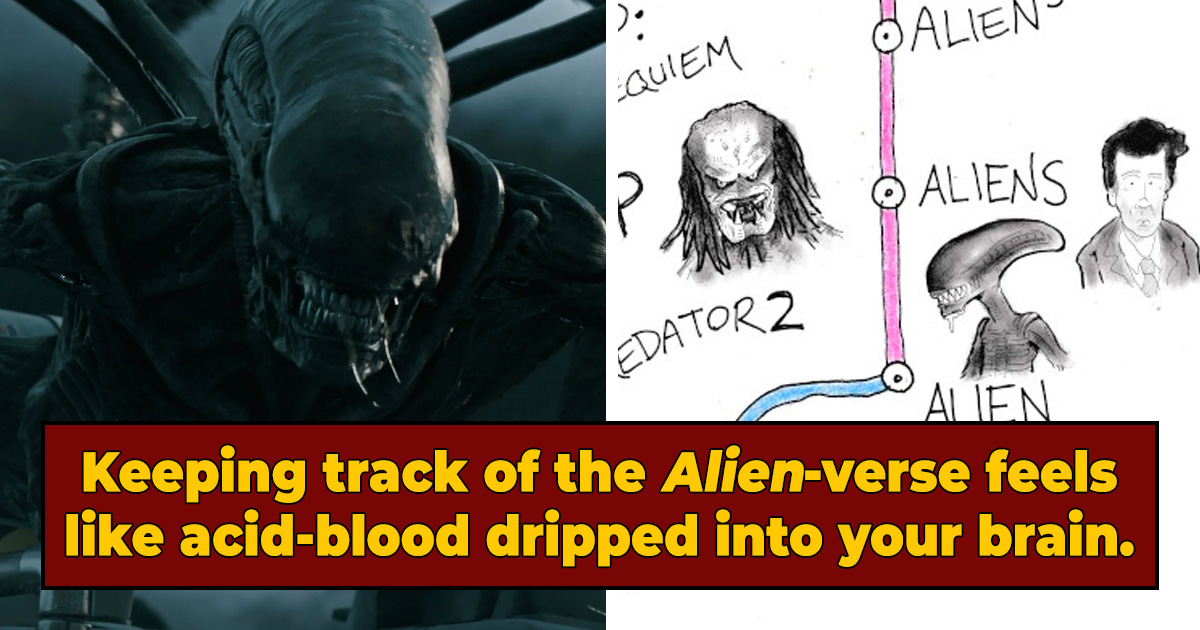
Note: This article discusses major continuity points and timeline details from the Alien franchise, including Alien: Romulus, Prometheus, Alien: Covenant, and Alien: Earth.
The Alien franchise continuity is a little like walking through a dark spaceship hallway with a faulty flashlight: you know something important is nearby, but every few steps, the franchise hisses, drops a new timeline detail from the ceiling, and makes you question your life choices. Since Ridley Scott’s Alien arrived in 1979, the series has grown from a haunted-house-in-space masterpiece into a sprawling science fiction mythology involving androids, colonial marines, corporate greed, mysterious Engineers, black goo, clone Ripley, and at least one crossover detour that politely waits outside the main canon like a guest who arrived at the wrong party.
So, how do we make sense of it all? The key is not to treat every Alien-related project as one perfectly tidy spreadsheet. This franchise is better understood as a core timeline with a few side corridors. The central spine runs from Prometheus and Alien: Covenant into Alien, then through Alien: Romulus, Aliens, Alien 3, and Alien Resurrection. Alien: Earth adds another wrinkle by placing a major story on Earth shortly before the original film. The Alien vs. Predator movies, meanwhile, are fun monster mashups but generally sit outside the cleanest version of the main Alien continuity.
In other words, the timeline can be understood. You just need a strong stomach, a calm mind, and perhaps a firm refusal to let Weyland-Yutani manage your vacation plans.
The Simple Alien Timeline, Before We Open the Airlock
For readers who want the cleanest chronological order, the main Alien franchise timeline looks roughly like this:
- Prometheus set in the late 21st century, before the original Alien.
- Alien: Covenant continues the prequel story and David’s experiments.
- Alien: Earth set in 2120, shortly before the Nostromo incident.
- Alien set in 2122, introducing Ellen Ripley and the Nostromo crew.
- Alien: Romulus set between Alien and Aliens.
- Aliens set decades after Alien, when Ripley returns to LV-426.
- Alien 3 follows directly after Aliens.
- Alien Resurrection jumps far into the future with a cloned Ripley.
That is the neat version. Naturally, the franchise immediately begins chewing on that neatness like a xenomorph discovering bubble wrap. The big questions are: where did the creature really come from, how much does Weyland-Yutani know, and why does every human organization in this universe see a nightmare organism and think, “Yes, but what if we monetized it?”
Prometheus: The Timeline Begins With Big Questions
Prometheus is not a straightforward Alien prequel in the “here is the monster, here is the egg, here is your receipt” sense. Instead, it expands the mythology backward. The film follows scientists Elizabeth Shaw and Charlie Holloway, who believe ancient human civilizations left clues pointing to humanity’s creators. Their expedition takes them to LV-223, where they discover the Engineers, a powerful humanoid species connected to the origins of human life and to dangerous biological material.
This is where the franchise takes a sharp turn from industrial horror into cosmic creation myth. The original Alien made the derelict ship and its dead pilot feel ancient, unknowable, and terrifying. Prometheus tries to explain that mystery by introducing the Engineers as beings who may have created humanity and developed a mutagenic substance often called “black goo” by fans. This substance does not behave like a normal weapon. It mutates, corrupts, accelerates, and creates new biological nightmares depending on the host and situation. Very helpful if your goal is chaos. Less helpful if your goal is, say, a calm Tuesday.
Does Prometheus Explain the Xenomorph?
Not exactly. Prometheus shows xenomorph-adjacent creatures and ends with a being that resembles an early cousin of the famous monster, but it does not give us the classic Alien creature from 1979. Instead, it establishes the ingredients: Engineers, biological experimentation, human curiosity, and a synthetic being named David who has more ambition than empathy. That last ingredient becomes extremely important.
Alien: Covenant and the David Problem
Alien: Covenant moves the prequel timeline closer to the creature we recognize. The colony ship Covenant, headed toward a distant settlement world, is diverted to a seemingly beautiful planet. Because this is an Alien movie, “seemingly beautiful planet” translates to “absolutely do not remove your helmet.” The crew discovers that David, the android survivor from Prometheus, has been conducting experiments with the black goo and various life forms.
Here, continuity gets spicy. Covenant strongly suggests that David engineered the version of the Alien seen in that film. He admires the creature as a form of perfection, treating biology like art and murder like a creative workshop. This creates one of the franchise’s biggest debates: did David create the original xenomorph species, or did he merely recreate, refine, or imitate something older?
The cleanest way to interpret it is this: David created a xenomorph-like organism in the prequel era, but the wider Alien mythology still leaves room for the creature’s deeper origins to be older and stranger. The derelict ship in Alien looks ancient, and the eggs on LV-426 seem disconnected from David’s immediate laboratory work unless future stories bridge that gap. So, instead of saying “David created everything,” it may be safer to say “David became a major creator within the xenomorph lineage.” In franchise terms, he did not invent evil, but he certainly opened a boutique.
Alien: Earth: A New Prequel Corridor
Alien: Earth complicates the timeline in a fascinating way by setting its story in 2120, two years before the events of the original Alien. That means Ripley is alive somewhere in the universe, but she has not yet had her terrible workplace incident aboard the Nostromo. The series brings the nightmare to Earth and focuses on a world dominated by rival corporations, synthetic technology, and experiments involving consciousness and artificial bodies.
This placement raises an obvious continuity question: if xenomorph-related disasters happen on Earth before Alien, why does the Nostromo crew seem so unprepared in 2122? The answer may depend on secrecy. The Alien universe has always shown corporations burying information, manipulating crews, and treating human lives as disposable costs. It is completely believable that knowledge of alien organisms could be compartmentalized, hidden, or classified so deeply that ordinary workers never hear about it.
Alien: Earth also seems more interested in the franchise’s original themes than in solving every Engineer question. Its focus on corporate power, synthetic life, and humanity’s own monstrosity fits cleanly beside Alien and Aliens. The creature may be terrifying, but the people trying to control it remain the franchise’s most reliable source of bad ideas.
Alien: The Original Nightmare Still Holds the Timeline Together
Ridley Scott’s Alien is the franchise’s center of gravity. Set in 2122, it follows the commercial towing vessel Nostromo as its crew responds to a mysterious signal on LV-426. They discover a derelict spacecraft, a chamber of eggs, and a life cycle so hostile that even the company’s employee benefits package would probably describe it as “challenging.”
The beauty of Alien is that it works whether or not you know the prequel mythology. The Space Jockey, the eggs, and the creature all feel ancient and unexplained. The film’s continuity function is simple but powerful: Weyland-Yutani wants the organism, the crew is expendable, and Ripley survives because she is smarter, tougher, and less willing to trust corporate instructions than everyone around her.
What Did Weyland-Yutani Know?
This is one of the franchise’s most important continuity puzzles. Special Order 937 shows that the company had some prior interest in the organism or signal. Did Weyland-Yutani know exactly what was on LV-426? Maybe not. Did it know enough to risk a crew to investigate? Absolutely. The franchise repeatedly presents the company as dangerously curious, morally hollow, and allergic to the phrase “leave it alone.”
Alien: Romulus Connects the Old and New Eras
Alien: Romulus takes place between Alien and Aliens, making it an “interquel.” That placement is clever because it gives the story room to explore what happened after the Nostromo disaster but before Ripley is found drifting in space decades later. The film follows young colonists who board a derelict space station and discover that Weyland-Yutani has continued studying the organism.
Continuity-wise, Romulus acts like a franchise bridge. It uses the gritty industrial atmosphere of Alien, the creature-driven suspense of the early films, and elements from the prequels, including biological experimentation that echoes the black goo concept. It also reinforces the idea that Weyland-Yutani never truly stops chasing the xenomorph. The company sees disaster and thinks, “Great, we have proof of concept.”
The film’s most important contribution is that it makes the timeline feel connected without requiring a full reboot. It acknowledges the past, plays inside the gap between the first two films, and gives newer audiences a direct route into the franchise’s central nightmare: poor workers trapped inside corporate systems, facing creatures designed or exploited by people far above their pay grade.
Aliens: The Franchise Becomes a War Story
James Cameron’s Aliens takes place 57 years after Alien. Ripley is recovered from hypersleep and learns that LV-426 has been colonized. When contact with the colony is lost, she returns with a squad of colonial marines. The result shifts the franchise from haunted-house horror to military science fiction, but the continuity remains strong. Ripley’s trauma matters. Weyland-Yutani’s greed matters. LV-426 matters.
Aliens also introduces the Alien Queen, which reshapes how audiences understand the creature’s life cycle. The first film showed eggs and a single adult monster, but Aliens reveals a hive structure. Some fans see this as a clean expansion; others note that later prequels complicate it by focusing on mutation and artificial creation. Both can coexist if we view the xenomorph not as one fixed species but as a highly adaptable biological system.
Alien 3: Brutal Continuity, Emotional Fallout
Alien 3 begins right after Aliens, and it makes one of the franchise’s most controversial choices by removing Newt and Hicks from the story almost immediately. For many fans, this felt less like continuity and more like emotional vandalism with a studio logo. Still, the film follows the established timeline: Ripley crash-lands on Fiorina 161, a prison planet, and discovers that the Alien threat has followed her again.
The film’s major continuity role is to end Ripley’s original life. She sacrifices herself to prevent Weyland-Yutani from obtaining the queen embryo inside her. Thematically, it is grim but consistent. The company still wants the creature. Ripley still refuses to let them have it. The franchise’s moral equation remains painfully clear.
Alien Resurrection: The Future Gets Weird
Alien Resurrection jumps 200 years after Alien 3. Scientists clone Ripley using recovered genetic material, hoping to extract the Alien Queen from her. Because nothing says “we learned our lesson” like resurrecting both the survivor and the nightmare she died to stop, the experiment creates a hybridized Ripley with alien traits.
This movie is often treated as the odd cousin of the franchise, but it is not impossible to place. It belongs at the far end of the main Ripley timeline. Its tone is stranger, pulpier, and more comic-book-like, yet its ideas connect to earlier themes: cloning, corporate or military exploitation, artificial life, and the dangerous fantasy of controlling the uncontrollable.
Where Do Alien vs. Predator Movies Fit?
The Alien vs. Predator films are best treated as a separate continuity. They include xenomorphs and Predators interacting on Earth long before the main Alien timeline, which creates major conflicts with the mystery and corporate knowledge surrounding the original film. If xenomorphs were already publicly or semi-publicly involved in modern Earth events, the 2122 Nostromo incident becomes harder to accept as a hidden corporate discovery.
That does not mean fans cannot enjoy them. They work as crossover monster movies, and their concept has deep roots in comics, games, and fan culture. But if your goal is to understand the core Alien continuity, leave Alien vs. Predator in its own display case. A cool display case, yes, but still separate.
The Big Continuity Themes That Actually Matter
1. The Monster Is Biology Without Mercy
Whether created by Engineers, shaped by David, or recovered by Weyland-Yutani, the xenomorph represents biology stripped of comfort. It adapts, reproduces, and survives. The continuity details change, but the fear remains the same: life can be hostile, efficient, and completely indifferent to human importance.
2. Androids Are Mirrors, Not Just Machines
Ash, Bishop, David, Walter, Andy, and other synthetic characters reveal what humans value and fear. Ash serves the company’s hidden agenda. Bishop becomes a trustworthy contrast. David turns creation into obsession. Andy brings vulnerability and loyalty into the conversation. The franchise uses androids to ask whether humanity is defined by biology, morality, memory, or choice.
3. Weyland-Yutani Is the Real Recurring Villain
The xenomorph may be the poster monster, but the company is the engine of repetition. Again and again, people in power try to capture, study, weaponize, or profit from the organism. The Alien franchise continuity makes the most sense when you understand one rule: the company never learns because learning would interfere with quarterly growth.
So, What Is the Best Way to Watch the Alien Franchise?
If you are new to the series, release order is still the best experience: Alien, Aliens, Alien 3, Alien Resurrection, Prometheus, Alien: Covenant, Alien: Romulus, and then Alien: Earth. Release order preserves the mystery first, then lets the mythology expand later. Chronological order can be fun for returning fans, but it changes the mood. Watching Prometheus first turns the franchise into a creation myth before it becomes a horror story. Watching Alien first lets the universe feel unknown, which is exactly why the original film works so well.
For continuity analysis, however, chronological order is useful. It shows how the franchise moves from cosmic origins to corporate exploitation, from isolated survival to militarized disaster, and finally to cloning and hybrid identity. The timeline may not be perfectly smooth, but its obsessions are remarkably consistent.
Final Explanation: The Alien Continuity Is Messy, But Not Broken
The Alien franchise’s continuity is not a straight hallway. It is a space station with locked doors, flickering lights, and at least three departments doing secret experiments without telling each other. But the main story still makes sense if you separate the core timeline from the crossovers and accept that some mysteries remain intentionally unresolved.
Prometheus and Alien: Covenant explore origins, Engineers, black goo, and David’s role as a synthetic creator. Alien: Earth adds a pre-Nostromo Earth-based story that emphasizes corporate rule and artificial bodies. Alien remains the central nightmare. Alien: Romulus bridges the gap between the first two films. Aliens expands the creature into hive warfare. Alien 3 closes Ripley’s original arc. Alien Resurrection asks what happens when science digs up what sacrifice tried to bury.
Does every detail align perfectly? No. But perfection is overrated, especially in a franchise about organisms that keep mutating. The Alien timeline works best when viewed as a living mythology: part horror, part science fiction, part corporate satire, and part cautionary tale about why humans should stop poking eggs in dark rooms. Seriously, humanity. Stop poking the eggs.
A Viewer’s Experience: Why Alien Continuity Feels So Addictive
Trying to understand the Alien franchise continuity is not just an academic exercise for movie fans. It is an experience. The first time many viewers watch Alien, they are not thinking about Engineers, black goo, corporate timelines, or whether David’s experiments technically match the eggs on LV-426. They are thinking, “Why is that hallway so dark?” and “Please do not send the cat into danger.” The original film works because it traps the audience in the same limited knowledge as the crew. Nobody has the full picture. Nobody has a lore chart. Everyone is just trying to survive a situation that keeps getting worse.
Then Aliens changes the emotional experience. Suddenly, the story is not only about fear but also about trauma. Ripley returns to the place that destroyed her life, and the audience understands why she is terrified before the marines do. That dramatic irony is one of the franchise’s great pleasures. We know the monster is not just another hostile species. We know the company is not just another employer. We know confidence in this universe usually lasts about five minutes before reality bites it in half metaphorically, narratively, and very decisively.
The prequels create a different kind of viewing experience. Prometheus invites curiosity more than pure terror. It asks huge questions about creation, belief, and whether meeting your makers would actually be a good thing. Spoiler: in this universe, it is usually not. Alien: Covenant then makes the experience darker by turning David into the franchise’s most disturbing artist-scientist figure. Watching those films after the original movies feels like reading the forbidden appendix to a nightmare. You may get answers, but each answer has teeth.
Alien: Romulus offers the experience of returning to the franchise’s roots with modern pacing. Its young colonists are not legendary heroes; they are trapped workers looking for a way out. That makes the story feel connected to the original blue-collar atmosphere of Alien. The horror lands because the characters are not explorers seeking glory. They are people crushed by systems bigger than themselves, and the abandoned station becomes a physical version of the franchise’s continuity: old secrets floating in space, waiting for new victims to open the wrong door.
For longtime fans, the addictive part is that the Alien timeline rewards both casual and obsessive viewing. You can enjoy the movies as survival thrillers, or you can spend an entire evening asking whether Weyland-Yutani knew about LV-426 before the Nostromo, whether David’s creations are ancestors or cousins of the classic xenomorph, and whether Earth-based stories can coexist with the original film’s mystery. The franchise keeps inviting interpretation because it never fully closes the case.
That is why making sense of Alien continuity is fun rather than frustrating. The gaps are part of the atmosphere. The contradictions become conversation fuel. The unanswered questions keep the universe feeling dangerous and alive. A perfectly explained Alien franchise might actually be less scary. After all, darkness is easier to fear when you cannot see every corner. And in this franchise, every corner probably contains a corporate memo, a synthetic with secrets, or something breathing quietly where it absolutely should not be.
Conclusion
The Alien franchise continuity is complicated, but it is not impossible. Think of it as a core cinematic timeline surrounded by side stories, reinterpretations, and crossovers. The main line begins with the prequel mythology of Prometheus and Alien: Covenant, moves toward the Earth-based tension of Alien: Earth, locks into the iconic terror of Alien, expands through Alien: Romulus and Aliens, then follows Ripley’s tragic end and strange resurrection in the later sequels.
The franchise endures because its continuity is not just about dates. It is about repeated human arrogance. Every generation discovers the same nightmare and thinks it can control it. Every corporation sees horror and imagines profit. Every synthetic character forces us to ask what intelligence means without compassion. That is the real continuity: humans keep opening doors they should leave shut, and the universe keeps answering with teeth.