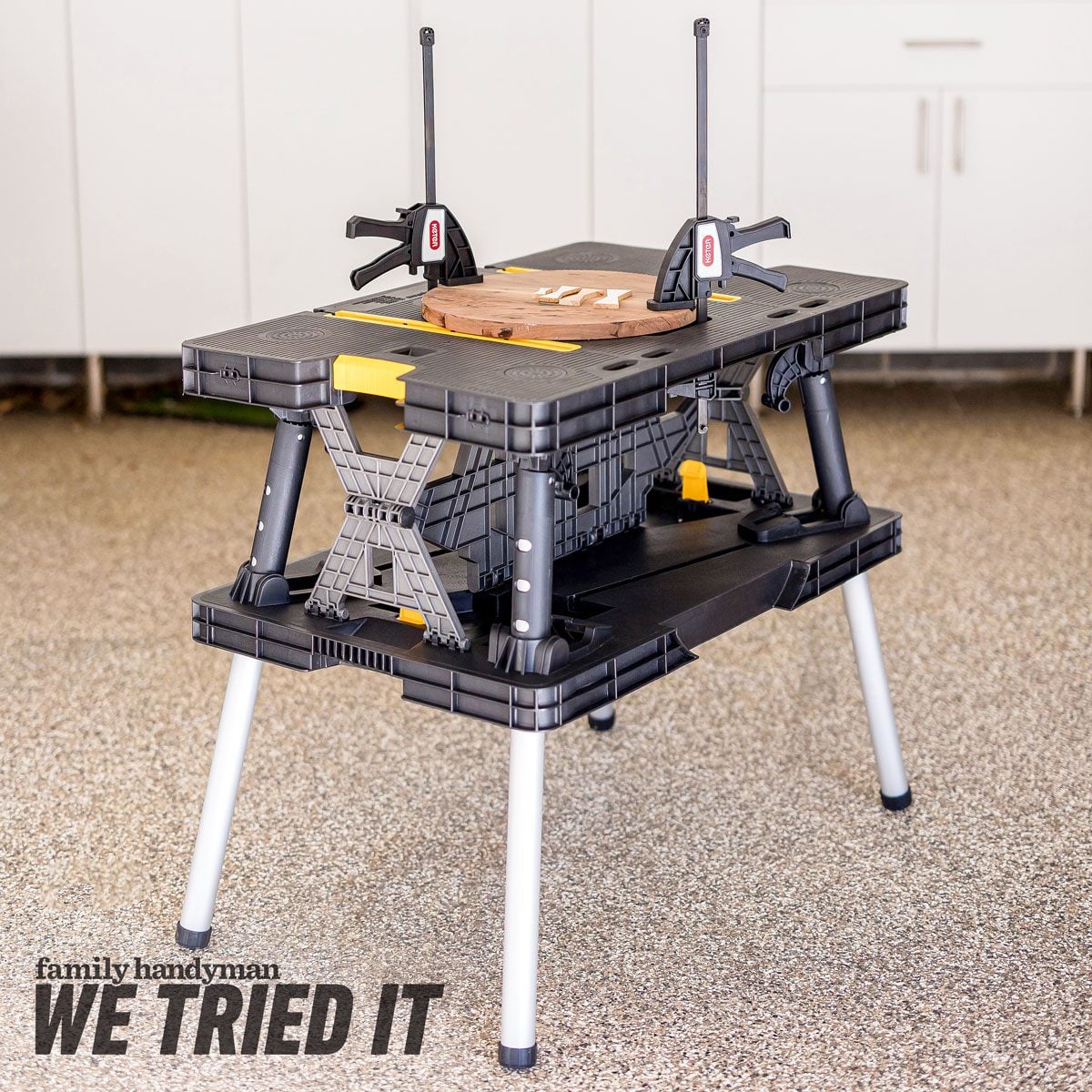
A permanent workbench is wonderfulright up until you realize it has permanently occupied half the garage. The Keter Folding Work Table offers a different bargain: a sturdy work surface when you need one and a slim, suitcase-shaped package when you do not. It is aimed at homeowners, mobile contractors, weekend woodworkers, and anyone whose “workshop” occasionally needs to become a parking space again.
Its headline specifications sound almost suspiciously ambitious. The table weighs roughly 27 pounds, folds to about 4.4 inches thick, includes two adjustable clamps, and carries a stated maximum load of 1,000 pounds. Those numbers make it one of the more interesting portable workbench options for heavy materials, compact storage, and quick household projects.
But specifications do not tell you whether the clamps are pleasant to use, whether the plastic top feels like patio furniture, or whether the table begins dancing across the floor when you start sawing. This Keter Folding Work Table review examines its construction, portability, stability, clamping system, limitations, ideal uses, and overall value.
Keter Folding Work Table Review: Quick Verdict
The Keter Folding Work Table is an excellent portable workbench for general DIY projects, assembly, sanding, painting, repairs, and light-to-moderate woodworking. Its quick-opening design is genuinely convenient, the lower shelf is useful, and the included clamps make the table more functional than a plain folding surface.
It is not a substitute for a thick hardwood bench anchored to the floor. The fixed working height will not suit everyone, the clamping channels can feel less refined than premium systems, and vigorous hand-planing or chiseling may reveal some movement. Still, for people who prioritize storage and mobility, its balance of strength, size, and convenience is difficult to ignore.
- Best for: Homeowners, DIYers, mobile repair work, small garages, outdoor project setup, sanding, cutting, painting, and assembly.
- Less suitable for: Heavy hand-tool woodworking, precision cabinetmaking, very tall users, uneven ground, and permanent workshop installations.
- Overall assessment: A practical, space-saving work table with real utility and a few predictable portable-bench compromises.
Key Specifications
| Feature | Specification |
|---|---|
| Open dimensions | Approximately 33.5 inches long, 21.7 inches wide, and 29.7 inches high |
| Folded thickness | Approximately 4.4 inches |
| Product weight | Approximately 27 pounds, depending on listing and model number |
| Maximum stated capacity | 1,000 pounds with a properly distributed load |
| Worktop material | Heavy-duty polypropylene or resin |
| Leg material | Aluminum |
| Included accessories | Two 12-inch adjustable clamps |
| Assembly | No initial assembly required |
Keter products sometimes appear under different retailer model numbers, including 17182239 and 197283. Before ordering replacement parts or comparing listings, confirm that the dimensions, clamp arrangement, and folding mechanism match the version being reviewed.
Design and Construction
A Resin Worktop That Makes Sense for Portability
The tabletop is made from molded resin rather than wood or steel. That choice keeps the weight manageable and eliminates concerns about rust, peeling paint, or the seasonal swelling that can affect unfinished wood. The surface is also easy to wipe down after painting, gardening, automotive work, or a glue-up that became more enthusiastic than expected.
The top is not indestructible. Deep saw cuts, drill holes, soldering irons, torches, and excessive heat can permanently damage it. Keter’s instructions specifically warn that cutting or drilling into the work surface can weaken its supporting structure. In other words, use a sacrificial board when making cuts. Your workbench should support the project, not slowly become the project.
Aluminum Legs and a Folding Support Structure
The aluminum legs unfold from beneath the tabletop and lock into position through the center support structure. When opened correctly on a flat surface, the arrangement feels much more substantial than an ordinary plastic folding table.
The legs are not height-adjustable, however. At just under 30 inches high, the bench is lower than many fixed workshop benches, which commonly stand several inches taller. The lower height can be helpful when applying downward pressure with a circular saw or sander, but taller users may notice more bending during long assembly sessions.
Setup, Folding, and Portability
Convenience is the product’s strongest argument. There are no loose legs to attach, braces to bolt together, or instruction diagrams requiring an advanced degree in pictograms. Release the side latches, lift the top, allow the legs to drop, and lock the center support into position.
Keter advertises a setup time of about 30 seconds. Once the mechanism becomes familiar, many owners will complete the process faster. Independent reviews have consistently praised the straightforward opening and closing system, although users should always verify that the legs and center support are fully locked before loading the table.
When folded, the workbench becomes a flat package roughly 4.4 inches thick. A built-in handle makes it easier to carry into a backyard, load into a vehicle, or hang from a strong garage hook. At approximately 27 pounds, it is portable without feeling disposable. It is not featherlight, but most adults can move it comfortably for short distances.
That compact folded profile is especially valuable in townhouses, apartments, storage sheds, shared garages, and workshops where every square foot already has three job descriptions.
Work Surface and Load Capacity
The worktop measures approximately 33.5 by 21.7 inches. That is enough room for small furniture parts, cabinet doors, shelves, power tools, planters, trim pieces, and household repairs. It is less suitable for full sheets of plywood or large dining-table components unless paired with sawhorses or a second support.
The stated 1,000-pound capacity is impressive for a folding resin workbench, but it needs context. It refers to a balanced load on a fully opened, properly supported table. The instruction manual warns against unbalanced loading and leaving extremely heavy material on the surface for extended periods.
The figure should not be interpreted as permission to use the table as a ladder, scaffolding platform, gym bench, or emergency stage for an unusually ambitious karaoke performance. The manufacturer explicitly warns users not to stand on either the tabletop or lower shelf.
Clamping System
Two 12-inch clamps are included and can be installed in horizontal or vertical positions. This makes it easier to secure boards for sanding, hold trim while cutting, stabilize materials during drilling, or keep glued pieces from wandering around like unsupervised toddlers.
For ordinary DIY work, the clamps are a meaningful advantage. They store with the table, so the complete workstation remains relatively self-contained. You can carry the folded bench to another room without making a separate expedition for clamping equipment.
The system is not perfect. The molded clamp guides can require some alignment and may not slide as smoothly as the channels on more expensive portable benches. Independent testers have described the guides as somewhat finicky, while some woodworking users report that the supplied clamps are more effective on medium and large workpieces than on very small components.
For delicate parts, odd shapes, or precision joinery, supplementary clamps and a sacrificial plywood top may improve flexibility. Just avoid drilling through the original resin surface to create permanent mounting holes.
Stability During Real Projects
Stability depends heavily on the task and floor conditions. On level concrete, the Keter work table performs well for sanding, painting, assembling furniture, cutting boards, and supporting benchtop tools. A recent comparative test described it as notably solid under normal use, and several retailer reviews similarly praise its resistance to shaking during common cutting jobs.
More forceful woodworking exposes the difference between a portable table and a permanent bench. Repeated chiseling, aggressive hand-planing, or pushing hard from one side may produce movement. The fixed legs also cannot be individually adjusted to compensate for an uneven driveway or rough yard.
This does not make the table unstable in general. It means its stability is optimized for distributed downward loads, clamped work, and portable power-tool tasksnot for absorbing heavy horizontal force all afternoon.
The Lower Storage Shelf
The lower shelf is easy to underestimate until the project begins. It provides a convenient location for a drill, sanding discs, screws, tape measure, safety glasses, extension cord, or the pencil that would otherwise disappear the moment you set it down.
The shelf is not intended as a step, and it should not be overloaded. Its real value is workflow. Keeping frequently used tools beneath the work surface reduces trips across the garage and limits the temptation to place every tool on top of the workpiece.
Weather Resistance and Storage
The resin worktop and aluminum legs tolerate temporary outdoor use better than an unfinished wood bench. The materials resist ordinary moisture-related problems such as rust, peeling, and minor water exposure.
However, “weather-resistant” does not mean “store it behind the shed until civilization ends.” Keter’s manual advises against storing the workbench outdoors or in a damp location. Long-term exposure to sunlight, water, freezing temperatures, dirt, and temperature swings can age plastic components and folding mechanisms prematurely.
Use it outdoors when the project demands it, wipe it clean, allow it to dry, and return it to protected storage.
Best Uses for the Keter Portable Workbench
Furniture and Household Assembly
The table provides a comfortable alternative to assembling shelves, cabinets, and flat-pack furniture on the floor. Small components remain visible, hardware can sit on the lower shelf, and the work surface is large enough for many common parts.
Sanding and Finishing
The clamps hold boards securely while sanding, scraping, staining, or painting. Because the surface is resin, dried glue and finish residue are generally less alarming than they would be on a polished hardwood bench.
Cutting Trim, Shelves, and Small Boards
With the workpiece properly supported and clamped, the table is useful for cutting short boards and trim. Place scrap material beneath the cutting line so the blade never contacts the tabletop.
Mobile Repairs and Jobsite Tasks
The folding design works well for installers, maintenance technicians, property managers, and contractors who need a temporary surface but do not want to unload a traditional bench. It can also function as a staging area for tools and materials during interior repairs.
Gardening and Outdoor Projects
Repotting plants, repairing outdoor furniture, assembling irrigation parts, and cleaning equipment are all easier when the work is raised off the ground. The washable top is particularly welcome when the project involves soil, grease, or both.
Limitations to Consider
- Fixed working height: There is no height adjustment for taller or shorter users.
- Limited surface area: Large panels and long boards require additional support.
- No integrated vise: The included clamps are useful, but they do not replace a traditional woodworking vise.
- Plastic top: Heat, drill bits, saw blades, and sharp tools can damage the surface.
- Uneven-ground performance: Nonadjustable legs cannot compensate for major floor irregularities.
- Clamping channels: The guides may feel less smooth than premium rail systems.
- Not a standing platform: The large capacity rating applies to supported materials, not people.
Keter Folding Work Table vs. Popular Alternatives
Keter vs. Worx Pegasus
The Worx Pegasus offers greater multifunctionality. It converts between a worktable and sawhorse, includes clamp dogs, and can connect to compatible Worx tables. Its tabletop mode has a lower stated capacity than the Keter, although its sawhorse configuration supports heavier loads.
The Keter counters with a 1,000-pound stated table capacity, a built-in carrying handle, simple suitcase-style storage, and a useful lower shelf. Choose the Worx for modularity and sawhorse functions; choose the Keter for a straightforward heavy-duty portable table. Comparative buying guides regularly rank both among the better portable workbench options.
Keter vs. DeWalt Express Folding Workbench
The DeWalt Express is slightly larger and has an extremely rapid folding mechanism. It is a strong choice for users already invested in DeWalt jobsite equipment or those who prioritize the fastest possible deployment.
The Keter’s included clamps and lower shelf give it a more complete workstation feel immediately out of the box. The better choice depends on whether you value accessory integration or minimal setup time.
Keter vs. a Traditional Workmate-Style Bench
A Workmate-style bench generally provides a split top that functions as a vise, making it useful for gripping irregular pieces and applying horizontal clamping pressure. The Keter provides a broader, flatter surface and easier tabletop-style workflow.
Traditional folding benches may suit hand-tool woodworking better, while the Keter is often more convenient for assembly, sanding, portable power tools, and general home maintenance.
Who Should Buy the Keter Folding Work Table?
This table is a strong choice when permanent workshop space is unavailable or unnecessary. It is particularly appealing to:
- Homeowners who regularly tackle repairs and weekend projects
- DIYers working in compact or shared garages
- Renters who cannot install a wall-mounted bench
- Contractors who need a portable staging and cutting surface
- Woodworkers who want a secondary assembly or finishing table
- People who need a workbench that can be stored in a closet or vehicle
Buy a heavier fixed workbench instead when your projects involve daily hand-planing, repeated hammering, large cabinetry, integrated machinery, or a need for drawers and permanent tool storage.
Extended Real-World Ownership Experience
The most noticeable advantage appears before any cutting or sanding begins: the table removes the friction from starting a small project. A permanent workbench may already be buried beneath paint cans, chargers, sports equipment, and an appliance part nobody remembers ordering. The Keter can be carried into an open area, unfolded, and made ready before procrastination has time to prepare a formal argument.
Consider a typical shelf-building project. Two boards need trimming, the edges need sanding, and brackets need to be installed. The table opens beside the garage door, one clamp holds the board, and the lower shelf keeps the drill and fasteners nearby. A scrap board protects the resin top during cutting. After assembly, the surface becomes a finishing station. The entire workflow happens in one compact area rather than across the floor, a trash can, and the hood of a car.
The carrying experience is reasonably good. The handle is comfortable enough for moving the folded unit from a garage to a backyard or vehicle. At approximately 27 pounds, it feels substantial but manageable. Carrying it across a large commercial property would eventually become a workout, but moving it around a home is unlikely to create drama.
Setup becomes nearly automatic after a few uses. The important habit is checking the center support and each leg before applying weight. Folding is similarly straightforward, although it is wise to remove tools, cords, and loose hardware first. This advice sounds obvious until a container of screws performs a dramatic interpretation of rainfall.
During sanding, drilling, and light circular-saw work, the bench feels reassuring on level concrete. Clamping the workpiece improves stability and control. When the project involves harder sideways forcesuch as hand-planing a stubborn boardthe table may shift more than a fixed bench. Positioning one side near a wall, using a nonslip mat, or changing the direction of force can help, but these are workarounds rather than transformations.
The clamps are convenient for common boards, shelves, and trim. Their ability to work horizontally or vertically broadens the number of useful positions. They are less impressive with tiny parts, unusual curves, or pieces requiring very precise pressure. In those situations, separate bar clamps, blocks, and a removable plywood panel can create a more adaptable setup without altering the original table.
Over time, the resin surface will probably collect scratches, stains, and evidence of past decisions. That cosmetic wear is normal for a working table. Protecting it from direct blade contact, extreme heat, and prolonged outdoor storage matters more than keeping it photographically perfect.
Verified owner feedback and independent reviews repeatedly emphasize the same practical benefits: fast setup, convenient folding, useful clamp storage, and a surprisingly sturdy feel for the size. Less enthusiastic comments tend to focus on plastic components, fixed legs, or individual hardware issues rather than the basic concept of the table.
The ownership experience is therefore best described as uncomplicated. The Keter does not attempt to become a cabinetmaker’s heirloom bench or a universal machine stand. It gives ordinary projects a stable, elevated place to happen, then gets out of the way when the garage needs to resume its other career.
Final Verdict: Is the Keter Folding Work Table Worth It?
Yes, the Keter Folding Work Table is worth considering for DIYers who need portability, compact storage, and a capable temporary workspace. Its 1,000-pound stated load capacity, aluminum legs, resin top, included clamps, lower shelf, and fast folding system deliver an unusually useful combination.
The best reason to buy it is not the impressive capacity number. It is the likelihood that you will actually use it. A workbench that unfolds in seconds and stores against a wall can be more valuable than a larger bench that your space cannot accommodate.
Its weaknesses are reasonable for the category. The table is not height-adjustable, the top is smaller than a permanent bench, and demanding hand-tool work can expose movement. Treat it as a portable project center rather than a miniature industrial bench, and it becomes a dependable assistant for home repairs, woodworking, assembly, finishing, and mobile jobs.
Note: Product specifications, accessories, model numbers, warranties, and availability may vary by retailer. Confirm the exact listing and follow the supplied Keter instruction manual before using heavy materials or power tools.