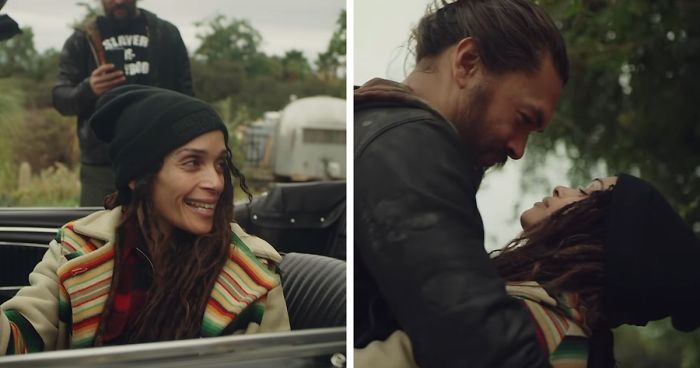
Some gifts come in tiny boxes. Some a And some rumble into the driveway as a beautifully restored 1965 Ford Mustang convertible with decades of memories tucked behind the steering wheel.
In 2020, Jason Momoa surprised Lisa Bonet with the restoration of her first car: a weathered 1965 Mustang she bought when she was 17. The project was not a casual “let’s wash it and call it vintage” situation. It involved a deep restoration, a secret plan years in the making, and the kind of reveal that made car lovers, romantics, and people who have cried over an old Honda Civic all pause for a moment.
Editor’s note: The restoration occurred in 2020, while Jason Momoa and Lisa Bonet were married. Their relationship later ended, but the story remains a memorable example of how a classic car can preserve a chapter of someone’s life.
The Story Behind Jason Momoa and Lisa Bonet’s 1965 Mustang
Jason Momoa has never exactly projected the image of a man who buys generic gifts at the airport on the way home. The actor is known for his love of motorcycles, vintage machines, handmade objects, and projects with personality. So when he decided to do something meaningful for Lisa Bonet, he did not reach for a handbag, a bouquet, or a giant novelty mug that says “World’s Best Wife.”
He went after her first car.
Bonet bought the 1965 Ford Mustang when she was 17 years old, making it far more than a collectible vehicle. First cars tend to become accidental diaries. They hold memories of first jobs, first arguments, first road trips, terrible parking attempts, favorite songs, and that one mysterious fast-food smell that somehow survives three decades.
Momoa described the project as being 14 years in the making. His goal was not simply to make an old Mustang look expensive. He wanted to bring a deeply personal car back into the family’s life. In the restoration film, he captured the idea perfectly: people cannot relive a memory, but they can sometimes rebuild one.
That distinction is important. A classic car restoration can be about resale value, concours judging, engine originality, or collecting trophies at a weekend show. This project was about emotional value. The Mustang was not merely an object from Bonet’s past. It was a physical connection to the younger version of herself who first bought it.
From Rusty Relic to Family Heirloom
Before the restoration, Bonet’s Mustang was not a glossy social-media prop waiting for dramatic lighting. It had clearly endured years of wear, exposure, and neglect. The car showed visible corrosion, missing or damaged components, and the kind of tired appearance that makes a casual observer say, “Maybe it has character,” while a professional restorer quietly reaches for a very large estimate.
Momoa brought the vehicle to Divine 1 Customs in Las Vegas, where the team took on the demanding job of transforming the tired convertible into a finished classic. Reports and footage from the project showed major work involving the body, floors, paint, interior, drivetrain components, convertible top, and countless details that most people never notice until they are wrong.
Why the Restoration Was More Than a Fresh Coat of Paint
A real restoration is rarely glamorous during the middle stage. There is no cinematic soundtrack when technicians discover hidden rust, worn mounts, damaged wiring, or metal that has become more air than steel. Early Mustangs are unibody cars, which means structural areas such as floor pans, torque boxes, frame rails, cowl sections, and rockers matter enormously. Cosmetic polish is nice, but a shiny classic car with weak structure is basically a very pretty warning label.
The restoration team reportedly removed the original 289-cubic-inch Ford V8 and the four-speed manual transmission as part of the work. That does not mean the project lost its identity. It means the team had to evaluate, repair, replace, restore, or rebuild systems that had aged far beyond their intended lifespan. Old cars do not care that you are famous. Rust remains wonderfully unimpressed by celebrity status.
The finished Mustang emerged in a sleek dark finish with a refined black interior. Bonet’s reaction focused on exactly what good restoration work should achieve: the car looked pristine without becoming loud, overstyled, or disconnected from its original personality.
Why a 1965 Ford Mustang Matters So Much
The 1965 Ford Mustang was already becoming an American icon when Bonet’s car was new. Ford introduced the Mustang in April 1964, and the model quickly became a sensation because it offered youthful styling, multiple customization options, sporty proportions, and an accessible sense of freedom. It was not just transportation. It was transportation with cheekbones.
The long-hood, short-deck design helped create the pony-car formula that competitors spent years trying to chase. Buyers could choose a practical six-cylinder model, a V8-powered version, a convertible, a coupe, or a more performance-oriented combination. That flexibility made the Mustang feel personal long before personalization became a marketing buzzword.
Bonet’s Mustang was a GT convertible, a version that represented the stylish, sporty side of the first-generation Mustang experience. Convertibles from this era carry a special kind of cultural electricity. They suggest sunlight, coastal roads, late-night drives, movie scenes, and the confidence to wear sunglasses even when the weather is aggressively cloudy.
A Car That Grew Up With Its Owner
The most interesting part of this story is not that the car was rare or valuable. It is that the Mustang stayed emotionally relevant. Plenty of people remember their first car fondly, even if it was a beige sedan with a transmission that made every uphill drive feel like a negotiation. But keeping or recovering that first car decades later creates a stronger connection.
In Bonet’s case, the restored Mustang became a bridge between her teenage years and her family life. The reveal included Momoa, Bonet, and their children, turning a personal memory into a new shared experience. That is the real magic of heirloom vehicles: they do not freeze time; they give old memories a chance to continue moving.
What Jason Momoa’s Mustang Restoration Says About Thoughtful Gifts
Celebrity gift stories often become contests of scale. Someone buys an island, a diamond the size of a doorknob, or a sports car that probably requires a second sports car just to carry the groceries. Momoa’s gesture stood out because it was not centered on price alone. It centered on attention.
He remembered the story behind Bonet’s first car. He understood that the Mustang represented independence, youth, and identity. Then he invested years into returning it to a condition where it could be driven, admired, and experienced again.
That is why the story resonated far beyond celebrity-news headlines. The restoration was extravagant, yes, but the emotional logic was familiar. Most people have an object tied to an earlier version of themselves: a guitar, a childhood bicycle, a family camera, a handwritten recipe book, an old leather jacket, or a car that carried them through an important season of life.
The best meaningful gifts often work like restoration projects. They do not erase age, wear, or history. They respect the story while making it possible to enjoy the object again.
The Restoration Lessons Hidden Under the Hood
Preserve the Story Before Chasing Perfection
When restoring a classic car, owners usually face a major question: should they preserve originality or build a modernized restomod? There is no universal answer. A museum-grade restoration may keep factory-correct finishes, date-coded parts, and original specifications. A restomod may add better brakes, updated suspension, modern cooling, safer wiring, and more dependable drivability.
Momoa’s project seems to have followed a middle path. The finished car looked polished and usable without appearing like a modern machine wearing a 1965 costume. That balance is difficult. Too much modernization can erase the car’s soul. Too much loyalty to old parts can make the vehicle beautiful but impractical.
Do Not Underestimate Structural Work
Classic Mustang restorations often reveal corrosion in areas that are not obvious from the outside. Floors, cowls, torque boxes, shock towers, and frame rails can hide serious damage. Buyers and restorers who focus only on paint, chrome, and upholstery may discover later that the real problems were hiding underneath the carpet, behind the fenders, or under several decades of optimistic undercoating.
The lesson is simple: a restoration should begin with a complete inspection, not with a color chart. The color can wait. Gravity cannot.
Use the Car After the Reveal
The emotional payoff of a restoration is strongest when the car returns to real life. A first car should not spend the rest of its existence trapped under a cover like a glamorous hostage. Weekend drives, local car events, family photos, and short road trips give a restored vehicle fresh meaning.
Momoa’s surprise worked because it ended with a drive. That final moment transformed the Mustang from a restored artifact into a living part of the family story again.
Why This Story Still Connects With Car Lovers
The Jason Momoa and Lisa Bonet Mustang restoration remains memorable because it blends several things people already love: classic cars, meaningful surprises, family history, craftsmanship, and a before-and-after transformation dramatic enough to make every neglected garage project feel briefly hopeful.
It also reminds people that classic cars are not only for collectors with climate-controlled warehouses and jackets embroidered with obscure engine codes. They can be deeply personal objects. A 1965 Mustang can represent American automotive history, but it can also represent a young person’s first taste of independence.
That is what made Momoa’s gesture land. He did not give Bonet a random vintage Mustang. He gave her back a piece of her own story, restored carefully enough to create new memories around it.
Extended Experience: What It Feels Like to Bring a First Car Back to Life
Anyone who has ever reunited with an old car understands that the experience is rarely logical. You may know perfectly well that modern vehicles are safer, quieter, more efficient, and far less likely to require a roadside conversation with a tow-truck driver. None of that matters when an old car opens a door in your memory.
The smell of old vinyl, gasoline, warm metal, leather, and slightly dusty carpet can trigger memories faster than a photo album. A steering wheel can feel like a time machine. The shape of a dashboard can bring back old roads, old friends, old jobs, old music, and even old worries that somehow seem smaller when viewed from several decades away.
Restoring a first car is especially powerful because first cars represent more than transportation. They often mark the beginning of independence. They are where people learned to drive alone, where they made mistakes, where they sat in parking lots talking too long, and where they decided that gas money was apparently a real adult responsibility.
A restoration does not make the past perfect. In fact, the scratches, faded photos, old registration papers, and strange repairs can become part of the charm. The best restoration projects respect that history. They do not pretend the car was always flawless. They simply make it possible for the vehicle to continue its story.
There is also something deeply satisfying about watching a neglected machine become functional again. A car that has sat silent for years begins with small victories: a door closes correctly, an engine turns over, lights work, brakes respond, and the interior starts to look like a place where someone could actually sit without needing a tetanus shot.
Then comes the first drive. That moment is usually less about speed than emotion. The engine may not sound as refined as a modern vehicle. The steering may feel heavier. The brakes may remind you that automotive engineering has made some useful progress since the mid-1960s. But the car feels alive, and so does the memory attached to it.
For families, restored vehicles can become unexpected storytellers. A parent can explain what life was like when they bought the car. Children can see a parent not only as a parent, but as a teenager with dreams, questionable fashion choices, and a favorite vehicle. That shift in perspective can be more meaningful than any museum display.
Jason Momoa’s restoration of Lisa Bonet’s Mustang captured that feeling. The project was not simply about saving an old Ford. It was about honoring the 17-year-old who first owned it, while inviting a new generation to ride in the same car. That is why classic-car restorations continue to matter: they do not just rebuild metal, paint, engines, and interiors. They rebuild connections.
Conclusion
Jason Momoa restoring Lisa Bonet’s 1965 Mustang was more than a celebrity surprise. It was a thoughtful classic-car restoration rooted in memory, craftsmanship, and family history. By bringing her first car back from years of decline, he turned a worn vintage convertible into something far more valuable than a polished collectible.
The story proves that the most powerful restoration projects are not always about horsepower, rarity, or auction prices. Sometimes the real value sits in the driver’s seat, waiting for someone to remember why the car mattered in the first place.