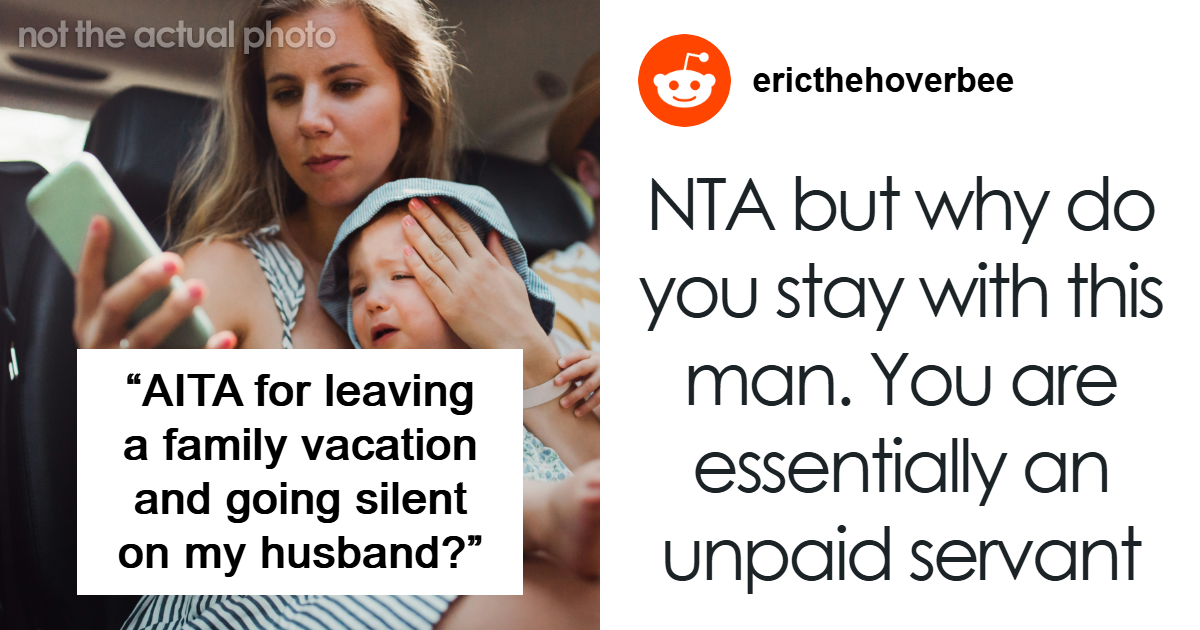
Family vacations are supposed to be the highlight reel: sandy toes, goofy photos, overpriced snacks, and at least one relative insisting that “we should all do this every year.” But sometimes the trip turns into a live-action lesson in emotional labor, boundaries, and why ignoring your family on a family vacation is like bringing sunscreen to the beach and refusing to use it. Technically possible. Wildly unwise.
That is the situation behind the viral story summed up by the phrase, “I left the next morning.” A woman reportedly planned a family getaway with her husband and children, only to realize that her partner was treating the vacation like a solo social tour. Instead of sharing parenting duties, making memories, or even acting like he knew the people he arrived with, he went off with friends and left her managing the kids. Eventually, she packed up and left. The husband, suddenly promoted from “carefree vacation guy” to “confused man in abandoned hotel room,” had to face the consequences.
The story struck a nerve because it is not really about one bad trip. It is about a familiar relationship problem: one person believes “family time” means shared effort, while the other hears “vacation” and mentally clocks out. When expectations clash, suitcases are not the only things that get unpacked.
Why This Family Vacation Story Went Viral
The reason people reacted so strongly is simple: many readers recognized the pattern. A family trip often reveals who plans, who cares, who notices the diaper bag, who remembers nap schedules, who checks the reservation, and who mysteriously disappears when the baby starts crying near the appetizer menu.
In the viral vacation conflict, the husband’s mistake was not merely wanting personal time. Personal time is healthy. Adults are allowed to breathe without a toddler using them as a climbing gym. The problem was imbalance. He appeared to treat his wife as the default parent and household manager, even while they were away from home. That made the vacation feel less like relaxation and more like unpaid overtime with a scenic view.
For many couples, travel amplifies existing dynamics. If one partner usually handles childcare, schedules, meals, packing, and emotional coordination, that pattern often follows them onto the plane. The palm trees may be new; the resentment is carry-on.
The Real Issue: Ignoring Family Is Not “Needing Space”
There is a big difference between needing alone time and abandoning shared responsibility. A healthy vacation might include separate activities: one parent takes a morning walk, the other gets an afternoon nap, the kids enjoy a pool session, and everyone meets for dinner. That is coordination. What happened in this story sounds more like one partner opted out of the family experience while still expecting the benefits of being part of the family.
Ignoring family members during a trip sends a message, whether intended or not. It says: “My fun comes first.” It also says: “Your time is less valuable than mine.” That message becomes especially painful when children are involved, because the ignored partner is not just lonely; they are responsible for keeping the entire trip functioning.
Vacations are emotional pressure cookers. People are tired, routines are off, money has been spent, and everyone expects the trip to be magical. When one adult checks out, the other adult often becomes the travel agent, parent, referee, snack distributor, and crisis manager. That is not a vacation. That is a mobile command center with a hotel breakfast buffet.
How Family Trips Expose Old Relationship Patterns
Family vacations can be wonderful because they create shared memories. They can also be brutally honest. At home, routines hide a lot. On vacation, every decision becomes visible: where to eat, when to leave, who watches the kids, who compromises, who complains, and who gets to enjoy leisure while someone else manages logistics.
This is why conflicts during trips often feel bigger than the immediate event. The argument is not only about one dinner, one missed outing, or one person going out with friends. It becomes a symbol of a bigger pattern. The ignored partner may think, “This is what always happens. I carry the weight, and he gets the fun.” Once that thought lands, the vacation mood can sink faster than a beach chair in wet sand.
In this case, leaving the next morning was not just dramatic. It was a boundary. It communicated, “I will not stay in a situation where I am treated like staff instead of family.” Whether readers agree with leaving or think there should have been one more conversation first, the reaction makes sense. When people feel invisible long enough, distance starts to look like oxygen.
Was Leaving the Right Move?
That depends on what happened before the breaking point. In any relationship conflict, context matters. Did she clearly explain that she needed help? Did he dismiss her? Was this the first time, or part of a long-term pattern? Was she safe, financially able to leave, and able to travel with the children? Those details matter because boundaries should protect well-being, not create new danger.
Still, leaving can be reasonable when a person has repeatedly communicated a need and the other person refuses to respond. A boundary is not the same as punishment. Punishment tries to control someone else. A boundary defines what you will do to protect your own emotional, physical, or mental health.
For example, “If you keep leaving me alone with the kids while you go out with friends, I will take the kids home” is a boundary. “You are a terrible person and I hope your vacation is ruined” is a grenade with hotel Wi-Fi. One creates clarity. The other creates rubble.
What the Husband Should Have Done Differently
The husband could have avoided the solo-trip disaster with a few basic moves. First, he should have discussed expectations before the vacation. If he wanted to see friends, that needed to be on the table early. “I would like one evening with my friends” is very different from disappearing repeatedly and assuming his wife would absorb the work.
Second, he should have shared parenting duties without being asked every five minutes. Adults do not need engraved invitations to parent their own children. If the baby needs care, if the kids need lunch, if the family needs a plan, both parents should be involved.
Third, he should have checked in emotionally. A simple “Are you okay?” can prevent a relationship from reaching DEFCON Suitcase. Vacations move fast, but emotional neglect often starts with tiny missed moments. When one partner looks exhausted and the other keeps scrolling, chatting, or leaving, resentment starts writing its own itinerary.
What the Wife’s Decision Reveals About Boundaries
The phrase “I left the next morning” sounds abrupt, but in many relationships, the final action is rarely the first signal. People often speak up, hint, ask, explain, soften, and swallow frustration before they finally take action. By the time someone leaves, they may already feel like they have tried everything short of hiring a skywriter.
Healthy boundaries are clear, direct, and enforceable. They are not about winning an argument. They are about refusing to participate in a dynamic that causes harm. In this vacation story, leaving created an unavoidable consequence. The husband could no longer pretend everything was fine because the evidence was gone: wife gone, kids gone, family vacation gone.
That is why the story resonates. Many people know what it feels like to be present but unseen. A person can be sitting beside you at dinner and still make you feel alone. On a family vacation, that loneliness can feel even sharper because the setting is supposed to be joyful.
How Couples Can Avoid a Vacation Meltdown
Talk About the Trip Before Booking It
Before anyone clicks “reserve,” couples should discuss the purpose of the trip. Is it family bonding? Rest? Visiting friends? Adventure? A kid-centered getaway? A romantic reset? If two people are imagining two different vacations, conflict is already boarding early.
Useful questions include: Who handles the children at different times of day? Will either partner see friends or relatives separately? How much alone time does each person need? What is the budget? What activities are must-do, optional, or absolutely-not-unless-you-pay-me?
Create a Shared Parenting Plan
Parents do not need a military schedule, but they do need fairness. One parent can take breakfast duty while the other sleeps in. One can manage bath time while the other handles dinner logistics. Each adult should get breaks, and each adult should contribute.
The magic word is “shared.” Not “helping.” Not “babysitting.” Not “watching the kids for you.” Parenting is not a favor one partner grants the other. It is the job description.
Build in Personal Time Without Disappearing
Personal space can make a family vacation better. The problem is not separate time; the problem is surprise abandonment. If one spouse wants to meet friends, schedule it. If the other spouse wants a spa hour, reading time, a solo walk, or a nap that does not involve being kicked by a preschooler, schedule that too.
Fairness does not mean every minute must be identical. It means both people’s needs count.
Use “I” Statements Before Things Explode
Instead of “You never care about us,” try, “I feel alone and overwhelmed when you leave me with the kids without checking in.” The first version starts a courtroom drama. The second gives the other person a chance to understand the impact.
Of course, communication only works when the other person cares enough to listen. If one partner calmly communicates and the other dismisses, mocks, or repeats the behavior, the issue is no longer poor wording. It is disrespect.
What Families Can Learn From This Solo Trip Disaster
The biggest lesson is that family vacations require teamwork. A trip does not become a family vacation because the reservation has multiple names on it. It becomes a family vacation when people act like a team.
That means noticing when someone is overwhelmed. It means including your partner in plans. It means not leaving one adult to do all the invisible work while the other chases fun like a golden retriever spotting a tennis ball. It also means understanding that children remember the emotional temperature of a trip. They may forget the restaurant, but they remember tension, silence, and who showed up.
Another lesson: boundaries are easier before resentment becomes volcanic. If the wife in the story had said early, “I need you present with us, or I will not continue this trip,” perhaps the husband would have changed course. Or perhaps he would not have. Either way, clarity would have arrived sooner.
Specific Examples of Healthier Vacation Behavior
Imagine a couple traveling with two young children. On day one, the father wants to meet old friends for lunch. A healthy version sounds like this: “I would love to meet them from noon to two. Can I take the kids to the pool first so you get the morning off? Then tonight we will all do dinner together.” That shows planning, fairness, and respect.
An unhealthy version sounds like this: “I’m heading out. You’ve got the kids, right?” That is not communication. That is a drive-by delegation.
Another example: If one partner feels ignored, they can say, “I came here to spend time as a family. If you want this to be a friends’ trip, I need to know, because I’m not willing to spend the week parenting alone.” This statement is direct without being cruel. It gives the other person a choice and explains the consequence.
For extended family vacations, the same rules apply. Grandparents, siblings, cousins, and in-laws can add joy, but they can also add pressure. Families should define expectations around childcare, money, meals, personal time, and privacy. Otherwise, the vacation becomes a group project where one person did all the work and everyone else signed the card.
When a Vacation Conflict Points to a Bigger Relationship Problem
Not every bad trip means a relationship is doomed. Travel is stressful. People get hungry, lost, sunburned, overstimulated, and weirdly emotional over restaurant choices. Sometimes a vacation fight is just a vacation fight.
But repeated neglect is different. If one partner regularly ignores family needs, dismisses requests for help, refuses accountability, or treats shared responsibilities as optional, the vacation may simply reveal what already exists. In that case, the couple may need a serious conversation after the trip, possibly with a counselor or therapist.
The goal should not be to assign a permanent villain label. The goal should be to ask: What pattern showed up here? Who felt unsupported? What needs to change before the next trip, holiday, or ordinary Tuesday?
Experience Section: What This Story Feels Like in Real Life
Anyone who has been the “responsible one” on a trip knows the emotional math. You are not just watching the kids. You are tracking sunscreen, snacks, allergies, nap windows, bathroom breaks, missing shoes, hotel key cards, and whether the toddler is about to lick a railing. Meanwhile, the other adult says, “Relax, we’re on vacation,” as if relaxation can be summoned by someone who has applesauce on their shirt and no idea where the stroller went.
That is why stories like “I left the next morning” hit so hard. They capture a specific kind of loneliness: being surrounded by people and still feeling abandoned. It is the feeling of watching your partner laugh with friends while you bounce a fussy baby in the corner. It is eating cold fries because everyone else ate first. It is hearing “Why are you upset?” from the person who created the exact conditions for your upsetness. Truly, the audacity sometimes arrives with complimentary resort towels.
Many people have experienced a smaller version of this. Maybe a partner slept in every day while the other handled breakfast. Maybe someone promised to help but vanished when the kids needed baths. Maybe relatives treated one parent like the automatic childcare station. These moments may seem minor individually, but together they create a painful message: your rest does not matter.
A healthier experience feels different. Both adults look around and notice what needs doing. One says, “I’ve got the kids for an hour; go take a walk.” The other says, “You handled bedtime last night, so I’ll do it tonight.” Nobody needs applause for basic fairness, but appreciation still helps. A simple “Thank you for managing that” can soften a long day.
The best family trips are not perfect. Someone will forget pajamas. Someone will cry in a gift shop. Someone will insist they are not tired while slowly melting into a pool chair. But good trips have a sense of teamwork. People adjust. They apologize. They laugh when plans collapse. They do not make one person carry the whole emotional suitcase.
If there is one practical takeaway from this story, it is this: do not wait until the final straw becomes a plane ticket home. Speak early. Be specific. Ask for what you need. And if someone repeatedly ignores your needs, take the boundary seriously. A vacation should not require one person to disappear before the other realizes they were there.
Conclusion
The viral story of a family vacation turning into a solo trip is more than online drama. It is a reminder that relationships are built in everyday choices, including who packs the bag, who watches the kids, who listens, and who notices when someone is quietly reaching their limit.
A family vacation should not feel like a test of endurance for one partner and a playground for the other. It should be a shared experience, with shared joy and shared responsibility. The husband in this story may have thought he was just enjoying himself, but ignoring his family sent a message he could not unsend. The wife’s decision to leave may sound extreme, but sometimes a boundary is the only language a dismissive person finally understands.
In the end, the lesson is simple: if you go on a family vacation, be part of the family. Otherwise, do not be shocked when the “family trip” continues without you.
Note: This article is an original, rewritten analysis based on public reporting, relationship psychology, family travel research, and expert guidance about boundaries, family conflict, communication, and vacation planning. It is written for web publication and contains no copied source text.