Space is big. Very big. It is also, rather inconveniently, getting cluttered. Above Earth, dead satellites, spent rocket stages, broken fragments, and hardware bits too stubborn to fall home are circling the planet at speeds that make even tiny debris a serious problem. What sounds like a futuristic janitorial issue is actually an active engineering challenge with real consequences for communications, weather forecasting, navigation, national security, science missions, and astronaut safety.
That is where one of the strangest phrases in modern aerospace comes in: cleaning up space junk with harpoons and nets. Yes, the idea really did leave the whiteboard. Engineers have tested both technologies in orbit, and they did it for a good reason. If a dead satellite is tumbling through low Earth orbit like a wrench tossed into a wind tunnel, you cannot exactly ask it to hold still and smile for the docking camera. Sometimes you need a tool that can grab an object that was never designed to be grabbed.
Still, the headline is only half the story. Harpoons and nets are not magic cosmic vacuum cleaners. They are part of a broader strategy called active debris removal, and they work best when paired with smarter satellite design, better tracking, stronger disposal rules, and a healthy respect for orbital physics. In other words, cleaning Earth’s orbital attic takes more than one clever gadget.
Why Space Junk Is Such a Mess in the First Place
Orbital debris is basically any human-made object in space that no longer serves a useful purpose. That includes dead payloads, old rocket bodies, fragments from explosions and collisions, discarded mission hardware, and tiny shrapnel-like particles created over decades of launches. Some of those objects are large enough to track from the ground. Many are not. That is a problem, because in orbit, “small” does not mean “harmless.” A paint fleck moving at orbital velocity is not cute. It is a tiny bullet with a PhD in bad manners.
The biggest concern is not just what is already floating around, but what can happen next. When large objects collide, they create clouds of smaller fragments. Those fragments raise the odds of more collisions, which can produce even more debris. This is the logic behind the dreaded Kessler Syndrome conversation: a cascading chain of breakups that makes important orbital regions harder and more expensive to use. Scientists and policy experts do not treat that as movie-trailer drama anymore. They treat it as risk management.
That is also why engineers keep emphasizing a key point that sounds boring until you think about it: prevention is cheaper than cleanup. A satellite that can deorbit itself at the end of its mission is far better than a dead satellite that later requires a rescue mission with robotics, advanced navigation, fuel, and enough software to make a self-driving car look underqualified.
So Why Harpoons and Nets?
Because orbital debris does not usually cooperate. A dead object in space can be tumbling, spinning, asymmetric, fragile, or partly damaged. It may not have a docking port. It may not have a grapple fixture. It definitely is not reading your operations manual. Engineers looking for ways to capture such objects explored several concepts, including robotic arms, magnetic docking systems, claws, tethers, drag devices, nets, and harpoons.
Nets appeal to engineers because they can wrap around oddly shaped objects. Imagine trying to catch a slowly tumbling suitcase in zero gravity without breaking it or bouncing off it. A net gives you some forgiveness. It does not require perfect alignment with a single hard point. It can envelop the target, distribute loads, and give the servicer spacecraft a way to control the captured object for deorbiting.
Harpoons, on the other hand, are designed for a more direct capture. The basic idea is to fire a tethered projectile into a suitable part of the target, secure it, and then reel the object in or control its motion. Harpoons sound dramatic because, well, they are dramatic. But the engineering logic is straightforward: if the target lacks a clean interface, create one. The tricky part is doing that without turning one piece of junk into seventeen smaller pieces of even more annoying junk.
How Nets Work in Orbit
A net-based debris cleanup mission usually involves a chaser spacecraft approaching a target at very low relative speed. Once guidance software confirms the geometry, the net is deployed around the object. In a full operational setup, the net can be tethered to the servicer, which then uses its propulsion system to lower the target’s orbit until atmospheric drag finishes the job. The goal is not to store debris in a giant floating trash bag. The goal is to capture it long enough to send it into a controlled or at least intentional path toward reentry.
The big advantage of nets is versatility. They can help with irregular shapes and can work when a target is awkwardly oriented. The downside is that nets introduce their own hazards. Tethers can tangle. Capture dynamics can get messy. A rebound or twist at the wrong time can threaten the chaser spacecraft. In orbit, even a simple “wrap and pull” maneuver turns into a graduate seminar in momentum, tension, and regret.
How Harpoons Work in Orbit
Harpoons are more selective. They are not ideal for every target, but they can be useful when the target structure is sturdy enough for penetration and when a direct tethered attachment is preferable to wrapping the whole object. A harpoon system generally includes the projectile, a tether, a deployment mechanism, and a way to reel in or control the captured target after impact.
The benefits are obvious: a fast, direct attachment without the need to envelop the entire object. The risks are equally obvious: impact shock, material fragmentation, uncertain anchoring, and public relations headaches because the phrase “space harpoon” tends to make diplomats sit up straighter than usual. This is one reason some debris-removal companies have favored magnetic or robotic systems instead. A magnet may be less cinematic, but it does not sound like the opening act of an orbital bar fight.
The Mission That Made Harpoons and Nets Real
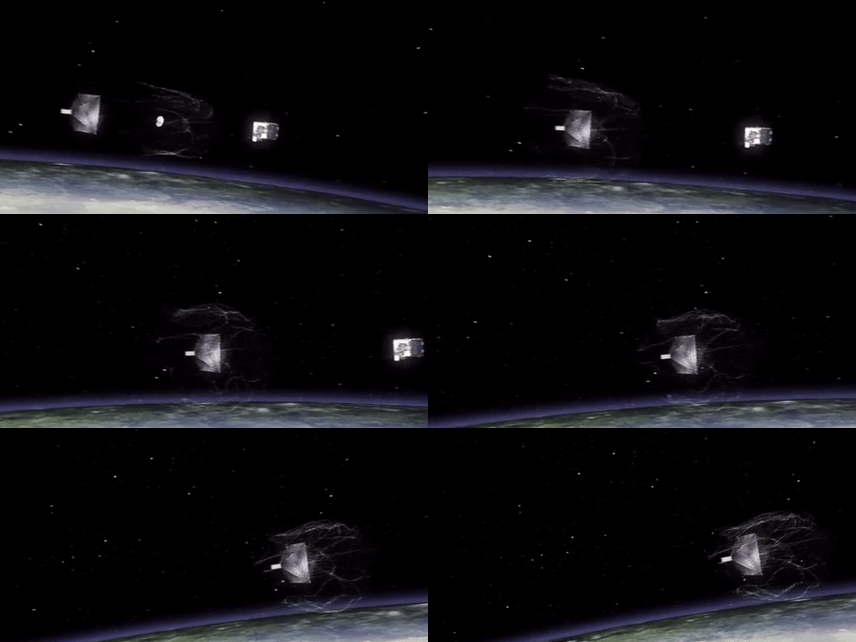
The most famous proof-of-concept for these tools was the RemoveDEBRIS mission, a technology demonstration that made “space junk cleanup” sound a lot less theoretical. The mission, released from the International Space Station in 2018, tested multiple debris-removal technologies in orbit.
Its net demonstration captured a small target satellite, showing that a net could actually be deployed in space and used to snag a debris-like object. Later, the mission tested a tethered harpoon against a target mounted on a boom, and that demonstration also succeeded. Those moments mattered because they moved the conversation from “Would this work in principle?” to “All right, now let’s discuss where this is practical, where it is risky, and how much it costs.”
That shift is important. In space engineering, a successful demo is not the same thing as a commercial solution. It means the physics checks out, the mechanism survives, the software behaves, and the idea deserves a seat at the grown-ups’ table. RemoveDEBRIS gave harpoons and nets that seat.
Why Cleaning Up Space Junk Is Harder Than It Sounds
Tumbling Targets Are a Nightmare
One of the biggest technical challenges in orbital debris removal is that many objects are unprepared and uncontrolled. They were not built to be serviced. They may be spinning. Their mass properties may be uncertain. Their surfaces may be delicate. Their exact motion may change as sunlight, thermal shifts, and residual energy interact with the body. Approaching such a target is less like docking with a spacecraft and more like trying to hug a shopping cart thrown into a tornado, except the shopping cart is moving at orbital speed and your insurance policy is made of PowerPoint slides.
You Need to Avoid Making More Debris
The cruel joke of debris cleanup is that a sloppy cleanup attempt can create new debris. Any capture technique has to minimize the chance of fragmentation, unintended contact, tether snags, or fuel-system mistakes. That is why many modern missions invest heavily in sensors, autonomous guidance, relative navigation, fault management, and careful staging. The actual grab may take seconds. The safe setup for the grab can take months of simulation.
Law, Ownership, and Politics Matter Too
Here is the part that keeps policy specialists awake: debris is often still legally owned by whoever launched it, even when it is dead, drifting, and behaving like orbital litter. You cannot just send up a cleanup truck and start collecting other countries’ old rocket stages like aluminum cans on a Saturday morning. Add in the fact that any spacecraft capable of rendezvous, capture, and relocation could also be interpreted as a dual-use technology, and you get a political problem wrapped in an engineering problem wearing a legal problem as a hat.
The Economics Are Still Tricky
Space junk cleanup has a classic market problem. The benefits are widely shared, but the costs are concentrated. One company paying to remove a dangerous object helps everyone using that orbital region. That means governments, regulators, insurers, and satellite operators all have a stake in creating incentives for cleanup. Without those incentives, active debris removal can remain a very impressive service that everyone praises and nobody wants to pay for first.
What the Industry Is Learning From Harpoons and Nets
The net and harpoon tests proved something valuable: non-cooperative capture in space is possible. But they also helped clarify where these methods fit in the toolbox. Nets may be useful for certain shapes and conditions. Harpoons may work for robust targets where tethered attachment makes sense. Yet many newer efforts in debris removal and end-of-life servicing are leaning toward robotic arms, magnetic interfaces, cooperative docking aids, and design-for-removal features.
That trend is not a rejection of harpoons and nets. It is a sign of maturity. Once engineers see what works, they start optimizing for repeatability, safety, regulation, and business models. A dramatic capture video is great for headlines. A removal method that can be licensed, insured, scaled, and standardized is what turns headlines into infrastructure.
This is also where prevention loops back into the story. Regulators have tightened expectations for post-mission disposal. In the United States, the FCC’s five-year disposal requirement for many low Earth orbit systems has added pressure for operators to clean up their own spacecraft sooner. Meanwhile, mission designers are increasingly thinking about demisable materials, passive safety measures, deorbit systems, and service-friendly interfaces before launch. That is the real plot twist: the best way to clean up future space junk is to stop building tomorrow’s debris the lazy way today.
Can Harpoons and Nets Actually Solve the Space Junk Problem?
Not by themselves. But they absolutely matter.
If the orbital debris crisis were a household mess, harpoons and nets would be specialized tools for the garage and backyard, not the entire cleaning plan. You still need house rules, storage bins, a schedule, and someone to stop leaving socks on the stairs. In orbit, that translates to debris tracking, mitigation standards, disposal rules, active removal, and spacecraft designed for retirement instead of permanent haunting.
The most effective long-term strategy is a layered one:
First, stop adding avoidable junk. Second, remove the biggest dangerous derelicts that are most likely to create future fragment clouds. Third, improve situational awareness so operators know what is up there and can maneuver when needed. Fourth, build satellites that can be serviced, deorbited, or captured more gracefully at end of life. In that system, harpoons and nets are not gimmicks. They are practical answers to a very specific question: how do you grab something in orbit that never wanted to be grabbed?
And that question is going to matter for a long time. Low Earth orbit is becoming more crowded, more commercial, and more valuable. If space is going to remain useful, debris removal must evolve from experiment to routine service. The future may end up favoring robotic arms, magnetic systems, or techniques not yet dominant. But harpoons and nets helped prove the bigger point: we are not powerless against orbital trash. We just need the will, the rules, and the budget to stop pretending the sky cleans itself.
Real-World Lessons and Experiences From the Push to Clean Up Space Junk
One of the most useful ways to understand how to clean up space junk with harpoons and nets is to look at the practical experience engineers and mission planners have already gained. The first lesson is that orbital cleanup is not a single heroic action. It is a chain of careful decisions. By the time a net opens or a harpoon fires, teams have already spent years testing capture dynamics, modeling target motion, studying material strength, building navigation systems, and figuring out how not to create the very debris they are trying to remove. The emotional version of debris cleanup is “Go get it.” The operational version is “Check the lighting angle, verify the relative velocity, confirm the tether behavior, review the fault tree, and please do not accidentally invent a new debris field.”
RemoveDEBRIS offered one of the clearest examples. The mission’s net test showed that capture could work, but it also highlighted how much discipline surrounds even a short maneuver. Engineers were not just proving that a net could leave a spacecraft. They were proving that it could deploy predictably, reach the target, wrap it without unpredictable rebound, and avoid interfering with the rest of the mission. The harpoon test taught a similar lesson. Yes, the harpoon hit the target. But just as important was the fact that it remained tethered and managed in a way that did not generate extra junk. That is the kind of experience that shapes the next generation of systems.
Another lesson from real missions is that the field has become more conservative in a good way. Early concepts often sounded bold, almost swashbuckling. Recent efforts sound more like precision logistics. Companies and agencies now talk more about inspection, rendezvous, detumbling, controlled deorbit, and cooperative interfaces. That shift reflects experience. Once engineers get close to an uncontrolled object in orbit, the romance fades and the mathematics takes over. A dead rocket stage is not just debris. It is a moving target with unknown behavior, historical design quirks, and the ability to ruin everyone’s week if approached carelessly.
There is also a policy experience emerging. Regulators and operators have learned that cleanup cannot rely only on future removal missions. It has to be baked into the life cycle of every spacecraft. That means better disposal planning, more transparent debris mitigation filings, and designs that make end-of-life handling easier. In simple terms, the industry is slowly learning that space sustainability begins at the drafting table, not when a satellite dies.
Finally, there is a cultural lesson. For years, space debris was treated like a problem for specialists to worry about in technical workshops. That is changing. Today, debris is a business issue, an insurance issue, a national policy issue, and an environmental stewardship issue. The experience of the last decade has taught the industry that the orbital environment is not an abstract frontier with infinite room. It is infrastructure. And infrastructure needs maintenance. Harpoons and nets may not be the final answer, but the experience gained from testing them has done something vital: it has made orbital cleanup feel less like science fiction and more like a job humanity is finally ready to take seriously.
Conclusion
Cleaning up space junk with harpoons and nets is one of those rare ideas that sounds like a joke until the engineering papers, flight demos, and policy debates pile up on your desk. The technologies are real. The need is real. And the bigger message is even more important: the future of space depends on treating orbit less like a limitless void and more like a shared environment that requires upkeep. Harpoons and nets helped prove we can capture debris. The next challenge is proving that humanity is organized enough to do it at the scale the problem demands.