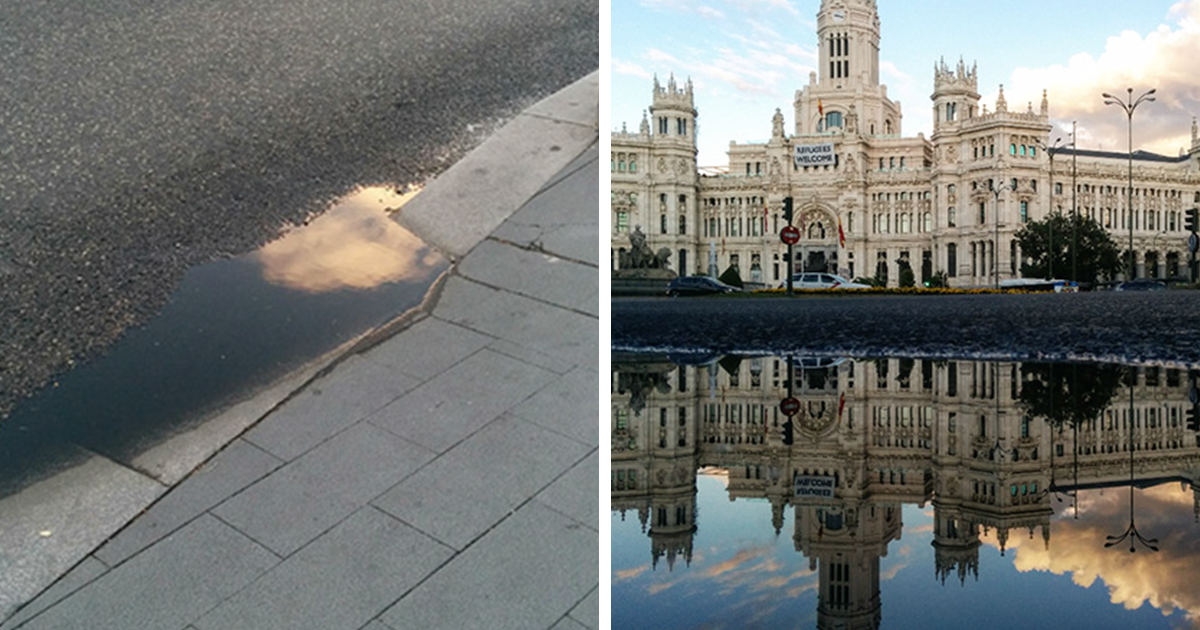
A puddle is usually treated as one of life’s minor inconveniences: something to jump over, walk around, or discover too late when you’re wearing socks that had optimistic plans for the day. But point a smartphone camera toward that same patch of rainwater from the right angle, and the puddle stops being a nuisance. Suddenly, it becomes a doorway.
Buildings appear to sink beneath the pavement. Cathedrals float upside down. Streetlights stretch into pools of color. Clouds seem trapped below your shoes. An ordinary sidewalk can look as though somebody secretly installed a second city underneath it and forgot to mention this in the urban planning documents.
That visual trick sits at the heart of puddle reflection photography, a form of smartphone photography that proves interesting images depend far more on observation, timing, light, and perspective than on carrying expensive equipment. Photographer Guido Gutierrez Ruiz helped popularize this idea with a series of smartphone photographs showing Madrid and Seville reflected in everyday puddles, including recognizable landmarks such as the Royal Palace of Spain, the Palace of Cibeles, the Royal Opera, and Almudena Cathedral. His project turned temporary patches of rainwater into miniature parallel worlds.
The beauty of the idea is its simplicity. You do not need a lake, a studio, or a suitcase full of lenses. You need rain, a phone, a willingness to crouch in public, and enough confidence to ignore the person wondering why you appear to be having an intense conversation with a storm drain.
Why Puddles Create Such Powerful Photographs
Reflection photography works because water can reorganize an otherwise familiar scene. A building that people pass every morning becomes strange when it appears upside down beneath the street. A tree becomes an abstract painting when wind moves across the surface. A person walking through the frame suddenly exists twice: once in the real world and once in the temporary version beneath it.
Still water produces the clearest mirror effect, while moving water stretches and distorts reflected shapes. Nikon’s photography guidance specifically notes that motion in a pool or puddle can make reflected subjects appear wavy and diluted, turning recognizable scenes into more abstract compositions. Canon similarly encourages photographers to experiment with both complete reflections and images containing only the reflected scene.
That gives puddle photography two personalities. On a calm day, the goal might be symmetry. After a breeze, a passing car, or one enthusiastic pigeon, the same puddle can become impressionistic art.
A Tiny Surface Can Suggest a Huge World
A puddle may be only a few feet wide, yet your camera does not care about its physical size. What matters is the angle between the lens, the water, and the reflected subject.
Lowering the camera dramatically changes what appears inside the reflection. B&H’s photography guidance points out that positioning a camera close to a reflective surface can produce a mirror-like view, while moving higher creates an entirely different composition. Adobe likewise recommends experimenting with very low viewpoints around puddles, even if getting the photograph requires an undignified squat next to a storm drain. Photography, apparently, occasionally demands both artistic vision and flexible knees.
The Smartphone Is Surprisingly Perfect for Puddle Photography
A large professional camera can obviously produce superb images, but a smartphone offers one enormous advantage: it is already with you.
Puddles are temporary. Reflections change minute by minute as clouds move, pedestrians arrive, wind starts, traffic passes, or the water simply disappears. Smartphone photography lets you react immediately rather than schedule an expedition involving a backpack that looks capable of supporting a small documentary crew.
Professional photographers interviewed by TIME and WIRED have emphasized that strong phone photography often begins with basic practices rather than specialized equipment: cleaning the lens, watching natural light, controlling focus and exposure, composing carefully, and keeping the camera steady.
Start With the World’s Least Exciting Photography Tip
Clean your lens.
Yes, that is disappointingly practical advice for an article about secret parallel universes.
Your phone lives in pockets, bags, hands, and places best left undocumented. Fingerprints and grease can soften highlights and create haze, which becomes particularly noticeable when photographing bright skies, lamps, and reflected architecture. Google specifically recommends gently cleaning a phone camera lens with a soft, clean cloth when photographs look blurry or hazy.
Ten seconds of cleaning can sometimes improve an image more than ten minutes of editing.
How to Photograph Dramatic Puddle Reflections
1. Get the Smartphone Almost to Water Level
The single biggest improvement usually comes from changing your perspective.
Instead of standing upright and pointing downward, lower the phone until the camera lens is only slightly above the puddle. The reflection expands dramatically from this position because the phone sees across the water rather than simply looking into it.
You may discover that a puddle you considered disappointingly tiny suddenly contains an entire building.
Experiment with positioning the phone at the edge rather than directly above the water. Move slowly left and right. A few inches can determine whether your reflection contains a magnificent tower or an extremely artistic view of a recycling bin.
2. Look for Strong Architectural Subjects
Architecture works particularly well because buildings provide recognizable lines, shapes, towers, windows, arches, and repeating patterns.
The original puddle series associated with Guido Gutierrez Ruiz demonstrates this beautifully through Spanish landmarks. Grand architecture is reduced to the size of rainwater yet somehow feels even more dramatic because viewers immediately recognize that something about the perspective is impossible.
You do not need a royal palace, though. Parking garages, apartment buildings, neon signs, bridges, trees, utility poles, storefronts, and even ordinary houses can become excellent reflected subjects.
3. Decide Whether You Want Symmetry or Mystery
The most obvious composition places the real subject above the puddle and its reflection below it, creating visual symmetry.
But that is only one option.
Try excluding the real object completely and photographing only its reflection. Without visual context, viewers may need a moment to understand what they are seeing. That tiny delay creates intrigue.
You can also rotate the finished picture 180 degrees so the reflection appears upright and the real world looks inverted. B&H highlights image flipping as a playful way to make reflection photographs more mysterious and encourage viewers to inspect them longer.
4. Control Exposure for the Reflection
A reflected sky can be much brighter than the surrounding pavement. If your phone exposes primarily for the dark ground, clouds and architectural highlights inside the puddle may lose detail.
Modern smartphones allow surprisingly useful exposure control. On an iPhone, for example, Apple allows photographers to tap the desired focus point, manually adjust brightness, and lock focus and exposure when needed.
Try tapping the reflected building or bright sky, then slightly reduce exposure. Dark pavement around a bright reflection often creates a dramatic natural frame.
Do not automatically brighten every shadow. Darkness can be part of the composition.
5. Use Grid Lines, but Don’t Become Their Employee
Camera grids are helpful for keeping buildings straight and arranging major elements according to the rule of thirds. Apple includes grid and level tools for composition, while smartphone photography guidance from TIME also recommends grid overlays as a practical framing aid.
However, composition rules should guide your eye rather than imprison it.
Perfect central symmetry can be wonderful for reflections. So can intentionally placing a reflected tower in one corner. Sometimes an awkward-looking composition has exactly the tension that makes an image memorable.
6. Wait for People to Enter the Frame
Architecture gives the photograph structure. People give it scale and life.
Once you find a good reflection, do not immediately leave. Wait.
A cyclist may cross the background. Someone with an umbrella may walk past. A child might jump over the puddle. A dog might investigate your composition and contribute creatively in ways you did not authorize.
A fast capture can freeze a pedestrian inside a reflection even when there are slight ripples in the water; Adobe notes that faster shutter speeds are useful when photographing moving subjects reflected in puddles or windows.
Weather Can Completely Change the Image
The obvious time to photograph puddles is after rain, but the quality of light matters almost as much as the existence of water.
Overcast Skies
Cloudy weather creates softer illumination and fewer harsh shadows. Buildings, people, and reflective surfaces can therefore maintain detail across more of the image. Canon’s photography education material notes that cloudy conditions can naturally soften daylight, while B&H describes overcast skies as useful for producing even illumination around reflective water scenes.
Golden Hour
Shortly after sunrise and before sunset, low-angle light can transform a muddy puddle into liquid gold. Warm buildings reflected against colorful skies often produce much more atmosphere than the same scene at noon.
Blue Hour and Night
After sunset, wet streets become excellent collectors of artificial color.
Traffic lights produce streaks of red and green. Storefront signs become floating patches of color. Streetlights double themselves. Adobe specifically recommends using wet pavement and puddles to photograph reflected streetlights, traffic lights, clouds, and sunsets after rainfall.
In low light, stabilize the phone against a wall, curb, tiny tripod, or other solid surface. Night photography modes can also help when the scene is stationary, although moving people may become blurred.
Use Ripples Instead of Fighting Them
Beginners often wait for water to become perfectly still because they want flawless reflections.
Try the opposite.
Drop a leaf into the water. Photograph raindrops hitting the surface. Wait for footsteps to create rings. Capture the moment a wheel passes beside the puddle.
Adobe’s reflection photography guidance encourages photographers to intentionally disrupt reflective water because the broken image can create an entirely different visual result.
A perfect reflection says, “Look at this beautiful mirror.”
A shattered reflection says, “Something just happened.”
The second version often has more story.
Editing Smartphone Puddle Photos Without Destroying Them
Editing should strengthen what happened in front of the camera rather than make the photograph look as though the saturation slider escaped supervision.
Start with exposure. Reflected clouds often contain bright highlights, so reducing highlights may recover useful detail. Lifting shadows slightly can reveal pavement texture, while moderate contrast can separate the dark street from the brighter world inside the water. Lightroom Mobile provides dedicated controls for exposure, contrast, highlights, shadows, whites, and blacks for precisely this type of tonal adjustment.
Next, check perspective. Architectural reflections often work better when strong vertical lines feel intentional. Straightening the image by one or two degrees can make an enormous difference.
Finally, examine color carefully. Wet streets naturally intensify color and contrast. You may need less saturation than you expect.
A useful editing sequence is:
- Crop and straighten the photograph.
- Correct overall exposure.
- Reduce overly bright highlights.
- Open shadows only when necessary.
- Add modest contrast or clarity.
- Adjust color temperature for mood.
- Use sharpening conservatively.
- Stop editing before reality requires legal representation.
Why These Images Feel Like Parallel Worlds
The phrase hidden parallel worlds works because reflection photography changes the relationship between ordinary objects.
Your brain knows a cathedral belongs above the pavement, not beneath it. It knows clouds should be overhead, not under someone’s shoes. When photography reverses those expectations while remaining visibly connected to reality, the result feels dreamlike without requiring elaborate manipulation.
Real examples show how effective even tiny reflections can be. Smithsonian’s photo contest has featured a mountain reflected inside a small puddle in California, photographed with an iPhone 5sanother reminder that the physical size of the reflective surface is far less important than viewpoint and composition.
This is also why reflection photography can refresh familiar places. You do not necessarily need to travel somewhere new. You need to see somewhere familiar differently.
Common Mistakes That Make Puddle Photos Less Interesting
Shooting From Normal Standing Height
This usually makes the puddle look small and places too much boring pavement around it. Lower the phone.
Using Digital Zoom
Walk closer whenever possible. Digital zoom generally crops and enlarges the existing image rather than creating genuine optical detail, which can reduce image quality. TIME recommends avoiding digital zoom when better positioning or an optical camera option is available.
Ignoring the Background
A reflection may be excellent while the upper half of the frame contains parked vehicles, signs, trash cans, random strangers, and one badly positioned lamp growing directly from somebody’s head.
Inspect every corner before pressing the shutter.
Taking Only One Photograph
Puddle reflections change dramatically when you move only a few inches. Shoot horizontal and vertical versions. Lower the phone. Raise it slightly. Step left. Step right. Try perfect symmetry. Then deliberately break the symmetry.
The first composition may be good. The seventh may be the one that feels magical.
The Bigger Lesson: Interesting Photography Begins With Attention
The most inspiring thing about photographing puddles is not that smartphones have become technically sophisticated, although they certainly have.
It is that the project rewards attention.
A puddle is available to almost everyone and interesting to almost no oneuntil somebody looks more carefully.
WIRED’s smartphone photography guidance makes a similar broader point: powerful mobile images come from concentrating on the moment, subject, story, focus, exposure, and available light rather than obsessing over equipment.
That philosophy perfectly suits puddle photography. The camera is merely the recording device. The important step happens before you touch the shutter: noticing that something ordinary might contain another picture entirely.
Field Experience: What a Rainy Walk Teaches You About Puddle Photography
A useful way to understand this style is to imagine a typical photography walk immediately after a rainstorm.
At first, nothing looks particularly promising. The sidewalks are gray. Cars are wet. Pedestrians are moving quickly because apparently they have better plans than photographing drainage infrastructure.
Then you start looking down.
The first puddle reflects almost nothing except a cloudy sky. You photograph it anyway and learn lesson number one: water alone is not enough. A successful reflection needs something visually interesting positioned at the correct angle.
Twenty yards later, another puddle appears beside an office building. From standing height, the composition is terrible. You can see approximately eight percent building and ninety-two percent depressing asphalt.
You lower the phone.
Everything changes.
The glass facade fills the water. Windows create geometric patterns. A patch of blue sky appears between clouds. The pavement forms a dark border around the reflection, almost like a natural picture frame.
You take one photograph.
Then you move slightly to the right and discover that the reflected building lines up with a streetlamp. Move left and a tree appears. Lower the phone another inch and suddenly the entire top of the building fits inside water that looked barely large enough to inconvenience a sneaker.
This is when puddle photography becomes addictive. You stop searching for large puddles and start searching for useful angles.
Soon you notice that the best photograph often requires waiting.
You find a reflection of a downtown building and compose it carefully, but the picture feels empty. Instead of leaving, you hold the phone in position.
Ten seconds pass.
A pedestrian enters.
Not right.
Another passes.
Still not right.
Then someone carrying a bright umbrella crosses exactly where the reflected building creates an open patch of sky. You press the shutter several times. The human silhouette gives scale to the architecture while the umbrella provides one small point of color.
The resulting photograph feels intentional even though most of its ingredients were accidental.
Later, wind begins moving across the puddles. At first this seems disappointing because the sharp reflections disappear. Then the second lesson arrives: a distorted reflection can be more interesting than a perfect one.
Windows stretch into wavy stripes. Trees dissolve into green brushstrokes. A traffic signal becomes a red ribbon floating through black pavement. The photograph no longer resembles a mirror. It resembles a painting.
By evening, another transformation occurs.
The puddles that seemed gray during daylight begin collecting artificial light. Store signs glow in the water. Headlights sweep through the frame. Orange streetlamps form bright islands surrounded by darkness.
You realize that you have walked through the same neighborhood for hours without technically photographing the neighborhood itself. You have photographed its duplicate: fragmented, upside down, temporary, and visible only because it happened to rain.
That may be the most rewarding experience behind smartphone puddle photography. It changes your behavior even after the camera goes back into your pocket.
You start noticing polished floors, car windows, wet streets, glass walls, mirrors, rivers, metal surfaces, and tiny pools of water differently. Instead of asking, “What am I looking at?” you begin asking, “What else is this showing me?”
And once that habit develops, the parallel worlds are suddenly everywhere.
Conclusion
Hidden Parallel Worlds Of Everyday Puddles Captured With My Smartphone is more than a clever photography concept. It is an example of what happens when an ordinary environment is examined from an unusual perspective.
Rainwater becomes a mirror. Architecture becomes abstract. Streets become galleries. Familiar landmarks appear to exist beneath the ground. A smartphone becomes enough of a camera because the most important equipment is not a larger sensor or another lensit is the photographer’s ability to notice possibilities that everyone else walks past.
The next time rain leaves puddles across your neighborhood, resist the instinct to see only wet shoes and inconvenient sidewalks. Clean your phone lens, switch on the camera, get close to the ground, explore several angles, control the exposure, and wait for the right moment.
You may discover that the city above you is only half the picture.
SEO Metadata
Note: This publication-ready article was independently rewritten and expanded from research across multiple reputable photography, imaging, technology, and camera-education sources. The wording, organization, examples, commentary, and practical guidance are original rather than copied from any individual source.