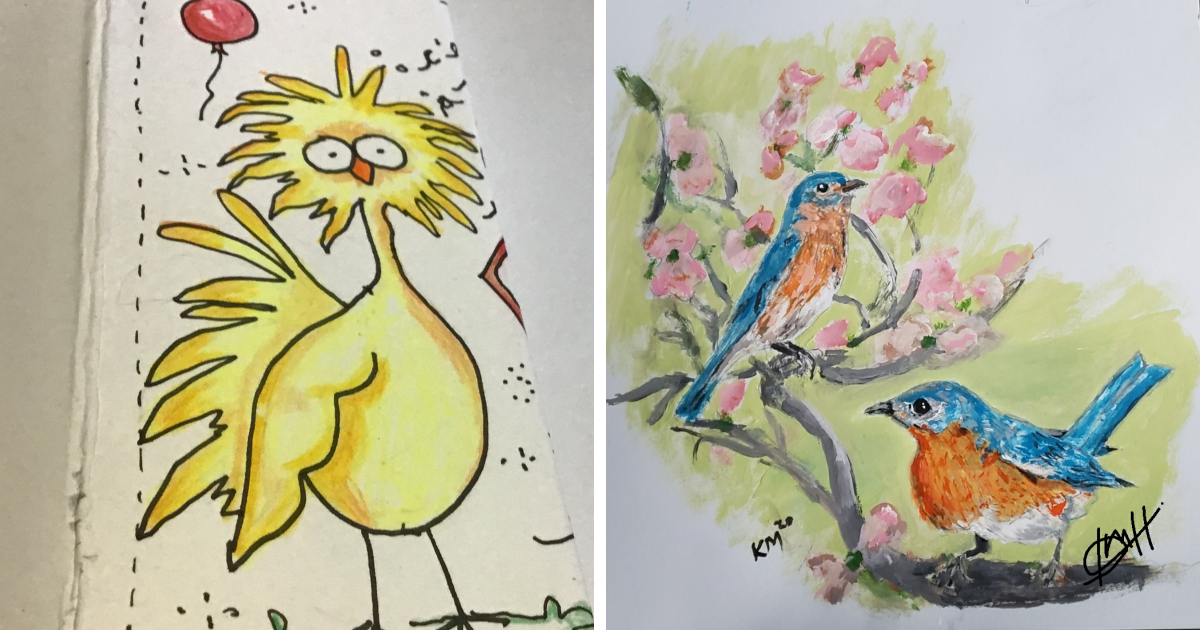
There are internet challenges that ask you to run faster, cook something outrageous, or organize your closet until it looks like a catalog had a nervous breakdown. Then there are challenges that feel kinder, quieter, and much more feathered: “Hey Pandas, post your best drawing of a bird.” It sounds simple, but that is exactly why it works. A bird drawing can be a polished watercolor eagle, a goofy pigeon with suspicious eyebrows, a five-minute sparrow sketch from a park bench, or a tiny cartoon duck that looks like it knows your secrets.
Birds have always been irresistible to artists because they combine two things humans love: beauty and drama. A bird can be delicate enough to fit on a branch, loud enough to wake a neighborhood, and aerodynamic enough to make engineers feel personally challenged. For anyone joining a bird drawing challenge, the goal is not to produce a museum masterpiece on the first try. The goal is to look closely, enjoy the process, and share something that says, “I saw this little winged creature, and my pencil attempted diplomacy.”
Online art prompts like this also turn drawing into a community activity. Bored Panda-style “Hey Pandas” posts invite people to share their own work, react warmly, and celebrate effort instead of perfection. That matters. A drawing challenge becomes more than a gallery; it becomes a friendly digital birdhouse where artists of all skill levels can perch for a while.
Why Bird Drawings Are Perfect for an Online Art Challenge
A bird is one of the best subjects for artists because it can be simplified or studied in serious detail. Beginners can start with a round body, a small head, a beak, two legs, and a tail. More advanced artists can focus on feather groups, wing structure, field marks, posture, texture, lighting, and movement. That range makes bird art unusually welcoming. Nobody has to arrive with professional credentials, a studio lamp, and a mysterious black turtleneck.
Birds also come with endless personality. A crow can look like a tiny judge in a feathered robe. A hummingbird feels like a flying jewel with a caffeine problem. A puffin looks as if someone designed a seabird and then added clown shoes to the face. From realistic bird illustration to funny bird doodles, the subject naturally supports many styles.
Birds Help Artists Practice Observation
One of the biggest lessons from bird sketching is that drawing is not only about the hand. It is about the eye. Cornell Lab’s bird resources emphasize anatomy, feather structure, and field marks, while Audubon’s sketching advice often connects drawing with deeper observation. When an artist tries to draw a bird, they suddenly notice things they may have ignored before: how the beak connects to the skull, how the legs bend, how the tail balances the body, and how feather patterns wrap around form.
That is the sneaky magic of a bird drawing challenge. You join because the prompt sounds fun. You leave knowing that a sparrow is not just “small brown bird.” It is a compact miracle wearing stripes, spots, subtle color shifts, and the facial expression of someone late for a meeting.
How to Start Your Best Drawing of a Bird
The best way to begin is not with feathers. That may sound illegal in bird court, but it is true. Feathers are details. The structure comes first. Start with simple shapes: an oval for the body, a smaller circle or rounded block for the head, a line for the posture, and a wedge for the beak. This approach is common in bird art instruction because it helps artists avoid getting trapped in tiny details too early.
Once the basic body is in place, look at the bird’s pose. Is it upright like a robin on alert? Horizontal like a duck cruising across a pond? Compressed and round like a sleepy owl? The posture gives the drawing life. A bird with accurate feathers but no gesture can look stiff. A bird with a strong gesture can look alive even if the feet are basically two confused noodles.
Step 1: Choose a Bird With a Clear Silhouette
For a community art prompt, pick a bird that has a recognizable shape. Cardinals, owls, ducks, hummingbirds, herons, parrots, penguins, and eagles are excellent choices because people can identify them quickly. A strong silhouette also makes the drawing easier to read online, especially when viewers are scrolling on a phone.
Step 2: Block In the Big Shapes
Before drawing individual feathers, map the large forms. A bird’s body is not a single smooth potato, although some pigeons try very hard to prove otherwise. There is the chest, belly, back, folded wing, head, beak, legs, and tail. Light construction lines help you place these parts before committing to darker outlines.
Step 3: Add Field Marks and Personality
Field marks are the stripes, patches, colors, and patterns that help identify birds. For artists, they are also visual storytelling tools. A chickadee’s dark cap, a red-winged blackbird’s shoulder patch, or a mallard’s green head can make a drawing instantly recognizable. Add the most important markings first, then decide how much detail your style needs.
Step 4: Suggest Feathers Instead of Drawing Every Feather
Here is a public service announcement for your wrist: you do not need to draw every feather. In fact, trying to draw every feather can make a bird look busy and flat. Better bird drawings often suggest feather groups with a few confident lines, value changes, and edges. Wing feathers, tail feathers, and facial markings deserve attention, but the viewer’s brain can fill in more than you think.
Realistic Bird Drawing vs. Cartoon Bird Drawing
The phrase “best drawing of a bird” does not have to mean “most realistic.” A realistic hawk with carefully rendered talons can be stunning, but so can a cartoon pigeon holding a tiny coffee cup. The best drawing is the one that understands its goal. Are you trying to capture accuracy, humor, mood, motion, cuteness, elegance, or chaos? Birds generously offer all of the above.
Realistic bird art benefits from references, careful anatomy, and patient layering. Artists often study photographs, field guides, and live observations to understand proportions and feather patterns. Cartoon bird art, on the other hand, depends on exaggeration. Big eyes, tiny legs, dramatic eyebrows, and expressive wings can turn a bird into a character. Neither style is “better.” They simply speak different dialects of the same feathered language.
When Realism Works Best
Realism is ideal when the species itself is the star. A bald eagle, sandhill crane, barn owl, or blue jay has enough natural drama to carry a detailed piece. Realistic work also suits conservation themes because it can highlight the beauty and individuality of species that people may overlook.
When Humor Works Best
Humor works beautifully with familiar birds: pigeons, gulls, ducks, chickens, parrots, and crows. These birds already have public reputations. Gulls steal fries. Pigeons walk like retired detectives. Parrots act like they have read your diary. A funny bird drawing can lean into those traits and become instantly shareable.
What Makes a Bird Drawing Stand Out Online?
Online audiences respond quickly to clarity, emotion, and originality. A bird drawing does not need to be technically flawless to be memorable. It needs one strong idea. Maybe the colors are luminous. Maybe the posture is funny. Maybe the background adds a story. Maybe the bird is drawn with only ten lines, but every line knows where it is going.
Good presentation also matters. Photograph or scan your drawing in bright, even light. Crop out clutter. Avoid heavy filters that blur the pencil work. If your drawing is digital, export it clearly. If it is traditional, a simple white or neutral background helps the artwork stand out. The internet is a busy forest; give your bird a clean branch.
Write a Caption That Adds Charm
A caption can make the post more engaging. Instead of simply writing “bird drawing,” try something more specific: “My dramatic owl, judging everyone from a branch,” or “A cardinal I sketched after seeing one outside my kitchen window.” Captions create connection. They tell viewers why the bird mattered to you.
Bird Art Can Build a Deeper Connection With Nature
Bird drawing is not only an art exercise. It can also become a doorway into birdwatching, nature journaling, and conservation awareness. When people sketch birds, they often begin noticing local species more carefully. The ordinary backyard becomes more interesting. A walk through the park turns into a slow treasure hunt. Even a parking lot pigeon starts to look less ordinary when you notice the iridescent color around its neck.
This is where art and science quietly shake hands. Birders use field notes, photos, recordings, and observations to document what they see. Artists use sketches, color studies, and gestures to record the same living details in a different language. Both practices reward attention. Both ask you to slow down. Both make birds harder to ignore.
There is also a conservation angle. Birds depend on healthy habitats, and many conservation programs use art to help students and communities care about wetlands, migration, and biodiversity. A drawing may not save a habitat by itself, but it can make someone pause long enough to care. Caring is often where action begins.
Creative Bird Drawing Ideas for the “Hey Pandas” Challenge
If you want to join the challenge but do not know what to draw, start with a theme. A theme gives your creativity a perch. Here are a few ideas that work well for beginners and experienced artists alike.
1. The Neighborhood Bird Portrait
Draw a bird you actually see near your home: a robin, crow, sparrow, pigeon, dove, starling, blue jay, or cardinal. Local birds make great subjects because you can observe their posture, habits, and attitude. Bonus points if the bird has personally yelled at you from a fence.
2. The Fancy Bird Fashion Show
Turn a bird into a fashion icon. Give a heron a scarf, a peacock a dramatic stage pose, or a penguin a tiny formal bow tie. This works especially well for cartoon and semi-realistic styles.
3. The One-Minute Gesture Bird
Set a timer for one minute and sketch the bird’s movement, not the details. Fast gesture drawing helps artists capture life and posture. The result may look messy, but it often feels energetic.
4. The Scientific Sketchbook Page
Create a nature-journal style page with labels: beak, wing, tail, eye stripe, feet, and feather groups. Add notes about color, behavior, or habitat. It looks smart, and you get to feel like a field scientist with better stationery.
5. The “Tiny Bird, Big Mood” Drawing
Draw a small bird with an enormous emotion: furious wren, suspicious finch, exhausted hummingbird, proud chickadee, or dramatic duckling. This idea is perfect for social media because emotion reads instantly.
Common Mistakes When Drawing Birds
The first common mistake is making the head too large or too small for the body. Bird proportions vary widely, so compare carefully. Owls have large-looking heads because of facial disks and fluffy feathers. Ducks have long bodies and flatter profiles. Hummingbirds have tiny bodies with long beaks and wings that change shape in motion.
The second mistake is placing the legs incorrectly. Bird legs often attach farther forward or farther back than beginners expect, depending on the species. A heron, sparrow, duck, and eagle do not stand the same way. Feet also tell a story: perching feet grip, raptor talons clutch, and webbed feet paddle.
The third mistake is outlining every feather equally. Nature does not use a black marker around each feather, and neither must you. Use contrast selectively. Put sharper detail near the head and focal point, then simplify the body and wings where possible.
Why Sharing Imperfect Art Is Worth It
Many people hesitate to post their drawings because they think the work is not “good enough.” But community challenges are not final exams. They are invitations. The charm of a prompt like “Hey Pandas, post your best drawing of a bird” is that “best” can mean your most careful drawing, your funniest drawing, your newest drawing, or simply the drawing you are brave enough to share.
Posting imperfect art can also help other people feel welcome. When every shared piece looks polished, beginners may assume they do not belong. But when artists share sketches, experiments, and learning moments, the community becomes warmer. A wobbly bird can be a tiny ambassador for creative courage.
Experience: What Drawing Birds Teaches You After the First Few Attempts
The first time you sit down to draw a bird, you may feel confident. After all, you know what a bird looks like. It has wings, a beak, feathers, and the general energy of something that could leave the conversation whenever it wants. Then you put pencil to paper and discover that birds are surprisingly complicated. The head is not where you expected. The wing has sections. The feet look like ancient calligraphy. The feathers are not just decoration; they describe the whole form.
That first awkward sketch is part of the experience. In fact, it is probably the most important part. Drawing birds teaches you to separate “what I think I know” from “what I can actually see.” A sparrow is not a generic brown oval. It has a posture, a rhythm, a small tilt of the head, and field marks that make it different from another small brown bird. A duck is not just a floating loaf. It has a bill shape, chest curve, tail angle, and patterned feathers that change with light.
After a few attempts, you begin building habits. You start looking for the big shape before the details. You notice the line of action from beak to tail. You learn that the eye placement can make a bird look alive or accidentally haunted. You stop trying to draw every feather and start grouping them into larger patterns. This is the stage where bird drawing becomes less intimidating and more addictive. Suddenly, every bird outside becomes a possible model. Unfortunately, most birds did not sign a modeling contract and will fly away mid-sketch. Rude, but legal.
Drawing birds also changes how you experience ordinary places. A backyard, sidewalk, school field, or city park becomes full of subjects. You may notice pigeons turning their heads to judge distance, crows communicating with body language, or tiny birds hopping with mechanical precision. These observations make your drawings better, but they also make daily life richer. You are no longer just passing through the world. You are paying attention.
The social side matters too. Sharing a bird drawing online can feel scary, especially when other artists seem more skilled. But a good community challenge rewards honesty and personality. Someone may love your messy robin because it has charm. Someone else may ask how you made the wing texture. Another person may share their own first attempt, and suddenly the challenge feels less like competition and more like a group sketchbook passed around a table.
Perhaps the best experience is realizing that bird art has no single finish line. You can draw birds realistically for the rest of your life and still find new details to study. You can draw cartoon birds forever and never run out of expressions. You can sketch birds for calm, for practice, for humor, for science, or simply because a blue jay looked dramatic on a fence and demanded documentation. That is the joy of the prompt. Your best bird drawing is not only the one with the cleanest lines. It is the one that made you look closer, laugh a little, and keep drawing.
Conclusion
“Hey Pandas, Post Your Best Drawing Of A Bird” is more than a cute art prompt. It is an invitation to observe nature, practice creativity, and share a piece of your imagination with a friendly audience. Birds are ideal subjects because they can be elegant, ridiculous, colorful, mysterious, and deeply expressivesometimes all before breakfast. Whether you draw a realistic eagle, a nervous pigeon, a stylish parrot, or a tiny sparrow with heroic confidence, the real win is joining the creative conversation.
So grab a pencil, tablet, pen, brush, marker, or whatever tool does not immediately roll under the couch. Pick a bird. Study the shape. Add the attitude. Share the result. The internet has plenty of noise; a good bird drawing adds a little song.
Note: This article is written as original, publication-ready content based on real bird art, bird observation, and online community challenge concepts. It does not copy source wording and does not include unnecessary citation placeholders.