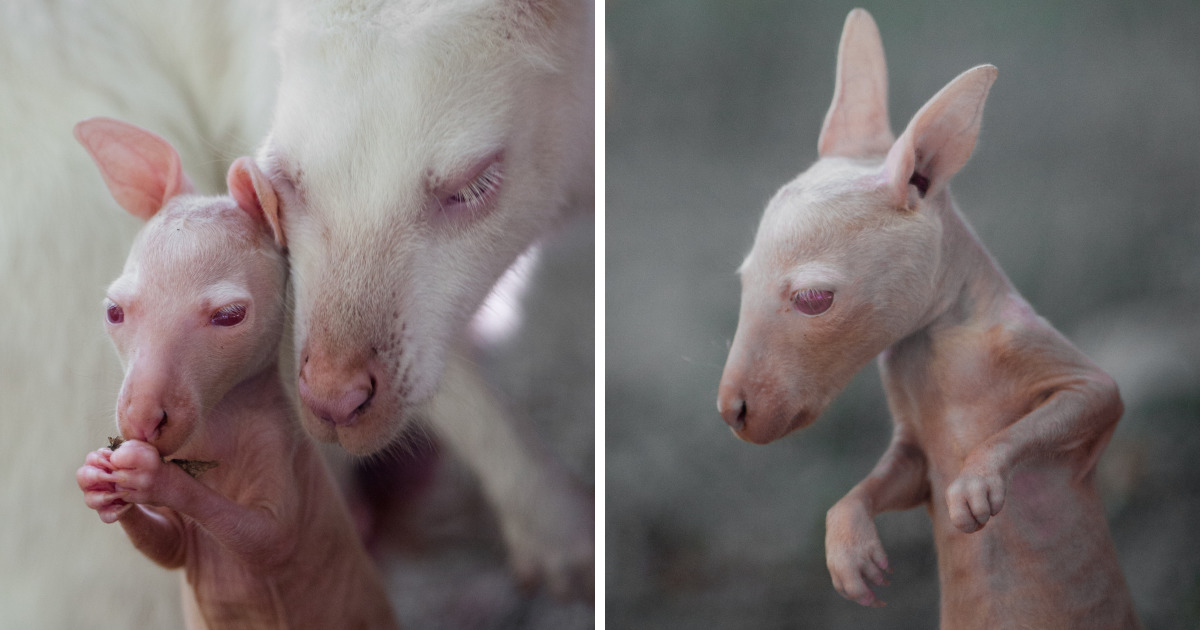
Some animals politely enter the internet. Others kick the door open with tiny paws, marshmallow-white fur, and the sort of face that makes grown adults say “awww” in a voice they normally reserve for puppies and unexpected tax refunds. A baby white kangaroo belongs firmly in the second category.
For anyone who has never seen one, picture a joey peeking from a pouch like a curious snowball with ears. It is part wildlife wonder, part living plush toy, and part gentle reminder that nature still has a few surprise cards tucked behind its back. White kangaroos and white wallabies are rare, beautiful, and often misunderstood. Some are true albinos, meaning their bodies produce little or no melanin. Others are leucistic, which means they have reduced pigmentation but may still keep darker eyes, noses, or patches of normal color.
Either way, a baby white kangaroo is more than a cute photo opportunity. It is a chance to learn about marsupials, genetics, animal care, conservation, and the strange little miracle called a pouch. Yes, the pouch is doing a lot of work here. It is basically a nursery, cafeteria, blanket, security system, and private studio apartment rolled into one.
What Makes A Baby White Kangaroo So Special?
The main keyword here is “baby white kangaroo,” but the real story is bigger than one adorable joey. Kangaroos are marsupials, a group of mammals whose babies are born extremely underdeveloped. A newborn joey can be about an inch long, hairless, blind, and startlingly tiny. Instead of arriving ready to toddle around, it crawls through the mother’s fur into the pouch, attaches to a teat, and continues developing there for months.
That alone sounds like something nature wrote after drinking too much coffee. Now add a rare white coat. Most kangaroos and wallabies come in shades of gray, reddish brown, tan, or sandy beige, depending on the species. A white joey stands out instantly because its color does not match the usual camouflage of Australian grasslands, woodlands, or scrub habitats.
In a zoo or sanctuary setting, a white joey may safely become a beloved ambassador for its species. In the wild, however, that same bright coat can make life harder. A white animal is easier for predators to spot, may be more sensitive to sunlight, and, if truly albino, can have vision problems. Cuteness, as it turns out, does not automatically come with a survival warranty.
Albino Or Leucistic? The White Kangaroo Color Mystery
When people see a white kangaroo, the first word they usually use is “albino.” Sometimes that is correct. Sometimes it is not. The difference matters because albinism and leucism are not the same thing.
Albino Kangaroos
An albino kangaroo has a genetic condition that affects melanin production. Melanin is the pigment responsible for much of the color in skin, fur, and eyes. In true albinism, the animal often has white or cream-colored fur and pinkish or reddish eyes because blood vessels show through where pigment would normally mask them.
Albino animals can be stunning, but they may face extra challenges. Their eyes can be sensitive to light, their skin can be vulnerable to sun damage, and they may be more noticeable to predators. For a baby kangaroo, which already depends heavily on its mother, those challenges make the pouch even more important.
Leucistic Kangaroos
Leucism is different. A leucistic animal may appear pale, patchy white, or almost completely white, but the eyes usually keep normal pigmentation. That means a white kangaroo with dark eyes may not be albino at all. It may be leucistic, or it may have another unusual color variation.
So, the next time someone points at a white joey and says, “Look, an albino kangaroo!” you can gently adjust your imaginary wildlife professor glasses and say, “Possibly, but let’s check the eyes.” Then prepare to be invited to fewer casual picnics, but more trivia nights.
The Joey Journey: From Jellybean To Little Hopper
A baby kangaroo is called a joey, and the joey’s early life is one of the most fascinating stories in the mammal world. Kangaroos do not give birth to large, well-developed babies. Instead, after a short gestation period, the newborn joey makes an incredible climb into the pouch.
At birth, a joey is tiny, pink, and fragile. Its hind legs are not ready for hopping, but its forelimbs are developed enough to help it crawl. Once inside the pouch, it attaches to the mother’s teat and stays there while its body finishes the job of becoming recognizably kangaroo-like. Eyes open. Fur grows. Ears become more expressive. The nose starts investigating the world. Eventually, a little head appears at the pouch opening, and suddenly everyone nearby forgets how to speak in complete sentences.
For many kangaroo species, joeys spend several months in the pouch before taking short trips outside. At first, those trips are clumsy. Imagine a toddler trying roller skates on a trampoline. The joey sniffs, wobbles, hops badly, returns to the pouch, and repeats until confidence arrives. Even after leaving the pouch, young kangaroos may continue nursing and staying close to their mothers.
Why A White Joey Looks So Magical
Part of the magic is contrast. A normal-colored kangaroo blends naturally into dry grass, dusty soil, and woodland shadows. A white kangaroo does the opposite. It catches the eye immediately. A baby white kangaroo, especially one peeking from a pouch, looks almost fictional, like a character from a children’s book who has wandered into real life and is now wondering where the snacks are.
But the appeal is not only visual. People are drawn to rare animals because they interrupt routine. We have all seen kangaroo pictures. We know the big feet, the strong tail, the upright posture, and the famous hop. Then a white joey appears and suddenly the familiar becomes new again. It makes people pause, look closer, and ask questions.
That curiosity is valuable. A cute animal can become an entry point into deeper learning. Someone who clicks for the adorable baby white kangaroo may stay to learn about marsupial development, responsible wildlife care, genetic variation, and habitat protection. That is the secret power of animal stories: they sneak education into the room wearing fuzzy ears.
Are White Kangaroos Common?
No, white kangaroos are uncommon, and true albino kangaroos are considered rare. Exact odds vary by species and population, but white coloration in wild mammals is generally unusual. In kangaroos and wallabies, sightings are memorable because the animals normally rely on natural colors to blend into their environment.
Some places have become known for unusually pale or albino wallabies. Bruny Island in Tasmania, for example, is often associated with white wallabies. Zoos have also occasionally celebrated the arrival of albino wallaby joeys, which are close relatives of kangaroos and often get grouped into the same “adorable hopping pouch baby” category by excited visitors.
It is worth noting that not every viral “white kangaroo” photo is actually a kangaroo. Sometimes the animal is a wallaby, which is generally smaller. Kangaroos, wallabies, wallaroos, and quokkas all belong to the macropod family, a name that essentially means “big foot.” If you ever needed proof that scientists can be both precise and charmingly blunt, there it is.
Kangaroo, Wallaby, Or Wallaroo: What Are We Looking At?
The word “kangaroo” is often used loosely, especially online. A small white joey may be called a baby white kangaroo even when it is technically a wallaby. That does not mean people are trying to trick anyone. It simply means macropod identification can be tricky when the animal is young, pale, and busy being outrageously cute.
Generally speaking, kangaroos are larger, wallabies are smaller, and wallaroos fall somewhere in between. Red kangaroos are the largest marsupials in the world. Eastern gray and western gray kangaroos are also large and powerful. Wallabies tend to be more compact, with shorter legs relative to body size. But as babies, the differences can be subtle for casual viewers.
For SEO and reader clarity, “baby white kangaroo” is the phrase most people search. For accuracy, it is helpful to mention that many viral examples may involve wallabies or other macropods. The emotional response remains the same: tiny white hopper, big internet feelings.
Life In The Pouch: Nature’s Most Underrated Nursery
The pouch is one of the reasons baby kangaroos are so fascinating. It is not just a pocket. It is a living nursery with warmth, protection, and milk. The mother’s body supports the joey through different stages of development, and the joey’s entire survival depends on reaching and staying in that pouch early on.
Inside, the joey grows from a barely formed newborn into a furred, alert, increasingly curious youngster. It begins by staying attached to the teat. Later, it detaches, moves around, and eventually peeks out. Those first pouch peeks are the marsupial version of opening the front door, seeing the world, and immediately deciding whether it is too much today.
Mother kangaroos also clean their pouches. This is both practical and necessary because, yes, joeys do all the normal baby things in there. Nature is amazing, but it is not always tidy. The pouch may look like a cozy hammock from the outside, but behind the scenes, kangaroo motherhood involves serious maintenance work.
What A Baby White Kangaroo Eats
A very young joey survives entirely on milk. Kangaroo mothers can produce milk that changes as the joey develops. Even more impressively, some female kangaroos can support young at different stages at the same time. One joey may be inside the pouch, another outside but still nursing, and an embryo may be paused in development until conditions are right.
As the joey grows, it begins nibbling grasses, leaves, herbs, and shrubs. Adult kangaroos are herbivores, and grazing becomes a major part of their daily life. A young kangaroo’s first attempts at eating solid food may involve more sniffing and confusion than elegance, but eventually the diet shifts from milk to plants.
If the joey is white because of albinism, animal care teams may pay extra attention to sunlight exposure, skin health, and eyesight. In a managed setting, shade, veterinary care, and careful observation can help protect the youngster. In the wild, the mother’s behavior and the surrounding habitat become even more important.
Why People Fall In Love With Rare Animal Babies
There is a reason a baby white kangaroo can charm people across the world. Humans are wired to notice babies. Big eyes, small bodies, uncertain movements, and soft features pull at our attention. Add rarity, and the effect multiplies.
But there is also something refreshing about seeing an animal that looks so unexpected. A baby white kangaroo feels like a visual contradiction: wild but delicate, strange but familiar, rare but instantly lovable. It invites both wonder and protectiveness. You do not need to be a zoologist to understand that you are looking at something unusual.
That emotional connection can be useful when it leads to respect. The goal is not to treat rare animals like collectible toys or internet mascots. The better response is appreciation: admire the joey, learn about its species, support ethical wildlife organizations, and remember that every cute animal has real biological needs.
Conservation Lessons From A Tiny White Joey
A baby white kangaroo is not automatically endangered just because it is rare in color. Red kangaroos, for example, are widespread in Australia. Some kangaroo species are abundant, while other macropods face serious pressure from habitat loss, predators, disease, climate stress, and human activity.
The broader conservation lesson is that healthy ecosystems matter. Kangaroos need suitable habitat, access to food and water, and safe spaces to raise young. Smaller relatives, such as some wallabies and tree kangaroos, may face more urgent conservation concerns. Tree kangaroos, which live in forests and climb surprisingly well, are especially vulnerable in parts of their range due to habitat loss and hunting pressure.
Rare color variants remind us how much diversity exists within wildlife. They also show why careful observation matters. A white joey might inspire a child to ask what albinism is, why pouches exist, or how animals survive in harsh climates. Those questions are the beginning of conservation thinking.
How To Appreciate A Baby White Kangaroo Responsibly
If you are lucky enough to see a baby white kangaroo or wallaby in person, enjoy the moment respectfully. Keep your distance unless you are in a supervised wildlife encounter designed for safe viewing. Do not try to feed, touch, chase, or startle the animal. A joey may look like a plush toy, but it is a living creature with instincts, stress limits, and a mother who did not sign up for paparazzi duty.
In zoos and sanctuaries, follow staff instructions. Ethical facilities design rules around animal welfare, not visitor inconvenience. If a keeper says no flash photography, there is a reason. If a barrier exists, it is not a suggestion. If the joey decides to hide in the pouch, respect that too. Everyone deserves a private day, including tiny celebrity marsupials.
For online sharing, avoid spreading misinformation. If the animal is a wallaby, call it a wallaby. If you are not sure whether it is albino or leucistic, say “white” or “pale” instead of guessing. Accuracy does not ruin the magic. It makes the story stronger.
Experiences Related To Seeing A Baby White Kangaroo
The first time you see a baby white kangaroo, even in a photo, the reaction is rarely calm. Nobody says, “Ah yes, a juvenile macropod displaying unusual pigmentation.” No. The usual response is more like, “Excuse me, why is that snowflake looking at me?” It is the kind of animal encounter that makes people stop scrolling, lean closer to the screen, and immediately call someone else over.
Imagine visiting a zoo on a warm afternoon. You walk past the reptiles, admire a bird that looks like it pays rent in a luxury rainforest, and then arrive at the kangaroo habitat. At first, nothing dramatic happens. A few adults lounge in the shade with the relaxed confidence of creatures that know hopping is their brand. Then one mother shifts, and from the pouch appears a little white face. The joey blinks. You blink back. For three seconds, the entire universe is just ears, fur, and silent emotional damage.
What makes the experience memorable is not only the rarity. It is the tenderness of the scene. A joey peeking from a pouch reminds us that wildlife is not just about speed, strength, or survival. It is also about dependency, patience, and care. The mother stands calmly while the youngster studies the outside world. The joey may retreat quickly, as if deciding that public life is overrated. Then it peeks again. This small rhythm turns into a story visitors remember long after they leave.
For children, seeing a baby white kangaroo can be the spark that turns a casual zoo trip into a lifelong interest in animals. A child may ask why the joey is white, why it lives in a pouch, whether kangaroos are born tiny, and how far they can hop. Those questions matter. They transform cuteness into curiosity. A good animal encounter does not end with “That was adorable.” It continues with “How does that work?”
For photographers, the challenge is patience. The joey may not pose. In fact, it almost certainly will not pose, because animals are famously bad at respecting content calendars. The best shot might come after twenty minutes of waiting, when the baby finally peeks out beside its mother’s fur. Natural light, distance, and calm behavior matter more than chasing a perfect close-up. A respectful photograph tells the truth of the moment: this is a young animal exploring safely, not a prop arranged for human entertainment.
For adults, the experience can be unexpectedly grounding. Modern life is loud, fast, and stuffed with notifications. A baby white kangaroo offers the opposite: a small, quiet moment that asks nothing except attention. It is easy to forget how restorative simple wonder can be. You do not need a grand adventure to feel connected to nature. Sometimes all it takes is a pale joey peeking from a pouch like it has just remembered it left the oven on.
Even if you only see a baby white kangaroo online, the experience can still be meaningful. The best approach is to let the cuteness lead somewhere useful. Read about marsupials. Learn the difference between albino and leucistic animals. Share accurate information. Support reputable zoos, sanctuaries, and conservation groups. In other words, enjoy the adorable little snow-roo, but also let it teach you something.
Conclusion: A Tiny White Wonder With A Big Story
A baby white kangaroo is easy to love at first sight, but its real value goes beyond the “aww” factor. It opens a door to the remarkable world of marsupials, where newborns are tiny, pouches are essential, and mothers perform biological multitasking that would make any calendar app resign in shame.
Whether the joey is albino, leucistic, or another pale color variation, it represents the beautiful unpredictability of nature. Its white fur may make it look like a fairy-tale creature, but its life is grounded in real biology: genetics, development, maternal care, diet, habitat, and survival. That mix of magic and science is exactly why people find rare animal babies so captivating.
So, if you have never seen a baby white kangaroo before, consider this your invitation. Look closely, learn a little, smile a lot, and remember that the world is still capable of producing tiny pouch-dwelling surprises that look like they were designed by nature’s most sentimental intern.
Note: This article is synthesized from reputable zoological, wildlife education, and conservation sources, including major zoo, encyclopedia, university, national park, and animal science references. No direct source links are included, as requested.