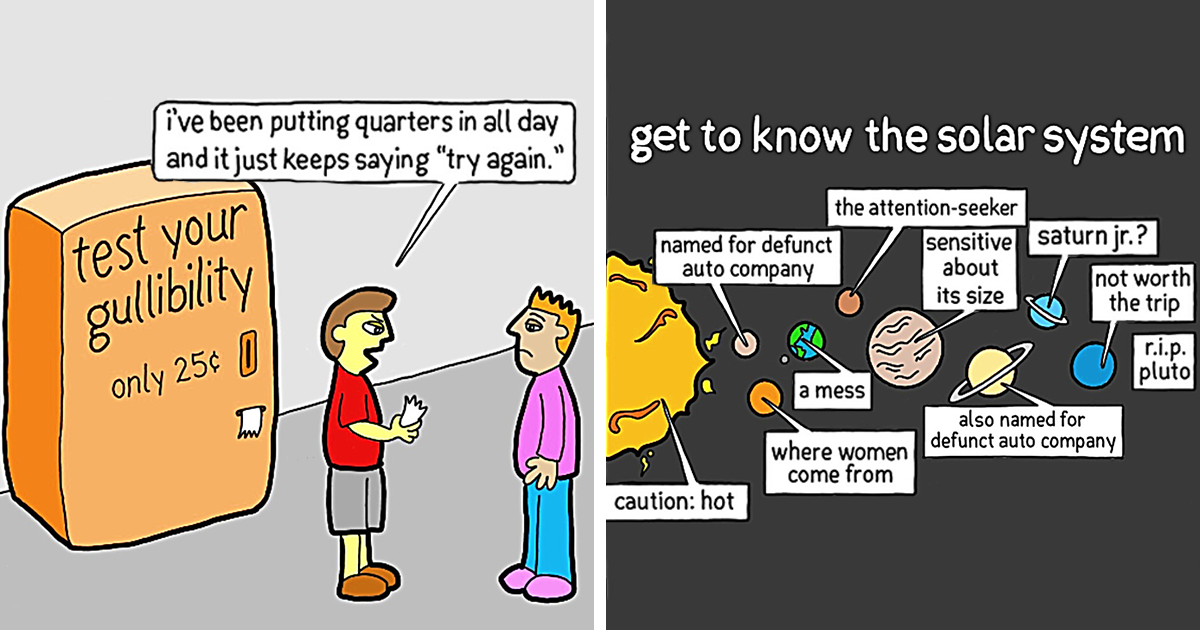
Some jokes need a stage, a spotlight, three acts, and a patient audience. Others need one drawing, one sentence, and approximately half a second to sneak up on your brain wearing fake glasses. That is the strange little magic of funny single panel comics: they are tiny, efficient comedy machines. Blink, laugh, scroll, repeat.
The series known as Eyewash, created by cartoonist Chris Agee, lives happily in that compact world. These one-panel comics lean on bold, simple artwork, quick punchlines, silly characters, wordplay, and the kind of everyday absurdity that makes you suspect your coffee mug is silently judging you. The charm is not in polished perfection. It is in timing, personality, and the joyful confidence to say, “Yes, this doodle of a confused animal has something important to tell us.”
In a digital culture packed with long videos, endless threads, and articles that require enough scrolling to qualify as cardio, single panel cartoons feel refreshingly direct. They do not ask for a big commitment. They walk in, make the room weird, and leave before anyone can ask follow-up questions.
Why Single Panel Comics Still Hit So Hard
A single panel comic is one of the purest forms of visual humor. Unlike a comic strip, which can build a joke across multiple frames, a one-panel cartoon has to do everything at once. The setup, character, conflict, surprise, and punchline all share the same small space. It is less like telling a joke and more like packing a suitcase for a two-week vacation using only one sock drawer.
That limitation is exactly what makes the format fun. The reader gets the full scene immediately: a talking animal, a panicked office worker, a confused monster, a tiny misunderstanding that has grown legs and wandered into public. Then the caption, speech bubble, or visual twist flips the meaning. The joke lands because the brain connects the image and words faster than it can file a complaint.
Classic gag cartoons have long used this formula. A clever drawing creates a situation; the punchline turns that situation sideways. Sometimes the humor comes from a pun. Sometimes it comes from social awkwardness. Sometimes it comes from the simple fact that a dinosaur is behaving like someone’s exhausted uncle at a barbecue. The best single panel comics do not overexplain. They trust the reader to make the final leap.
The Eyewash Style: Simple Art, Sharp Timing, Big Personality
What makes Eyewash stand out is its combination of simple illustrations and pithy punchlines. The drawings are clean enough to read instantly, but loose enough to feel human. That matters. A joke cartoon does not always need museum-level shading or anatomical accuracy. In fact, if the artwork becomes too detailed, it can distract from the punchline. The goal is not to prove that every duck has perfect feather structure. The goal is to make the duck funny before the reader scrolls away.
Chris Agee has described Eyewash as a project shaped by pandemic-era creative focus, rough drafts, social media feedback, and a love of one-panel humor. That origin story fits the comics themselves. They feel handmade, immediate, and built from the kind of random idea that arrives while brushing your teeth and refuses to leave until you draw it.
The humor often has a friendly bite. It plays with literal meanings, awkward misunderstandings, animals acting like people, people acting like animals, and tiny moments of chaos. The result is a collection of funny one-panel comics that are easy to enjoy individually but even better as a batch. Reading 24 of them in a row feels like opening a drawer full of joke grenades. Most are harmless. A few go off unexpectedly.
What Makes a Funny Single Panel Comic Work?
1. The Joke Arrives Fast
Timing is everything. In stand-up comedy, timing may involve pauses, rhythm, and delivery. In single panel comics, timing happens in the reader’s eye. The image sets the stage first. The caption or dialogue then reveals the absurd twist. If the reader has to study the panel like an ancient map, the joke risks losing its spark.
That is why many great single panel cartoons use familiar setups: office desks, desert islands, living rooms, classrooms, restaurants, therapy couches, farms, and animals in suspiciously human situations. A familiar setting lets the cartoonist skip the long explanation. The reader recognizes the world instantly, which gives the joke room to misbehave.
2. The Art Supports the Punchline
Single-panel cartooning is not about drawing everything. It is about drawing the right things. A raised eyebrow, an oddly calm chicken, a tiny sign in the background, or a character standing one inch too confidently can carry the entire gag. The artwork does not need to be fancy; it needs to be legible, expressive, and timed to the joke.
Eyewash uses that principle well. The art is bold and simple, allowing the humor to stay in the foreground. The characters are often drawn with enough detail to make the scene clear, but not so much that the reader forgets to laugh. In other words, the visuals are not trying to win a beauty contest. They are trying to sneak a whoopee cushion under your expectations.
3. The Caption Does Not Waste Words
A strong single panel caption is usually short, specific, and surprising. It should add a new layer rather than describe what is already visible. If the drawing shows a bear at a laptop, the caption should not be, “I am a bear using a laptop.” Unless, of course, the entire joke is that the bear has been forced to attend a webinar on professional branding. Then we may allow it.
Good captions create a second meaning. They turn a normal scene into a ridiculous one or a ridiculous scene into a strangely normal one. That reversal is a major reason why funny single panel comics feel so satisfying. The joke is not just in the drawing or the words. It is in the collision between them.
The Long Tradition Behind One-Panel Humor
Although webcomics and Instagram have given single panel comics a new life, the format has deep roots in American cartoon culture. Newspapers, magazines, greeting cards, humor books, and later social platforms have all made room for gag cartoons. The New Yorker became especially famous for sophisticated single-panel humor, while Gary Larson’s The Far Side showed how bizarre, surreal, and animal-obsessed a daily panel could become without losing mainstream appeal.
That history matters because it shows how flexible the form is. A single panel can be elegant, silly, dark, wholesome, philosophical, political, or completely bananas. It can joke about workplace culture, marriage, science, pets, ghosts, food, parenting, language, dinosaurs, or that one person who replies-all to company emails and should be studied by federal researchers.
Eyewash fits comfortably into this tradition while still feeling modern. It embraces the old-school discipline of the gag cartoon but uses the speed and casual intimacy of online publishing. Instead of waiting for a newspaper page, readers can discover a comic in a feed, share it with a friend, or leave a comment that is sometimes almost as funny as the cartoon itself.
Why 24 Comics Is the Perfect Snack-Sized Collection
A collection of 24 funny single panel comics is long enough to show range but short enough to stay breezy. It gives readers multiple flavors of humor: clever puns, visual jokes, absurd scenarios, animal gags, and little moments of “I did not see that coming, and frankly I feel attacked.”
This matters for online reading. People enjoy humor posts because they are easy to sample. One comic might make them laugh out loud. Another might make them groan in the sacred tradition of dad jokes. Another might be forwarded to a friend with no explanation except “this is you.” That shareability is part of the format’s strength.
Single panel comics also reward rereading. The first pass gives you the punchline. The second pass lets you notice the expression, the background detail, or the tiny visual choice that made the joke work. In a good cartoon, everything is there for a reason, even if that reason is “the cow needed a hat.”
The Humor of the Everyday Absurd
One reason Eyewash-style comics connect with readers is that they make the world feel slightly tilted. The jokes are not always about huge events. They often begin with everyday logic and then push it one step too far. What if an idiom became literal? What if animals had office politics? What if an ordinary phrase caused extraordinary confusion? What if a monster had completely reasonable concerns about dental insurance?
This kind of humor works because it mirrors how people actually think. Our minds are constantly making strange associations. A phrase sounds like another phrase. A boring situation suddenly looks ridiculous. A serious moment becomes funny because someone says exactly the wrong thing with perfect confidence. Single panel cartoons catch those sparks before they disappear.
And unlike long-form comedy, a one-panel gag does not need to explain its entire universe. The reader supplies the missing context. That makes the joke feel collaborative. The cartoonist builds the doorway; the reader walks through it and trips over the punchline.
Why Simple Comics Can Feel More Personal
There is something inviting about simple cartoon art. It lowers the barrier between creator and reader. Instead of saying, “Look at this flawless illustration,” it says, “Come over here; I found a weird thought.” That informality can make the humor feel warmer, especially when the comic is built around puns, observations, and playful nonsense.
For many readers, that is part of the appeal. A highly polished comic can be impressive, but a simple one can feel like a joke from a clever friend who doodles in the margins during meetings. Eyewash has that friendly energy. It does not try to look untouchable. It tries to be funny, readable, and memorable. In comedy, that is usually the better business plan.
What Creators Can Learn From These Comics
Aspiring cartoonists can learn several useful lessons from funny single panel comics like Eyewash. First, a strong idea beats a complicated drawing. Second, clarity matters. Third, the funniest jokes often come from combining two ordinary things that do not belong together. Fourth, not every idea will work, and that is normal. Comedy is partly inspiration and partly throwing a lot of spaghetti at the wall while apologizing to the wall.
Writers can learn from the format too. A single panel comic is basically a masterclass in compression. Every word must earn its place. Every visual detail must help the joke. The best cartoons prove that a small package can carry a surprisingly large comic payload.
That is also why these comics are good for readers who need a quick break. They deliver humor without demanding a complicated plot, a subscription to a fictional universe, or a spreadsheet explaining character relationships. You see it, you get it, you laugh. Civilization continues.
Experience: What It Feels Like to Make and Read Funny Single Panel Comics
Spending time with funny single panel comics changes the way you look at ordinary life. After a while, every object starts auditioning for a joke. A banana is no longer just a banana; it is a suspicious yellow character with terrible posture. A toaster becomes a tiny appliance with trust issues. A squirrel outside the window is not simply gathering food; it is clearly late for a meeting and blaming traffic.
That is the hidden joy of the format. It trains the brain to notice comic possibilities in small moments. You begin to understand that humor does not always arrive as a giant lightning bolt. Sometimes it arrives as a weird phrase, a clumsy doodle, or a question that starts with “What if?” What if a fish misunderstood fishing? What if a ghost was bad at haunting because it hated confrontation? What if a chicken crossed the road and then refused to discuss its motives with the press?
Creating single panel comics can also be humbling. A joke that sounds brilliant in your head may collapse the moment it reaches paper. A drawing you expected to take five minutes may suddenly require a deep investigation into how many legs a beetle has and whether anyone will notice if you get it wrong. Someone will notice. Someone always notices. The internet contains many people who know beetle legs professionally.
Still, that challenge is part of the fun. The format rewards persistence. You sketch, rewrite, simplify, stare into space, drink coffee, delete three words, add one better word, and suddenly the joke clicks. The finished panel may look effortless, but behind it is a tiny comedy obstacle course. The reader sees the final leap, not the 17 times the cartoonist tripped over the starting line.
Reading a collection like “Here Are 24 Of My Funny Single Panel Comics” also reminds us that humor is personal. Not every gag lands for every reader. Some people love puns. Some people groan at them but secretly enjoy the groaning. Some prefer darker absurdity, while others want wholesome weirdness with a smiling animal and no emotional damage. A good collection offers enough variety for different kinds of laughter.
The best experience is when a comic catches you off guard. You are scrolling casually, half paying attention, and then one panel makes you stop. Maybe the joke is clever. Maybe it is dumb in exactly the right way. Maybe it reminds you of your family, your job, your pet, or your own habit of overthinking things that absolutely do not require a committee meeting inside your skull.
That tiny moment of recognition is powerful. It turns a simple drawing into a shared experience. The cartoonist says, “I noticed this absurd thing.” The reader replies, “Unfortunately, yes, me too.” That is why single panel comics continue to work across newspapers, magazines, books, and social media feeds. The delivery method changes, but the human appetite for compact silliness remains undefeated.
In the end, funny single panel comics are proof that comedy does not need to be large to be effective. A small drawing can hold a big laugh. A simple caption can flip an entire scene. A silly doodle can brighten someone’s day before they return to emails, errands, or pretending they understood the last meeting. And if that is not a noble use of cartoon animals, awkward humans, and suspiciously expressive vegetables, what is?
Conclusion
Here Are 24 Of My Funny Single Panel Comics is more than a collection of quick jokes. It is a celebration of compact creativity, visual timing, and the delightful art of saying more with less. Eyewash shows that a cartoon does not need elaborate detail or recurring characters to be memorable. It needs a clear setup, a clever twist, and enough personality to make readers pause their scrolling for a laugh.
In a world that often feels overloaded with noise, single panel comics offer a rare pleasure: instant humor with lasting charm. They are small, smart, silly, and surprisingly durable. Whether you love clever puns, oddball animals, everyday absurdity, or the proud tradition of jokes that make you laugh and groan at the same time, these funny one-panel comics deliver exactly what they promise: a quick escape into a world where the punchline always has the final word.