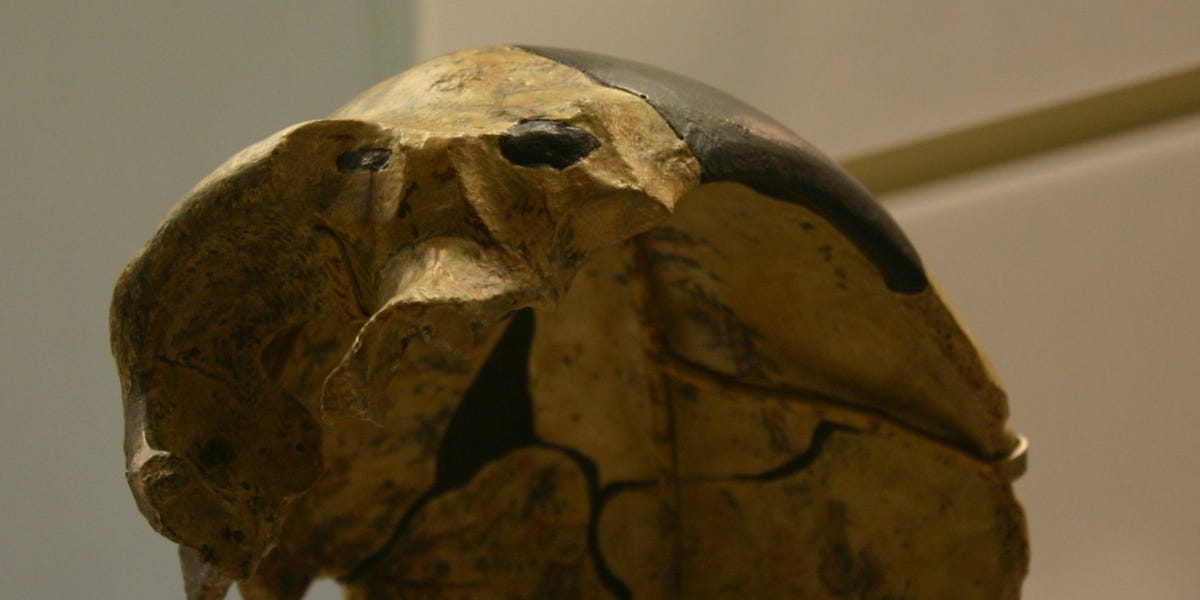
In 1958, farmers in southern China were not looking for a lost branch of the human family tree. They were collecting bat guano from a limestone cave near Maba Village in Guangdong Province, because fertilizer is useful and ancient mysteries are rarely listed on the day’s to-do list. Then bone fragments appeared. They looked human enough to make everyone stop digging and start asking a question that scientists are still wrestling with today: who was this person?
The fossil became known as Maba 1, or Maba Man. It is not a complete skeleton, not even a complete skull, but the surviving pieces are strange enough to keep paleoanthropologists busy for decades. The remains include part of a skull and facial bones from a late Middle Pleistocene hominin, often discussed as roughly 300,000 years old, though dating estimates have varied. At first glance, Maba 1 seemed to carry a Neanderthal-like face. But later studies, especially those using micro-CT scans, showed something far more complicated. The skull does not comfortably fit with Neanderthals, Homo erectus, Homo sapiens, or any tidy label we might want to slap on it.
In other words, the skull is a scientific party crasher. It walks into the human evolution timeline, looks at the seating chart, and refuses to sit down.
The Discovery: From Fertilizer Trip to Fossil Fame
The story began in an eroded limestone cave near Maba Village, close to Shaoguan City in Guangdong Province. Local farmers were gathering bat guano, a natural fertilizer, when they found fossilized bones. What began as a practical agricultural task turned into one of the most debated human fossil discoveries in East Asia.
Because the skull was fragmentary, researchers had a hard time placing it. Fossils are not like museum mannequins with labels already attached. A partial cranium can reveal a lot, but it can also hide just enough to make classification maddening. The Maba 1 skull preserved parts of the frontal and facial region, but without a full skeleton, jaw, teeth, or DNA, scientists had to rely on shape, thickness, internal anatomy, comparisons, and dating context.
Early interpretations leaned toward a Neanderthal connection because of the face. That gave rise to the informal nickname “Chinese Neanderthal.” It sounded dramatic, and to be fair, the fossil did have traits that invited the comparison. But later research has shown that the nickname may be more catchy than accurate.
Why Maba 1 Is So Hard to Classify
The big problem with Maba 1 is that it shows a mosaic of traits. In paleoanthropology, “mosaic” means a fossil carries a combination of features associated with different groups. This is wonderful if you enjoy complexity. It is less wonderful if you want a simple family tree with neat branches and no weird cousins.
Maba 1 has facial traits that once seemed Neanderthal-like. Its braincase, however, does not tell the same story. Earlier endocranial research found that its estimated cranial capacity was around 1,300 cubic centimeters, a range that overlaps with modern humans, Neanderthals, and Homo heidelbergensis. Yet the shape of parts of the braincase appeared more archaic, with features resembling Homo erectus or Homo heidelbergensis.
That does not mean Maba 1 was definitely Homo erectus. It also does not mean the fossil was definitely Neanderthal, Homo sapiens, Denisovan, or anything else currently pinned to the corkboard of human ancestry. The latest reappraisal of its internal cranial anatomy suggests that Maba 1 combines features found in multiple hominin groups and cannot be confidently assigned to any known taxon.
Micro-CT Scans Changed the Conversation
For many years, scientists mainly studied the outside of the fossil. That is understandable; fossils are rare, fragile, and not exactly something you want to slice open like a birthday cake. But modern scanning technology has changed what researchers can do. Micro-CT scans allow scientists to examine hidden internal structures without damaging the fossil.
When researchers looked inside Maba 1, they found new clues in the sinuses, braincase, and vascular structures within the skull bone. These internal details matter because external skull shape can sometimes mislead. Two hominins can share a similar facial look because of parallel evolution, adaptation, or plain anatomical coincidence. Internal structures can provide another layer of evidence.
The new scans weakened the old “Chinese Neanderthal” interpretation. Maba 1 did not show internal features uniquely diagnostic of Neanderthals. In some ways, the skull’s general morphology appeared closer to Homo erectus, but even that comparison was not a perfect fit. Its frontal lobe shape, cranial capacity, and other details created a mixed signal. Scientists love mixed signals about as much as drivers love a GPS that says “turn left, maybe.”
A Skull With Evidence of Survival
Maba 1 is not only interesting because of its uncertain identity. It also carries evidence of injury. Researchers have documented a healed lesion on the frontal bone, suggesting that this individual suffered trauma while alive and survived for some period afterward.
The injury appears as a semicircular depression with signs of bone remodeling. That matters because healing takes time. A person who dies instantly does not remodel bone. The injury may have resulted from a localized blunt-force impact, although the exact cause remains uncertain. It could have come from an accident, a fall, an encounter with another individual, or another form of trauma. There is no need to turn it into a prehistoric crime drama, but yes, it is tempting. Somewhere, a detective with a stone hand axe is asking questions.
More importantly, the healed injury hints at survival in a social world. If Maba 1 suffered a serious head wound and lived afterward, that raises fascinating possibilities about resilience, care, and group life among ancient humans. Survival after trauma does not automatically prove long-term nursing, but it does remind us that these hominins were not just bones and labels. They were living beings who experienced pain, danger, recovery, and possibly support from others.
The Bigger Picture: Human Evolution Was Not a Straight Line
Many people still imagine human evolution as a clean ladder: ape, slightly less ape-like creature, caveman, modern person checking email. Real human evolution is nothing like that. It is more like a tangled bush, with branches splitting, crossing, disappearing, and sometimes leaving behind fossils that make experts mutter into their coffee.
The Middle Pleistocene, the broad period in which Maba 1 belongs, is famous for being confusing. Scientists sometimes call this era the “muddle in the middle” because many fossils from this time show overlapping traits. Some look partly like Homo erectus. Some resemble later humans. Some show hints of Neanderthal-like features. Others may connect to Denisovans, a mysterious group known mostly from DNA and a small number of fossils.
East Asia is especially important in this puzzle. For a long time, public conversations about human origins focused heavily on Africa and Europe. Africa remains central to the origin of Homo sapiens, and Europe is vital for understanding Neanderthals. But fossils from China and other parts of Asia show that the story was far richer than a two-continent drama. Maba 1, Hualongdong, Dali, Jinniushan, Xujiayao, Xuchang, and other East Asian fossils suggest that multiple human populations lived, evolved, and possibly interacted across the region.
Was Maba 1 a Denisovan?
One of the most exciting questions is whether Maba 1 could be related to Denisovans. Denisovans are among the most mysterious known human relatives. They were first identified through ancient DNA from a finger bone found in Siberia, and genetic traces of Denisovans survive in some modern populations today. But their physical appearance remains only partly understood.
Some researchers have suggested that certain East Asian fossils may represent Denisovans or Denisovan-related populations. That possibility makes Maba 1 intriguing. However, the evidence is not strong enough to call Maba 1 a Denisovan. The skull lacks DNA evidence, and its anatomy does not settle the issue. Some comparisons point in one direction; others push back.
The best answer for now is unsatisfying but honest: Maba 1 may represent a population related to known archaic humans, or it may belong to an unknown regional group. It might even reflect the messy outcomes of population mixing. Ancient humans did not obey our textbook categories. They moved, met, adapted, and sometimes interbred. Evolution was not running a filing cabinet.
Why a Fragment Can Matter So Much
It may seem odd that a partial skull can cause so much excitement. After all, Maba 1 is incomplete. But in paleoanthropology, even a fragment can be a headline act if it preserves rare information. A skull records braincase shape, facial structure, brow development, bone thickness, trauma, sinus anatomy, and sometimes clues about ancestry.
Think of it like finding a torn page from a very old book. You do not have the whole chapter, but the few sentences you can read may change the plot. Maba 1 tells scientists that late Middle Pleistocene humans in Asia were anatomically diverse. It also warns against forcing fossils into categories just because those categories already exist.
This is one of the great lessons of modern paleoanthropology: new technology often makes old fossils new again. A specimen discovered in 1958 can still produce fresh insights in 2025 because scanning tools, digital reconstruction, and comparative databases keep improving. The fossil did not change. Our ability to listen to it did.
What Maba 1 Teaches Us About Scientific Humility
Maba 1 is a reminder that science is not weakened by uncertainty. It is strengthened by admitting uncertainty clearly. The most honest conclusion is not “we solved it,” but “this fossil is more complicated than we thought.” That may sound less dramatic, but it is how real discovery works.
In popular media, fossils often get introduced as “missing links.” The phrase is catchy, but it can be misleading. Human evolution does not require one perfect transitional fossil to connect everything. Instead, scientists build a picture from many discoveries, each one adding a little more detail. Maba 1 is not a missing link in the old cartoon sense. It is a clue that the human family tree had more experiments, more regional diversity, and more evolutionary side roads than we once imagined.
What Scientists Still Need to Know
Several questions remain open. First, researchers need better dating context. Maba 1 is usually discussed as a late Middle Pleistocene fossil, often around 300,000 years old, but the exact age has been debated. Better chronological control would help scientists compare it more precisely with other fossils in China, Africa, Europe, and Southeast Asia.
Second, scientists need more associated fossils. A skull fragment is valuable, but a jaw, teeth, limb bones, or artifacts from the same individual or same secure layer would add enormous context. Teeth are especially helpful because dental anatomy can preserve strong evolutionary signals.
Third, researchers would love molecular evidence, such as ancient DNA or proteins. Unfortunately, warm and humid environments are often terrible for DNA preservation. Southern China is not exactly a freezer. Still, new methods in paleoproteomics may eventually help where DNA fails.
Finally, Maba 1 must be compared with the growing fossil record of East Asia. The more fossils scientists study, the easier it becomes to see whether Maba 1 is a one-off oddity, part of a regional population, or a clue to a broader pattern of human evolution.
Experience Section: Standing Face-to-Face With Deep Time
Imagine being one of those farmers in 1958. The cave is dim, earthy, and probably not winning any tourism awards. You are there for fertilizer, not fame. The air smells of soil, stone, and bats. Your hands are dirty. The work is ordinary. Then something pale and hard appears in the sediment. At first, it is just bone. Then it becomes human-looking bone. Suddenly, the cave feels less like a workplace and more like a doorway.
That is the emotional power of discoveries like Maba 1. They collapse time. A person who lived hundreds of thousands of years ago, long before agriculture, cities, writing, or Wi-Fi passwords, is suddenly present. Not fully, not clearly, but enough to make the past feel close. The skull is broken, but it still speaks.
For anyone who has visited a natural history museum, the feeling is familiar. You stand in front of a fossil and realize that history is not only kings, wars, and inventions. History is also bone healing after injury. It is a brow ridge shaped by ancestry. It is a cave used by animals, later entered by farmers, later studied by scientists with scanners powerful enough to see inside stone-like remains. The fossil becomes a meeting point between manual labor, local knowledge, global science, and human curiosity.
There is also something charmingly humbling about the way major discoveries happen. Not every breakthrough begins with a professor in a spotless lab coat announcing, “Today I shall revise human evolution.” Sometimes it begins with farmers digging guano. Sometimes it begins with a construction worker, a child, a shepherd, or someone walking where no one expected history to be hiding. The earth has a flair for dramatic timing.
Maba 1 also changes how we experience our own identity. We like to think of ourselves as the final, polished product of evolution. But fossils like this remind us that humanity emerged from a crowded and experimental past. Our ancestors and relatives were not stepping stones designed to produce us. They were successful in their own environments, living complete lives, solving daily problems, avoiding predators, finding food, caring for injuries, and adapting to changing landscapes.
The healed trauma on Maba 1 makes the experience even more personal. This was not simply “a specimen.” This was an individual who survived a serious wound. Perhaps they woke up with pain. Perhaps others noticed. Perhaps they rested in a group, ate with difficulty, recovered slowly, and carried the mark for the rest of their life. We cannot prove every detail, but the bone preserves the most important fact: survival happened.
That is why the fossil matters beyond taxonomy. Whether Maba 1 was closer to Homo erectus, an unknown archaic human, a Denisovan-related population, or something else entirely, the skull reminds us that the human story has always been messy, social, and surprising. It tells us that science is still catching up with the past. And it tells us that sometimes, the most extraordinary discoveries are waiting inside ordinary work, under a farmer’s tool, in a cave full of bat fertilizer. Evolution, apparently, has a sense of humor.
Conclusion
The Maba 1 skull is one of those fossils that refuses to behave. Found by farmers in a cave in southern China, it has spent decades challenging simple explanations. It looks partly familiar and partly strange. It carries hints of Neanderthal-like facial anatomy, Homo erectus-like traits, archaic braincase features, modern-range cranial capacity, and evidence of a healed injury. Yet it cannot be confidently placed in any known human species.
That uncertainty is exactly what makes it valuable. Maba 1 shows that the human family tree was not a straight line but a branching, tangled, regionally diverse story. East Asia was not a quiet background stage in human evolution. It was a dynamic landscape where different hominin populations may have lived, changed, and interacted in ways scientists are still uncovering.
So, was Maba 1 a Neanderthal? Probably not in the classic sense. Was it Homo erectus? Not exactly. Was it Denisovan? Maybe related, but unproven. Was it a reminder that our ancient relatives were more diverse than our labels? Absolutely. And that may be the skull’s greatest message: the past is not finished speaking.