A refrigerator door left slightly open is one of those tiny household mistakes that can grow into a chilly little disaster. One minute, someone reaches for oat milk. The next, the door is resting half-closed, the compressor is working like it owes money, and your leftovers are drifting toward the danger zone. That is exactly where a fridge buzzer earns its keep.
A fridge buzzer, also called a refrigerator door alarm or fridge door open alarm, is a simple device that alerts you when the refrigerator or freezer door has been open too long. Some modern refrigerators already include this feature, but many older, budget, garage, basement, dorm, and backup units do not. For those appliances, a small add-on buzzer can be the difference between a quick “oops” and a trash bag full of spoiled groceries.
The idea behind the project “Don’t Lose Your Cool With This Fridge Buzzer” is beautifully practical: build or install a compact alarm that detects when the door is not fully closed, waits a short period, then makes noise until someone fixes the problem. It is not flashy smart-home magic. It does not need to talk to your toaster. It simply notices trouble and yells before your cheese becomes a science project.
Why a Fridge Buzzer Is More Useful Than It Sounds
The refrigerator is one of the hardest-working appliances in the house. It runs quietly in the background, guarding milk, eggs, produce, leftovers, medicine, and that mysterious container everyone is afraid to open. But its performance depends on one boring detail: the door must seal properly.
When the door stays open, warm room air enters the cabinet. The interior temperature rises, moisture condenses, frost may build up, and the compressor has to run longer to pull the temperature back down. If the door remains ajar long enough, food safety becomes the real concern. Refrigerated foods should generally be kept at 40 degrees Fahrenheit or below, while freezers should stay at 0 degrees Fahrenheit. Once perishable foods spend too long above safe temperatures, “it still smells fine” is not a reliable safety test.
A refrigerator door alarm helps solve the problem before it becomes expensive. It does not make the appliance colder, but it helps preserve the conditions your fridge is designed to maintain. Think of it as a tiny kitchen referee: it blows the whistle when someone forgets the rules.
How a Fridge Door Buzzer Works
At its simplest, a fridge buzzer needs three jobs: detect the door position, wait long enough to avoid false alarms, and make a sound that people cannot ignore. Different designs accomplish this in different ways, but the basic logic remains the same.
1. Door detection
The device must know whether the refrigerator door is open or closed. A common approach uses a magnet and a magnetic sensor, such as a reed switch or Hall effect sensor. When the door closes, the magnet aligns with the sensor. When the door opens, the magnetic field changes, and the circuit knows the door is no longer sealed.
Another simple design uses a light-dependent resistor, or LDR. Since many refrigerators turn on an interior light when the door opens, an LDR can detect that light and trigger a timer. This method is easy to understand, but it depends on the fridge light working consistently. A magnetic sensor is often more precise because it can detect whether the door is physically closed, even if the light switch behaves oddly.
2. A delay timer
Nobody wants an alarm screaming every time they compare mustard brands for six seconds. A good fridge buzzer includes a delay. It may wait 30 seconds, 60 seconds, two minutes, or five minutes before sounding. That delay gives you normal use without annoyance, while still catching the classic household crime of “I thought I closed it.”
Commercial refrigerators often beep after a few minutes. Some Samsung models, for example, sound an alert if the door is open for more than two minutes, while other brands may use a five-minute delay. A DIY buzzer can be customized for your habits. Homes with children, pets, roommates, or late-night snack artists may benefit from a shorter delay.
3. The buzzer itself
The final part is the sound. The buzzer does not need to be elegant. It needs to be noticeable. A gentle chime works in a quiet kitchen, but a freezer in the garage may need a louder alert. Some units offer adjustable volume, repeating beeps, or different alarm modes. The goal is not to punish the household. The goal is to make the problem impossible to miss.
The Clever DIY Build Behind the Buzz
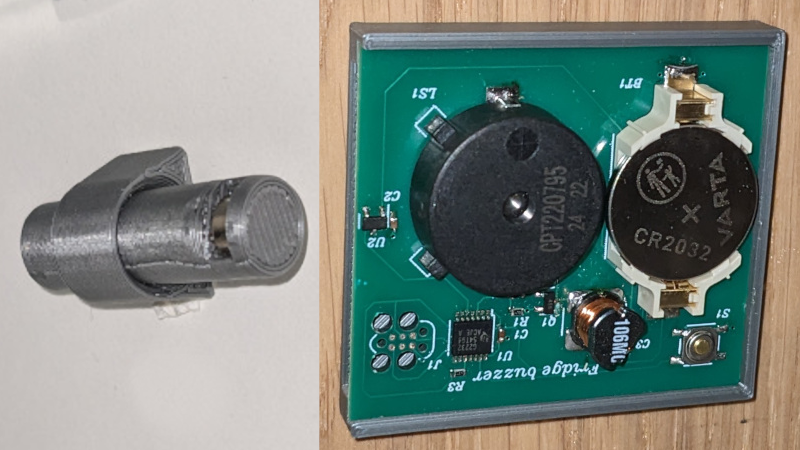
The fridge buzzer project that inspired this article is a tidy example of practical electronics. It uses a low-power microcontroller, a magnetic Hall sensor, a coin-cell battery, a push button, and a small buzzer. The components are fitted into a compact housing, with a separate magnet positioned so the device can tell when the door is properly closed.
The clever part is not just that it beeps. The clever part is that it is designed to sip power. A low-power microcontroller can sleep most of the time, waking only when the sensor state changes or when it needs to run the alarm timing. That matters because nobody wants to replace a battery every Thursday. A good door alarm should be boringly reliable: install it, test it, forget about it until it saves your groceries.
A 3D-printed enclosure also makes sense for this kind of project. Refrigerators vary in door shape, gasket position, shelf clearance, and wall geometry. A custom mount lets the builder place the magnet and sensor precisely. That precision is important because a door can look closed while still being slightly open. A well-positioned sensor can catch that small gap before it becomes a big mess.
DIY Fridge Buzzer vs. Store-Bought Refrigerator Door Alarm
Should you build your own fridge buzzer or buy one? The honest answer depends on whether you enjoy soldering more than you enjoy fast shipping.
Choose a DIY fridge buzzer if:
A DIY build is ideal if you like electronics projects, own a soldering iron, have access to a 3D printer, or want to customize the timing, sensitivity, or sound pattern. It is also a great learning project because it combines sensors, low-power design, timing logic, enclosure design, and real-world troubleshooting. Unlike many beginner electronics projects, this one solves an actual household problem.
The downside is that refrigerators are awkward environments. They are cold, humid, frequently cleaned, and full of food. Your enclosure should protect the circuit from condensation, accidental splashes, and contact with containers. Any battery-powered device inside or near a refrigerator should be secured well, kept away from food contact surfaces, and designed so the battery compartment cannot pop open.
Choose a store-bought alarm if:
A commercial refrigerator door alarm is the better choice if you simply want the problem solved today. Many battery-powered alarms attach with adhesive and use a magnet sensor. Some allow delay settings, volume adjustments, and chime modes. They are especially useful for garage freezers, rental apartments, dorm refrigerators, beverage coolers, and older units without built-in alerts.
When shopping, look for adjustable delay time, loud enough volume for the appliance location, reliable adhesive or screw mounting, clear low-battery behavior, and easy battery replacement. If the refrigerator is in a garage or basement, choose a buzzer you can hear from the main living area or consider a smart temperature monitor that sends phone notifications.
Where to Install a Fridge Buzzer
Placement matters. A fridge buzzer that cannot reliably sense the door is just a tiny decorative noisemaker.
For magnetic designs, mount the sensor on the fridge frame or door edge and place the magnet opposite it so the two align when the door is fully closed. Test the setup several times before permanently attaching it. Open the door a crack, close it gently, and try the “almost closed” position that usually causes problems. If the alarm only reacts when the door is wide open, adjust the magnet and sensor.
Avoid mounting the device where shelves, drawers, bins, or food containers will bump it. Also avoid areas that collect condensation. If you use adhesive, clean the surface first and let it dry completely. A greasy or damp surface can make adhesive fail, and then your fridge buzzer becomes a fridge floor buzzer, which is less helpful and much sadder.
Common Problems a Fridge Buzzer Can Help Prevent
Spoiled food
This is the obvious one. Milk, meat, seafood, eggs, soft cheeses, cooked leftovers, and prepared foods depend on stable cold storage. A buzzer gives you a chance to correct the mistake before temperatures rise too far.
Higher energy use
When warm air enters the refrigerator, the appliance must work harder to remove that heat. Repeated door-open events can make the compressor run longer, especially during hot weather or in kitchens with poor ventilation. A buzzer encourages faster door closing and helps reduce needless strain.
Frost and moisture buildup
Warm air carries moisture. When that moisture enters a cold compartment, it can condense or freeze. In freezers, a slightly open door may lead to frost buildup, icy packages, and drawers that suddenly require Olympic-level strength to open.
False confidence
A door can look closed from across the room while a bulky container, misaligned drawer, or sticky gasket keeps it from sealing. A well-adjusted alarm detects the actual door position, not your optimistic glance from the hallway.
How to Stop a Refrigerator From Beeping for the Wrong Reason
Sometimes the refrigerator is not warning you because the door is open. It is warning you because something is preventing the door from closing, the gasket is dirty, the unit is not level, or the sensor is confused. Before blaming the buzzer, inspect the basics.
Check for blocked shelves and bins
A crisper drawer that is not fully pushed in can stop the main door from sealing. So can a pizza box, tall bottle, storage container, or condiment collection that has expanded into a small vinegar-based empire. Rearrange items so nothing pushes against the door.
Clean the gasket
The rubber door gasket must be clean and flexible. Crumbs, syrup, sauce, and dust can prevent a tight seal. Wipe the gasket with mild dish soap and water, then dry it thoroughly. Pay attention to the folds, where sticky debris likes to hide like it pays rent.
Inspect the seal
Look for cracks, tears, hard spots, or sections that pull away from the door. A weak gasket allows warm air to leak in even when the door appears closed. If the gasket is damaged, replacing it may solve both temperature problems and nuisance alarms.
Level the refrigerator
A refrigerator that leans the wrong way may not close properly. Many units are designed to tilt slightly backward so the doors swing shut more easily. Check the owner’s manual for leveling instructions, and adjust the feet if needed.
Food Safety: Why the Alarm Matters
A fridge buzzer is not just about convenience. It supports food safety. Cold temperatures slow bacterial growth, which is why refrigerator temperature matters so much. The safest habit is to keep an appliance thermometer inside the refrigerator and freezer, even if the appliance has a digital display. Built-in displays may show the set temperature, while a thermometer shows what is actually happening inside.
During a power outage or a long door-open incident, do not rely on taste or smell to decide whether food is safe. Perishable foods can become unsafe before they smell dramatic. When in doubt, follow food safety guidance and discard items that have spent too long above safe temperatures. It hurts to throw away groceries, but it hurts less than turning dinner into a gastrointestinal group project.
Smart Fridge Alerts vs. Simple Buzzers
Smart refrigerators and temperature sensors can send alerts to your phone. That is useful if you are away from home or monitoring a freezer full of expensive food. A Wi-Fi temperature monitor may be best for deep freezers, second refrigerators, medical storage, or vacation homes.
But a simple buzzer still has advantages. It is fast, local, cheap, and independent of Wi-Fi. It does not need an app update. It does not care whether the router is having an emotional crisis. It just beeps when the door is open. For many homes, that is exactly the right level of technology.
What Makes a Good Fridge Buzzer?
A good refrigerator door alarm should be reliable, easy to hear, and hard to ignore without being unbearable. It should have a delay long enough for normal use and short enough to prevent trouble. It should mount securely, work in the appliance environment, and avoid false alarms once properly aligned.
For DIY builders, low power consumption is a major design goal. Coin-cell batteries have limited capacity, so the circuit should sleep when the door is closed and wake only when necessary. Magnetic sensing is a smart option because it avoids mechanical wear. A push button can be useful for testing, silencing, or changing modes.
For buyers, adjustable settings matter most. A refrigerator in a busy family kitchen may need a friendly chime after two minutes. A garage freezer may need a louder alarm after one minute because nobody wants to discover thawed steaks three days later and have an awkward conversation with the trash can.
Real-World Experiences: What Living With a Fridge Buzzer Teaches You
The first thing you learn after installing a fridge buzzer is that your household opens the refrigerator far more often than anyone admits. People do not simply “grab one thing.” They browse. They contemplate. They stare into the glowing rectangle as if the leftover pasta might reveal career advice. A door alarm gently exposes this behavior.
In one common scenario, the buzzer catches the almost-closed door. This usually happens after someone shuts the door with a hip while holding a plate, a drink, and the confidence of a circus performer. The door looks closed, but a jar in the door bin taps a shelf inside. Without an alarm, the refrigerator might sit that way for hours. With a buzzer, the problem is fixed in seconds, and the jar learns its place in society.
Another experience involves kids. Children are excellent at opening refrigerators and less consistent at closing them. They also tend to negotiate with snacks while the door is open, as if yogurt requires a legal hearing. A fridge buzzer does not scold; it simply creates a clear rule. If it beeps, close the door. Over time, the sound becomes part of the kitchen routine.
Roommates are another test group. In shared apartments, nobody wants to be the official refrigerator police. A buzzer handles the awkwardness. Instead of saying, “Please stop leaving the freezer open like a raccoon with thumbs,” the alarm says it for you in a neutral electronic tone.
Garage freezers may benefit most. These appliances are often opened when someone is carrying groceries, tools, sports drinks, or frozen meat. The door may not seal because a bag shifts or frost blocks a drawer. Since the garage is not always visited frequently, a door left ajar can go unnoticed for a long time. A louder buzzer or connected temperature monitor can save hundreds of dollars in food.
The second lesson is that installation takes patience. A magnetic sensor may need several adjustments before it detects the difference between fully closed and barely open. The best test is not the dramatic wide-open door. The best test is the sneaky gap: the door resting against a package, the gasket touching but not sealed, the freezer drawer pushed in almost all the way. That is where the alarm proves its value.
The third lesson is that a buzzer can reveal maintenance problems. If it keeps sounding even when the door seems closed, do not immediately blame the device. Check the gasket, clean the seal, inspect shelves, and make sure the refrigerator is level. Many “bad alarm” problems are actually “bad seal” problems wearing a tiny electronic disguise.
Finally, a fridge buzzer changes behavior without requiring a lecture. It turns an invisible problem into an audible one. The compressor works less, the food stays safer, and the household gets a tiny reminder that cold air is not free. It may not be the most glamorous gadget in the kitchen, but it is the one that can protect the lasagna, the ice cream, and your dignity after a midnight snack.
Conclusion
A fridge buzzer is a small device with an unusually practical mission: alert people before an open refrigerator or freezer door causes spoiled food, wasted energy, frost buildup, and unnecessary appliance strain. Whether you build a custom Hall-sensor buzzer, install a store-bought refrigerator door alarm, or rely on the feature built into a newer appliance, the principle is the same. The faster you know the door is open, the faster you can fix it.
The best fridge buzzer is not the fanciest one. It is the one that works reliably in your kitchen, garage, dorm, rental, or workshop. Choose a sensible delay, mount the sensor carefully, keep the gasket clean, and use a thermometer to verify safe temperatures. Your refrigerator will stay cooler, your groceries will last longer, and your ice cream will remain scoopable instead of becoming a tragic dairy puddle.