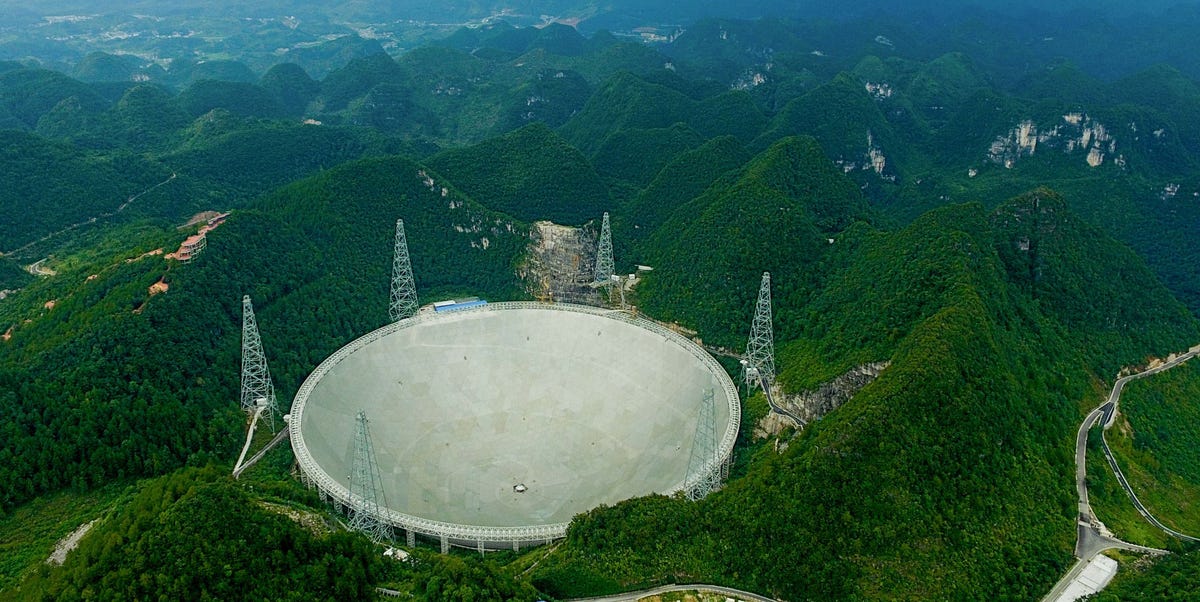
If you follow space news long enough, you learn one important truth: astronomers are never fully satisfied. Give them a giant telescope, and they immediately ask for a bigger one, a better one, or at least one with more antennas attached. That helps explain why China’s FAST telescope keeps making headlines. The Five-hundred-meter Aperture Spherical Telescopemercifully shortened to FASTis already one of the most talked-about observatories on Earth. Now it is back in the news because China is not treating it like a finished trophy. It is treating it like an upgradeable cosmic machine.
For readers searching for the latest China FAST Telescope News, the real story is not just that FAST is huge. Everybody already knows it is huge. The bigger story is how FAST is evolving, what it is discovering, and why astronomers across the world keep paying attention whenever the giant dish in Guizhou listens to the sky. Recent coverage has focused on expansion plans, new scientific potential, and FAST’s growing role in radio astronomy after the collapse of Puerto Rico’s famed Arecibo Observatory. In other words, FAST is no longer just a symbol of scientific ambition. It is now one of the busiest and most consequential listening posts in modern astronomy.
Why FAST Is Back in the Headlines
The freshest FAST news centers on expansion. In late 2024, reports highlighted a second-phase project called the FAST Core Array, which will add 24 movable radio dishes around the main telescope. That matters because FAST’s giant dish is incredibly sensitive, but adding surrounding antennas can sharpen resolution and broaden what astronomers can do with the facility. Think of it as giving a world-class ear a pair of very smart glasses.
This planned array is not a small cosmetic touch-up. It is a serious attempt to turn FAST from a giant single-dish receiver into the heart of a more flexible observing network. That could improve detection and imaging performance while supporting work beyond classic astronomy, including tracking small solar system objects, improving space situational awareness, and helping with communications tied to deep-space missions. That is a big leap from “very large telescope in a scenic bowl” to “strategic scientific platform with range.”
That is why current FAST telescope news feels more interesting than a standard observatory status update. It suggests China sees FAST as a long-term infrastructure project, not a one-hit wonder built mainly for prestige. The telescope is being positioned for an even larger role in global radio astronomy, and that gets attention fastpun fully intended.
What Makes the FAST Telescope Such a Big Deal
FAST sits in a natural karst depression in Guizhou Province, and its raw scale is part of its mystique. The dish measures 500 meters across, making it the world’s largest single-dish radio telescope. That size gives FAST tremendous collecting power, which is exactly what astronomers want when they are chasing faint radio signals from distant and elusive cosmic sources.
FAST was completed in 2016 and later entered formal operations in 2020 after an extended testing and commissioning period. From the start, the telescope was designed for ambitious science: pulsar hunting, neutral hydrogen studies, fast radio burst observations, and the ever-clickable search for extraterrestrial intelligence. A telescope this sensitive can pick up whispers from the universe that other facilities might miss entirely.
Its location also helps. FAST was built in a relatively radio-quiet environment, far from the usual urban soup of electronic noise. That gives it a cleaner listening environment, which is a little like trying to hear a cricket in a library instead of at a sports bar. In radio astronomy, quiet matters.
FAST After Arecibo: Bigger, But Not a Perfect Replacement
Any discussion of China FAST Telescope News eventually runs into Arecibo. That is unavoidable. For decades, Arecibo Observatory in Puerto Rico was an icon of radio astronomy and planetary science. FAST had already surpassed Arecibo in size, but Arecibo’s 2020 collapse changed the conversation. Suddenly, FAST was not just impressive. It was the most famous giant dish still standing.
Still, bigger does not mean identical. One detail often lost in the hype is that FAST does not replace every Arecibo capability. Arecibo had powerful radar transmitters that could bounce signals off asteroids and planets. FAST is a receiving powerhouse, but it is not outfitted the same way. So when people ask whether FAST “replaced” Arecibo, the honest answer is yes in visibility and sensitivity for some radio astronomy work, but no in a full one-for-one operational sense.
That nuance matters because it reveals what FAST is best at. It is not a universal Swiss Army knife for every radio science problem. It is a deeply specialized instrument with extraordinary sensitivity, especially for studying faint cosmic radio sources. And in science, specialization often beats trying to do everything at once.
FAST and the Hunt for Pulsars
If FAST had a favorite hobby, it might be finding pulsars. Pulsars are rapidly spinning neutron stars that beam radiation like cosmic lighthouses. They are weird, dense, and reliable in a way that would make your flaky group chat jealous. Because their signals can be extraordinarily faint, a sensitive instrument like FAST is ideal for discovering them and timing them precisely.
Over the years, coverage from U.S. science outlets has repeatedly pointed to FAST’s success in identifying pulsars and other promising candidates. That is not a side quest. Pulsar discoveries matter because these objects help scientists study extreme physics, stellar evolution, magnetic fields, and even the subtle structure of spacetime. In some cases, pulsars are so regular that they rival atomic clocks, which is delightfully unfair for an object born in a stellar catastrophe.
So when FAST news mentions pulsar discoveries, it is not just astronomers padding a résumé. It is a sign that the telescope is doing the kind of patient, high-value work that changes catalogs, improves models, and expands the known population of one of the universe’s strangest star remnants.
FAST Radio Bursts: Where the Telescope Really Gets Spicy
The subject most likely to make China FAST Telescope News feel genuinely electric is the telescope’s work on fast radio bursts, or FRBs. These are brief, intense radio flashes from deep space that last only milliseconds. They are one of astronomy’s most entertaining mysteries because they are both scientifically useful and dramatically difficult to explain. Nothing says “good luck, humans” quite like a cosmic signal that appears, disappears, and leaves behind a thousand arguments.
FAST became especially important in FRB research when it recorded 1,652 bursts from a single repeating source between August and October 2019. That was a huge result. It gave astronomers one of the richest data sets ever collected from a repeating FRB and helped shift the discussion from “what on Earth is this?” to “what in the universe could produce this so often?”
FAST has also been tied to wider debates over what causes FRBs. Work across the fieldincluding NASA-backed observations and other reporting in U.S. science mediahas strengthened the idea that at least some FRBs come from magnetars, which are neutron stars with outrageously powerful magnetic fields. That does not mean every FRB has the same origin, and FAST’s own detections have helped complicate the picture in useful ways. In 2022, astronomy coverage highlighted FRB 190520, discovered with FAST, as a burst that challenged simple one-size-fits-all explanations. Translation: the universe is still enjoying itself at our expense.
SETI, Alien Signals, and the Headlines People Cannot Resist
Let us be honest. A big reason FAST gets attention is the alien angle. The telescope has long been associated with SETI-style work because a giant, sensitive radio dish naturally invites the question nobody can resist: could it detect a technological signal from another civilization?
Recent reporting kept that angle alive. In 2025, researchers used FAST to conduct an especially sensitive search of the TRAPPIST-1 system, the nearby red dwarf star with seven rocky planets, at least three of which are in the habitable zone. The search covered five independent L-band pointings and found no convincing evidence of alien technology. That may sound anticlimactic, but in science, a clean non-detection is still useful. It sets constraints, refines methods, and shows what kinds of signals are not thereat least not yet.
FAST also appeared in reporting connected to the old SETI@home archive from Arecibo. Citizen scientists had identified billions of signals of interest in decades of Arecibo data, and follow-up work narrowed those to a much smaller set of candidates. Some of that follow-up now involves FAST. So yes, the telescope is listening for astrophysics, but it is also occasionally drafted into humanity’s oldest speculative hobby: staring into the dark and asking whether anybody else is awake.
Why Astronomers Worldwide Care About FAST
It would be a mistake to frame FAST as just a national showpiece. Its scientific importance is broader than that. Radio astronomy works best when different instruments complement one another. Some observatories are better at surveying large areas of sky. Some are better at pinpointing locations. Some excel at timing, some at imaging, and some at high-sensitivity follow-up. FAST’s role is obvious: it is one of the world’s best tools for hearing incredibly faint radio phenomena.
That matters for international astronomy because the field increasingly depends on coordination. A transient event might first be noticed by one facility, confirmed by another, localized by a third, and studied across multiple wavelengths by still more telescopes. FAST fits neatly into that ecosystem. It is not the only player, but when the signal is weak and the stakes are high, astronomers want access to an ear this good.
That is also why news about opening FAST to international researchers and continuing proposal access has been important. Science moves faster when world-class facilities are used by the strongest ideas, wherever those ideas come from.
What to Watch Next in China FAST Telescope News
The next chapter will likely revolve around three things. First, watch the FAST Core Array build-out. If that upgrade proceeds smoothly, FAST could become more capable and more versatile, especially for observations that benefit from array-style performance. Second, expect more pulsar and FRB papers. Those are FAST’s comfort zones, and the telescope still has plenty of sky left to interrogate. Third, do not be surprised if FAST appears more often in stories about SETI, exoplanet systems, and radio searches for strange narrow-band signals. Giant dishes attract giant headlines.
The larger takeaway is simple. FAST is no longer news merely because it exists. It is news because it keeps changing what radio astronomers can do. In a field where instruments often define the pace of discovery, that is the kind of development that deserves attention.
Experiences Related to China FAST Telescope News
Following China FAST Telescope News can feel a little like following a championship sports team that plays a very slow, very nerdy, and extremely high-stakes game. Nothing seems to happen for a while. Then suddenly there is a headline about repeating radio bursts, magnetars, pulsars, alien signal candidates, or a brand-new array being built around an already giant dish. The rhythm is oddly addictive. You learn to appreciate that astronomy does not deliver daily fireworks. Instead, it delivers long stretches of patient listening followed by a result that can quietly reshape what scientists think the universe is doing.
For readers, there is also a special thrill in the scale of it all. FAST is one of those scientific projects that feels almost mythic when you first encounter it. A five-hundred-meter radio telescope set inside a natural depression in the mountains sounds less like ordinary infrastructure and more like something a science-fiction novelist would invent after too much coffee. The experience of reading FAST coverage often begins with pure awe. Then the technical details arrive and somehow make the story even better. You start with “wow, that thing is enormous,” and end up discussing spectral resolution, magnetars, or whether non-detections in TRAPPIST-1 are still scientifically valuable. That is a pretty good day for the human brain.
There is also a subtle emotional side to the FAST story. After the collapse of Arecibo, many science readers felt like astronomy had lost not just a telescope, but a landmark. FAST entered that conversation whether it wanted to or not. Reading about FAST in the years since has carried a mix of excitement and comparison. People want to celebrate the next generation of discovery, but they also remember what Arecibo meant. So the experience of following FAST news is not just about a new machine taking over. It is about a changing era in radio astronomy, where one giant eye on the sky is gone and another is growing into a more central role.
And then there is the alien factor, which makes every FAST article at least 17 percent more clickable. Even readers who know betterespecially readers who know bettercannot help leaning in when headlines mention techno-signatures, suspicious radio signals, or searches of potentially habitable systems. Most of the time, the answer is not aliens. It is interference, noise, a natural astrophysical source, or a useful dead end. But the experience of following the story remains compelling because the question itself is so fundamentally human. We are not just asking what FAST can detect. We are asking what kind of universe we live in.
Ultimately, keeping up with FAST news feels like watching science work in real time: ambitious, incremental, occasionally messy, and often more interesting than the headline suggests. One week the story is engineering. The next week it is an FRB mystery. Then it is an ultra-sensitive search that finds nothing and still manages to matter. That is the charm of it. FAST news is not only about one telescope in China. It is about how modern astronomy keeps pushing outwardquietly, carefully, and with just enough cosmic drama to keep the rest of us refreshing the page.
Conclusion
So what is the real takeaway from today’s China FAST Telescope News? It is this: FAST is not simply the world’s largest single-dish radio telescope. It is one of the world’s most important radio observatories, and it is entering a new phase. Its recent expansion plans show that China wants more than a giant landmark. It wants a more powerful scientific system. Combined with FAST’s work on pulsars, repeating fast radio bursts, magnetars, and sensitive SETI-style searches, that makes the telescope one of the clearest examples of how big instruments can drive big discoveries. The dish may be fixed in one valley, but the implications reach across astronomy.