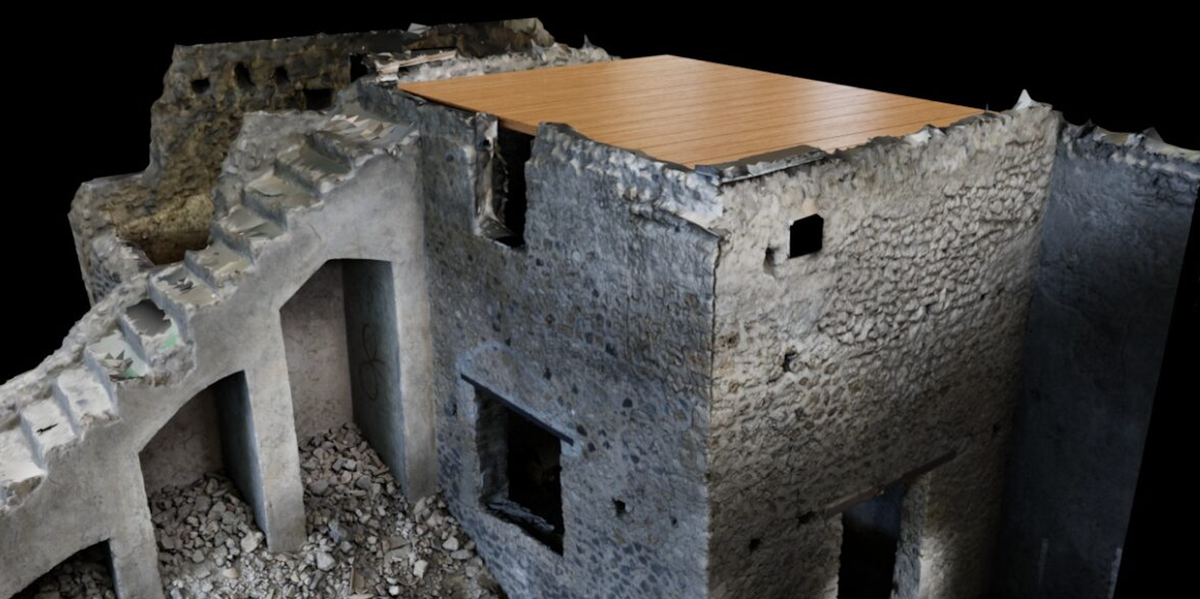
Archaeologists found a staircase that leads to “Lost Pompeii,” and, no, this is not the opening scene of an adventure movie where someone whispers, “Don’t touch the cursed tile.” The discovery is real, and it is changing how experts imagine one of the most famous ancient cities on Earth. In Pompeii’s House of Thiasus, also known as Casa del Tiaso, researchers studied a monumental staircase that seemed to climb toward nothing. At first glance, it looked like architectural leftovers: a grand set of steps with no obvious destination, the ancient Roman equivalent of a dramatic hallway to nowhere.
But archaeology loves a “nowhere.” Give researchers a broken wall, a beam hole, a staircase stub, and a suspiciously fancy fresco, and suddenly the ruin starts talking. In this case, the staircase may have once led to an upper tower or elevated dining space that disappeared when Mount Vesuvius erupted in 79 C.E. The phrase “Lost Pompeii” does not refer to a second city hidden under a trapdoor. It refers to the vanished upper floors of Pompeii’s buildingsthe parts destroyed, collapsed, burned, or erased while the lower rooms were sealed in volcanic debris.
That matters because most visitors imagine Pompeii as a city of ground-floor streets, bakeries, baths, courtyards, painted rooms, and tragic stillness. Yet ancient Pompeii likely had a skyline. It had balconies, terraces, upper rooms, service areas, and possibly elite towers where wealthy residents could host guests, show off, enjoy views of the Bay of Naples, and remind the neighbors that social status has always enjoyed a good balcony.
What Exactly Did Archaeologists Find?
The focus of the discovery is the House of Thiasus in Regio IX, one of Pompeii’s excavation areas that has recently produced remarkable new evidence about Roman domestic life. The house gets its modern name from imagery connected to a thiasus, a procession or festive group associated with Dionysus, the god of wine, theater, ritual excitement, and, apparently, very memorable wall art.
Inside this house, researchers examined a large staircase that appeared too significant to be merely practical. It was not the kind of cramped stairway one expects in a servant corridor or storage corner. It had presence. It suggested an architectural statement. The question was simple: if the staircase went up, what was up there?
The answer, according to the current hypothesis, is a tower-like upper structure. Digital reconstructions suggest the staircase may have connected lower service spaces with a more elegant upper room, possibly used for dining or entertaining. Some reconstructions imagine a tower rising roughly 40 feet, or about 12 meters, above the house. That is not skyscraper territory, but in a dense Roman city, it would have been enough to create views, prestige, and probably a little neighborhood envy.
Why “Lost Pompeii” Is Mostly Above Our Heads
When people hear “lost city,” they usually picture a jungle temple, a desert ruin, or an underground chamber with a suspicious number of snakes. Pompeii is different. Much of the city is not lost because nobody knows where it is. It is lost because part of it no longer exists in physical form.
The eruption of Mount Vesuvius buried Pompeii under ash, pumice, and volcanic material. That disaster preserved an extraordinary amount of the city: street surfaces, wall paintings, food remains, shops, houses, public buildings, and even everyday objects. But preservation was uneven. Lower levels were entombed and protected, while upper floors were often wrecked by impact, fire, collapse, exposure, and later disturbance.
For generations, archaeological attention naturally focused on what survived best. Ground floors held frescoes, mosaics, tools, ovens, counters, amphorae, inscriptions, and the evidence that made Pompeii famous. Upper floors were harder to study because they were missing, fragmentary, or represented only by clues: holes in walls where beams once sat, staircases that stop abruptly, fragments of collapsed ceilings, and painted scenes showing what Roman architecture could look like when complete.
Digital Archaeology: The New Time Machine Without the Weird Goggles
The House of Thiasus discovery is part of a broader research effort known as POMPEII RESET, a collaboration involving the Archaeological Park of Pompeii and Humboldt University of Berlin. Its goal is not to dig wildly until someone finds a golden doorknob. Instead, the project uses non-invasive digital tools to record what remains and reconstruct what may have been lost.
Researchers create detailed 3D models of surviving walls, staircases, spaces, and structural traces. They use methods such as laser scanning, drone scanning, photogrammetry, structured-light scanning, close architectural observation, and virtual simulation. In plain English: they measure the ruins very carefully, turn the evidence into a digital twin, and then test possible reconstructions to see what makes structural and historical sense.
This is important because digital archaeology does not simply make pretty pictures for museum screens, although pretty pictures do help keep the public from falling asleep during lectures. The serious value lies in testing ideas. If a staircase, beam sockets, wall scars, and nearby parallels all point toward an upper structure, a digital model lets scholars explore whether that structure could have existed, how it may have functioned, and what kind of experience it created for ancient residents.
The House of Thiasus: A Roman Home With a Vertical Personality
The House of Thiasus was not just any building. It appears to have belonged to a wealthy family, possibly connected to Pompeii’s local elite. The home included decorated rooms and evidence of refined social life. In Roman domestic architecture, houses were not merely shelters. They were stages. A visitor entering an elite domus moved through carefully designed spaces that communicated wealth, education, taste, political ambition, family identity, and social rank.
That is why the staircase matters. A tower or elevated dining room would not simply be a nice place to catch a breeze. It would be an architectural flex. Imagine hosting a dinner above the city with windows framing Pompeii, Vesuvius, and the Bay of Naples. Your guests recline, the wine flows, the food arrives from below, and the host casually says, “Lovely view, isn’t it?” That is not just hospitality. That is branding, first-century style.
The lower portion of the reconstructed structure may have been simpler and more functional, possibly connected to food preparation or service. The upper space, by contrast, may have been more elegant and representative. This pattern fits a familiar social logic: the work happens out of sight, while the performance happens where the guests can admire it.
Pompeii’s Skyline May Have Been More Dramatic Than We Thought
The staircase discovery supports a larger idea: ancient Pompeii may have had more vertical architecture than earlier interpretations suggested. For a long time, upper floors in Roman towns were often imagined as basic, cramped, or associated mainly with lower-status occupants. That may have been true in many cases, but the new research complicates the picture.
If wealthy homeowners built towers or elevated rooms, then Pompeii’s skyline was not just a low spread of roofs and courtyards. It may have included lookout spaces, terraces, upper dining chambers, balconies, and tower-like features inspired by elite villas. Roman wall paintings also show multi-level buildings with towers, bridges, balconies, and raised viewpoints. Literature from the Roman world includes references to towers as desirable features of luxurious residences.
In other words, the wealthy of Pompeii may have looked upward when designing status. Before medieval Italian cities became famous for towers in places like Bologna and San Gimignano, earlier Roman homeowners may already have understood a basic truth: height gets attention. It turns a house into a landmark. It gives the owner a visual claim over the city.
Why This Discovery Changes the Story of Daily Life
The staircase does more than add a cool architectural detail. It changes the social map of Pompeii. If upper floors included elite dining rooms, observation spaces, and carefully decorated areas, then archaeologists must rethink how ancient residents moved through their homes.
Daily life in Pompeii was layered. A single house could include elegant reception rooms, family spaces, service areas, storage rooms, kitchens, courtyards, gardens, work zones, rental units, and upper levels. The same building might bring together owners, servants, enslaved workers, clients, guests, craftspeople, and visitors. The vertical dimension adds another layer to this social choreography.
Think of a dinner party in the reconstructed tower. Food may have been prepared below, carried upward, and served in a room designed to impress. The movement of servants and workers would have been hidden or controlled, while guests enjoyed the view. Architecture shaped behavior. Stairs were not neutral. They organized status, privacy, labor, and spectacle.
How a Staircase Becomes Evidence
To casual eyes, ruins can look like a puzzle after a toddler has had a very enthusiastic afternoon. Archaeologists, however, read tiny details. A staircase tells them direction, traffic flow, importance, and building hierarchy. Beam holes show where floors once sat. Wall scars suggest collapsed structures. Masonry changes can reveal phases of construction. Doorways, thresholds, plaster lines, and surviving decoration help reconstruct how rooms connected.
The House of Thiasus staircase was persuasive because it was monumental and because other traces supported the idea of a substantial upper structure. Digital modeling then allowed researchers to ask whether a tower-like reconstruction was plausible. The result is not a wild guess. It is a hypothesis built from physical evidence, comparative architecture, visual sources, and structural testing.
Good archaeology is not about pretending uncertainty does not exist. It is about managing uncertainty carefully. The tower is a reconstruction, not a fully standing building. Scholars are not saying, “Here is the tower exactly as it was, down to the host’s favorite cushion.” They are saying the evidence points strongly toward a vanished upper structure, and digital tools help us understand what that structure may have been like.
The Role of Vesuvius: Destroyer, Preserver, and Extremely Rude Interruptor
Mount Vesuvius is the reason Pompeii is famous and the reason so much of Pompeii is gone. The eruption in 79 C.E. was catastrophic, burying Pompeii, Herculaneum, and nearby villas. Volcanic material sealed parts of the city so completely that modern excavators found wall paintings, food remains, tools, and spaces preserved with eerie clarity. Yet the same event also smashed roofs, destroyed upper levels, and transformed inhabited rooms into archaeological riddles.
That contradiction is central to Pompeii. The city is not a perfect time capsule. It is a damaged, preserved, excavated, restored, interpreted, and reinterpreted place. Some things survived because they were buried. Other things vanished because they were exposed, collapsed, or dismantled. The “Lost Pompeii” of upper floors reminds us that even the world’s most famous archaeological site still contains blind spots.
Why the Discovery Captured Public Imagination
The phrase “staircase to Lost Pompeii” is irresistible because it feels cinematic. It gives the story a hook: a mysterious stairway, a hidden world, a vanished city above the city. But its real power is subtler. The discovery asks people to look at Pompeii differently. Instead of seeing ruins as flattened remains, we begin to imagine height, movement, sound, service, spectacle, and views.
It also shows how modern archaeology has changed. The field is no longer only about excavation trenches and brushes, though those still matter. It is also about sensors, drones, modeling software, conservation science, architectural engineering, and interdisciplinary collaboration. Archaeologists are not replacing dirt with data. They are combining both.
That is a major shift for public understanding. Many people think archaeology is mostly about finding objects. The staircase story shows that archaeology is also about reconstructing relationships: between rooms, between social classes, between architecture and ambition, between disaster and memory.
What Visitors Should Imagine When Walking Through Pompeii
If you visit Pompeii today, it is easy to walk along the streets and imagine everything at eye level. But after this discovery, the better approach is to look up. Imagine wooden floors overhead, balconies extending toward the street, roof terraces catching sunlight, staircases carrying workers and guests, and upper rooms with windows open to the sea air.
The ancient city was not a museum of quiet stone. It was noisy, vertical, crowded, colorful, and socially alive. People cooked, argued, bargained, prayed, gossiped, entertained, repaired walls, served meals, carried water, painted rooms, and made choices that left marks in architecture. The House of Thiasus staircase is one of those marks. It is a clue that refuses to stay small.
Conclusion: A Staircase That Rebuilt a Skyline
The discovery of the staircase in Pompeii’s House of Thiasus is not just another archaeological headline with a dramatic nickname. It is a meaningful clue to the city’s missing vertical life. Through digital archaeology, researchers are rebuilding the parts of Pompeii that physical excavation alone cannot fully recover. The result is a richer, taller, more socially complex picture of the ancient city.
“Lost Pompeii” is not hidden under a stone hatch. It is the Pompeii that once rose above street level: towers, upper rooms, terraces, service paths, elite dining spaces, and views that turned architecture into social theater. A staircase that seemed to lead nowhere may, in fact, lead modern archaeology toward one of its most exciting questions: how much of the ancient world has been overlooked simply because we forgot to look up?
Experience Notes: What This Discovery Feels Like for Modern Readers and Travelers
There is something strangely personal about the idea of a staircase that leads to a lost place. Anyone who has explored an old building, a grandparent’s attic, a half-forgotten neighborhood, or even a school hallway that clearly used to connect to something else knows the feeling. A staircase is never just stone or wood. It is an invitation. It says, “Someone went this way. Someone expected this path to matter.” That is why the Pompeii discovery feels so powerful. It turns a ruin from a static object into a human route.
For travelers, the story changes the way Pompeii should be experienced. Instead of treating the site as a checklistforum, baths, bakery, fresco, photo, espresso, souvenir magnetyou can walk it as a layered city. Stand in a house and imagine not just what is in front of you, but what used to be above you. The missing floors become part of the visit. A broken wall becomes a memory line. A stairway becomes social evidence. A beam socket becomes a ghost of a room.
That kind of looking takes patience, but it rewards you. Pompeii is crowded with famous scenes, yet some of the most interesting experiences come from small clues. A worn threshold tells you where feet passed again and again. A counter suggests trade. A painted wall suggests taste and money. A staircase suggests movement, labor, privacy, hierarchy, and ambition. Archaeology turns ordinary architectural leftovers into biography.
The House of Thiasus also reminds modern readers that luxury has always had a theatrical side. Today, people post rooftop dinners, skyline views, balcony sunsets, and “casual” vacation photos that required twelve attempts and one annoyed friend behind the camera. Ancient elites did not have smartphones, but they understood the same principle. A tower with a view was not only useful; it was a statement. It told guests that the owner had money, access, taste, and enough confidence to build upward in a city already full of eyes.
For students, writers, history lovers, and curious readers, the lesson is even broader: the past is not finished just because the event is old. Pompeii has been studied for centuries, yet new methods continue to reveal new questions. Digital archaeology is especially exciting because it allows researchers to test possibilities without damaging fragile remains. It is a respectful way of asking the past to speak again.
And perhaps that is the best experience connected to this discovery: wonder without exaggeration. The staircase does not need a curse, a treasure chest, or a secret society to be fascinating. Its magic is better than that. It shows how a single architectural clue can reopen an entire city’s skyline. It invites us to imagine people moving through rooms that no longer exist, climbing toward views we can only reconstruct, and living in a Pompeii that was not flat, frozen, or silent, but tall, noisy, ambitious, and very much alive.