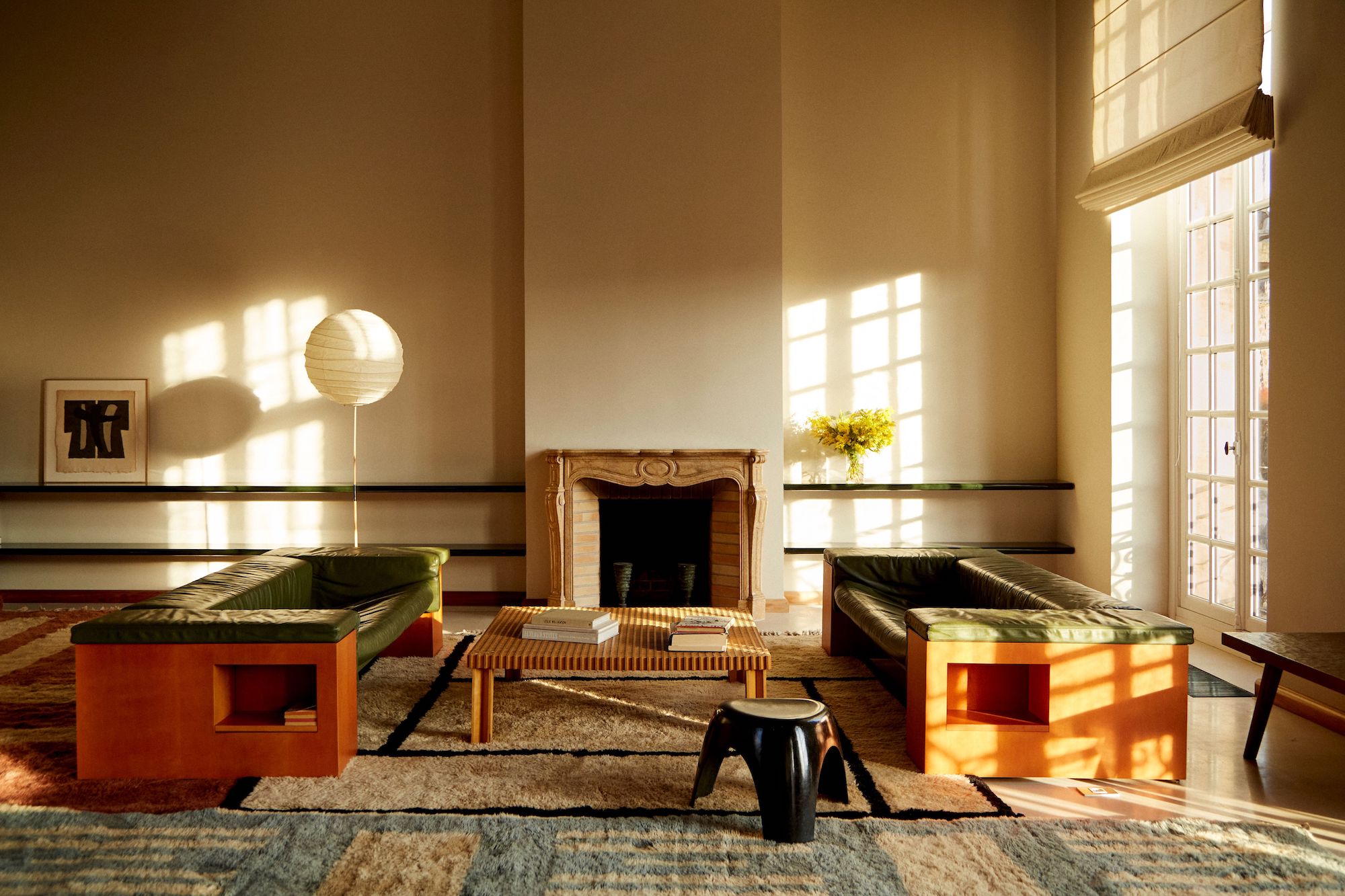
Some rug collections enter a room politely. Others arrive with a passport, a sketchbook, and the confidence of someone who knows exactly where the good light lands at 4 p.m. An American in Paris: A New Collection for Beni Rugs by Colin King belongs to the second group. Officially known as A Study on Balance, the collection brings together Moroccan weaving, Japanese restraint, French modernist references, and Colin King’s unmistakable eye for quiet drama. That sounds like a lot of countries in one sentence, but somehow the result is not visual jet lag. It is calm, graphic, warm, and surprisingly livable.
King, the New York-based stylist, designer, author, and artistic director-at-large for Beni Rugs, has built a career on making rooms feel less decorated and more discovered. His work often looks as if a branch, a bowl, a shadow, and a chair just had a thoughtful conversation while nobody was watching. With this rug collection, he applies that same sensibility to the floor, turning wool into architecture, geometry into softness, and cross-cultural inspiration into pieces that feel old, new, and slightly mysterious at the same time.
The Story Behind A Study on Balance
A Study on Balance was released by Beni Rugs in 2023 and photographed in Paris at Place des Vosges, one of the city’s most historically elegant settings. The collection explores the influence of Japanese aesthetics, principles, and craft on French art, architecture, and design. In simpler terms: imagine Parisian modernism borrowing Japan’s sense of proportion, then handing the idea to Moroccan weavers who understand wool the way chefs understand butter. Good things happen.
The collection was inspired in part by Japonisme, the wave of Japanese influence that transformed European visual culture after Japan reopened to Western trade in the mid-19th century. French artists, architects, furniture designers, and decorative arts makers became fascinated by asymmetry, negative space, restrained palettes, repeating motifs, and the idea that craft could be as intellectually rich as fine art. King translates that history into rugs that feel structured but never stiff.
Who Is Colin King, and Why Does His Eye Matter?
Colin King is often described as an interior stylist, but that phrase undersells him a little. It makes the job sound like fluffing pillows for sport, when his work is closer to choreography. Before entering the design world, King trained as a dancer, and that background shows. His spaces understand pause, movement, proportion, and the power of what is left empty. A bare wall, in King’s universe, is not an accident. It is breathing room.
His book Arranging Things helped bring his philosophy to a wider audience: beauty does not always require grand gestures. Sometimes it is a vessel turned slightly off-center, a stack of books that refuses to look too perfect, or a single object placed where light can do half the decorating. This thinking naturally suits rug design. A rug is not just an accessory; it controls rhythm, scale, sound, mood, and the way people move through a room.
Beni Rugs: Moroccan Craft with a Modern Pulse
Beni Rugs is known for handwoven Moroccan rugs that blend traditional techniques with contemporary design. The company works from its studio in Tameslouht, near Marrakech, where rugs are designed, woven, washed, and shipped through a vertically integrated process. This matters because a rug is not only a product; it is a long chain of decisions, hands, materials, and time. Faster may be convenient, but in the world of handmade wool, faster is not always better. Your rug should not feel as if it has been emotionally rushed.
The brand’s approach gives designers room to experiment while keeping Moroccan weaving at the center. In King’s case, that means translating graphic ideas into pieces that still feel tactile, human, and warm. The designs are not flat digital patterns pretending to be craft. They are made to carry the small irregularities that make handmade objects quietly addictive.
The Visual Language: Geometry Without the Headache
The collection features simple geometric forms, strong line work, repeated patterns, and compositions that feel architectural without becoming bossy. Designs such as Doors, Maze, Faces, Rain, Vase, and City Buildings show how King uses structure to create feeling. Lines cross, blocks stack, shapes repeat, and yet the rugs do not scream for attention. They speak in a low voice, which is often how the most expensive-looking rooms behave.
Doors
Doors uses intersecting lines to suggest thresholds, movement, and architectural framing. It can work beautifully in a living room, but it also has enough graphic presence to hang on a wall like a textile artwork. That is one of the best tricks in the collection: the rugs are functional, but many also read as compositions.
City Buildings
City Buildings plays with skyline-like geometry and layered color. It has the feeling of looking at urban architecture through memory rather than through a window. The design is orderly, but not rigid; modern, but not cold. In a neutral room, it gives the eye a destination.
Maze
Maze brings a more graphic energy, with lines that guide the eye across the surface. It is an excellent example of how a rug can add movement to a space without adding clutter. If your room already has enough decorative objects to start a small museum, a piece like this can organize the mood instead of adding to the noise.
The Palette: Muted, Earthy, and Grown-Up
The colors in A Study on Balance are restrained but not boring. Expect warm oat tones, black line work, dusty blue, brick red, mocha, indigo, and other earthy shades that feel softened by time. The palette supports the collection’s vintage textile mood. These are not glossy, high-volume colors shouting across the room. They are more like well-traveled dinner guests: interesting, composed, and unlikely to knock over the wine.
This restraint is part of what makes the collection versatile. The rugs can anchor a minimalist loft, warm up a modern apartment, soften a formal room, or add structure to a relaxed bungalow. They have enough personality to matter, but not so much that your sofa needs a motivational speech before sharing space with them.
Why the Paris Setting Works
Photographing the collection in Paris was not just decorative staging. Paris is central to the story because the collection reflects the long conversation between Japanese craft and French design. The Place des Vosges setting gives the rugs architectural context: historic walls, elegant proportions, and the layered sense that beauty can accumulate over centuries. Against that backdrop, the rugs look neither trendy nor antique. They look like they belong to a room that reads books with footnotes.
The Paris apartment setting also helps explain the title, An American in Paris. King brings an American design sensibilityrelaxed, intuitive, editorially sharpinto a French environment shaped by history and restraint. The rugs become cultural translators. They are Moroccan in craft, Japanese and French in influence, American in styling, and global in the way contemporary interiors now actually work.
How to Style the Collection at Home
The best way to style these rugs is to let them breathe. King’s own interiors often rely on negative space, organic textures, sculptural forms, and a sense of looseness. That approach works especially well here. Do not bury the rug under too much furniture. Let a strong pattern show. Let the line work connect with nearby architecture. Let the colors talk to wood, plaster, stone, linen, leather, and aged metal.
For a Living Room
Use a graphic design such as Doors or Maze beneath a low sofa and a simple coffee table. Keep accessories edited: one ceramic bowl, a stack of books, perhaps a branch in a vase if you are feeling spiritually Colin King. The rug will provide the composition, so the rest of the room does not need to audition for attention.
For a Bedroom
Choose a softer palette and let the rug extend generously beyond the bed. Wool underfoot in the morning is a small luxury that makes getting up slightly less offensive. Pair it with linen bedding, warm woods, and lighting that flatters everyone involved.
For a Dining Room
A geometric rug can bring order to a dining space, especially if the furniture is simple. Look for enough size so chairs remain on the rug when pulled out. Nothing ruins a dinner party faster than chair legs half-on, half-off a rug, except maybe someone explaining cryptocurrency during dessert.
Why This Collection Feels Relevant Now
Design has spent years flirting with minimalism, maximalism, quiet luxury, cottagecore, and several other movements that sound like they should come with playlists. What makes A Study on Balance feel relevant is that it does not chase any of them too desperately. It offers something more durable: craft, proportion, history, restraint, and warmth.
People want homes that feel personal but not chaotic, refined but not sterile. These rugs answer that need. Their geometry gives a room structure. Their wool gives it softness. Their references give it depth. Their handmade nature gives it soul. In a market full of fast decor, that combination feels refreshingly adult.
The Deeper Design Analysis: Balance as a Verb
The word “balance” can sound passive, as if design is simply about making sure two lamps match. King’s collection treats balance as an active process. It balances line against softness, old references against new rooms, global influences against local craft, and simplicity against emotional richness. The result is not symmetry for symmetry’s sake. It is tension managed beautifully.
This is where King’s background as a stylist becomes especially valuable. Stylists understand that objects do not exist alone. A rug changes when it sits near a curved chair, a plaster wall, a chrome table, or a shaft of winter light. A Study on Balance seems designed with that relational thinking in mind. Each piece is complete, but it leaves room for the room.
Buying a Rug Like This: What to Consider
Before choosing a piece from the collection, think about scale first. A bold geometric design often looks best when it has enough room to unfold. Too small, and the pattern may feel cramped; too large, and the room may feel swallowed. Measure carefully, then measure again, preferably before falling emotionally in love with a size that requires moving a wall.
Next, consider pile and use. A plush wool rug can soften a living room or bedroom, while flatter constructions may suit dining areas or layered spaces. Also think about color temperature. Oat, cream, and mocha tones warm a room; indigo and dusty blue add depth; black line work sharpens the architecture. The right choice should connect with your existing materials rather than fight them in the hallway.
Experience Notes: Living with the Spirit of An American in Paris
To understand the appeal of An American in Paris: A New Collection for Beni Rugs by Colin King, imagine walking into an old Paris apartment late in the afternoon. The ceilings are high, the floorboards have opinions, and the windows make even dust look cinematic. In the center of the room is a Moroccan wool rug with a pattern that feels both ancient and freshly drawn. You do not immediately think, “Nice rug.” You think, “This room has figured itself out.” That is the experience this collection aims to create.
The most memorable rooms are rarely the ones where everything matches. They are the ones where different histories coexist without arguing. A French chair, a Japanese textile reference, a Moroccan weaving tradition, an American stylist’s eye, a modern sofa, and a slightly crooked stack of books can all belong together when scale and tone are handled with care. This collection gives homeowners a practical way to create that layered feeling without turning the living room into an international design conference.
In real life, a rug like this changes daily. In morning light, the wool may look soft and pale. At night, the line work becomes more graphic. Under bare feet, the design stops being theoretical and becomes physical. That is the magic of handmade textiles: they are not just seen; they are lived with. Children may sprawl on them. Dogs may claim them as personal kingdoms. Guests may stand on them while holding tiny plates and pretending not to drop crumbs. A good rug survives all of this with dignity.
There is also an emotional experience in choosing restraint. Many people decorate as if every corner must prove something. King’s collection suggests another path: edit, pause, leave space, let one strong piece hold the room together. This can feel almost rebellious in an age of endless scrolling and instant visual noise. A rug with a few confident lines can be more powerful than a room full of decorative chatter.
For design lovers, the collection offers a lesson in looking. Notice how a line changes a floor. Notice how a muted red can warm a neutral palette. Notice how a pattern inspired by architecture can make a room feel more grounded. Notice how softness and geometry can coexist. That attention is the real luxury. The rug is the object, yes, but the experience is learning to see your own space with more curiosity.
And that may be the most charming thing about A Study on Balance. It does not demand a perfect Paris apartment, a museum-grade chair, or a life in which nobody ever leaves socks on the floor. It simply asks for a room willing to slow down. Add good light, honest materials, and a little breathing room, and the collection does the rest with quiet confidence.
Conclusion
An American in Paris: A New Collection for Beni Rugs by Colin King is more than a stylish product launch. It is a thoughtful study in how design travels: from Japan to France, from Morocco to New York, from historical reference to contemporary home. Through A Study on Balance, King shows that a rug can be architectural, poetic, practical, and deeply human all at once.
The collection succeeds because it understands restraint without becoming dull. It honors craft without feeling nostalgic. It uses geometry without losing warmth. Most importantly, it gives modern interiors something they increasingly need: a sense of calm with a pulse. In a world full of rooms trying very hard to be interesting, these rugs offer a better idea. Be balanced. Be tactile. Be quietly unforgettable.