Note: This article is based on synthesized research from reputable design publications, gallery biographies, museum references, marketplace records, and exhibition coverage. Source links are not included in the article body for clean web publishing.
Some accessories sit quietly on a table and politely hold your keys. Others enter the room like a tiny opera: reflecting light, bending space, making the wall look deeper than your last online rabbit hole. Sam Orlando Miller’s work belongs firmly in the second camp. The British artist and designer, long associated with Italy’s rural Marche region, has built a poetic world around mirrored surfaces, patinated glass, sculptural furniture, and objects that refuse to behave like ordinary décor.
The title “Accessories: Sam Orlando Miller in Italy” may sound simple, but it opens a fascinating door. Miller’s pieces are often described as mirrors, tables, lamps, chandeliers, or wall objects, yet none of those labels quite pins them down. They are accessories in the richest design sense: objects that complete a space, alter its mood, and bring a room into conversation with light. They do not merely decorate. They perform.
In an era when many interiors are stuffed with trend-driven objects that age faster than a viral dance, Miller’s work feels different. It is rooted in craft, place, experiment, and patience. Italy, especially the landscape of Le Marche, gave him the quiet and visual drama to turn reflection into a language. His accessories are not background players; they are visual instruments tuned to atmosphere.
Who Is Sam Orlando Miller?
Sam Orlando Miller is a British artist born in London in 1966. His early life was shaped by the family silversmithing workshop, where making, polishing, shaping, and understanding reflective surfaces were not abstract ideas but daily realities. That background matters. Many designers learn to love materials later; Miller grew up with metal, reflection, and handwork as familiar companions.
Rather than treating craft as a decorative afterthought, Miller uses it as a way of thinking. His work often begins with drawing, then develops through physical experimentation with glass, silver, mirror, patina, wood, steel, and form. The result is difficult to categorize, which is exactly the point. A Miller mirror may behave partly like sculpture. A table may feel like a landscape. A wall piece may appear to hold a tiny weather system inside it.
After periods in London, Scotland, and Italy, Miller settled for many years in the Marche region of central Italy. There, away from the speed and noise of the city, his studio practice evolved toward objects that are both intimate and atmospheric. The Italian countryside did not simply provide a pretty backdrop. It influenced the way he thought about light, color, shadow, weather, and the emotional life of materials.
Why Italy Matters in Miller’s Work
Italy has a long history of treating functional objects as carriers of beauty. From Murano glass to Renaissance metalwork, from carved furniture to contemporary collectible design, the country has never been shy about giving everyday objects a little drama. Sam Orlando Miller’s Italian chapter fits naturally into that tradition, while remaining distinctly his own.
Le Marche, located between the Apennine Mountains and the Adriatic coast, is quieter than Milan, Florence, or Venice. That quiet seems important. In Miller’s case, it allowed the studio to become almost like a laboratory for slow perception. A dark corner, a patch of reflected sky, a changing green hillside, or the glow of weather moving across a room could become the seed for an object.
One of the most important stories in Miller’s practice involves his first sculptural mirror. It emerged from a desire to bring light into a dim space in his Italian home. That simple need became a creative breakthrough. Instead of seeing the mirror as a tool for checking hair, posture, or whether you still have toothpaste on your chin, Miller treated it as a way to animate architecture.
This is why his Italian-made accessories feel so alive. They do not just occupy space; they modify it. They catch light, soften it, distort it, color it, and send it back into the room with a wink.
The Mirror as an Accessory, Artwork, and Trickster
Most mirrors are brutally honest. They show you the shirt, the face, the haircut, and sometimes the reason you should have slept earlier. Sam Orlando Miller’s mirrors are less interested in factual reporting. They are more poetic. They use reflection as a material, not merely a function.
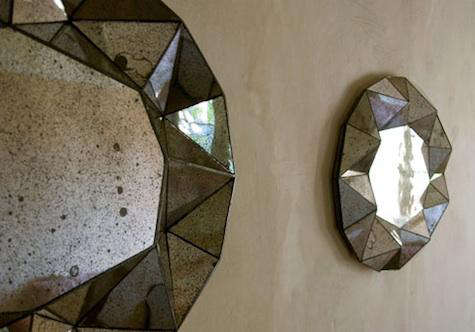
His mirrored works are often made with hand-patinated or antiqued glass. Some include marks, numbers, color gradations, or layered surfaces that interrupt the viewer’s reflection. Instead of producing a clean image, they create depth and ambiguity. You see the room, but not exactly. You see yourself, but softened, fragmented, or partially absorbed into the object.
That quality makes the work especially powerful as an interior accessory. A conventional mirror enlarges a room. A Miller mirror changes the mood of a room. It can make a hallway feel mysterious, a living room feel warmer, or a minimalist wall feel suddenly charged with history. It has the usefulness of a mirror, the presence of sculpture, and the personality of someone who knows a secret but refuses to spoil it.
Antiqued Glass and the Beauty of Imperfection
One reason Miller’s accessories feel so distinctive is his embrace of imperfection. Patina, clouding, tonal shifts, and irregular markings are not flaws to be hidden. They are the story. In mass-produced design, imperfection is often treated as a production problem. In Miller’s world, it is evidence of life.
Antiqued mirror glass has long been used in interiors to add softness and depth. But Miller pushes the material beyond decoration. His surfaces can look celestial, weathered, watery, or mineral-like. A blue mirror may suggest sky, memory, or distant water. An emerald surface may echo forest and olive groves. A dark reflective piece may feel like a window into evening.
This is where the humor of great design sneaks in. A mirror is supposed to show what is in front of it. Miller’s mirrors seem more interested in showing what a room feels like. They are less “Here is your reflection” and more “Here is your reflection after reading poetry in an Italian farmhouse during a thunderstorm.” Honestly, interiors could use more of that.
From Wall Accessories to Sculptural Furniture
Although Miller is widely known for mirrored wall pieces, his practice extends into furniture and objects. His output has included oak tables, lacquered bowls, chandeliers, sculptural lamps, and mirrored furniture. These pieces blur the line between accessory and artwork.
A table, in Miller’s hands, is not just a horizontal surface waiting for coffee cups. It can become a reflective landscape, a color field, or a small architectural event. A lamp is not just a device for preventing you from bumping into the sofa. It becomes a vessel for atmosphere. A chandelier can appear rustic, medieval, or theatrical while still feeling contemporary.
This range is important for understanding the phrase “Accessories: Sam Orlando Miller in Italy.” These are not accessories in the disposable sense. They are collectible design objectspieces that support a room while also becoming its emotional center. They function, but they also provoke attention.
The Role of Craftsmanship
Miller’s craftsmanship is not glossy perfection for its own sake. It is thoughtful, material-driven, and exploratory. His silversmithing background taught him that reflective materials are never passive. Silver and mirror capture the world around them. They depend on context. Move the object, change the light, repaint the wall, or open a window, and the piece becomes slightly different.
That responsiveness makes his accessories unusually dynamic. Many decorative objects look the same at 9 a.m. and 9 p.m. Miller’s work can shift across the day. Morning light may reveal one layer. Evening shadow may reveal another. Candlelight, sunlight, and artificial light each create a different reading.
In practical interior terms, this means his pieces are especially suited to spaces where light changes: entryways, dining rooms, stairwells, bedrooms, salons, libraries, and quiet corners that need a little visual oxygen.
Design Lessons from Sam Orlando Miller’s Italian Accessories
You do not need to own a collectible Miller piece to learn from his design language. His work offers useful lessons for anyone styling a home, choosing accessories, or trying to make a room feel less like a furniture showroom and more like a place where life actually happens.
1. Let Light Be the Main Decoration
Miller’s mirrors prove that light can be more powerful than pattern, color, or ornament. Before adding more objects to a room, study where the light lands. A reflective accessory placed near a window, lamp, or doorway can make a space feel larger and more layered without adding clutter.
2. Choose Accessories with Depth
A good accessory should reward a second look. Miller’s pieces often contain layers: patina, color, reflection, shadow, and shape. In everyday decorating, this could translate to choosing a hand-thrown bowl, a textured lamp, a softly aged mirror, or a table with visible grain instead of a perfectly anonymous object.
3. Use Imperfection Warmly
Rooms become sterile when everything is too flawless. Patinated glass, worn metal, handmade ceramics, and natural wood introduce human feeling. Miller’s work reminds us that a little irregularity can be more luxurious than perfect symmetry.
4. Treat the Wall as a Stage
A wall mirror does not have to be a flat rectangle purchased in a panic five minutes before guests arrive. It can be a focal point. Miller’s wall pieces demonstrate how a reflective object can anchor a room the way a painting might, while also interacting with the changing environment.
5. Think Beyond Labels
Is it a mirror, sculpture, table, lamp, or accessory? With Miller, the answer is often yes. This is a useful mindset for interiors. A bench can be sculpture. A lamp can be art. A bowl can be architecture in miniature. The best rooms do not obey categories too strictly. They mix function with surprise.
How to Style a Space Inspired by Sam Orlando Miller
To create an interior inspired by Sam Orlando Miller’s Italian period, start with restraint. His work may be visually rich, but it does not scream. It glows, reflects, and slowly reveals itself. The surrounding room should give such objects breathing space.
Begin with a natural palette: warm whites, stone, olive green, tobacco brown, soft gray, charcoal, and muted blues. These tones echo the atmosphere of rural Italy without turning the room into a theme restaurant called “Tuscan Feelings.” Add one reflective focal point, such as an antiqued mirror or a sculptural metallic object. Keep nearby accessories simple so the reflection can do its work.
Texture is essential. Pair mirror or glass with matte plaster, linen, raw wood, aged brass, stone, or handmade ceramics. The contrast between reflective and absorbent surfaces creates tension. Miller’s work often thrives on this tension: shiny against rough, precise against weathered, luminous against earthy.
Lighting should be layered. Use a mix of natural light, wall lights, table lamps, and candles. Avoid blasting the room with one harsh ceiling fixture unless your design goal is “airport restroom at midnight.” Reflected light is most beautiful when it has something subtle to work with.
Why Collectors and Designers Respond to His Work
Sam Orlando Miller’s pieces appeal to collectors because they sit at the intersection of art, design, and craft. They are functional enough to live with, but expressive enough to hold attention in a gallery or design fair. This hybrid quality is central to contemporary collectible design, where objects are valued not only for utility but also for concept, authorship, and material intelligence.
Designers are drawn to his work because it solves a difficult interior problem: how to add drama without shouting. A Miller mirror can make a room feel more sophisticated, but it does not rely on obvious luxury signals. No giant logo. No gold-plated peacock. No desperate attempt to announce, “This wall went to art school.” Instead, the drama comes from depth, reflection, and craft.
His pieces also photograph beautifully, which matters in the modern design world. But unlike many camera-friendly accessories, they are not shallow in person. The more time you spend with them, the more they change. That is the difference between an object that decorates and an object that lives.
The Italian Spirit: Slow Design, Strong Atmosphere
The strongest connection between Sam Orlando Miller and Italy may be the idea of slow design. His work does not feel rushed. It carries the patience of handwork, the observation of landscape, and the willingness to let materials misbehave productively.
Italy has always understood atmosphere. A room is not just walls and furniture; it is light, temperature, proportion, memory, and ritual. Miller’s accessories fit into that sensibility because they heighten awareness. They ask you to notice how a surface glimmers, how a shadow moves, how a reflection can make a space feel deeper than it is.
That is why his work remains relevant for contemporary interiors. In a world overloaded with screens, fast shipping, and trend cycles, Miller’s objects invite slower looking. They are accessories for people who want their rooms to have a pulse.
Experiences Related to Sam Orlando Miller’s Accessories in Italy
Experiencing Sam Orlando Miller’s work through the lens of Italy is less like shopping for a mirror and more like learning how to notice a room again. Imagine walking into a quiet old house in the hills of Le Marche. The walls are thick, the windows are modest, and the light moves slowly across the day. In one corner, instead of a conventional mirror, there is a patinated reflective form. At first, you think you are looking at an object. Then the object starts looking backthrough color, shadow, and a reflection that refuses to behave like a bathroom mirror.
This is the kind of experience that makes Miller’s accessories memorable. They change your relationship with the interior. A wall is no longer just a flat boundary. It becomes a place where light can gather. A table is no longer just a useful surface. It becomes a small landscape, holding reflections of ceiling beams, flowers, books, or the accidental poetry of an espresso cup left slightly off-center.
One practical experience inspired by Miller’s work is the discovery that a room does not always need more furniture. Sometimes it needs one object with enough visual intelligence to organize the atmosphere. Many people decorate by adding: another cushion, another print, another vase, another object that will eventually need dusting and perhaps emotional support. Miller’s approach suggests the opposite. Choose fewer accessories, but make them deeper, richer, and more responsive to light.
Another experience is learning to appreciate the imperfect surface. In Italy, especially in older towns and rural houses, beauty often comes from age: worn stone steps, faded shutters, cloudy glass, patched plaster, and metal that has darkened over time. Miller’s patinated mirrors speak the same language. They do not pretend to be brand-new, frictionless, and untouched by the world. They feel as though they have absorbed weather, memory, and use. That quality can make a modern room feel more grounded.
For homeowners, designers, or stylists, the lesson is wonderfully useful. If a space feels cold, add something reflective but not too perfect. If a corner feels dead, give it a surface that catches light. If a room feels overly predictable, introduce an accessory that bends the eye a little. A Miller-inspired mirror, lamp, or sculptural object can create intrigue without turning the home into a museum where everyone whispers and nobody knows where to put their drink.
There is also an emotional experience in this work. Miller’s accessories remind us that objects can be quiet and still feel alive. They do not need to flash, beep, rotate, or connect to Wi-Fi. They simply respond to the world around them. In the morning, they may feel pale and open. In the afternoon, they may become warmer. At night, under a lamp, they may turn mysterious and theatrical. That daily transformation is a form of luxury that has nothing to do with trendiness.
In the end, the best experience related to “Accessories: Sam Orlando Miller in Italy” is the realization that accessories are not minor. The right object can change how a person enters a room, how long they stay, and what they remember after leaving. Miller’s Italian-influenced work proves that a mirror can be more than a mirror, a table more than a table, and a decorative piece more than a finishing touch. In the right hands, an accessory becomes a little piece of architecture, a little piece of weather, and a little piece of magic.
Conclusion
Sam Orlando Miller’s Italian chapter shows how powerful accessories can become when they are shaped by craft, landscape, light, and curiosity. His mirrors, furniture, lamps, and sculptural objects do not simply decorate interiors. They alter them. They bring glow to dark corners, complexity to plain walls, and poetry to everyday surfaces.
For anyone interested in collectible design, Miller’s work is a reminder that the most memorable accessories are not always the loudest. Sometimes they are the ones that shimmer quietly, distort gently, and make a room feel as though it has been keeping a beautiful secret. Italy gave Miller the space and atmosphere to explore that idea deeply. The result is a body of work that continues to feel elegant, strange, useful, and wonderfully alive.