Some buildings ask to be admired from the sidewalk. Javornická Palírna invites you to step into the courtyard, follow the scent of fermenting fruit, inspect the copper distilling equipment, andunder the right arrangementsstay upstairs for the night.
Set among the forests, pastures, orchards, and rolling farmland of South Bohemia, this remarkable Czech distillery resembles a tiny storybook village. Its tidy gables, cobbled gathering spaces, muted colors, and collection of small buildings appear almost too charming to be real. Yet this is not a theme park, film set, or newly manufactured “historic” attraction. It is a working family-run fruit distillery created from a late-19th-century agricultural homestead.
The complex brings together old farm buildings, contemporary additions, a former village pub, a dance hall, production facilities, gardens, an orchard, and minimalist guest rooms. The result is an unusually convincing example of modern Czech rural architecture: respectful of tradition without dressing up in a fake mustache and pretending it is 1895.
Meet Javornická Palírna, South Bohemia’s Tiny Modern Village
Javornická Palírna, also known in English as JP Distillery or Javornice Distillery, stands in the small settlement of Javornice near Dub, between the towns of Bavorov and Vlachovo Březí. The property lies below the ruins of Helfenburk Castle in the gently hilly foothills of the Bohemian Forest.
Calling the complex a “storybook village” is an affectionate description rather than an official designation. It is not a separate municipality with a mayor, post office, and one resident permanently complaining about parking. It is a privately developed rural compound whose arrangement makes it feel like a miniature settlement.
The buildings face a partially enclosed courtyard paved with natural granite. Each structure has a distinct purpose and personality, but repeated rooflines and carefully coordinated materials give the ensemble a shared visual language. From a distance, the new construction blends comfortably into the surrounding village. Up close, crisp details reveal that this is a thoughtful contemporary project rather than a historical imitation.
From Neglected Farmstead to Architectural Destination
The site began as an agricultural homestead dating from the late 1800s. It included a farmhouse, stables, a barn, and a former pub with a small dance hall. By the time the property was acquired for redevelopment, many parts were in poor condition. Modern additions had weakened the original character, while roofs, trusses, and several secondary structures could not be saved.
Owner David Voverka and his family saw more than a collection of tired rural buildings. They imagined a small fruit distillery connected to the landscape, local agriculture, and communal life. Their inspiration included the atmosphere of traditional Scottish whisky distilleries, where production, architecture, history, and scenery often feel inseparable.
Prague-based architecture studio ADR, founded by architects Aleš Lapka and Petr Kolář, was commissioned to shape that idea into a functioning complex. The design and reconstruction process took place during the first half of the 2010s, with the completed property entering operation in 2016. Its first fruit distillate was produced that spring.
Preservation Without Architectural Taxidermy
ADR retained usable masonry, structural walls, traditional proportions, and important historic details wherever possible. When original elements were beyond repair, the team introduced compatible details inspired by other South Bohemian farm buildings.
That did not mean freezing the property in time. New construction was clearly contemporary, particularly the distillery building and the fermentation facility. The architects simply worked within the scale and basic geometry of the rural setting: rectangular plans, steep gabled roofs, lime-plastered walls, timber cladding, and straightforward openings.
This approach avoids a common problem in heritage projects. Reproducing every old crack and crooked beam can turn a working property into a museum display. Erasing everything, meanwhile, produces a building that could have landed anywhere. Javornická Palírna succeeds because it preserves the site’s memory while allowing it to function in the present.
Why the Architecture Feels Like a Storybook
The complex does not rely on turrets, gingerbread trim, fake wishing wells, or other fairy-tale shortcuts. Its charm comes from composition, proportion, color, and repetition.
A Courtyard That Connects Everything
The granite-paved courtyard is the heart of the property. Historic and new buildings gather around it, creating a protected outdoor room rather than a loose scattering of structures. Visitors can understand the layout almost immediately: production occurs in one volume, social life occupies another, and accommodation is tucked above the working areas.
This arrangement reflects the logic of traditional European farmsteads, where buildings were positioned to shelter daily work from wind and to keep people, animals, equipment, and stored crops close together. At Javornice, the same organizing idea serves a modern distillery and hospitality space.
Gables Give the Complex Its Rhythm
Repeated pitched roofs create the village-like silhouette. Some façades are finished with pale lime plaster, while timber-clad sections introduce warmth and texture. The main distillery stands out through solid brickwork painted white, marking it as the most important new building without making it shout across the valley.
The palette is restrained: white walls, natural wood, dark roofs, muted green paneling, soft blue-gray surfaces, and occasional deep red window frames. These colors contribute heavily to the storybook impression. They are cheerful without becoming sugary, which is fortunate because nobody wants to spend the night inside an architectural cupcake.
Old Rooms Retain Their Personality
The former pub and dance hall preserve a more decorative, nostalgic character. Traditional furniture, patterned wallpaper, painted woodwork, a beer tap, vintage objects, and a wood-burning stove recall the building’s social history. These areas can host gatherings and special events, continuing the property’s long association with conversation, food, drink, and dancing of varying levels of coordination.
A Working Czech Fruit Distillery
Beautiful design may attract architecture enthusiasts, but Javornická Palírna was created to make spirits. It is a small family-run operation specializing in fruit distillates, continuing a craft with deep roots in Central Europe.
Fruit selection depends partly on season and quality. Apples, plums, pears, cherries, and other produce may be sourced from regional growers or chosen from farther away when an exceptional ingredient is available. The fruit is prepared and fermented before distillation concentrates its aroma and flavor.
The production building is noticeably more industrial than the pub or guest rooms. Concrete floors, white-painted masonry, black structural details, exposed equipment, practical hooks, and metal stairs communicate that real work happens here. Copper distilling apparatus provides a warm focal point amid the monochrome surfaces.
The contrast is deliberate. Rather than disguising production behind rustic decoration, the architects let the machinery and process become part of the visual experience. The room is clean and orderly, but it still feels like a workshop rather than a lifestyle showroom where the most dangerous tool is a decorative whisk.
Additional facilities include a fruit store, refrigerated fermentation space, shop, warehouse areas, and other operational rooms. Together, they demonstrate how architecture can support a complete production cycle while remaining visually connected to the rural landscape that supplies its ingredients.
Overnight Accommodations Above the Distillery
The accommodation is one of the project’s most appealing surprises. Guest rooms occupy attic areas above parts of the working complex, allowing invited visitors to remain on the property after the courtyard grows quiet.
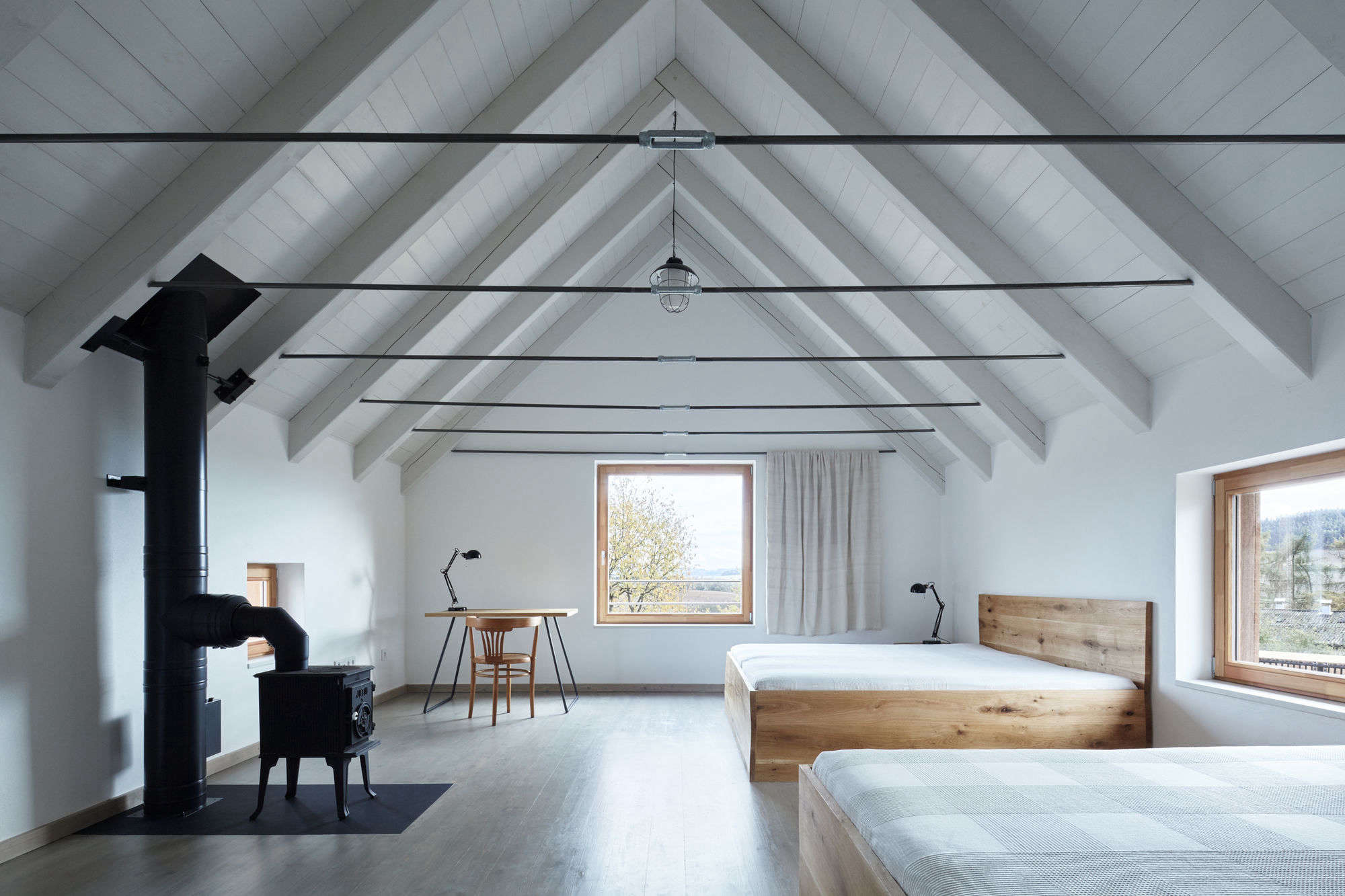
The rooms are minimalist but not cold. White-painted rafters emphasize the steep roof geometry, while black metal ties and industrial lights recall the production spaces downstairs. Simple wooden platform beds, pale linens, compact writing desks, wood-framed windows, and occasional stoves create a peaceful, uncluttered atmosphere.
Views extend toward the orchard and South Bohemian countryside. Instead of televisions dominating the walls, the landscape provides the evening programming. The plot is slow, but the lighting is excellent.
The accommodations were designed primarily for family members, friends, guests, and special clients of the distillery. Travelers should therefore not assume that Javornická Palírna operates like a conventional hotel with rooms available through major booking platforms every night. Visits, tastings, events, and overnight stays may require direct arrangements with the property.
What Makes This Adaptive-Reuse Project So Successful?
New Buildings Respect the Local Vernacular
The new architecture follows the height, scale, roof shapes, and basic materials of South Bohemian farm buildings. It belongs to its setting without copying historic construction line for line. This is contextual design at its best: polite, attentive, and confident enough not to arrive wearing a costume.
Every Building Has a Job
The complex is picturesque because it is functional, not despite being functional. Fermentation, storage, distilling, selling, entertaining, sleeping, and equipment maintenance each have an appropriate place. That clarity prevents the project from feeling like scenery assembled only for photographs.
Hospitality Is Built Into the Layout
The courtyard, pub, dance hall, tasting areas, garden, and guest rooms encourage visitors to linger. Production becomes part of a broader cultural experience involving agriculture, architecture, craftsmanship, and conversation.
The Landscape Is Treated as Part of the Design
The orchard and garden are not decorative leftovers. They connect the distillery to its raw materials and help the buildings settle naturally into the countryside. Beyond the property are forests, fields, pastures, distant ridges, and the romantic ruins of Helfenburk Castle.
Planning a Visit to Javornická Palírna
The distillery’s address is Javornice 27 near Vlachovo Březí in South Bohemia. The area is rural, so arriving by car is generally the most practical option. Road distances can look deceptively short on a map; local lanes prefer to reveal themselves one bend, tractor, and suspiciously relaxed chicken at a time.
Because this is a small working distillery rather than a mass-tourism attraction, confirm access directly before traveling. Ask whether tours, tastings, shop visits, events, or accommodations are available on the date of your trip. Never assume that production areas are open for unscheduled wandering.
South Bohemia rewards travelers who stay longer than a single afternoon. Nearby possibilities include the towns of Bavorov and Vlachovo Březí, hiking and cycling through the foothills, and a visit to Helfenburk Castle. Farther afield, the region is known for historic towns, rural villages, fishponds, forests, castles, and traditional brewing.
The Experience: A Memorable 24 Hours in a Modern Storybook Village
A well-arranged visit might begin in the late afternoon, when low sunlight stretches across the fields and sharpens the outlines of the gabled roofs. The first impression is not of a grand resort but of a small settlement that has always belonged beside the road. Only after entering the courtyard do the contemporary details become obvious.
Natural granite underfoot gives the space a pleasing irregularity. Lime-plastered walls reflect the light, timber façades soften the newer construction, and each doorway suggests a different chapter of the property’s story. One leads toward production equipment, another toward the former pub, and a staircase rises to the quiet rooms beneath the roof.
Seeing Craft and Architecture Work Together
Inside the distillery, the atmosphere changes from pastoral to practical. Copper machinery, black steel, concrete, pipes, and tools replace the courtyard’s gentle village character. Learning how ripe fruit becomes a clear aromatic spirit gives the architecture a purpose that photographs alone cannot communicate.
A guided tasting, when available, can reveal differences between fruit varieties and batches. Pear may produce an elegant floral aroma, plum can be richer and more familiar, while apple often expresses a fresh orchard character. Responsible tasting matters, particularly when stairs, unfamiliar country roads, and medieval castle trails remain on the agenda.
The old pub offers another mood entirely. Its painted woodwork, vintage furnishings, stove, and traditional details make it easy to imagine decades of local celebrations. The room feels collected rather than staged. You half expect someone’s uncle to appear with an accordion and a story that becomes 40 percent longer every time he tells it.
Sleeping Beneath the White Gables
After the activity downstairs subsides, the attic accommodation becomes especially appealing. The vaulted ceiling draws the eye upward, while pale surfaces amplify the remaining daylight. Furnishings are limited to what a guest genuinely needs, allowing the craftsmanship of the room and the view through the window to take center stage.
Night in the countryside has a different texture from night in Prague. Traffic noise fades. Outdoor lights are fewer. The complex no longer resembles a busy production site and instead feels like a tiny self-contained village resting after work. A wood-burning stove, when in use, adds both warmth and the irresistible urge to stare at it as though fire has only recently been invented.
A Morning Among Orchards and Ruins
Morning is likely to be the most memorable part of an overnight stay. Light enters through the simple wood-framed windows, tracing the roof beams and illuminating the otherwise restrained room. Outside, moisture may cling to the courtyard stones while birds conduct an enthusiastic meeting in the orchard.
A walk near the property offers views of farmland, pasture, and forested hills. With enough time, visitors can continue toward Helfenburk Castle. The large Gothic ruin occupies a wooded height near Bavorov and includes defensive walls, towers, gateways, and broad views of the surrounding countryside. It supplies the area with an authentic fairy-tale landmarkno fiberglass dragon required.
Season changes the experience considerably. Spring brings blossoms and fresh green fields. Summer favors hiking, cycling, and long evenings in the courtyard. Autumn connects most directly with fruit harvests, fermentation, wood smoke, and the amber colors of the landscape. Winter strips the architecture to its essential forms, emphasizing white walls, dark roofs, and the warmth of the interiors.
The pleasure of Javornická Palírna ultimately comes from its completeness. Visitors do not encounter an isolated designer room or a production facility hidden in a generic warehouse. They experience a network of related spaces: orchard, workshop, courtyard, pub, guest room, and countryside. Each part strengthens the others.
Conclusion: A Village-Sized Lesson in Modern Rural Design
Javornická Palírna proves that contemporary architecture does not have to overpower a historic rural setting. By preserving useful remnants, respecting traditional forms, and giving new construction a restrained identity, ADR transformed a deteriorating farmstead into a working modern complex with genuine character.
The distillery is practical, the pub is welcoming, the courtyard creates community, and the guest rooms turn a visit into an immersive experience. What looks like a modern storybook village is, in fact, something more interesting: a place where agricultural tradition, hospitality, adaptive reuse, and serious design operate together.
It is charming without becoming theatrical and modern without becoming anonymous. That balance is difficult to achieve, which explains why this small South Bohemian compound continues to attract attention from architecture and travel enthusiasts. It also contains beds above a fruit distillery, which is a fairly persuasive final argument.
Note: Javornická Palírna is a working family distillery, not a conventional full-service hotel. Guest-room access, tastings, tours, events, and shop hours should be confirmed directly with the property before planning a trip.