On a hot day, opening your car door can feel like stepping into a freshly baked casserole dish. The steering wheel is lava, the seat belt buckle is a tiny branding iron, and your sunglasses have somehow become a science experiment. Fortunately, many vehicles have a hidden convenience feature that lets you roll the windows down before you climb in: remote window opening with your key fob.
This feature is often called global opening, remote window control, or convenience opening. It is not available on every vehicle, and the exact button sequence depends on the make, model, year, trim level, and country where the vehicle was sold. Still, there are two simple methods worth trying before you resign yourself to entering the rolling sauna.
Below is a practical guide to rolling your windows down with a key fob, using either the remote buttons or the hidden mechanical key inside the fob. You will also learn what to do when the feature does not work, whether you can roll the windows back up remotely, and how to use the feature without accidentally giving rain, pollen, or neighborhood squirrels an invitation into your car.
What Is Remote Window Opening?
Remote window opening is a convenience feature that lets you lower some or all power windows while standing outside the vehicle. Depending on the vehicle, it may also open or vent the moonroof or sunroof.
The feature is especially useful when:
- Your car has been sitting in direct sunlight.
- You want to release hot air before getting inside.
- You need fresh airflow before loading groceries, kids, pets, or gym bags that have developed their own personality.
- You are approaching the vehicle with full hands and want a little ventilation before opening the door.
Manufacturers do not all use the same name for the feature. Ford commonly refers to it as global opening. BMW may call it convenient opening. Hyundai models may list it as remote window control. Toyota and Lexus manuals may describe it as opening power windows with the wireless remote control. The label changes, but the goal is the same: let the cabin breathe before you get there.
Before You Try It: A Few Important Checks
Before playing key-fob conductor and waiting for your windows to perform, make sure your vehicle is parked safely. The car should be in Park, turned off, and positioned where you can clearly see the windows.
Also check for children, pets, hands, loose clothing, and objects near the window openings. Opening windows is generally less risky than closing them, but you should still watch what the vehicle is doing. Some models may unlock the doors when remote window opening begins, so do not start the process and then wander away like you have just launched a spacecraft.
Keep in mind that this feature may only work within the normal operating range of the key fob. A weak key-fob battery, radio interference, thick walls, crowded parking garages, or simply standing too far away can prevent the signal from reaching the vehicle.
Method 1: Use the Unlock Button on the Key Fob
The first and most common method uses the Unlock button on your key fob. This is the version most people discover by accident after sitting on their keys or experimenting while waiting for coffee.
The Common Key-Fob Window Opening Sequence
- Stand close enough to the vehicle to watch the windows.
- Press and release the Unlock button once.
- Immediately press and hold the Unlock button.
- Keep holding it for about two to three seconds, or until the windows begin to move.
- Release the button when the windows reach the opening you want.
On many vehicles, holding the Unlock button lowers all windows. On others, it may lower only certain windows or open the windows and vent the sunroof at the same time. Think of it as your car briefly exhaling after sitting in the heat.
Ford models with global opening commonly require you to press and release Unlock, then press and hold Unlock for several seconds. BMW models with the feature may open the windows as long as you continue holding the Unlock button after unlocking the vehicle. Some Toyota, Lexus, Honda, Hyundai, and Volkswagen-family vehicles use a similar sequence, but availability depends heavily on trim and market configuration.
Do Not Assume Every Fob Uses the Same Timing
Here is the catch: there is no universal secret handshake for every vehicle. Some cars need one press followed by a long press. Some need the second press to happen within a short window of time. Others start lowering the windows after you hold Unlock continuously. A few vehicles require the function to be enabled first in the infotainment system or by a dealer.
Try the sequence slowly and deliberately. If nothing happens after two or three attempts, do not keep mashing the button as though you are entering a cheat code from a 1990s video game. Move on to the troubleshooting section below.
How to Stop the Windows Midway
Most vehicles let you stop remote window opening by releasing the button or pressing either Lock or Unlock again. The exact behavior varies, so keep watching the vehicle while the windows are moving.
This matters when you only want a small crack for ventilation instead of turning your sedan into an open-air gazebo. A one-inch opening can help release trapped heat without making the cabin fully exposed to dust, rain, bugs, or surprise leaves with suspiciously good aim.
Method 2: Use the Hidden Mechanical Key in the Key Fob
Your key fob may contain a small mechanical key that slides, flips, or pulls out from the remote. Most people only notice it when the key-fob battery dies, which is a little like discovering your umbrella after the rainstorm has already won.
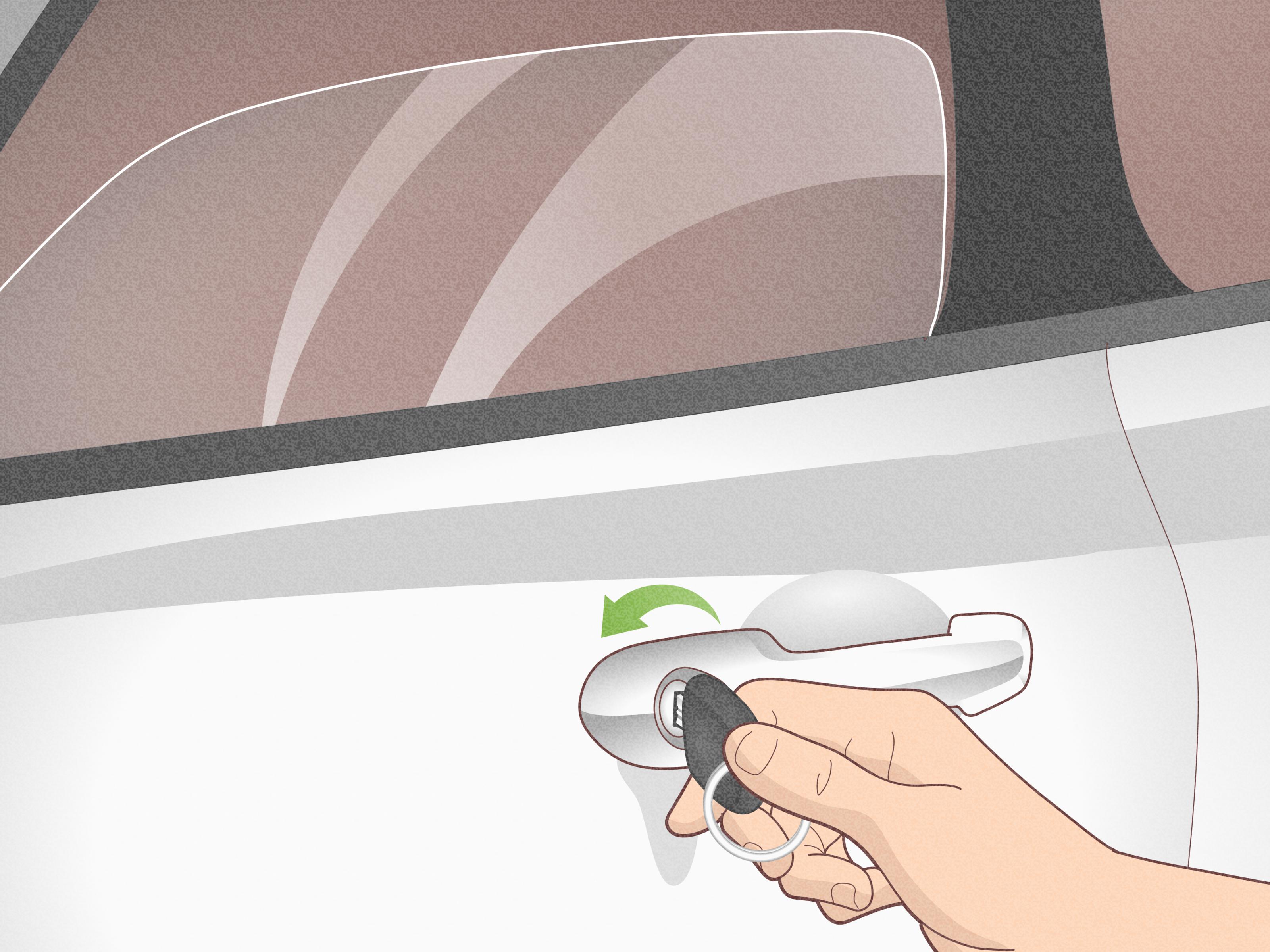
On some vehicles, the mechanical key can activate a feature known as convenience opening. Instead of using the remote buttons, you operate the driver’s door lock cylinder.
How the Mechanical-Key Method Usually Works
- Remove the hidden mechanical key from the key fob.
- Locate the driver’s door lock cylinder. Some vehicles hide it behind a small cover near the door handle.
- Insert the key gently into the lock.
- Turn the key in the unlock direction and return it to the neutral position if required by your vehicle.
- Turn and hold the key in the unlock direction.
- Keep holding it until the windows begin to lower.
- Release the key when the windows reach the desired position.
On vehicles equipped with this feature, holding the key in the unlock position may lower all windows and possibly open the sunroof. The exact operation varies by manufacturer, so never force the key or twist it aggressively. If the lock cylinder resists, stop. A bent key or damaged door lock is a much more expensive surprise than a warm car cabin.
Why This Method Is Worth Knowing
The mechanical-key method can be useful when your key-fob battery is weak, the remote buttons are damaged, or you simply prefer a backup method. It is also handy on certain older luxury vehicles and models with convenience-opening systems that work through the door lock rather than the remote transmitter.
However, this method is not available on every vehicle. Many modern cars still include a mechanical key for emergency entry, but the key may only lock and unlock the door. It may not control the windows at all.
What to Do If Your Key Fob Will Not Roll the Windows Down
If the windows do not move, do not immediately assume something is broken. The feature may be disabled, unavailable on your trim, or limited by the vehicle’s software settings.
Check the Vehicle Settings Menu
Look through the infotainment system or instrument-cluster settings for options with names such as:
- Remote Window Control
- Global Opening
- Convenience Opening
- Remote Operation
- Doors and Windows
- Comfort Access
Some vehicles allow owners to turn remote window control on or off. Hyundai models, for example, may place the feature under vehicle, door, or remote window settings. Other manufacturers may bury the option inside a convenience or personalization menu, because apparently hiding useful features is one of the world’s oldest automotive traditions.
Check Whether Your Vehicle Has One-Touch Windows
Remote window operation often depends on power windows with one-touch functionality and anti-pinch protection. If your vehicle has basic power windows but no automatic up/down feature, it may not support global opening.
If your windows recently had a battery replacement, repair, or electrical issue, the one-touch function may need to be reset. The reset procedure varies by vehicle, so use the instructions in your owner’s manual rather than trying a random internet ritual involving ignition cycles and crossed fingers.
Replace the Key-Fob Battery
If your locks work only from very close range, respond inconsistently, or require repeated button presses, the key-fob battery may be fading. Replacing the battery is often inexpensive and may restore normal remote operation.
Use the battery type specified for your key fob, install it in the correct direction, and avoid touching the battery surfaces more than necessary. If you are unsure how to open the fob, a dealership, locksmith, or parts store can usually help without turning the key into a plastic puzzle with missing pieces.
Can You Roll the Windows Back Up With the Key Fob?
Maybe, but this is where vehicle differences become especially important. Some vehicles support global closing, allowing you to hold the Lock button to close the windows and sometimes the moonroof. Others allow remote opening only.
Remote closing is more restricted because closing windows can create a pinch hazard. Vehicles that support it may require continuous button pressure, a nearby key fob, anti-pinch technology, or a particular safety setting. Some North American models intentionally limit remote closing even when similar versions in other markets allow it.
Never use remote window closing unless you can see the windows and confirm that no person, pet, hand, leash, toy, or dramatic curtain-like scarf is near the opening. Convenience is great. Convenience with an emergency trip to the veterinarian or urgent care is considerably less charming.
Safety and Security Tips for Remote Window Opening
- Use the feature only when you can monitor the vehicle.
- Do not leave windows open in rain, snow, heavy pollen, or dusty conditions.
- Remember that some vehicles unlock the doors when remote window opening begins.
- Do not rely on a cracked window as a safe way to leave pets in a parked car during hot weather.
- Never force the mechanical key in the door lock.
- Check your owner’s manual before adding aftermarket remote-window modules.
- Keep the key fob away from children who may press buttons accidentally.
Frequently Asked Questions
Do all cars let you roll down windows with a key fob?
No. The feature depends on the manufacturer, model year, trim level, power-window hardware, software configuration, and regional safety requirements. A key fob with an Unlock button does not automatically mean the vehicle supports remote window opening.
Why does my friend’s version of the same car have this feature but mine does not?
Vehicles can differ by trim, package, model year, production date, country, software version, and dealership programming. Two vehicles with nearly identical exterior styling can have very different convenience features hiding behind the scenes.
Will remote window opening work if the engine is running?
Usually, the feature is designed for a parked vehicle with the ignition off. Exact behavior varies, and some vehicles may ignore remote window commands when the engine is running or when a door is open.
Can a dealership activate the feature if my car does not have it?
Sometimes, but only if the vehicle already has the necessary hardware and software support. A dealership may be able to enable an available factory setting, but it cannot always add remote window control to a vehicle that was not built with that capability.
Does rolling the windows down remotely drain the car battery?
Using the feature occasionally has a minimal effect on the battery. Repeatedly operating the windows with the engine off, however, uses electrical power. It is not usually a problem for a healthy battery, but it is not something to do repeatedly while the car sits unused for long periods.
Conclusion
Learning how to roll windows down with a key fob can make summer driving more comfortable, especially when your car has been parked in the sun long enough to develop its own weather system. Start with the common method: press Unlock once, then press and hold Unlock. If that does not work, check whether your fob has a hidden mechanical key and whether your vehicle supports convenience opening through the driver’s door lock.
The most important rule is simple: your owner’s manual gets the final vote. Button sequences, settings, and available features vary widely, so treat generic instructions as a starting pointnot a legally binding contract with your car.
Real-World Experiences With Rolling Windows Down by Key Fob
For many drivers, the first successful use of remote window opening feels strangely satisfying. It is one of those small automotive tricks that makes you wonder how long the feature has been sitting there unnoticed while you sweated through countless summer errands. You walk toward the car, hold a button, and suddenly the windows glide down as if the vehicle has decided to cooperate with your life for once.
The biggest benefit usually appears during hot-weather parking. A car left in direct sunlight can trap a surprising amount of heat, especially when the windshield faces the afternoon sun. Opening the windows from a few steps away lets the hottest air escape before you sit down. It does not magically make the cabin icy cold, unfortunately. Your vehicle is not a walk-in refrigerator with cup holders. But it can make the first minute inside much more tolerable.
Drivers often find that opening the windows halfway works better than lowering them all the way. A partial opening releases heat while reducing the chance of leaves, dust, rain, or curious insects flying inside. This is especially useful in parking lots near trees, construction zones, or that one fast-food drive-thru where a mysterious gust always seems to carry napkins directly into the car.
Another common experience is discovering that the feature also opens the sunroof. This can be useful because heat naturally rises, allowing hot air to escape more quickly. It can also be surprising if you did not realize your vehicle was equipped to do it. The first time it happens, some owners assume they accidentally triggered something dramatic. Usually, it is simply the vehicle following its programmed global-opening routine.
Remote window opening is also convenient when your hands are full. Picture arriving at your car with grocery bags, a backpack, a coffee, and a level of optimism that is clearly unsupported by physics. Opening the windows before reaching the door can make the cabin feel less stuffy while you load everything in. It may seem like a minor benefit, but small conveniences matter when you are trying not to drop a carton of eggs in a parking lot.
There are also moments when the feature is less helpful. If your key fob is in a pocket, purse, or bag where the Unlock button can be pressed accidentally, you may return to find the windows open unexpectedly. That is why many owners test the feature in a driveway first and learn exactly how long the button must be held. It is better to discover the sequence at home than after a sudden rainstorm in a crowded parking garage.
Drivers with older vehicles sometimes prefer the mechanical-key method because it works even when the fob battery is weak or dead. The hidden key may feel old-fashioned compared with a sleek smart fob, but it remains an excellent backup. There is something deeply reassuring about a physical key: it does not need charging, software updates, Bluetooth pairing, or a password you forgot three years ago.
In daily use, remote window opening is best treated as a comfort tool rather than a security feature. Use it while approaching the vehicle, watch the windows, and enter the car soon afterward. It is not designed for leaving the car unattended with the windows down. Once you understand your vehicle’s sequence and limitations, the feature becomes one of those little ownership perks that makes summer driving feel less like entering an oven and more like entering a reasonably civilized machine.
Note: Remote window opening, global opening, convenience opening, and remote closing are vehicle-specific features. Always confirm the exact button sequence and safety limitations in the owner’s manual for your make, model, year, and trim.